

![[PRO Tips] Gold’s Bullish Revival: Seasonal Trends and Key Levels to Watch](https://xinker.org/uploads/images/202412/image_430x256_67724cc6ad0cd.webp)
![[PRO Tips] Gold Market Under Short-Term Pressure, Safe-Haven Demand and Central Bank Buying Support Long-Term Upside Potential](https://xinker.org/uploads/images/202412/image_430x256_676ffb4685287.webp)
![[PRO Tips] Analysis of 9 key points of differentiation strategy! Master differentiation to create a brand advantage that is unique in the world!](https://firebasestorage.googleapis.com/v0/b/xinker-tips.appspot.com/o/article_thumbnails%2Fscaled_differentiation%20strategy.png.png?alt=media&token=a1bfc3d2-e85a-4db7-8a6d-01c7274f8940)
![[PRO Tips] Will REITs regain growth momentum in 2024? 3 REITs ETFs you must know if you want to invest in real estate.](https://firebasestorage.googleapis.com/v0/b/xinker-tips.appspot.com/o/article_thumbnails%2Fscaled_REITs1.png.png?alt=media&token=8af4eb93-33ff-466f-8039-b6555fad52b4)
![[PRO Tips] Complete tutorial on how to make money in Adobe Stock!](https://firebasestorage.googleapis.com/v0/b/xinker-tips.appspot.com/o/article_thumbnails%2Fscaled_tut-adobe1.png.png?alt=media&token=0b2c8cf2-22bd-4142-883e-140ed1cbaf02)
![[Passive Income] Unlock the secret of passive income: 3 steps to apply for Google AdSense](https://xinker.org/uploads/images/202410/image_430x256_6717a4fb3052b.webp)
![[Passive Income] Earn over $200 a day with AI-generated articles!](https://firebasestorage.googleapis.com/v0/b/xinker-tips.appspot.com/o/article_thumbnails%2Fscaled_article1.png.png?alt=media&token=f61bf35b-8553-4719-826d-7360024adc70)
![[Passive Income] Earn over 20 USD per download with AI-generated images!](https://firebasestorage.googleapis.com/v0/b/xinker-tips.appspot.com/o/article_thumbnails%2Fscaled_adobe2.png.png?alt=media&token=3e20e76a-a907-45af-80aa-bf9b3600301f)
![[Passive Income] Earn 10 USD per new download by sharing CapCut!](https://firebasestorage.googleapis.com/v0/b/xinker-tips.appspot.com/o/article_thumbnails%2Fscaled_capcut2.png.png?alt=media&token=a04dec40-1fac-4857-86f2-19a8be02d38e)
![[Passive Income] Use your WiFi to create passive income in 5 minutes, and you can earn 4-6 U per day!](https://firebasestorage.googleapis.com/v0/b/xinker-tips.appspot.com/o/article_thumbnails%2Fscaled_Grassio.webp.png?alt=media&token=7659a95e-0e47-4f27-a17d-c942ac3cf7f4)


![[Business Talk] The Unique Theme of XINKER's Song: Beef Wellington and Business Mastery](https://xinker.org/uploads/images/202410/image_430x256_671afc155f47f.webp)
![[Business Talk] Chagee: Opening 3,500 stores in 6 years](https://xinker.org/uploads/images/202410/image_430x256_671afce80c5f9.webp)


Victoria 3 – Dev Diary #175 – Free Update 1.13 Overview
Greetings Victorians,And a rapturous Thursday to you! Today it is I, Admiral Lino, speaking to you, and I am going to try and walk you through everything that’s changing as part of the free Update 1.13 which releases alongside our expansion The Great Wave on April 28.The MissionMost of the reworks, additions and changes discussed today deal with all aspects of the Navy. That’s because, when we started work on this expansion, our goal was to deepen the gameplay for Navies across the board. Navies were a tremendously important part of the 19th century, with many major developments taking place. Previously, our game did not represent these well enough. This topic also allows us to lay a lot of groundwork for future work that we might want to do in upcoming expansions down the road.So, we wanted to focus on making ships and Navies behave a bit more like you’d expect from reality, while also improving upon the controls of Navies in order to allow for easier use of the tactical maneuvers you have available. Naturally, we still need some amount of abstraction in parts of the systems, but I’ll give some explanations as to why in the appropriate sections.Furthermore, we wanted Navies to be more involved in other fields where they previously did not have representation, e.g. in securing interests across the globe and ensuring that the men you send across the globe are actually arriving there.And last but not least, we also aimed to improve the audiovisual side of your Navies, by adding more appropriate types, models and soundscape to make your dreadnoughts and ironclads also feel impactful on the 3D map.This update is certainly one of our most ambitious and biggest updates yet, and we can’t wait to have you all play it in April and see what you think.As always, consider all values, names, icons, interfaces and really any other pieces shown here today, to be work in progress and subject to change.Without further ado, it is a LOT to go through, so we’ll dive right into it now.Ships becoming EntitiesIn the beginning there was the ocean. Then Great Britain came, looked at it and said “I want it”, and hence began the age of ship construction.With 1.13, ships will no longer appear to behave like a bunch of men swimming; but rather will be actual units that countries construct. They will have a health status, a long list of attributes, and can be damaged, repaired or sunk.But to explain more, we need to look at where these giants are built: the Shipyards of course.Some of you may remember how in the past, we’ve split Shipyards from one entity into two, (civilian) Shipyards and Military Shipyards.Well, it seems we’ve come full circle, and are back to having them as one. How the civilian part plays into it, I’ll get into later when I talk about Supply. For now, we focus on the military side of things.Very similarly to Construction Sectors, Shipyards now provide a capacity of ship construction points per week. A ship in construction (e.g. the future Dreadnought HMS Claudius) has a maximum number of points per week she can be assigned. If you have more ship construction capacity available than the highest entry on your ship construction queue can receive, the second highest entry will get the overflow to build it in parallel. This parallelization can be quite crucial if you want to secure a Navy to dominate the seas, since we’re also making the big ships’ construction take a long time—as they did historically. A dreadnought will take multiple years to construct in Victoria 3, while smaller vessels like Torpedo Boats can be produced at a much higher rate.Depending on the ship type, different resources and amounts of material will be consumed during the construction process. These are consumed as input goods by the shipyards, averaged out over all of them in your country. The old ship market goods, Man-o-Wars and Ironclads, are a thing of the past.During pre-production, we even toyed around with the idea of making individual shipyards have their own queue, but found it didn’t add enough compared to the effort it would have taken us.You can access ship construction via the construction panel, which has a new tab for ship construction in it.As you may see in the image below, when you construct a ship, you can choose a default fleet where ships should be sent to after their construction completes.You of course also get a list of all ships that are currently under construction.Not too many ships being built at the moment, but we can change that with a click of the + buttonsSo, after multiple years, the HMS Claudius has been built. But even this majestic ship won’t sail by herself, she needs a crew.With 1.13, ships receive their crews from a new building called Naval Administration. These cover the main functionality that Naval Bases used to have, the recruiting of servicemen. On that note, pour one out for Naval Bases, as they do no longer exist.With Naval Administrations come some key changes, though. The most impactful one is that

Greetings Victorians,
And a rapturous Thursday to you! Today it is I, Admiral Lino, speaking to you, and I am going to try and walk you through everything that’s changing as part of the free Update 1.13 which releases alongside our expansion The Great Wave on April 28.
Most of the reworks, additions and changes discussed today deal with all aspects of the Navy. That’s because, when we started work on this expansion, our goal was to deepen the gameplay for Navies across the board. Navies were a tremendously important part of the 19th century, with many major developments taking place. Previously, our game did not represent these well enough. This topic also allows us to lay a lot of groundwork for future work that we might want to do in upcoming expansions down the road.
So, we wanted to focus on making ships and Navies behave a bit more like you’d expect from reality, while also improving upon the controls of Navies in order to allow for easier use of the tactical maneuvers you have available. Naturally, we still need some amount of abstraction in parts of the systems, but I’ll give some explanations as to why in the appropriate sections.
Furthermore, we wanted Navies to be more involved in other fields where they previously did not have representation, e.g. in securing interests across the globe and ensuring that the men you send across the globe are actually arriving there.
And last but not least, we also aimed to improve the audiovisual side of your Navies, by adding more appropriate types, models and soundscape to make your dreadnoughts and ironclads also feel impactful on the 3D map.
This update is certainly one of our most ambitious and biggest updates yet, and we can’t wait to have you all play it in April and see what you think.
As always, consider all values, names, icons, interfaces and really any other pieces shown here today, to be work in progress and subject to change.
Without further ado, it is a LOT to go through, so we’ll dive right into it now.
In the beginning there was the ocean. Then Great Britain came, looked at it and said “I want it”, and hence began the age of ship construction.
With 1.13, ships will no longer appear to behave like a bunch of men swimming; but rather will be actual units that countries construct. They will have a health status, a long list of attributes, and can be damaged, repaired or sunk.
But to explain more, we need to look at where these giants are built: the Shipyards of course.
Some of you may remember how in the past, we’ve split Shipyards from one entity into two, (civilian) Shipyards and Military Shipyards.
Well, it seems we’ve come full circle, and are back to having them as one. How the civilian part plays into it, I’ll get into later when I talk about Supply. For now, we focus on the military side of things.
Very similarly to Construction Sectors, Shipyards now provide a capacity of ship construction points per week. A ship in construction (e.g. the future Dreadnought HMS Claudius) has a maximum number of points per week she can be assigned. If you have more ship construction capacity available than the highest entry on your ship construction queue can receive, the second highest entry will get the overflow to build it in parallel. This parallelization can be quite crucial if you want to secure a Navy to dominate the seas, since we’re also making the big ships’ construction take a long time—as they did historically. A dreadnought will take multiple years to construct in Victoria 3, while smaller vessels like Torpedo Boats can be produced at a much higher rate.
Depending on the ship type, different resources and amounts of material will be consumed during the construction process. These are consumed as input goods by the shipyards, averaged out over all of them in your country. The old ship market goods, Man-o-Wars and Ironclads, are a thing of the past.
During pre-production, we even toyed around with the idea of making individual shipyards have their own queue, but found it didn’t add enough compared to the effort it would have taken us.
You can access ship construction via the construction panel, which has a new tab for ship construction in it.
As you may see in the image below, when you construct a ship, you can choose a default fleet where ships should be sent to after their construction completes.
You of course also get a list of all ships that are currently under construction.
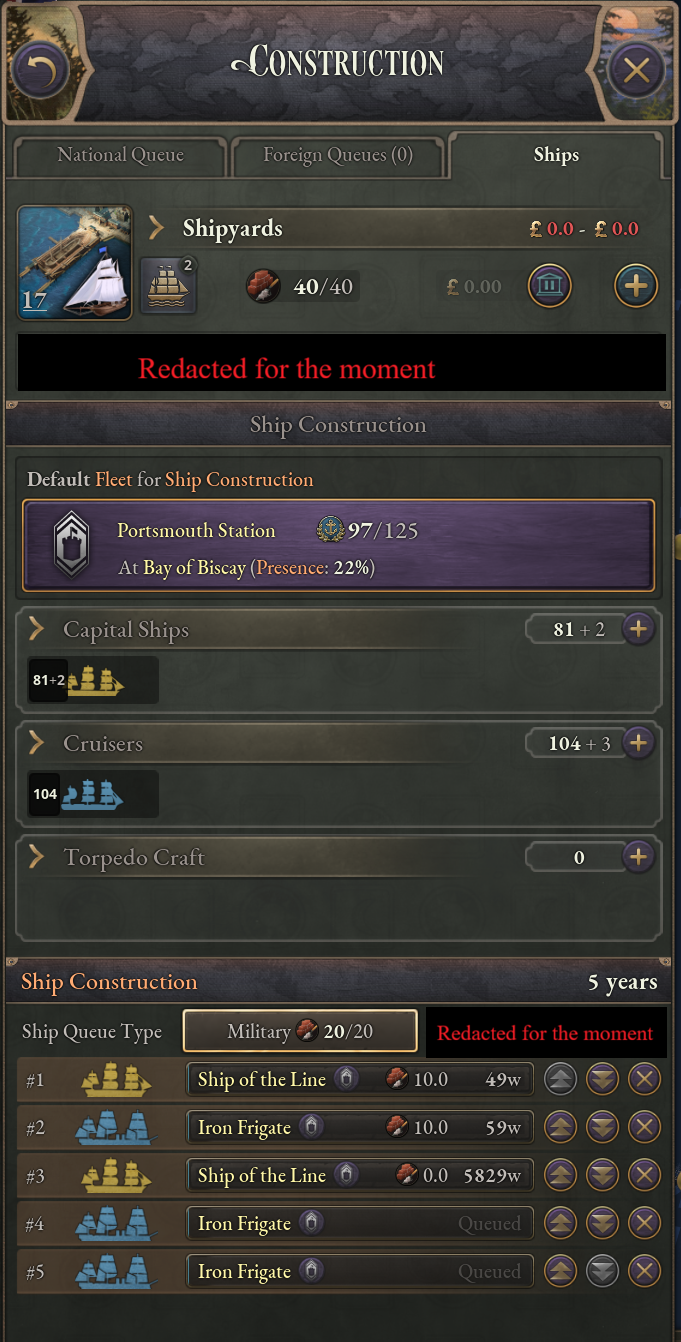
Not too many ships being built at the moment, but we can change that with a click of the + buttons
So, after multiple years, the HMS Claudius has been built. But even this majestic ship won’t sail by herself, she needs a crew.
With 1.13, ships receive their crews from a new building called Naval Administration. These cover the main functionality that Naval Bases used to have, the recruiting of servicemen. On that note, pour one out for Naval Bases, as they do no longer exist.
With Naval Administrations come some key changes, though. The most impactful one is that there is no longer a 1:1 connection between a ship and the building. Naval administrations will hire a total of 1000 sailors per level, but they can be distributed in chunks of 100 people. A small frigate may only need 100 people, and will take a “slot” of one level, leaving 900 men to be spread across other ships. Large ships such as our HMS Claudius may even need 1500 men, meaning they occupy more than one full level.
What also comes with that is that you now can (and should) construct Naval Administration buildings independently from ships. The construction of a new ship no longer automatically creates one new level of the crewing building, since there may still be capacity in other not-fully used Naval Administration buildings.
So, all in all, Naval Administrations act much more like a pool of sailors which your Navy draws from. Despite that, with the “slot” logic, we are still able to track directly which buildings should be affected by losses suffered in combat. So if the HMS Claudius, whose Naval Administration buildings are in Home Counties, should suffer crew losses, we would be able to see soldiers there being killed and having to be replenished.
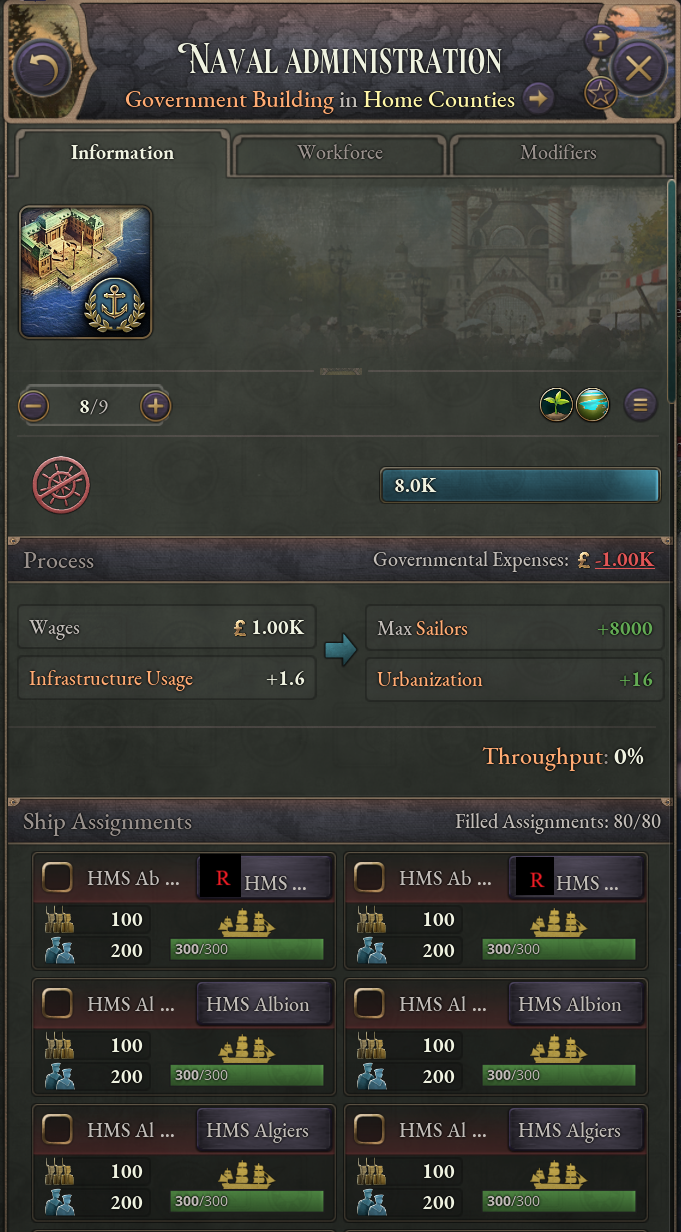
“They’re adding clone ships to Victoria 3?! This means their next project is related to the Star Wars license!” - Almost. Sadly, it’s just a bug.
If a Naval Administration building has hired a workforce, and a ship has assigned itself to it, it will take on these brave men as their crew. Once the ship is fully crewed, it is ready to leave port.
Let’s take a look at the true beauty HMS Claudius in the new panel for individual ships now that she’s ready!
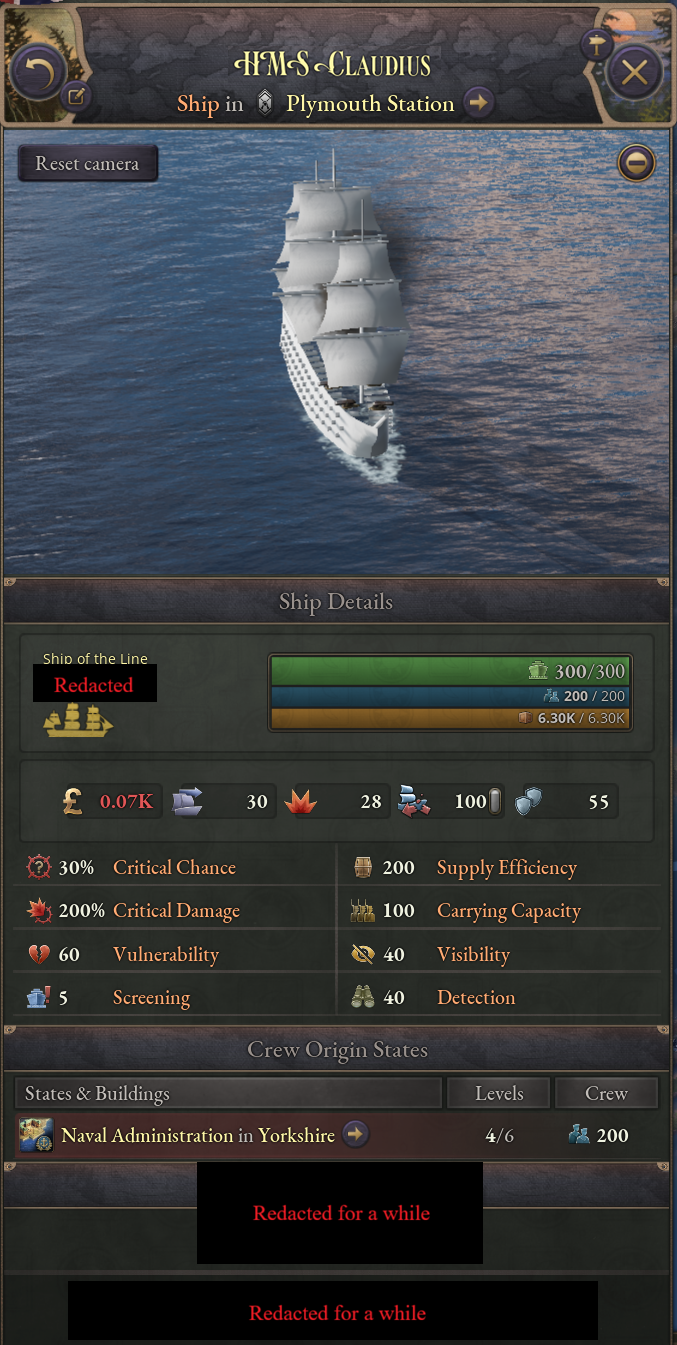
Can’t stress it enough, of course, the completely white ship is a placeholder
In this new panel you can see all details on one particular ship, including a preview of the 3D model. You can also rotate and zoom in the view to see the ship in all her glory.
We’ve also already christened her under the new name. Usually she would have a generated historical name, like HMS Victory or many, many others. That prefix is also dynamic, so if you move Great Britain out of a monarchy, the HMS will be dropped for example.
You’ll see some important information on the ship right below the preview.
In the three bars, we see the very important Hit points, crew and supply status of the ship. If a ship is reduced to 0 Hit points or Crew in battle, the ship sinks. You’d better not let that happen to our HMS Claudius!
Following these crucial bars, we have a lot of stats, with five of them being highlighted above the others. Here, the upkeep cost, speed, damage, blockade strength and armor find themselves.
The upkeep costs are dependent on the ship type and what goods they need and symbolize regular maintenance costs that would occur over time in reality. Furthermore, there’s also a small cost of ship construction points to symbolize this. So these costs also apply when a ship hasn’t been damaged yet.
Different from that, there are also repair costs being applied if a ship that was damaged in combat goes back to port to get repaired to full strength again. Repair costs are dependent on the total amount of goods being demanded for construction of a ship. So if a ship consumes 100 steel and 50 artillery for its construction, repairing 20% of its hit points would consume 20 steel and 10 artillery over the course of the repair time for example.
What all the other new stats do, I will cover in later sections when they become relevant—though most are fairly straightforward.
Now, of course, ships will usually not travel alone across the globe, but in a fleet.
So let’s take a look at the reworked fleet panel for a moment.
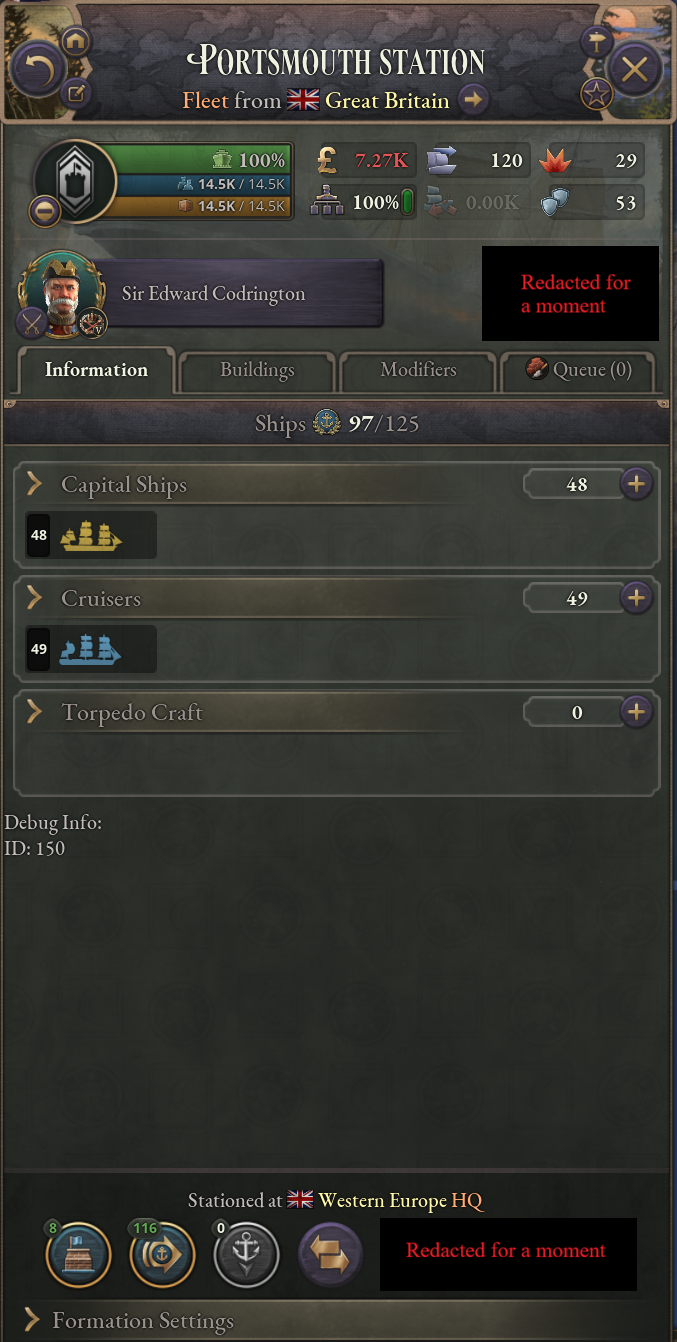
Very organized example of a British starting fleet
As you can see, the panel has undergone quite a bit of change. You’ll see the highlighted stats now either summed or averaged out on the fleet, with the total speed of a fleet being a logical exception. The slowest speed of a ship in a fleet determines the speed the whole fleet can travel at.
Speed itself also is noteworthy. Now, the speed of a fleet actually changes the travel time from one node to another, where previously it was fixed.
In this information tab you will see an overview of your fleet, sorted into three unfoldable categories of ships: Capital Ships, Cruisers and Torpedo Craft. I guess this is a good moment to talk about ship types in general!
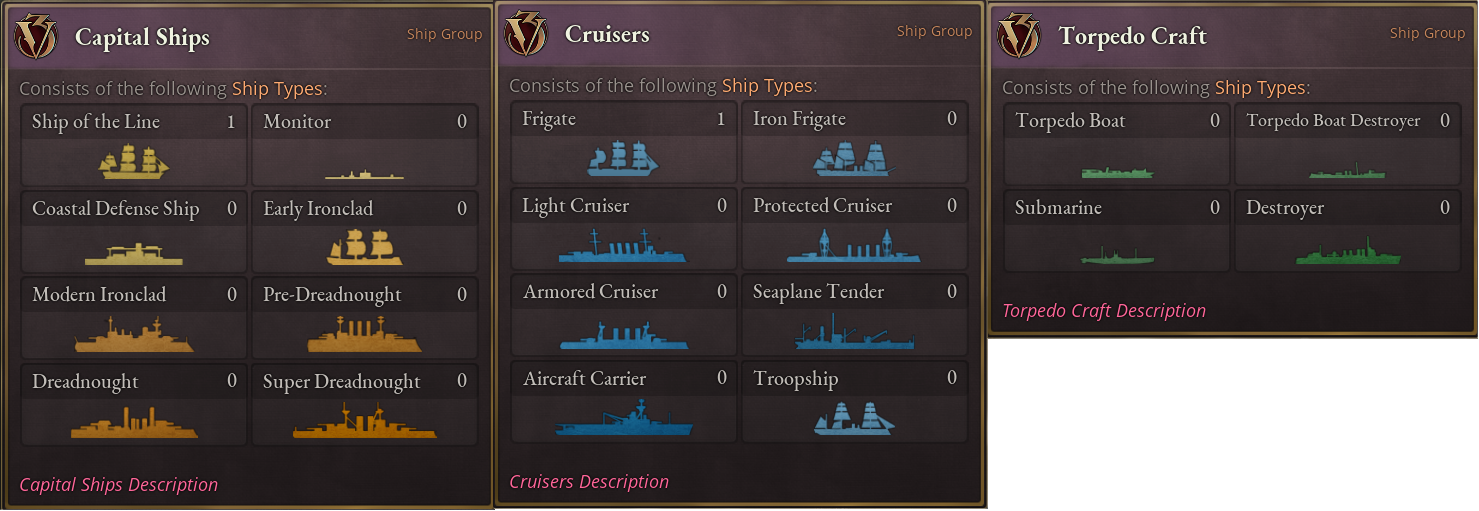 All Ship types to play and experiment with
Overall, we’re increasing the variety of ship types to 20. This setup provides a better line of progression from early to late-game, and allows us to model some more historical depth along the way.
In the “Buildings” tab of the fleet panel, you simply see a list of all Naval Administration buildings that contain at least 100 sailors of that fleet.
You can see how many ships are drawing from each of the buildings, how many levels the building currently has, and how many total sailors from them are associated with the fleet.
Note that the number of ships in a fleet doesn’t necessarily match up with the number of ships portrayed in this list, because a ship can theoretically draw crew from many different states, and will, therefore, be counted that many times.
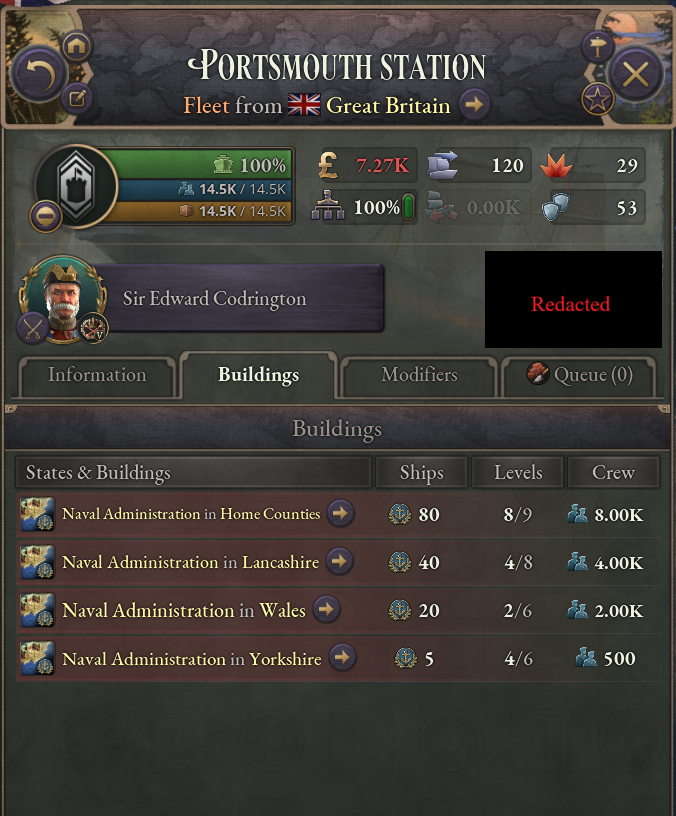
Buildings and Ships. We also ship Buildings building Ships with the Update.
All that’s left are the Modifiers and Queue tabs, which are pretty self explanatory.
The next big topic that I want to talk about today is Supply, so let’s take a look at it, shall we?
One major ambition we had when we started working on this expansion was to make Supply a more meaningful consideration. While we focussed most of our attention here on the Navies, of course, we decided to tie all situations where armies are fighting on the other side of an ocean into it as well.
We wanted to try and limit the situations where you can simply send 300.000 men across the globe without having the infrastructure in place for it, and that infrastructure (in our case ports along the route) should be relevant.
We also wanted to make the interruption of Supply lines more haptic, less magical as a number of -3520 convoys might have expressed previously.
So, what have we done to try and get there? First off, to appease Poseidon, we’ve put Convoys onto the sacrificial altar. Convoys are dead, long live Supply Ships. They symbolize the continuous transportation of goods to where a fleet or army would need them.
Supply Ships are not a market good, but rather need to be built like warships, and are strictly for military use.
This is a very clear distinction we’re introducing. All military operations that require Supply, e.g. sending a fleet or an army across the ocean, will make use of Supply Ships. All trade and civilian usage, e.g. for port connections with territories abroad, will use Merchant Marine.
That means that the civilian ship goods, Clippers and Steamers, remain in place and are produced by shipyards. This is where the “civilian” side of the formerly split shipyards comes into play, as the merged shipyards now produce all warships, supply ships and civilian market goods again.
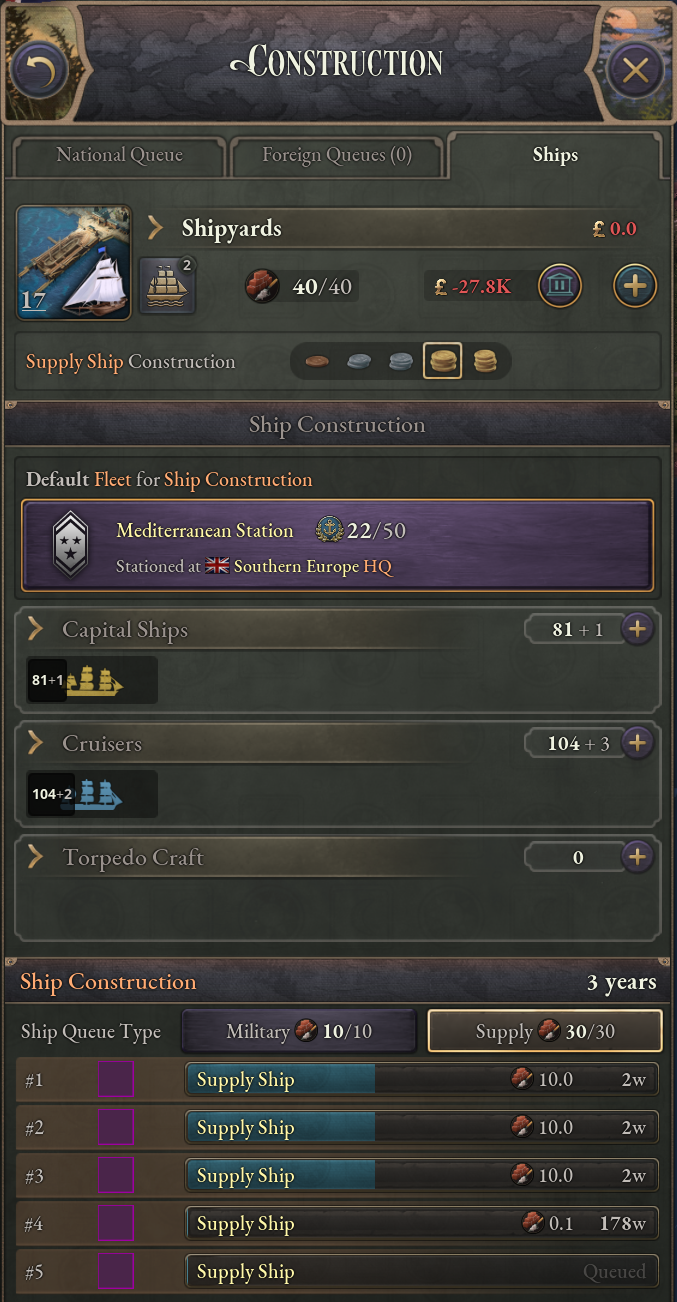
Higher “budget” allocation means higher share of Supply Ships being produced
What you can now see with the unredacted image of the shipyard is how the construction of Supply Ships works.
For this, you essentially assign the share of total production capacity that should go towards the military or the supply ship usage.
Supply ships also have a separate ship construction queue so that you can produce both warships as well as Supply Ships at the same time. In the example case this means the 40 total are split 10/30 across the two queues. The steps are 0%, 25%, 50%, 75% and 100% of the total construction capacity going to Supply Ship construction.
And how do Supply Ships work in practice to supply your fleet? Well, this is a complex question, so bear with me for a moment.
First, we need to talk about how supply actually works for a fleet of warships. Supply is stored on the ships, and each ship can have a different capacity for it. For example, a Monitor will have a lower capacity (e.g. 500) than, say, a Light Cruiser (e.g. 1800). But supply in a fleet is distributed equally among all ships. So, for example, if a fleet is at 75% supply status, that means that all ships are filled with 75% of their own capacity. That means it can be beneficial to have ships with larger capacity, as they contribute positively to the whole fleet in the case that they need to go without fresh supplies for a while. If a ship carrying a lot of supplies is sunk in battle, the supplies and the added supply capacity for the fleet is gone.
A fleet’s rate of supply consumption depends on the ships in it. For example,a large fleet like Great Britain’s, with ships across the oceans, will be harder to maintain than a small fleet protecting their own coast. Depending on the supply consumption of an army or fleet, you assign as many Supply Ships as they need to maintain supply.
By default, and assuming you have enough Supply Ships available, each fleet and army automatically gets assigned as many as they need to retain their Supply level (if it is at 100%), or to refill it to 100% again over time.
For example, the main battle fleet with the HMS Claudius consumes 2000 Supply per week. They are active, far away from home and sailing around Gibraltar. In order to keep their current Supply status of 100%, they need 250 Supply ships, which is what is being assigned to them by default.
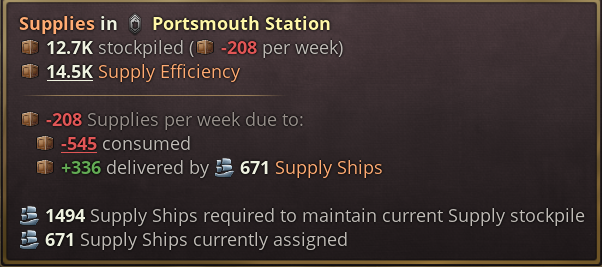
This fleet needs more Supply Ships assigned in order to maintain their Supply levels, currently it’s losing Supplies over time
Of course, this means that you’ll have to make some unpleasant calls if you ever lack Supply Ships sitting around in reserve. We’ve decided to add a three tier priority system that allows you to make sure that a particular fleet or army always receives Supply Ships first or last.
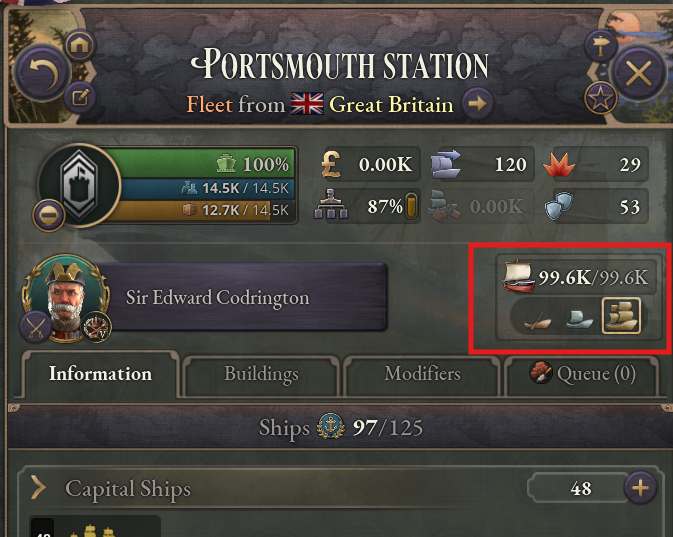
Three priority levels to assign Supply Ships per formation
Additionally, we wanted to represent coaling stations somehow, even though we didn’t go with a range based approach for ships.
So what we are doing is reducing the supply ship consumption based on the nearest available port. If you’re far from home, but you have managed to secure your own or a friendly port nearby, it will meaningfully reduce the demands on your supply network. This can be quite crucial to maintain a large overseas naval effort.
But how would a country ever end up in a situation where they don’t have enough Supply Ships available to support all needs?
Well, among economic struggles or the lack of shipyards, raiding supply lines is another answer. For that, I’ll have to explain how supply is traced from a country to their fleets or overseas armies.
We introduce a new type of building, Logistics Centers, one for Navies, and one for Armies. Logistics Centers are automatically created and built in the HQ of a military formation.
They are the place where all the goods are consumed that the formation needs, rather than the naval bases and barracks in the past.
This allows us to draw a concrete path from one central location to a formation. If we had it distributed across dozens of buildings, we could not have done this.
That, in turn, allows countries to raid the supply lines. This works differently than with Convoys, though. When a fleet raids supply lines, they actually engage the Supply Ships in the affected node in naval combat and need to sink them to cause actual damage.
Destroying these ships will then naturally mean fewer ships arrive at the formation in question, reducing their supply (at least temporarily). To continuously hurt an enemy’s supply, you’ll also need to continuously raid their supply lines, causing them to continuously lose Supply Ships in the process.
We will go into much more detail on how fleets engage in sea zones, what missions they have, how combat behaves now, and so on, in a later Dev Diary, even though all these changes are of course coming with the free Update. It’s a bit too much to talk about in this place.
Since our Steam screenshots caused some speculation, here’s also how the amount of available Supply Ships in your country will be displayed.
We use the old Convoy capacity spot for it and it will show you the unassigned Supply Ships. In its breakdown, you can see all currently used Supply Ships too. Other than the Convoys though, this is the actual number of Ships you have in reserve and not a capacity, as I explained.
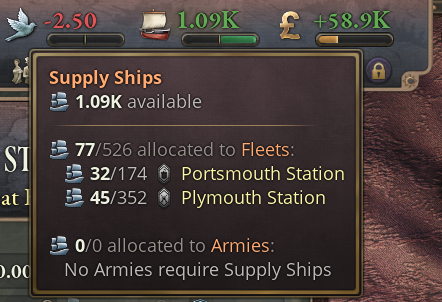
Currently, not many Supply ships are in use, but over time this will change until the fleets are full
One last thing on Supply. While we don’t cover anything for how supply travels further on land at the moment, armies that are overseas will be bound to the same rules as fleets. So they will also have their logistics center, and a route of supply ships depending on the army size going to them (while at sea) or their nearest port (when on land across the sea).
This should already make it more difficult to try and send 300.000 men across the globe, one major pain point we wanted to tackle for a long time.
Now, we move on to one of the use cases for the Navy. And it’s a big one that we have wanted to do for quite a while. Our dear Tunay will cover that part, before I’ll pick up again from the next.
Hello, Systems Designer Tunay here to give you a rundown on Tiered Interests!
Victoria 3’s Strategic Interests system is probably the one feature we have that was left almost untouched since release, but this changes now. We are transforming the entire mechanic from a binary representation into a multi-level system that is attained not by the click of a button, but through dedication and investment into a region by various means.
Keep in mind that everything you see here is from a work in progress build!
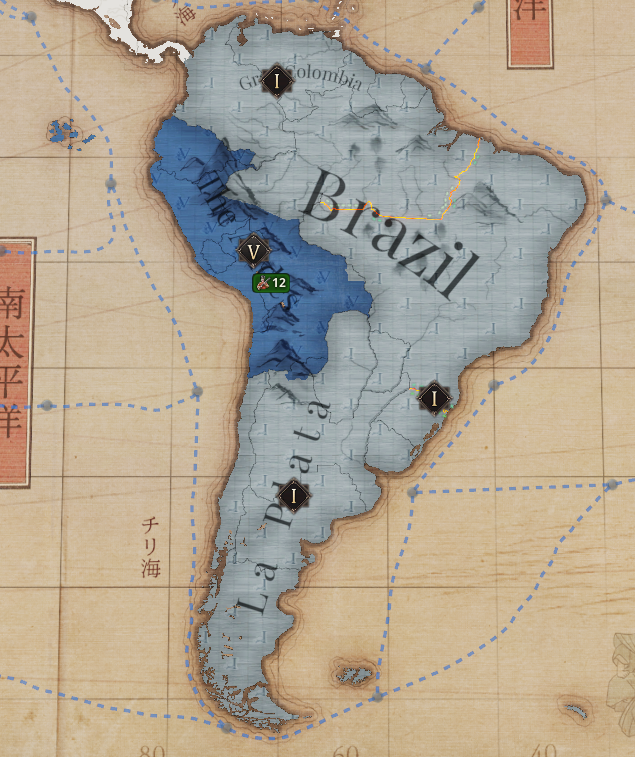
As Peru-Bolivia, I have a Hegemonic interest over the Andes strategic region—if I can keep it
To increase your interest level, you will have to build up your involvement in a given strategic region. This can be done by a variety of means: signing different treaties with local countries, having subjects, sending your fleets to Project Power off the coast—or, of course, outright conquest.
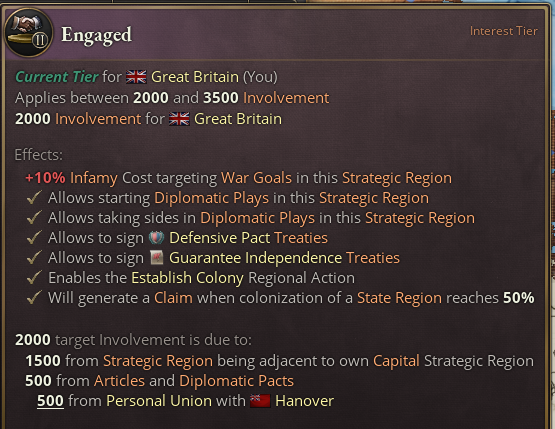
As Great Britain, we don’t have a real presence in Central Europe. But, because it’s in our direct neighborhood, and we have a Personal Union with Hanover, we can still reach level 2
Attaining ever higher levels of interests will be important because it will allow you access to diplomatic actions and treaty articles to sign with Local Countries that may otherwise not be available, as well as wholly new and never before seen benefits—like, for example, the ability to generate “Colonial Claims”. That is, being granted a claim on a state region, once your colony there grows to at least half the state region’s size.
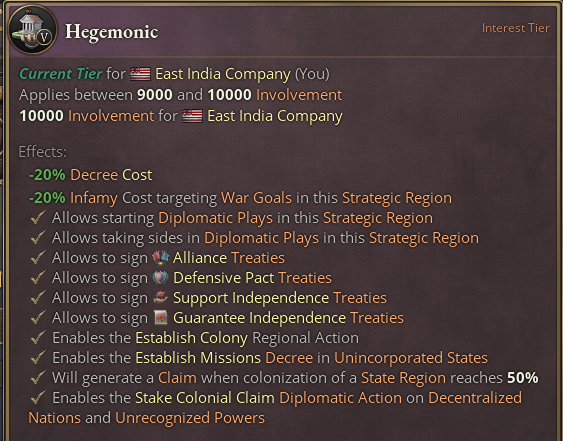
The East India Company’s status as the Hegemon of Northern India grants it practically free reign over the subcontinent
The term “local” has come up at this point, so allow me to explain this as well. When we look at the presence of a country in a strategic region, we generally divide all countries into one of two categories: local and non-local countries.
As a non-local country, you may gain involvement in a region by signing treaties with countries that are considered local there. ‘
Locality is determined by a couple of factors:
Having one's capital in a region
Having 25% locality in a region
Having 25% of one's own incorporated states in that region
Locality in a region itself is calculated based on a combination of owned states, population and gdp share. So it's not purely the number of states that count, but also what you have in them!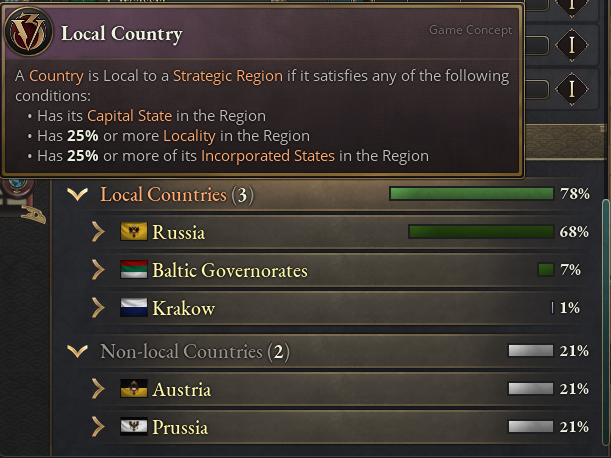
There is a suspiciously Poland-shaped hole in this region
By signing a treaty with Persia wherein the Shah grants us Investment Rights, and in return we send them some of our officers as military attachés, we will be generating enough involvement to push us to a level 1 interest.
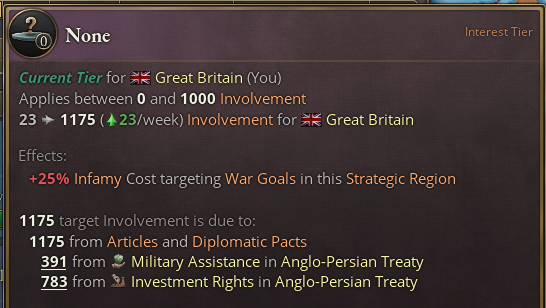
With this treaty we shall be friends forever! What is this Herat place you speak of?
The actual amount of involvement that you can generate from engaging in diplomacy with a local countries is scaled off of their “locality”. This very same treaty would grant a lot less involvement if we had signed it with tiny Kafiristan, for example.
Lastly, the eagle-eyed amongst you may have noticed that I’ve been bringing up a couple new strategic regions. That is because we have revisited our strategic region setup, generally reducing the density of strategic regions on the map:
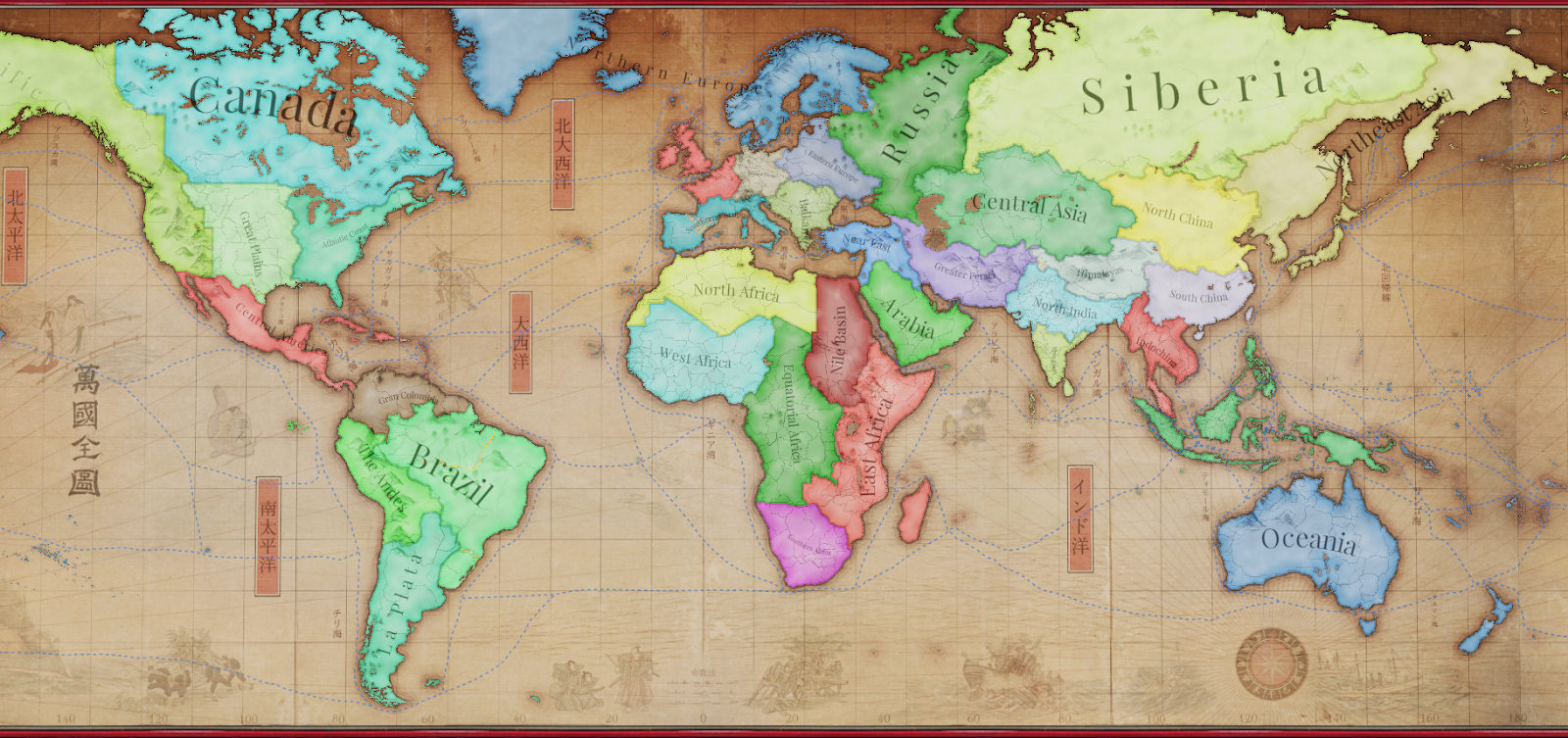 The new setup. Notably, South America has not been changed at all, as we used it as our template for the rest of the world
Lino is coming back with other important topics now.
Indeed, the next topic on our list is pretty quick to explain for a change, but has fairly big implications and is a lot of work to get right.
We wanted to improve upon Troop Transportation as well, to make it more haptic rather than armies simply ‘turning into boats’, and also requiring certain capabilities for you to move your armies across the globe.
So, with 1.13, armies will be transported across bodies of water using your military ships. We played around with some ideas of using merchant marine or supply ships for this purpose, but did not really find a way that would represent the requisitioning of civilian ships that would also be feasible for us to implement.
The way you do this is pretty simple. You give an army a command to move to a target state across the ocean (similar to a naval invasion) and then you’ll be asked to choose a fleet to transport/escort them. The only way to transport troops is to give them a concrete target, so you cannot have them out at sea with your fleet permanently.
While a fleet is transporting units, it cannot engage in other missions like intercepting or raiding, only moving to a target location.
Ships have different capabilities for how good they are at transporting units, and as you may have seen, there’s a ship specifically designed for this purpose which has low combat capabilities outside that.
Almost as a side note in there, I just mentioned that you target a particular state with your army. This is actually a pretty big change we’re doing where instead of HQs for stationing etc. you will now target a particular state, from which we can infer the HQ. This was not only necessary for Troop Transportation, but also increased in importance with the strategic region merging we have done, as many HQs simply grew a bit too big for logical distinction of where an Army currently is located.
That means you’ll be able to see armies stationed in the capitals of different states in peace time, rather than having them all stacked up in the same place if you desire to do so.
Now we wouldn’t be the Victoria 3 team, if we didn’t add some new feature in here too in addition to the reworks. The main background here being that we wanted to enable a different way to have your fleet be able to pose a threat in and of itself to enemy coasts and ports.
Any ideas?
It’s Marines. Marines are a new land unit, and, unlike other land units, they can be permanently travelling with a fleet. Marines have a separate capacity to be transported from regular units, which is going to be a lot smaller.
Unlike the regular land units, Marines do not prevent the fleet from engaging in other missions, so your fleet will be able to do the full spectrum of tasks while having some marine detachment with them.
What this allows you to do is to even launch a naval invasion with these Marines directly from the fleet they are attached to, rather than having to launch it from your own territory. Marines have a better effectiveness at conducting naval invasions compared to regular units, as they won’t suffer as big of a penalty.
Once Marines have secured a beachhead in a major enemy theater, you’ll probably want to reinforce them with your regular units quickly, as they’ll rarely outnumber your enemies on land. On their own, however, they are often more than capable of taking enemy islands or seizing a port from a technologically inferior opponent.
Next up, I’m gonna talk about some potentially interesting targets for using your Marines :eyesshakingemoji:
This was on my personal wishlist for a long time and now we’re actually doing it. It’s the perfect expansion and Update for it, so it makes total sense that we would tackle Straits too now.
With 1.13, we define a number of key straits across the globe, from the Öresund, to the Bosporus, to the Strait of Malacca.
With a single exception, they all work like this:
Control over the strait is shared between the two owners of the provinces we define in script. For example, for the Öresund, it would be a particular province in Danish Zealand and in Swedish Scania.
Being the strait controller allows you to do a couple of things. First off, you can set access levels on who gets to pass through the strait.
Here, you have a couple of options. You can choose between only yourself, your allies, everybody but your enemies, or everybody. And you can also distinguish between military and civilian ships to be let through.
Important to note here is that all access levels behave like an AND gate, meaning that if your buddy Denmark would gladly let you through, but the Swedes didn’t like your comments about their candy and closed the strait for you, you will NOT have access to the other side with your fleet. One side can block the other.
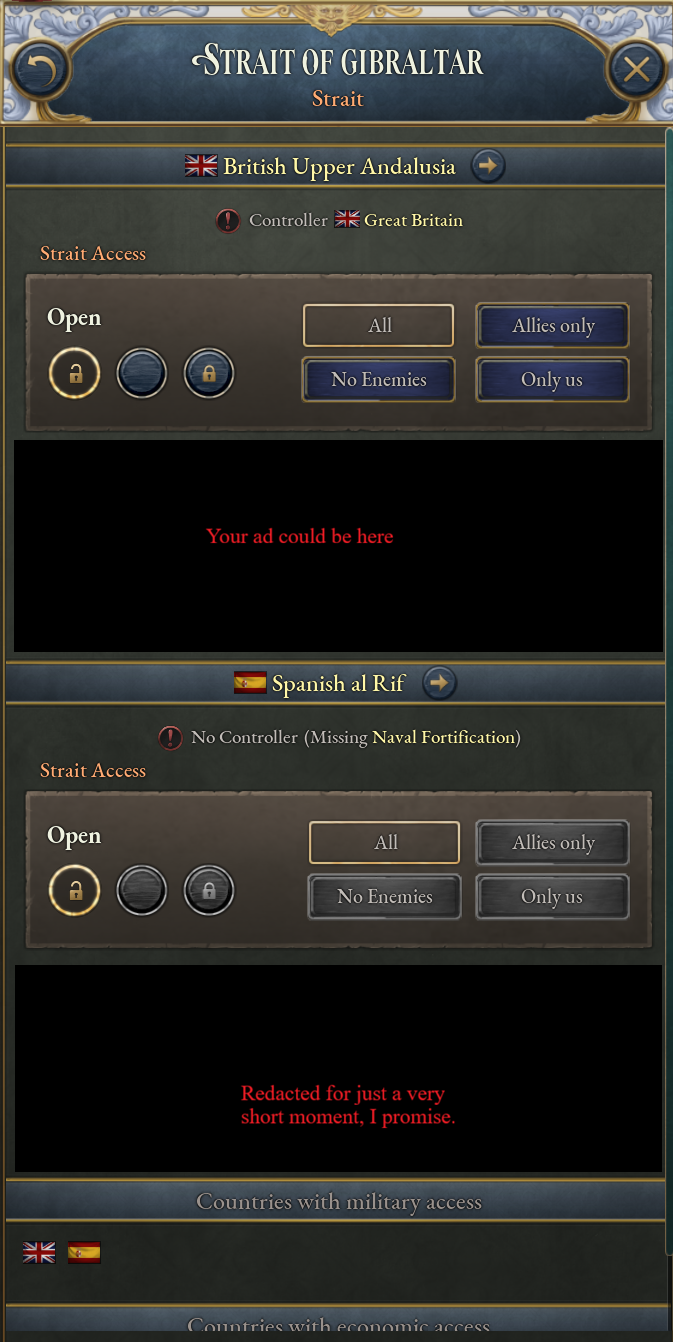
You shall (not) pass!
Now, just owning the province is not actually enough to actually unlock controlling the strait. For that, you’ll have to build at least one level of Naval Fortifications on your side of the strait.
Naval Fortifications, of course, are a new building, constructed at the coasts of your country. They take a lot of time to be built, and there’s a low limit to how many you can build in every state.
Apart from turning on the strait control, their main function is of course to defend your coast. The main way in which they do that is by completely blocking naval invasions if the attackers’ power is not above a threshold defined by the naval fortification.
For example, a level one naval fortification may require your enemy to attack with at least 6 battalions, a level three one with at least 11 etc. (as always these values are subject to change). This should help defend your coast in general, but also specifically help against the spamming of tiny naval invasions.
Other than this, they also provide a defensive bonus in case the enemy will assemble a large enough force to attempt to land. This bonus is scaled by the power difference between the initial attacker and defender. So if the attacker is twice as powerful as the defender for example, the defensive bonus applies with 50% of its maximum strength.
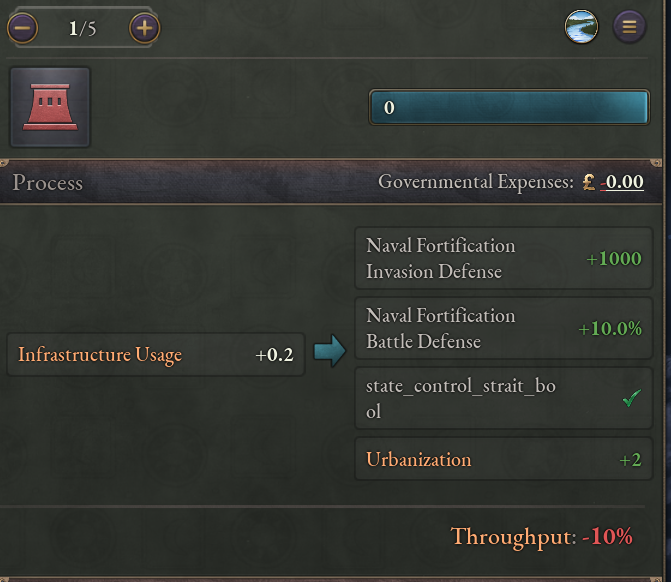
Again, all images can contain placeholders. Naval Fortifications will employ troops and their modifiers will have actual names of course.
With that out of the way, let’s return to the straits.
Another thing you can do with straits is collect Tolls. Tolls are collected based on the total trade volume going through the strait, so they will be differently valuable based on location.
You have, similar to access rights, the option per controlling side to set your Tolls level for how much you’d like to charge. So in the case of the Öresund for example, Denmark may decide to charge 15% tolls on everything while Sweden decides to charge nothing - resulting in a total of 15% for everybody coming through.
If Sweden also started charging 15%, it would add up to 30% for everybody.
What that means of course is just like with access, if you control both sides of a strait, you will have a lot more to say about the ongoings of a strait.
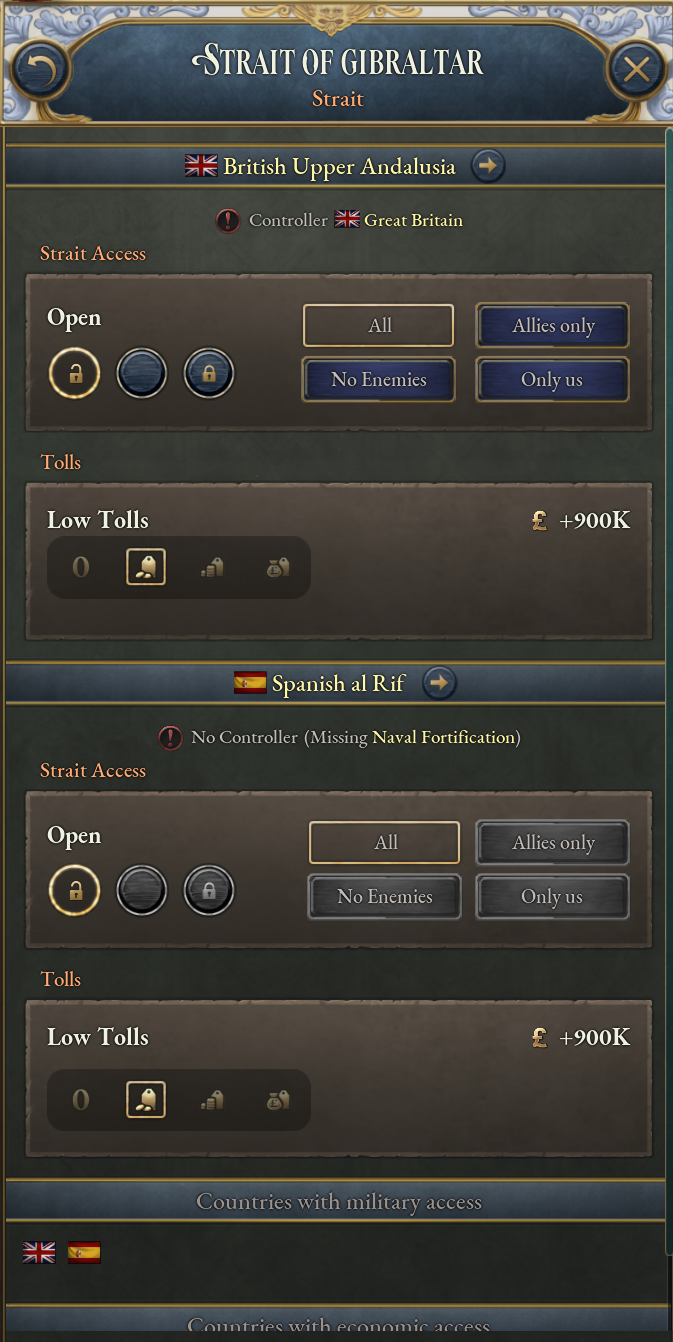
Nothing better than charging absurd amounts of money for ships to pass
I should also mention that we have implemented one special case, Gibraltar, which requires you to own both sides of the strait before you can lock it down. This was simply too impactful when you could lock down all of the Mediterranean from the get-go.
Canals will also be straits, by the way, following the same rules. We are investigating options to make their companies take the collected tolls into account, but this is challenging and might not make it for now. As you may see, we are trying to ship (ha!) a giant unit of an update to you.
That was our first Dev Diary for this cycle and we think you can see how much meat there is in this one. As mentioned, there’s some major free changes coming to combat which Tunay will go over in some time and we have a couple of other smaller additions, changes and improvements too which you’ll discover on release.
Here you have the full schedule for our upcoming Dev Diaries:
March 23 - Character features
March 26 - Ship Designer & Flagships & Ship Purchasing
April 02 - Naval Combat & Gunboat Diplomacy
April 09 - Narrative Content of The Great Wave
April 16 - Art & Music of The Great Wave
April 23 - Changelog & Achievements
April 28 - Release of The Great Wave and Update 1.13
So long everybody, enjoy a happy Thursday.
What's Your Reaction?