




![[PRO Tips] Gold’s Bullish Revival: Seasonal Trends and Key Levels to Watch](https://xinker.org/uploads/images/202412/image_430x256_67724cc6ad0cd.webp)
![[PRO Tips] Gold Market Under Short-Term Pressure, Safe-Haven Demand and Central Bank Buying Support Long-Term Upside Potential](https://xinker.org/uploads/images/202412/image_430x256_676ffb4685287.webp)
![[PRO Tips] Analysis of 9 key points of differentiation strategy! Master differentiation to create a brand advantage that is unique in the world!](https://firebasestorage.googleapis.com/v0/b/xinker-tips.appspot.com/o/article_thumbnails%2Fscaled_differentiation%20strategy.png.png?alt=media&token=a1bfc3d2-e85a-4db7-8a6d-01c7274f8940)
![[PRO Tips] Will REITs regain growth momentum in 2024? 3 REITs ETFs you must know if you want to invest in real estate.](https://firebasestorage.googleapis.com/v0/b/xinker-tips.appspot.com/o/article_thumbnails%2Fscaled_REITs1.png.png?alt=media&token=8af4eb93-33ff-466f-8039-b6555fad52b4)
![[PRO Tips] Complete tutorial on how to make money in Adobe Stock!](https://firebasestorage.googleapis.com/v0/b/xinker-tips.appspot.com/o/article_thumbnails%2Fscaled_tut-adobe1.png.png?alt=media&token=0b2c8cf2-22bd-4142-883e-140ed1cbaf02)
![[Passive Income] Unlock the secret of passive income: 3 steps to apply for Google AdSense](https://xinker.org/uploads/images/202410/image_430x256_6717a4fb3052b.webp)
![[Passive Income] Earn over $200 a day with AI-generated articles!](https://firebasestorage.googleapis.com/v0/b/xinker-tips.appspot.com/o/article_thumbnails%2Fscaled_article1.png.png?alt=media&token=f61bf35b-8553-4719-826d-7360024adc70)
![[Passive Income] Earn over 20 USD per download with AI-generated images!](https://firebasestorage.googleapis.com/v0/b/xinker-tips.appspot.com/o/article_thumbnails%2Fscaled_adobe2.png.png?alt=media&token=3e20e76a-a907-45af-80aa-bf9b3600301f)
![[Passive Income] Earn 10 USD per new download by sharing CapCut!](https://firebasestorage.googleapis.com/v0/b/xinker-tips.appspot.com/o/article_thumbnails%2Fscaled_capcut2.png.png?alt=media&token=a04dec40-1fac-4857-86f2-19a8be02d38e)
![[Passive Income] Use your WiFi to create passive income in 5 minutes, and you can earn 4-6 U per day!](https://firebasestorage.googleapis.com/v0/b/xinker-tips.appspot.com/o/article_thumbnails%2Fscaled_Grassio.webp.png?alt=media&token=7659a95e-0e47-4f27-a17d-c942ac3cf7f4)


![[Business Talk] The Unique Theme of XINKER's Song: Beef Wellington and Business Mastery](https://xinker.org/uploads/images/202410/image_430x256_671afc155f47f.webp)
![[Business Talk] Chagee: Opening 3,500 stores in 6 years](https://xinker.org/uploads/images/202410/image_430x256_671afce80c5f9.webp)


The Razer Blade 18 steps up to some of the most powerful gaming laptops I've tested and nearly steals the win
The 2026 Razer Blade 18 is more of an iterative update on what came before, swapping out that Intel Core Ultra 275HX processor for a shiny new 290HX Plus model. Still, this is a machine that's keeping pace with the most powerful on the market - and doing it all in a premium, slimline chassis. Throw in a dual-mode 4K display that you'll either love or loathe, a sturdy battery life, and a solid deck of keys and you've got yourself a suitably expensive rig vying for best gaming laptop status. I'll be primarily comparing the Razer Blade 18 against the Asus ROG Strix Scar 18 (as our current go-to 18-incher) and MSI Raider A18 HX for some 4K insights (and as the most powerful gaming laptop I've tested so far). The Intel Core Ultra 9 275HX / RTX 5090 Scar I've had my hands on goes for $4,499.99, $900 less than the Blade, while the Raider packs an AMD Ryzen 9 9955HX3D and RTX 5090 for $5,609.99 - $210 more than Razer's. Razer Blade 18 configurations (Image credit: Future) This being such a premium machine, the Razer Blade 18 sticks to the top end of the GPU market. That means you're choosing between RTX 5070 Ti, RTX 5080, and RTX 5090 flavors, paired up with Intel's 2026 Core Ultra 9 290HX Plus CPU. It's the processor that marks the biggest departure from last year's model, though the real-world performance upgrade is going to be minimal. That's why the price jump from $4,899 to $5,399 for an RTX 5090 model feels pretty squeaky. Of course, with rising component costs everything is more expensive in 2026 - but when the previous generation model is still available (and starting at $3,499.99), it's worth sitting down with some priorities. After all, this is the same dual UHD / FHD display with largely the same specs, and the same rock-solid chassis. RAM spans 32GB up to 128GB in the US (only 64GB in the UK), while 2TB and 1TB storage options are available as well. Ports are bountiful, with both a Thunderbolt 5 and 4 at your disposal (though some kind of labelling system would have been appreciated), as well as three Type-As and an RJ45 for a wired connection. Key Specs Tested Also Available Price $5,399.99 / £4,999.99 $3,999.99 - $6,999.99 / £3,599.99 - £5,799.99 Display Dual UHD+ 240Hz / FHD+ 440Hz - Processor Intel Core Ultra 9 290HX Plus - GPU RTX 5090 RTX 5070 Ti | RTX 5080 RAM 32GB 64GB | 128GB (US) Storage 2TB SSD 1TB SSD Connectivity WiFi 7, Bluetooth 5.4 - Ports 3x USB 3.2 Gen 2 Type-A, 1x Thunderbolt 5, 1x Thunderbolt 4, 1x RJ45, 1x HDMI 2.1, 1x UHS-II SD card reader - Dimensions 1.1 x 10.84 x 15.74 inch - Weight 3.1kg -Razer Blade 18 performance Well, this is about as close any gaming laptop has got to threatening the MSI Raider A18 HX A9W's throne. The previously 'most powerful' gaming laptop I tested has come in neck and neck with the Razer Blade 18 from my RTX 5090 tests, and the edge might just go to Sneki here. MSI beat Razer in two out of my three 3D Mark tests (Fire Strike, the easier run, and Steel Nomad, the hardest and most true to life run). An early point for the Raider. Then we get to the in-game benchmarks, where the duo tie in FHD and UHD wins, with Razer taking the crown for QHD performance overall. That's a tie so far. https://flo.uri.sh/visualisation/29705596/embed https://flo.uri.sh/visualisation/29705638/embed https://flo.uri.sh/visualisation/29705746/embed https://flo.uri.sh/visualisation/29705938/embed * With DLSS x4 generation enabled, the Razer Blade 18 averaged 172fps in Cyberpunk 2077 at 4K RT Ultra. We can try and break that tie with CPU-only scores. The Intel Core Ultra 9 290HX Plus scored 3,053 in its single core test and 20,387 in its multi core test. The first is good news for the Raider with its beefy AMD Ryzen 9 9955HX3D averaging around 3,186 in user tests. The second brings Razer right back into the race - AMD generally only musters a 20,220 position here. The Razer Blade 18 has blown it out the park with its performance. This is a slimline chassis operating with half the RAM of the MSI Raider and still keeping pace with the monster. That means we'll need to look deeper into the most important benchmarks; demanding QHD and UHD in-game runs and single core CPU performance. Cyberpunk 2077 in RT: Ultra represents the biggest challenge in my test pool, and we're still pretty close here. The Razer Blade 18 ran at an average of 86fps in these conditions, with the MSI Raider eking ahead at 90fps. The script is flipped in 4K, with the Razer Blade 18 sitting at 60fps and the Raider dropping slightly to 59fps. These are both evenly matched machines. Ultimately, then, it comes down to that single core performance. The Intel Core Ultra 9 290HX Plus may be helping the Blade 18 keep its battery life in check, but it's not quite getting the machine over the line against the most powerful rig on the market. What I loved about the Razer Blade 184K is a real luxury You won't find too many 4K gaming laptops on the shelves right now, which is a little frustrating considering the RT
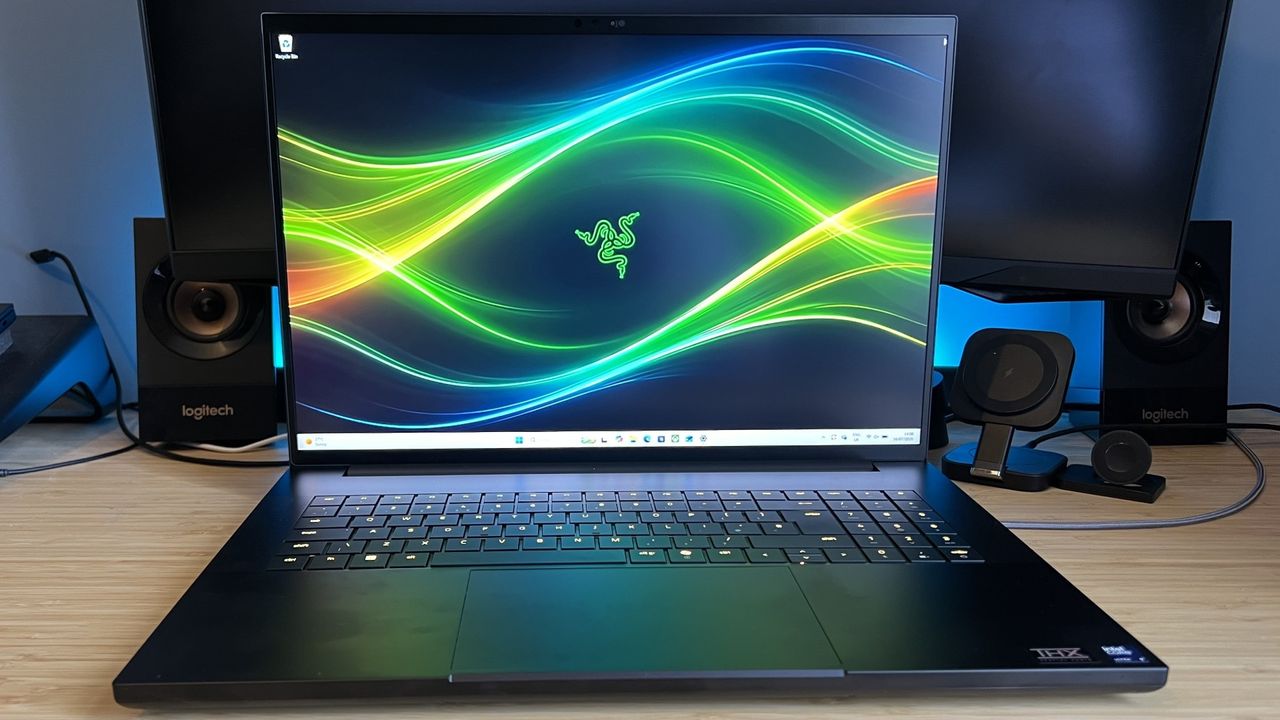 The 2026 Razer Blade 18 is more of an iterative update on what came before, swapping out that Intel Core Ultra 275HX processor for a shiny new 290HX Plus model. Still, this is a machine that's keeping pace with the most powerful on the market - and doing it all in a premium, slimline chassis. Throw in a dual-mode 4K display that you'll either love or loathe, a sturdy battery life, and a solid deck of keys and you've got yourself a suitably expensive rig vying for best gaming laptop status.
I'll be primarily comparing the Razer Blade 18 against the Asus ROG Strix Scar 18 (as our current go-to 18-incher) and MSI Raider A18 HX for some 4K insights (and as the most powerful gaming laptop I've tested so far). The Intel Core Ultra 9 275HX / RTX 5090 Scar I've had my hands on goes for $4,499.99, $900 less than the Blade, while the Raider packs an AMD Ryzen 9 9955HX3D and RTX 5090 for $5,609.99 - $210 more than Razer's.
Razer Blade 18 configurations
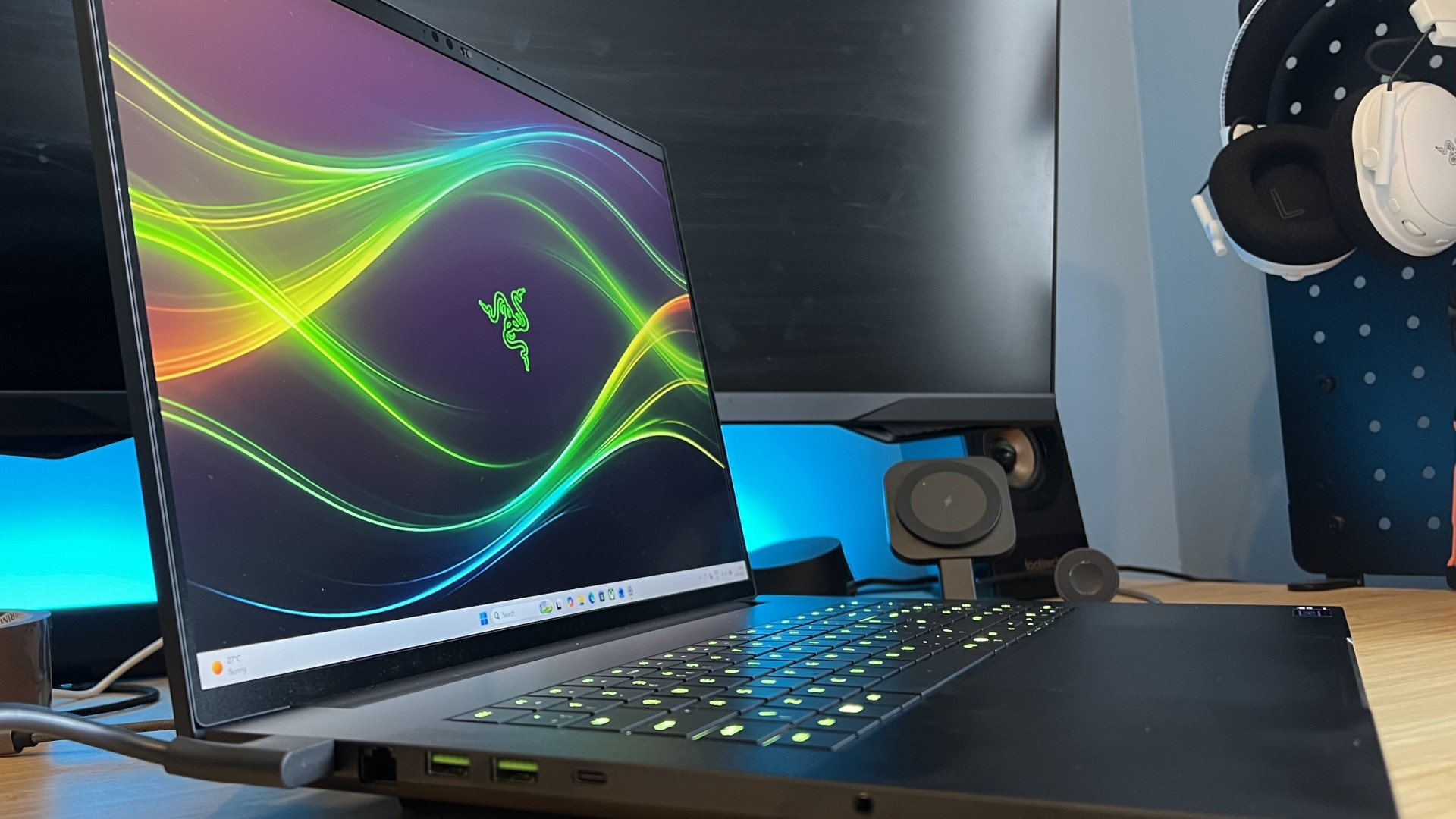
(Image credit: Future) This being such a premium machine, the Razer Blade 18 sticks to the top end of the GPU market. That means you're choosing between RTX 5070 Ti, RTX 5080, and RTX 5090 flavors, paired up with Intel's 2026 Core Ultra 9 290HX Plus CPU. It's the processor that marks the biggest departure from last year's model, though the real-world performance upgrade is going to be minimal. That's why the price jump from $4,899 to $5,399 for an RTX 5090 model feels pretty squeaky.
Of course, with rising component costs everything is more expensive in 2026 - but when the previous generation model is still available (and starting at $3,499.99), it's worth sitting down with some priorities.
After all, this is the same dual UHD / FHD display with largely the same specs, and the same rock-solid chassis. RAM spans 32GB up to 128GB in the US (only 64GB in the UK), while 2TB and 1TB storage options are available as well.
Ports are bountiful, with both a Thunderbolt 5 and 4 at your disposal (though some kind of labelling system would have been appreciated), as well as three Type-As and an RJ45 for a wired connection.
Key Specs
Tested
Also Available
Price
$5,399.99 / £4,999.99
$3,999.99 - $6,999.99 / £3,599.99 - £5,799.99
Display
Dual UHD+ 240Hz / FHD+ 440Hz
-
Processor
Intel Core Ultra 9 290HX Plus
-
GPU
RTX 5090
RTX 5070 Ti | RTX 5080
RAM
32GB
64GB | 128GB (US)
Storage
2TB SSD
1TB SSD
Connectivity
WiFi 7, Bluetooth 5.4
-
Ports
3x USB 3.2 Gen 2 Type-A, 1x Thunderbolt 5, 1x Thunderbolt 4, 1x RJ45, 1x HDMI 2.1, 1x UHS-II SD card reader
-
Dimensions
1.1 x 10.84 x 15.74 inch
-
Weight
3.1kg
-
Razer Blade 18 performance
Well, this is about as close any gaming laptop has got to threatening the MSI Raider A18 HX A9W's throne. The previously 'most powerful' gaming laptop I tested has come in neck and neck with the Razer Blade 18 from my RTX 5090 tests, and the edge might just go to Sneki here. MSI beat Razer in two out of my three 3D Mark tests (Fire Strike, the easier run, and Steel Nomad, the hardest and most true to life run). An early point for the Raider. Then we get to the in-game benchmarks, where the duo tie in FHD and UHD wins, with Razer taking the crown for QHD performance overall. That's a tie so far.
https://flo.uri.sh/visualisation/29705596/embed https://flo.uri.sh/visualisation/29705638/embed https://flo.uri.sh/visualisation/29705746/embed https://flo.uri.sh/visualisation/29705938/embed * With DLSS x4 generation enabled, the Razer Blade 18 averaged 172fps in Cyberpunk 2077 at 4K RT Ultra.
We can try and break that tie with CPU-only scores. The Intel Core Ultra 9 290HX Plus scored 3,053 in its single core test and 20,387 in its multi core test. The first is good news for the Raider with its beefy AMD Ryzen 9 9955HX3D averaging around 3,186 in user tests. The second brings Razer right back into the race - AMD generally only musters a 20,220 position here.
The Razer Blade 18 has blown it out the park with its performance. This is a slimline chassis operating with half the RAM of the MSI Raider and still keeping pace with the monster.
That means we'll need to look deeper into the most important benchmarks; demanding QHD and UHD in-game runs and single core CPU performance.
Cyberpunk 2077 in RT: Ultra represents the biggest challenge in my test pool, and we're still pretty close here. The Razer Blade 18 ran at an average of 86fps in these conditions, with the MSI Raider eking ahead at 90fps. The script is flipped in 4K, with the Razer Blade 18 sitting at 60fps and the Raider dropping slightly to 59fps. These are both evenly matched machines.
Ultimately, then, it comes down to that single core performance. The Intel Core Ultra 9 290HX Plus may be helping the Blade 18 keep its battery life in check, but it's not quite getting the machine over the line against the most powerful rig on the market.
What I loved about the Razer Blade 18
4K is a real luxury
You won't find too many 4K gaming laptops on the shelves right now, which is a little frustrating considering the RTX 5090 is the first mobile GPU I've seen that can actually natively tackle this kind of resolution in modern demanding games and DLSS 5 can get you there on lower cards as well. Still, this is one of the few rigs I've tested in the last few years pushing that resolution up to a super crisp UHD+, and games look fantastic as a result. Doom: The Dark Ages is one of my favorites to run on these high-end panels, and every gnarly detail is offered up in incredible sharpness.
If you're spending big on immersive single-player content, this is a rare feature to keep an eye on. While other 4K rigs, like the MSI Raider A18 HX, opt for MiniLED panels, though, Razer has stuck with an IPS screen here. It's still got a card in its pocket, though, because at the flip of a switch (and a restart of the laptop), the Blade 18 can run in either 4K 240Hz or 1200p 440Hz.
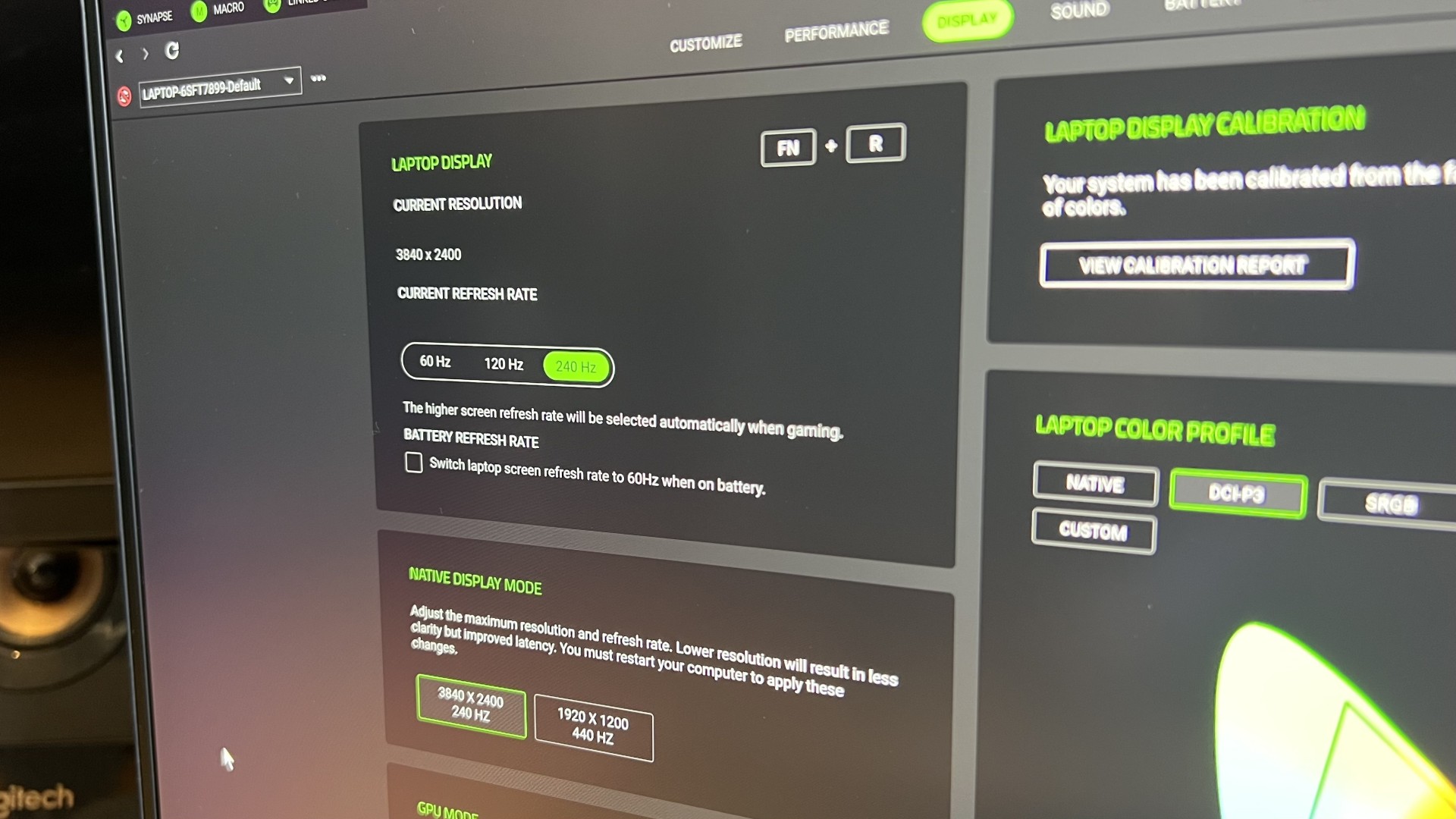
(Image credit: Future) It's a double edged sword as we'll see below, but it does give Razer a unique leg up against the competition. This is a unique party trick, allowing for both immersive solo ventures at full UHD+ resolution or faster competitive endeavours that prioritize sky-high framerates over visual detailing.
I did, however, encounter a few times when my refresh rate seemed to become locked to 60Hz in full 4K. A quick jump into Nvidia Control Panel could generally rectify the issue, though not always, and Synapse software didn't quite seem to catch up with the change once I'd made it. I've reached out to Razer regarding the issue, and will update here once I've heard back.
Big doesn't have to mean chunky
I feel like I say it every time a Razer laptop is on my desk but yes, this looks like a Razer Blade. Sneki hasn't deviated from the all-black CNC-milled aluminum chassis in years and it's not about to now. Being an 18-incher, this thing is still a lot wider than the Razer Blade 16 or Razer Blade 14 perched on my desk, but it's far from the cumbersome giants I usually have to wrestle with. 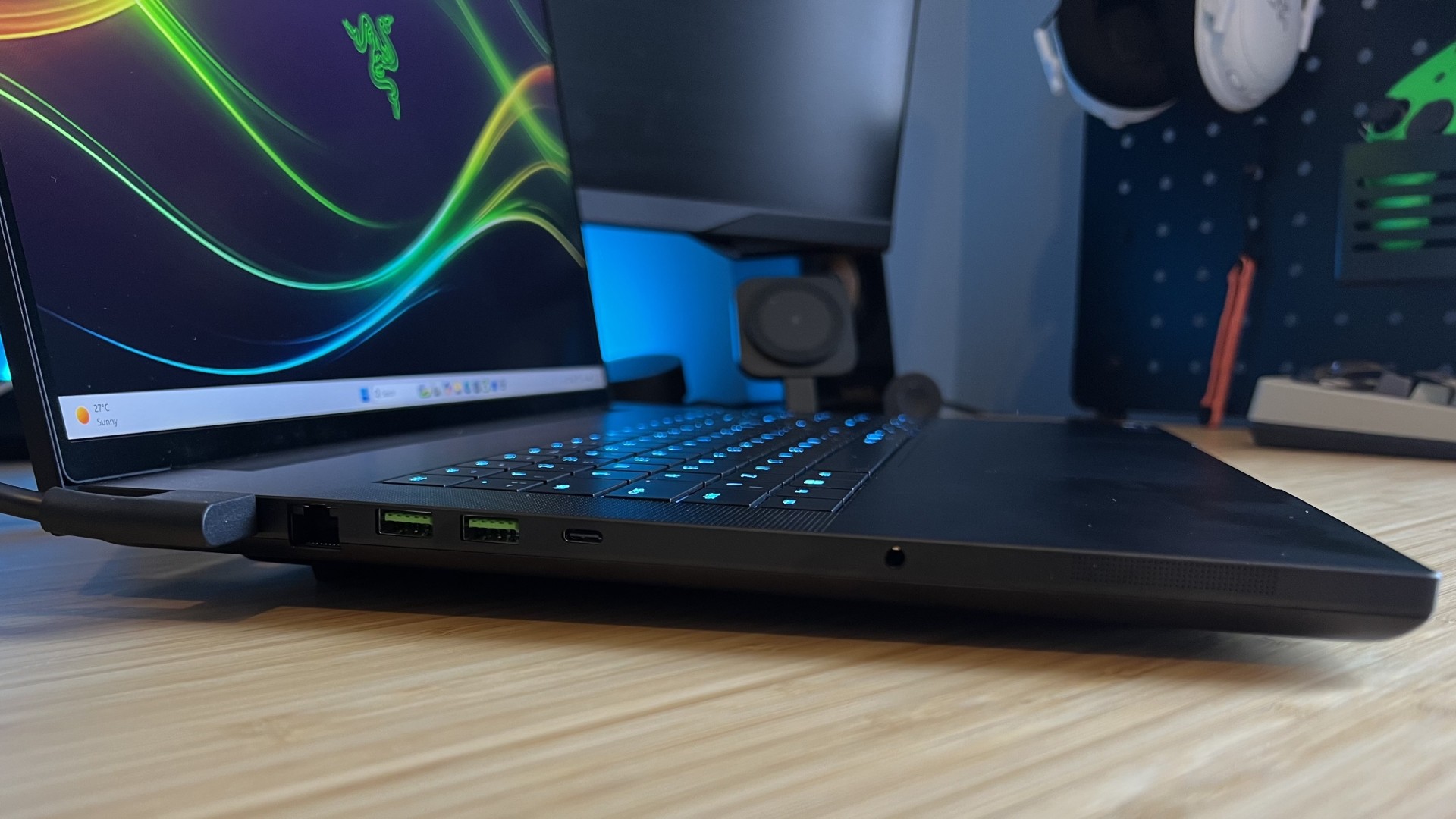
(Image credit: Future) Measuring in at 1.1 inches thick with the lid closed, it's thinner than the Asus ROG Strix Scar 18 and MSI Raider A18 (both 1.26-inches) while also maintaining a lighter weight. You're adding 3.1kg to your backpack, compared to Asus's 3.3kg waistline and MSI's 3.6kg heft.
That's still by no means at the lightest end of the market, an 18-inch gaming laptop isn't designed to be karted around, but it is slightly more portable than the chunkier beasts.
Impressive battery life
I can forgive gaming laptops for lacking battery life, and 18-inch powerhouses get an additional pass, but the Razer Blade 18 manages to perform surprisingly well without its charger close by. That's a relief, considering the chunky power brick shipped in the box. I generally aim for a comfortable two-odd hours of gaming time on a larger 18-inch machine, with power and graphical settings whittled down to a playable state. The Blade 18 held up for just over three hours of Doom: The Dark Ages during testing, with about six hours of work (Chrome tabs, Spotify, and the odd image edit) achievable in a more balanced productivity setting.
For reference, the MSI Raider lasted for just over an hour when gaming and about three hours in productivity with full Eco Silent Mode and 50% screen brightness.
That's certainly a win for the efficiency-minded Intel Core Ultra 9 290HX Plus.
Satisfying controls
With a full-sized keyboard and an expansive trackpad, the Blade 18 is outfitted with everything you need for both games and productivity - but it also feels fantastic. 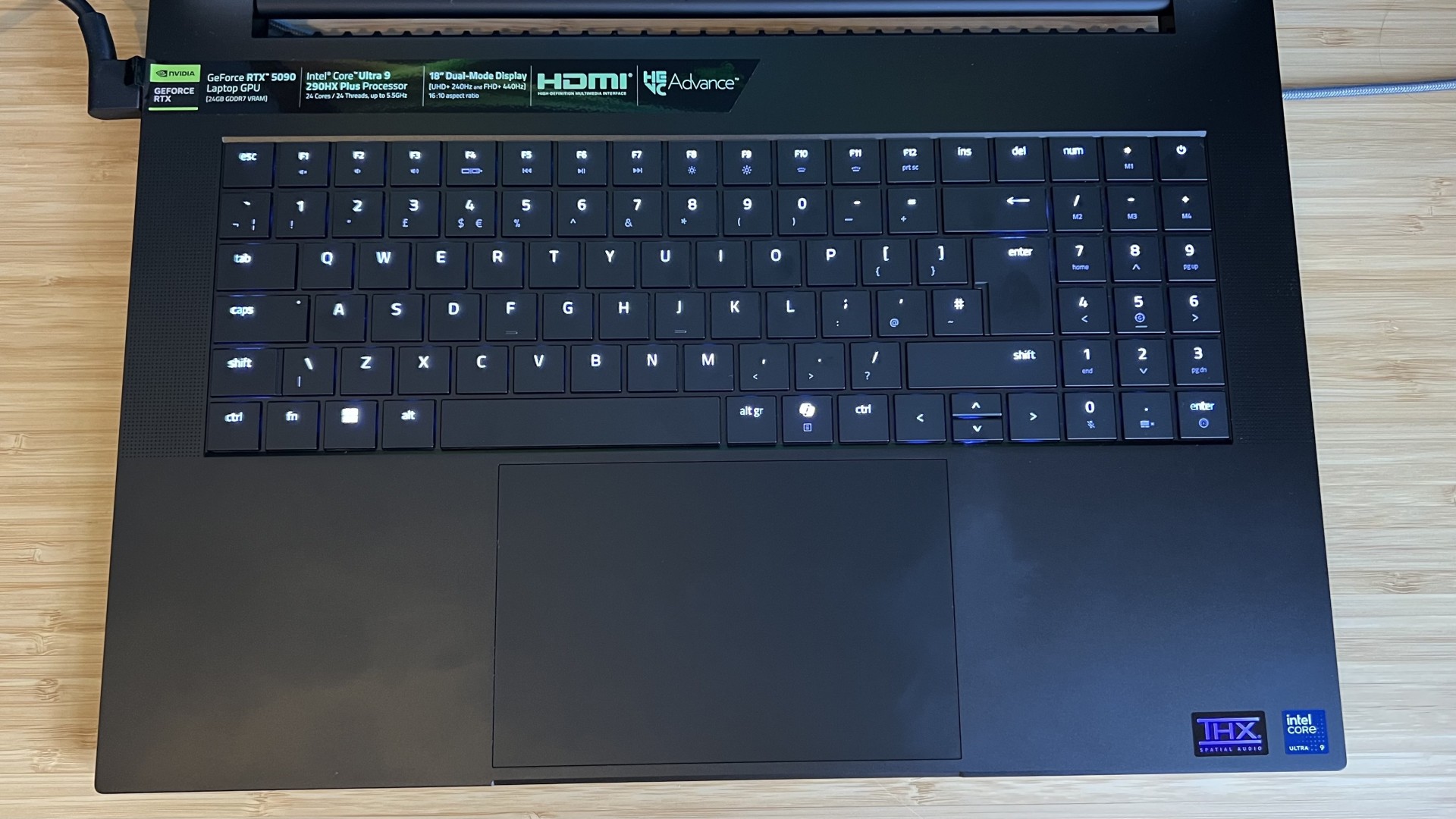
(Image credit: Future) 1.5mm key travel and a 63g actuation force make for a nicely snappy set of switches with a firm base and energetic bounce. Of course, I'd expect a $5,000+ gaming laptop to offer a nice typing experience but it can't be taken for granted. The Asus ROG Strix Scar 18, for example, has a little more flex than I'd expect from this kind of price and the MSI Raider (despite its SteelSeries mechanical keys) is particularly wobbly.
While both its competitors do away with Razer's half-sized up/down arrow keys, then, it's by far the best option for those typing over longer periods.
What to consider about the Razer Blade 18
Price doesn't keep up with incremental update
The only major difference between the early 2025 Razer Blade 18 and this one is that processor. The Intel Core Ultra 9 290HX Plus has stepped in and taken the reins from the Intel Core Ultra 9 275HX CPU. That's a processor that averages out at 2,799 single-core and 17,783 multi-core on Geekbench 6. We're looking at a 9% increase in the former test, and a 14.6% increase in the second. The problem is that overall 10% price increase. While it sits inline with CPU performance upgrades (though slightly higher than single-core performance uplift), the 275HX is unlikely to meaningfully downgrade your experience. These are very similar chips - you'll feel that RTX 5090 start to sag long before the CPU starts presenting problems.
Screen investment only makes sense for niche players
Back to that dual UHD+/FHD+ display, then. One can only assume it's adding to the final price tag, and potentially in no small way. Considering we're already paying a premium compared to last year's model, I'd argue the ability to swap down to high-speed 1200p isn't in the best interests of most players. It's only going to be the ultra-competitive among us who are unhappy with the kinds of framerates that RTX 5090 can spit out at full throttle, and only those players who will even be able to take advantage of the sky-high 440Hz refresh rate. 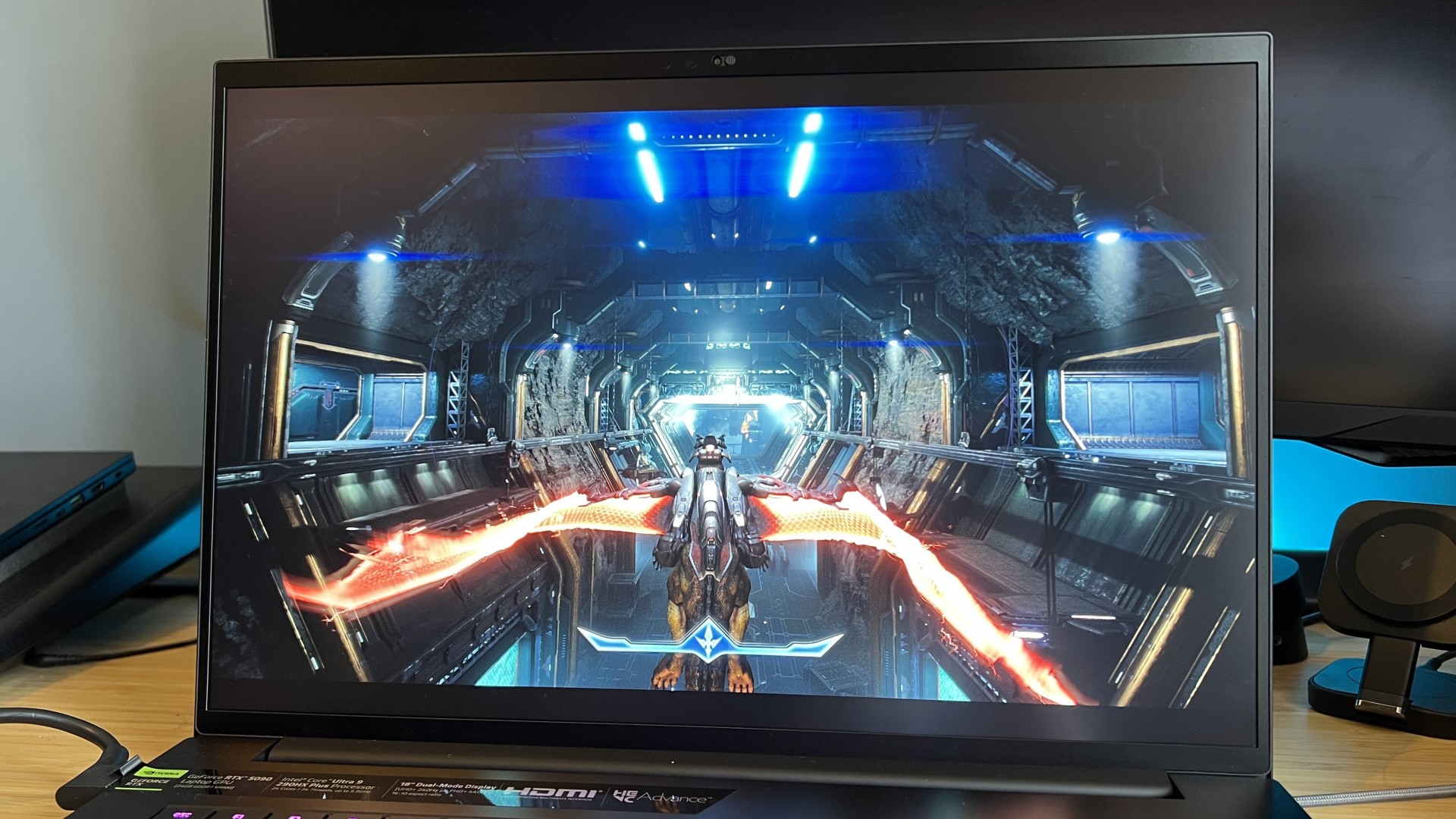
(Image credit: Future) Considering Mini LED options are rife across the rest of the high-end 18-inch market, offering a boosted punch to colors and vibrancy compared to the Blade 18, I'd rather invest the cash in that panel type or keep it in my pocket.
Runs a little warmer than chunkier models
The Blade 18's slimline design comes with its own drawbacks as well. The machine becomes noticeably hot to the touch after around half an hour of intensive gaming. Poring over a sweltering keyboard in a heatwave isn't exactly my idea of comfort, even if thermals never climbed to a throttling level. Using the Blade 18's keyboard becomes a slightly sticky endeavour after a short while, by virtue of that more condensed unibody design. Chunkier machines may be more difficult to transport but, as a desktop replacement, I'd take the extra vents and grills instead.
Should you buy the Razer Blade 18?
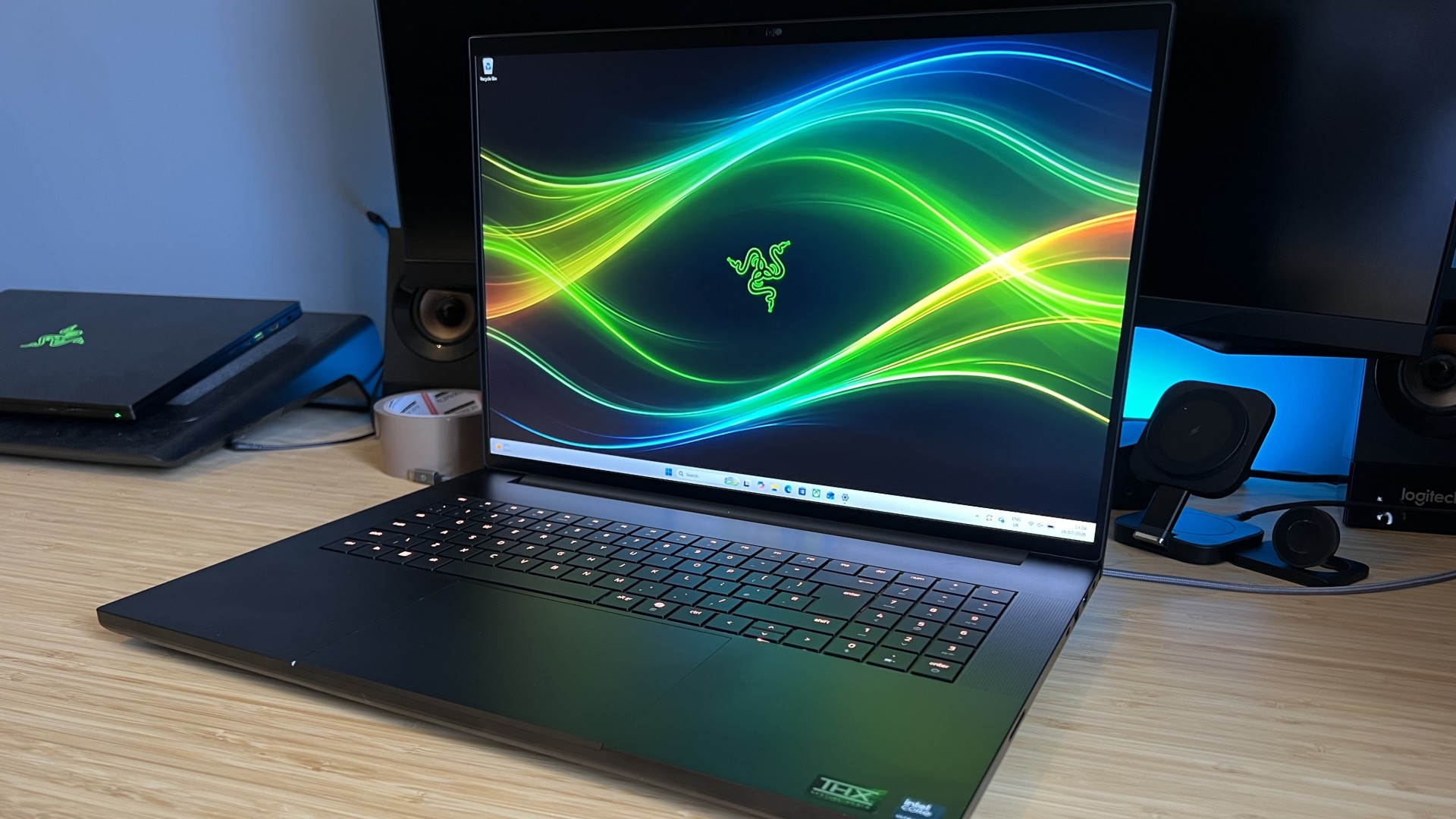
(Image credit: Future) See, now this is why I love and hate Razer laptops. I can spend a thousand words talking about how great it looks, feels, and plays, and then ultimately have to say it's difficult to recommend.
Up there with the best Alienware laptops, these are some of the most expensive models on the market and the 2026 Blade 18 not only upcharges by $500 compared to last year's, its dual-mode display is adding potentially unnecessary costing into that final price. It's vastly more expensive than the Asus ROG Strix Scar 18 and a good chunk of change costlier than larger 16-inch models.
And yet, in some lights, it's worth it.
The older model I mean, definitely buy the Intel Core Ultra 9 275HX variant while it's still around.
This thing is packing just as much power as the MSI Raider A18 HX A9W, for slightly less cash than MSI's $5,609.99 MSRP. For your money you're getting the same performance, a faster UHD+ refresh rate, a far more premium build quality, an actually workable battery life, and a more compact form factor. That's pretty compelling.
It's not a decision without sacrifice; the Raider wins for its overall screen quality thanks to that Mini LED panel and it also adds an additional Thunderbolt 5 rather than reserving one USB-C for Thunderbolt 4. The final ace in MSI's deck is its SSD. It's one of the few gaming laptops packing a full Gen 5 drive.
Ultimately, if you're shopping in these upper echelons with your heart set on a machine that looks and feels like its price tag, Razer's going to be your best bet. If you just want 60fps QHD power on a larger, immersive 18-inch display, Asus still wins for overall value for money.
How I tested the Razer Blade 18
The Razer Blade 18 became my central control panel for a period of two weeks, with some testing overlapping the Acer Nitro 18 AI. In that time I used the machine for work, play, and everything in between, running Doom: The Dark Ages, High on Life 2, and Planet Coaster 2 for day to day sessions. I used 3D Mark's Time Spy, Steel Nomad, and Fire Strike benchmarks with the Blade set to a Turbo performance setting while testing in-game across Shadow of the Tomb Raider, Total War: Three Kingdoms, Horizon Zero Dawn: Remastered, and Cyberpunk 2077 at 1080p, 1600p, and UHD+ in each game's high and highest settings. Each test was completed three times, with the final result above representing an average of each run.
For more information on how we test gaming laptops, check out the full GamesRadar+ Hardware Policy.
I've been testing plenty more of the best Razer laptops, as well as all the best Asus gaming laptops on the market. For something a little more reserved, though, check out the best gaming handhelds available.
[/url]
What's Your Reaction?








XINKER - Business and Income Tips
Explore XINKER, the ultimate platform for mastering business strategies, discovering passive income opportunities, and learning success principles. Join a community of thinkers dedicated to achieving financial freedom and entrepreneurial excellence.



![[Business Talk] Chagee: Opening 3,500 stores in 6 years](https://xinker.org/uploads/images/202410/image_140x98_671afce94bf91.webp)