
![[PRO Tips] Gold’s Bullish Revival: Seasonal Trends and Key Levels to Watch](https://xinker.org/uploads/images/202412/image_430x256_67724cc6ad0cd.webp)
![[PRO Tips] Gold Market Under Short-Term Pressure, Safe-Haven Demand and Central Bank Buying Support Long-Term Upside Potential](https://xinker.org/uploads/images/202412/image_430x256_676ffb4685287.webp)
![[PRO Tips] Analysis of 9 key points of differentiation strategy! Master differentiation to create a brand advantage that is unique in the world!](https://firebasestorage.googleapis.com/v0/b/xinker-tips.appspot.com/o/article_thumbnails%2Fscaled_differentiation%20strategy.png.png?alt=media&token=a1bfc3d2-e85a-4db7-8a6d-01c7274f8940)
![[PRO Tips] Will REITs regain growth momentum in 2024? 3 REITs ETFs you must know if you want to invest in real estate.](https://firebasestorage.googleapis.com/v0/b/xinker-tips.appspot.com/o/article_thumbnails%2Fscaled_REITs1.png.png?alt=media&token=8af4eb93-33ff-466f-8039-b6555fad52b4)
![[PRO Tips] Complete tutorial on how to make money in Adobe Stock!](https://firebasestorage.googleapis.com/v0/b/xinker-tips.appspot.com/o/article_thumbnails%2Fscaled_tut-adobe1.png.png?alt=media&token=0b2c8cf2-22bd-4142-883e-140ed1cbaf02)
![[Passive Income] Unlock the secret of passive income: 3 steps to apply for Google AdSense](https://xinker.org/uploads/images/202410/image_430x256_6717a4fb3052b.webp)
![[Passive Income] Earn over $200 a day with AI-generated articles!](https://firebasestorage.googleapis.com/v0/b/xinker-tips.appspot.com/o/article_thumbnails%2Fscaled_article1.png.png?alt=media&token=f61bf35b-8553-4719-826d-7360024adc70)
![[Passive Income] Earn over 20 USD per download with AI-generated images!](https://firebasestorage.googleapis.com/v0/b/xinker-tips.appspot.com/o/article_thumbnails%2Fscaled_adobe2.png.png?alt=media&token=3e20e76a-a907-45af-80aa-bf9b3600301f)
![[Passive Income] Earn 10 USD per new download by sharing CapCut!](https://firebasestorage.googleapis.com/v0/b/xinker-tips.appspot.com/o/article_thumbnails%2Fscaled_capcut2.png.png?alt=media&token=a04dec40-1fac-4857-86f2-19a8be02d38e)
![[Passive Income] Use your WiFi to create passive income in 5 minutes, and you can earn 4-6 U per day!](https://firebasestorage.googleapis.com/v0/b/xinker-tips.appspot.com/o/article_thumbnails%2Fscaled_Grassio.webp.png?alt=media&token=7659a95e-0e47-4f27-a17d-c942ac3cf7f4)


![[Business Talk] The Unique Theme of XINKER's Song: Beef Wellington and Business Mastery](https://xinker.org/uploads/images/202410/image_430x256_671afc155f47f.webp)
![[Business Talk] Chagee: Opening 3,500 stores in 6 years](https://xinker.org/uploads/images/202410/image_430x256_671afce80c5f9.webp)

How to master game systems design | Dan Felder interview
Game Design Skills (Funsmiths, LLC) announced the upcoming cohort of its “Mastering Game Systems: Design Bootcamp,” an intensive 12-week program designed to teach aspiring and working game designers how to build holistic game systems that keep players engaged over the long term. Enrollment closes at midnight on Friday, June 19, with the cohort beginning the weekend of June 20, 2026. I interviewed Dan Felder, a veteran of game systems design, about the topic and also interviewed Game Design Skills creators Alex Brazie and David Zheng. Systems design—the discipline behind progression, player retention, in-game economies, monetization, and social systems—is widely regarded as one of the scarcest and most in-demand skillsets in game development, in part because its problems can’t be solved through conventional playtesting alone. The bootcamp aims to give designers a structured framework for this work before costly mistakes reach shipped games. “System design is one of the rarest skills in game development. I don’t say that lightly,” said Dan Felder, the bootcamp’s lead instructor. “Most designers learn by shipping broken games and spending years piecing together what went wrong. My aim is to give you this knowledge before it costs you your game.” Felder has designed games at Blizzard, Riot Games, and Electronic Arts and has consulted on 26 titles, with credits including Hearthstone, Legends of Runeterra, World of Warcraft, League of Legends, and Ori & The Will of the Wisps. Program Highlights Over 24 live sessions across 12 weeks, participants learn 41 proven frameworks and tools for designing and balancing systems across progression, retention, economy, and social play—including feature maps, source-sink diagrams, and interlocking MMI goal structures. The curriculum is split between a craft portion and a career portion, the latter featuring real design-test and live-interview practice with professionals who have sat on hiring panels. No coding or game-engine experience is required. Participants complete a game systems analysis portfolio document intended to demonstrate to studios how a candidate thinks, alongside hands-on design workshops, peer playtesting, and three job-application design skill tests. Many course demonstrations draw on triple-A and double-A games the lead instructor has personally built and shipped. The program also features six guest instructors and one adjunct instructor drawn from studios including Scopely, Bungie, Riot Games, Supergiant Games, Niantic, Ubisoft, and PlaySide Studios, with collective credits spanning Marvel Strike Force, Star Wars: Galaxy of Heroes, Hades 2, Valorant, Pokémon GO, XDefiant, and more. Enrollment and Access Seats are limited to preserve individual attention for each participant. The program includes members-only Discord channels, full session recordings in a learning portal, and a certificate upon completion. Game Design Skills offers a 100% refund up to one week before the first session, along with scholarships for those facing financial hardship and localized pricing for regions with currency disparities. Prospective participants can assess their fit for the bootcamp at: https://gamedesignskills.com/courses/mastering-game-systems-design-bootcamp/ Here’s an edited transcript of our interview. Game Design Skills is teaching classes on game making. Source: Game Design Skills GamesBeat: Can you tell me more about the course? Dan Felder: The purpose of the course, it’s called mastering system design. The real goal is that–I’ve noticed that a lot of game designers have a lot of great material and resources about gameplay systems, in terms of the mechanics, core design, moment to moment game feel. There’s tons of theory about it. It gets a lot of attention. A lot of people are really good, especially within their genre, at mastering how these mechanics work. A lot of strong senior lead designers. Systems, not really as much. When I joined Riot Games, I joined as a senior gameplay designer to work on Legends of Runeterra. Within about two weeks, I was working as a system designer instead. I had given feedback on what would later become the Path of Champions PvE mode, on the progression systems for it, when I was doing a playtest. I gave a lot of feedback on what I thought it was doing well, what I thought needed to change. The lead designer reached out to me and said, “We’ve been looking for someone who can do a senior designer role on progression for many months now.” I think it was eight months. I don’t want to swear to that. It was a very long time. “We can’t find anyone. You’re just kinda here. Do you want to switch teams? We really need someone to do this.” He could do it. He could totally do it. But he’s a lead designer. He’s very busy. He needed someone, and they were having trouble filling that role. That drove home something I’d seen at a lot of studios, which is that system design is really hard to solve with the standard trial and error method a lot o

Game Design Skills (Funsmiths, LLC) announced the upcoming cohort of its “Mastering Game Systems: Design Bootcamp,” an intensive 12-week program designed to teach aspiring and working game designers how to build holistic game systems that keep players engaged over the long term.
Enrollment closes at midnight on Friday, June 19, with the cohort beginning the weekend of June 20, 2026. I interviewed Dan Felder, a veteran of game systems design, about the topic and also interviewed Game Design Skills creators Alex Brazie and David Zheng.
Systems design—the discipline behind progression, player retention, in-game economies, monetization, and social systems—is widely regarded as one of the scarcest and most in-demand skillsets in game development, in part because its problems can’t be solved through conventional playtesting alone. The bootcamp aims to give designers a structured framework for this work before costly mistakes reach shipped games.
“System design is one of the rarest skills in game development. I don’t say that lightly,” said Dan Felder, the bootcamp’s lead instructor. “Most designers learn by shipping broken games and spending years piecing together what went wrong. My aim is to give you this knowledge before it costs you your game.”
Felder has designed games at Blizzard, Riot Games, and Electronic Arts and has consulted on 26 titles, with credits including Hearthstone, Legends of Runeterra, World of Warcraft, League of Legends, and Ori & The Will of the Wisps.
Program Highlights
Over 24 live sessions across 12 weeks, participants learn 41 proven frameworks and tools for designing and balancing systems across progression, retention, economy, and social play—including feature maps, source-sink diagrams, and interlocking MMI goal structures.
The curriculum is split between a craft portion and a career portion, the latter featuring real design-test and live-interview practice with professionals who have sat on hiring panels. No coding or game-engine experience is required.
Participants complete a game systems analysis portfolio document intended to demonstrate to studios how a candidate thinks, alongside hands-on design workshops, peer playtesting, and three job-application design skill tests. Many course demonstrations draw on triple-A and double-A games the lead instructor has personally built and shipped.
The program also features six guest instructors and one adjunct instructor drawn from studios including Scopely, Bungie, Riot Games, Supergiant Games, Niantic, Ubisoft, and PlaySide Studios, with collective credits spanning Marvel Strike Force, Star Wars: Galaxy of Heroes, Hades 2, Valorant, Pokémon GO, XDefiant, and more.
Enrollment and Access
Seats are limited to preserve individual attention for each participant. The program includes members-only Discord channels, full session recordings in a learning portal, and a certificate upon completion. Game Design Skills offers a 100% refund up to one week before the first session, along with scholarships for those facing financial hardship and localized pricing for regions with currency disparities.
Prospective participants can assess their fit for the bootcamp at: https://gamedesignskills.com/courses/mastering-game-systems-design-bootcamp/
Here’s an edited transcript of our interview.
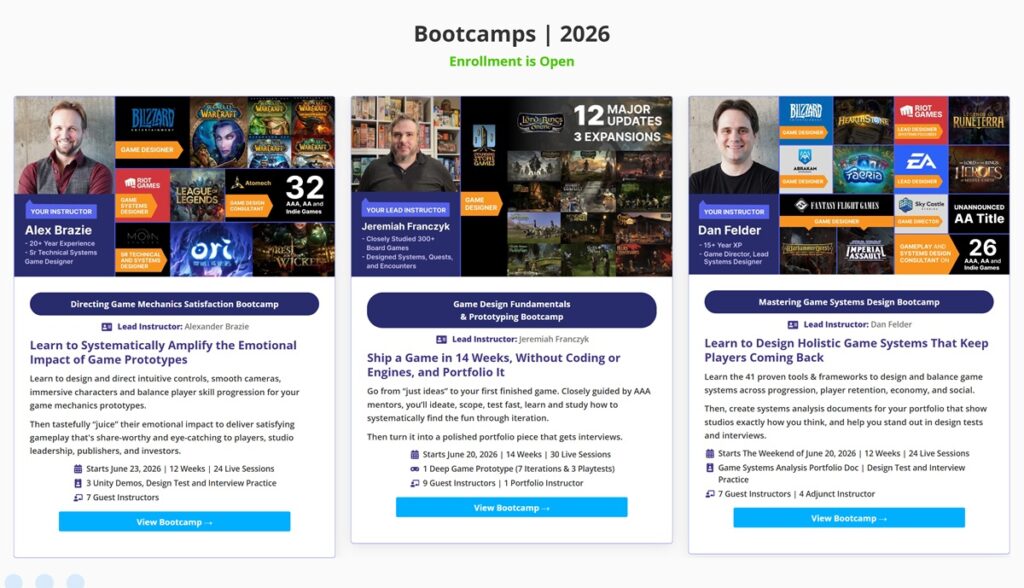 Game Design Skills is teaching classes on game making. Source: Game Design Skills GamesBeat: Can you tell me more about the course?
Dan Felder: The purpose of the course, it’s called mastering system design. The real goal is that–I’ve noticed that a lot of game designers have a lot of great material and resources about gameplay systems, in terms of the mechanics, core design, moment to moment game feel. There’s tons of theory about it. It gets a lot of attention. A lot of people are really good, especially within their genre, at mastering how these mechanics work. A lot of strong senior lead designers.
Systems, not really as much. When I joined Riot Games, I joined as a senior gameplay designer to work on Legends of Runeterra. Within about two weeks, I was working as a system designer instead. I had given feedback on what would later become the Path of Champions PvE mode, on the progression systems for it, when I was doing a playtest. I gave a lot of feedback on what I thought it was doing well, what I thought needed to change. The lead designer reached out to me and said, “We’ve been looking for someone who can do a senior designer role on progression for many months now.” I think it was eight months. I don’t want to swear to that. It was a very long time. “We can’t find anyone. You’re just kinda here. Do you want to switch teams? We really need someone to do this.” He could do it. He could totally do it. But he’s a lead designer. He’s very busy. He needed someone, and they were having trouble filling that role.
That drove home something I’d seen at a lot of studios, which is that system design is really hard to solve with the standard trial and error method a lot of game designers use. They have strong intuition. They can feel good gameplay at a glance. With a 30-second fun loop, or a few minutes, or 10 for a match or a cycle within it, you can try, iterate, tweak, try again a huge amount of times until you find the fun, follow the fun, and so on.
With systems, often the problems don’t emerge for 10 hours. How can you trial and error your way through 10 hours of content over and over again? You can’t. You need a deeper understanding of cognitive science, motivational theory, system design from other industries. Crowd control management. Motivation. Monetization. Just economic incentives in general. And also psychological elements. We draw a lot of this course from story structure, theater, all of these different industries. That’s one of the reasons I’m in games in the first place. I came from a background in business behavioral economics and theater. I wanted to spin that all together to make games. So I come from a very analytical, theoretical approach.
GamesBeat: How do you define system design? Or what’s included in it.
Felder: I often define systems as collections of game mechanics that create a holistic feature. In Hollow Knight, jumping is a mechanic. Double jumping is a mechanic. Pogoing off of enemies, dashing, these are all movement mechanics. Together they make a movement system. Together with attacks you get a combat system. You have movement, then you have damage and health and so on. Systems are the rules, and mechanics overall work together to create a holistic experience.
The course focuses on games at the architectural level. If you think of gameplay as being a brilliant interior decorator, systems are building the actual building – the wiring, the plumbing, the crowd flow, the structure of how it all fits together. It’s also why you can’t trial and error it. You don’t want to build a building with a cracked foundation and have to rebuild the whole thing.
 You can take bootcamps for game design skills. Source: Game Design Skills GamesBeat: More like an architect than a general contractor.
Felder: Yes. We actually have a phrase that I return to a lot. The point of this course is to help designers see games the way architects see buildings. You look at a blueprint, imagine how it’s going to work in your head using your theory structures, your models, and the various frameworks and tools we teach in the course to surface problems that are hard to see at a glance. And so in a design document you can set that foundation up to be really strong. Also, you can look at a problem from 1,000 feet and see what’s going to happen in 50 hours without having to wait for 50 hours of actual playtime to feel it.
David Zheng: Before we continue I want to clarify a couple of nuances. One is the semantics of system design. system design can mean anything if you use it without referring to game or gameplay system design. When you’re doing scalable infrastructure for an enterprise SaaS app, that’s also system design. Which is very different. It’s one of those terminologies–a lot of people don’t understand what a gameplay system is. That’s a very clear nuance you have to be careful with. To an audience that’s not aware of that, it might be confusing.
Felder: We draw a lot from non-game case studies in this course. This is really a course about, how do you shape human behavior in a positive way? As somebody coming from a business background originally – that’s what I went to college for – I was learning all these behavioral psychology marketing techniques. Rather than just trying to apply that, I want to say, “How do we create a great experience?”
In the course, a lot of our case studies are not just, “Here’s how this smart game did a thing.” We open the course talking about the 100,000 Lives campaign in health care. By trying to mitigate unnecessary medical errors, hundreds of thousands of lives have been saved. By slightly changing processes of how certain things happen. By switching defaults in how check-ins happen, where things happen.
One of the first exercises we ask our students to do is to imagine they’re in charge of ambulance dispatch for their city. How and where would they deploy their ambulances to save lives? The answer ends up being – this is from a real case study that dramatically reduced ambulance response times – to say, “Where are the calls coming from?” You have to think about that behavior interaction. Often they come from assisted living facilities for the elderly. When are they going to happen? The answer is, when a problem gets noticed. That’s when you think about the interaction of the system. When do things get noticed? At mealtimes and shift changes, when a worker checks in on someone or notices their absence. If you’re smart, which these people were, you can forward deploy your ambulances near assisted living facilities specifically at mealtimes and shift changes. That’s when the calls happen. It’s not when the incident happens. It’s when that system of interaction forces information to change over.
This is the type of thing you can apply directly to game design in all these different ways. Thinking about modeling systems, how players interact, and how small rule changes can cause huge changes.
GamesBeat: In that broader definition, you’re designing the environment in which people will behave.
Felder: Yes. It’s the rules and interactions. If you just talk about an environment, people sometimes confuse that with levels. Now, we discuss a lot of different parts of level design, gameplay design, and content in the course, because it’s all holistic. It does come together. But primarily the systems are the rules and interactions, and how the mechanics ultimately come together.
In League of Legends, last hitting an enemy when it dies is a mechanic to get extra gold. But that’s ultimately a system design, because you’re changing the incentives. We talk about comeback mechanics in a similar way.
Alex Brazie: As you said, game design is about shaping human behavior. Where gameplay is moment to moment, systemic goes over weeks, months, perhaps even years. When games have such a massive impact on the health and welfare and happiness of human beings, shaping them in a way that’s more intentional and aware is going to lead to not only better products, but also better human experiences. Dan is very familiar with that, only the dark pattern. Game design is also how to elevate those into better, healthier, more sustainable life cycles. Taking on that responsibility is effectively what system designers do, and often behind the scenes.
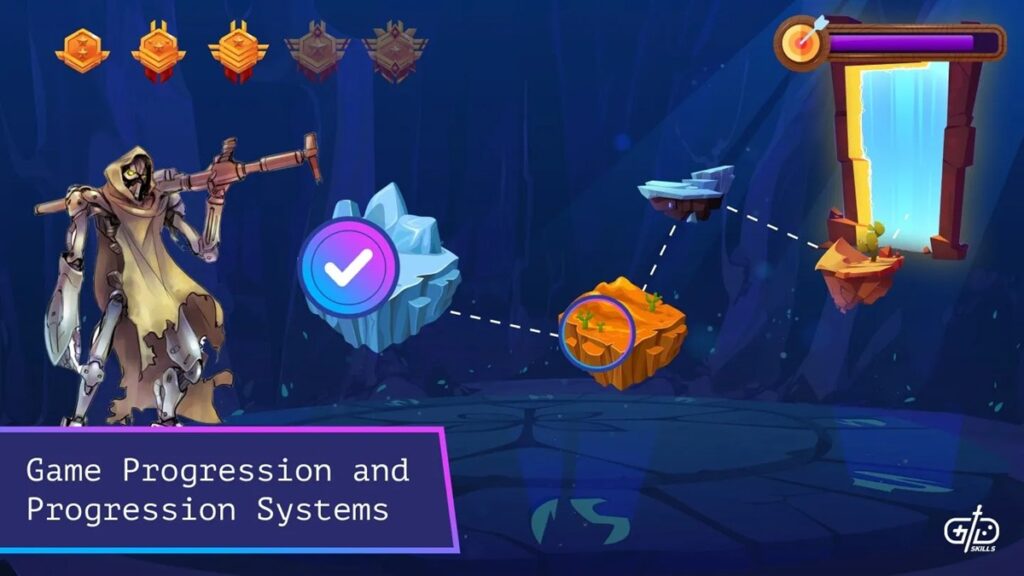 Game progression bootcamp. Source: Game Design Skills Felder: A lot of the discourse around painful monetization and other unethical stuff is often an issue of poor execution. You can take the parts that are fun and make them player positive rather than player negative. We have a lot of examples of that in the course.
GamesBeat: You have to educate people enough about dark patterns to tell them what to avoid.
Felder: It’s like defense against the dark arts, right?
Zheng: A big part of that, if you look at some of the tools in the curriculum, it’ll be like, how do you monetize, how do you do microtransactions ethically? A lot of the time these techniques and tactics are used unethically, mainly in mobile. Dan comes from more of a core gameplay background.
GamesBeat: It sounds like you align well with the folks who are trying to come up with a code of ethics for the game industry.
Felder: I love the work they’re doing with some of that. I disagree on some of the specifics, but that’s just tactical. I believe that good monetization is better not just on an ethical level, but a practical level. Whenever I start monetization work, I always focus on aligning the incentives of the players and the devs. The issue is that you want the players to be–a lot of these studios, especially indie studios, focus on trying to avoid annoying players and trying to figure out a way to monetize something that most players don’t care about.
When you phrase it that way, it’s probably not a great strategy for their sustainability. It also means that half the team gets dedicated to building stuff to fund the rest of the team that most players never experience. The huge cosmetic-driven teams make stuff that players will never own. That’s kind of sad. It works. It’s great that great games get built that way. But fundamentally I think it’s more healthy overall for players–the thing that players want more of should be sustainable and profitable to make. Trying to think of a healthy, positive way to build that usually makes players much happier.
For example, Warframe is a beloved free-to-play experience overall despite doing all these things that the YouTube videos would normally say that gamers hate. It gives players a good experience, while also being able to monetize the creation of awesome new content, awesome new Warframes, awesome new elements from those angles. You can get them for free in a fair way, but you don’t need to. We could go super deep into that.
There are two sessions a week, and on day 21, we’ll focus on monetization. One of the reasons it’s so late is because, as we mentioned, you have to build up a lot of information about how motivation works, how UI works, how core processes and systems work, in order to explain the things to avoid, as well as the things to do. A lot of the things that are considered dark patterns in certain contexts are very contextual. One of the good examples is how often things that players think are very exploitative are actually just developers not understanding the best way to present it in a way that’s clear.
One story I mention is from when I was first working on an economy in my first job, on Faeria. I wanted to add some excitement to the reward you got at the end of the match. If you got to the end of the match, by default you got 30 gold at the time. I wanted to say, “Hey, wouldn’t it be fun if sometimes you got a lot of gold?” Just to add a bit of variety and excitement to your ladder games. We said, “Sometimes, what if you got a few hundred gold, 300 gold?” We’ll have some variety at the end of the match. It’s always positive. It’s just pure upside. We changed the averages to be about an average of 35 gold. It was a buff. But it turns out that when you have a lot of 200 and 300 gold payouts possible, to balance that out you need a lot more 20 or 15 gold payouts. Players, the majority of the time in the new system, were getting less than 30 gold. They thought this was a huge rip-off, a scam, and we had nerfed the gold. We had actually buffed the gold, and done it for good reasons, but it made them really sad.
At first the response was, “We need to revert the system.” But I thought about it more. What if, instead, we just never give less than 30 gold, but very rarely we give more? We still give an average increase, and it feels so much better. Now players are happy. They always get what they expected, and they occasionally get an upside. They were yelling about how this was incredibly evil. Whenever players don’t understand why something is done, they assume it’s done for evil, in a free-to-play game. There are lots of systems we can dig into around that. We talk a lot about how to present things in ways that aren’t just good for the game, but that make players happy and appreciative.
GamesBeat: That gets to an interesting point. You can design a game and have all these intentions for what you’re doing, but games are special because they’re interactive. The player’s impression of the design can be very different. That changes how a game is experienced.
Felder: Absolutely. We talk a lot about alignment. How do you align player incentives with the actual fun of the game? How do you use different techniques to get there? One thing we talk about early on is how some famous games were almost cancelled. There’s a story about how Grand Theft Auto was almost cancelled when it was a cops and robbers game. It was all about playing as the cops. It was called Race and Chase at the time, I think. You lost points if you caused mayhem, because cops shouldn’t do that. It was very stressful. It was like a traffic simulator, essentially. Don’t go up on the sidewalk or you’re going to hit the pedestrians.
By switching it, inverting it so you got points for infamy, for causing crime, suddenly all your mistakes were happy accidents. It made the game so much more fun when they flipped the theme. And sure, they flipped the theme to justify the decision, but that’s fundamentally a system designer saving the game at a basic level. It changes the incentives. All you do is make the points go in the other direction and all of a sudden the game is extremely fun instead of extremely stressful.
GamesBeat: Along that line, what is bad system design? That’s maybe why you need to teach this course.
Felder: So many games die because of bad system design. It’s endemic in the industry. So many games will have thousands of hours of play that get messed up because some system designer is creating the wrong incentives and making you sad every moment you should be happy. You can take a game like Old School RuneScape, which has very weak core gameplay by most people’s standards. It’s very laggy stuttery. But because the system design is so strong, it’s one of the most popular MMOs. That’s not the only reason, but it’s a major reason. They’re just so good at building satisfying progressive goals. They’re good at building things for different activities. You want to play second monitor right now? You want to have an intense combat experience right now? They build for that.
Good system design is about aligning player incentives with the goal. That’s how you get whole genres. Bad system design is when the players are being incentivized to play in a way that’s just fundamentally not positive for them or for the developer. For example, anything that forces players to try to no-life and grind as fast as possible is really bad. If you have a mode where the incentive to go up the leaderboard is how early you clear it, that can be very destructive to the average player’s experience. For a top pro player guild that’s super hype, but the average player doesn’t want to have an incentive to wake up at midnight the moment the server update goes live, stay up to five in the morning, and try to grind out everything they can.
When I worked on Legends of Runeterra, we had a monthly challenge. It was really popular with the hardcore players. It was supposed to mostly just have a point-based leaderboard system. For however many challenges you beat, you got extra points. But to differentiate the players who could go perfect, never lose a single match, and do all 70 challenges in a row, the engineers created a tiebreaker system. If you did it earlier month, you were higher on the leaderboard. Because it went live at the start of the month, 12:01 AM on the west coast, a lot of people who were really competitive felt like they had to stay up all night to grind the whole month of content out as quickly as possible to smash those records.
I felt like that was a pretty negative experience for them. It was fun to do once as a big midnight release thing. But those incentives pushed a level of behavior that’s really unsustainable and player negative. It made them lose sleep and so on. That was a mistake. I probably should have changed that while I was there. It’s a good example of that type of frustration. I could go on endlessly about different major games, from MMOs to looters and so on. Diablo has run into this issue. Diablo III’s release. Famously, the Reaper of Souls release changed how the incentives played out. A lot of the hatred for Diablo III I think is just from the original launch systems, which Blizzard radically retooled for Reaper of Souls and made it so much more fun in all these different ways. I could go on forever. We have multiple hours of lectures on this exact topic.
GamesBeat: As to the opposite, then, where do you find your examples of good system design?
Felder: I already mentioned Old School RuneScape. That has extraordinary system design in many cases. One thing that makes it so good is it uses something called interlocking multifinality. You have a single goal that is motivating you very far in the distance. In order to do that goal you have to do another goal. But in the process of accomplishing that goal, you also progress toward a secondary goal, which is also helpful. In the process of progressing to that goal you progress to a third goal.
You might need to get 10 different skills up to between 50 and 70 in order to do this cool epic quest that unlocks a major item. All the activities that progress those skills also usually have side benefits. You’re maybe hunting enemies to get your slayer up. You’re also increasing your XP. You’re also getting loot from enemies that you use to progress your prayer. Now your prayer is at this level, so you can do this other quest that unlocks this other benefit. This type of long-term interlocking goal systems really powers Old School RuneScape, to the point where a game that has .6 seconds of lag per input, and such old-school graphics, very basic interactions–it’s not thriving on its gameplay at all for the vast majority of the time. It’s powered almost entirely by systems.
Look at the incremental genre, idle game genres. Games where you just click or don’t click. They’re entirely powered by satisfying, well-built progression systems to drive them forward. There’s also the classic WoW rested XP example. That’s a great example of good system design. Something that says, “We want to make sure you can take a break, so you don’t feel the urge to play linearly all the time.” By giving you bonus rewards for the first X amount of time you play every day, and then going back to normal afterward, you can relax. If you have less time to play every day, people who play more aren’t as far ahead. You even feel kind of smart for taking a break and only continuing to play if you feel like playing. You don’t feel the same linear pressure to keep playing.
They did the same thing originally, quite famously, by having it be a penalty after you played for a certain amount of time. That felt awful. Then they switched the level curves to need the same amount of experience ultimately, so it didn’t change the amount of time to max level or how the system worked at all, but they framed it as a bonus and then set it back to neutral. The system was good, but it needed a good presentation switch to be received well by players.
Often people will put a bad system in that disincentivizes good play. Or they will frame it incorrectly in a way that makes players resentful and try to avoid it. They become rebellious. Maybe you get pressure to pull the systems out. You can stop just short of a really positive experience. If you throw people into a battle royale map and you don’t have loot to pull them together, people will just camp and hide forever. The incentive is to let everyone else kill each other. Once you have the loot and the ring, you adjust the player behavior. Those systems are what make the genre a genre. They’re inevitabilities if you want the genre to work.
GamesBeat: I don’t know if this confuses different things, but when I hear people who are passionate about design, sometimes they’re talking about the notion of emergent design, like Warren Spector often talks about. Experiences that are not scripted, but that emerge from the systems of the game. Is that system design, or is that a different piece?
Felder: The only way you can get that, really, is with a deep understanding of game systems. How they interact, what’s possible, how to create those problems. You can create really good experiences with a handcrafted, bespoke approach. Those games are fantastic. But it’s often very time-consuming and very hard to scale. What’s great about systems, how we take this approach–often I’ll talk about how we make a human feel a thing. Here are all these handcrafted, very easy to understand level design examples, core design examples, encounter design, microscopic stuff you can look at briefly. But now, how do you build systems that do that for you, so that you can spend your time building cool stuff and not trying to build the basic infrastructure of fun in the first place?
If you build really good systems, rules, interaction potential, and you build the content with those systems in mind, so it doesn’t really matter how things break, you can kind of do whatever. It frees up designers, liberates them, so they can focus on making cool things and trust it will all work out. A good example of that from my own work is on Legends of Runeterra. There was a lot of desire originally–the natural pattern in Legends of Runeterra is to take two champions and mix them into the same deck. For the PvE mode that was very intuitive as well. We should let players mix champions together.
I really pushed back against that, because I knew that would mean–if we mixed those two champions together, players would be able to combine them in any number of crazy ways, and if any one of them had a problem, they would all potentially have a problem. That would force us to try to handcraft a lot more interactions, to try to restrict combos more. If we created a system around just being able to beat things or not, that would mean we’d have to make the game less cool.
Counterintuitively, what liberated the design was saying, “You can’t mix champions together. They’re all their own thing. If one of them is broken, only that champion is broken.” The progression system requires you to have lots of different good champions to solve your problems. You can’t solve them all with just one. That let us release some champions that were crazy overpowered and super fun. Players loved collecting them and using them to nuke stuff. Others were much weaker, but challenging and interesting. People liked using them for that challenge. The systems just said, “Players always need more stuff, and the stuff can’t break. Designers, make any cool thing you like.” It liberated them and let players enjoy lots more interesting, cool, broken interactions than they would have otherwise.
GamesBeat: Back to the kinds of things people are going to learn, what are some things that they might not learn otherwise?
Felder: Some of the things that are unique to this course–one is that we take a very strong cognitive science-based approach to a lot of this. I think that game design is applied cognitive science. Most of the stuff we build off the theory comes from cognitive science research and how it’s applied in other industries, how it’s applied in motivation theory, how it’s applied in theater and similar efforts across the course of history. We use lots of game examples, but we start with, why do humans think? Why do humans feel? What’s the evolutionary basis? And applying that to practical game design.
We take that approach and get a lot of really powerful content. One thing we deal with is–a lot of the stuff is some unique concepts in systems that I’ve built myself, based on useful tools for solving design problems. I take a lot of–the approach here is not just a 101 approach to system design. These are all tools, 41 different frameworks, that I use in my own work. That was one of the lenses for the course. Everything I teach has to be something I use myself regularly. Then I narrowed it down to the things I usually end up teaching when I’m at a new triple-A studio. Stuff that’s not already well-understood by at least some portion of the team.
I’m actually teaching very senior- and lead-level techniques. But because we have the benefit of a 12-week course, we can establish some strong foundations early. The course is all about the types of talks I would usually give at a triple-A studio, which are intended for junior designers as well as senior designers. We’re taking these high-level ideas that are highly practical, talking about how they solve problems in the day to day, and making them accessible to people who at least have a solid game design foundation at the associate level.
Then there’s a lot of very specific things. The way I build decision engines is a very specific framework in which questions about–how does a game automatically generate satisfying decisions on an equal basis? It’s a very specific formula I’ve used for a lot of my career. We talk about how it works, why it works. We apply it to all these different games. We have big lists of game balancing techniques as well. Some of these aren’t well-known. Some of them were popularized by one of my earlier articles. Some of them are well-known in the industry, but they’re worth digging into. Again, we talk about all the interactions, about how these tools work, how to use them, when not to use them. That’s another big thing. And what the structures can be.
We have a very analytical and structural approach with practical tools whenever possible. It’s not really about philosophy or general game design concepts. It’s very much about, what is the problem that I ran into one time in my career? What are the tools that make it easier to solve? What are the tools that seem to be not as well-known in the industry? Let’s make a course based on that.
GamesBeat: This is a timely subject in some ways. Alex pointed out some of the issues in the industry around layoffs and the rise of AI. What about the course do you think is relevant to these issues we’re facing?
Felder: One of the biggest things is that with the pressure of AI–people are being pressured to use AI in their day to day career. AI is extremely weak at system design, even more than it’s weak at some other things. Being able to understand all the contextual interactions of how a human is going to think about a situation, what the incentive is, how this little change over here can affect this other change over there. Something like saying, “Hey, we want to have a system where players can get an incentive to reset their characters,” for example. You get 50 gold every time you lose a battle and 100 gold every time you win. A system designer will instantly see the problem. If I get 50 gold every time I lose, I understand you want to make sure I don’t feel so bad about a loss, but now I have an incentive to concede at the start of every match.
That’s an easy thing to spot. But system design is so much more tangled with how different incentives can shape social interactions. It can be fully counterproductive and counterintuitive. It’s so contextual to an individual game. Often it is multi-genre in a way that most game design expertise is not. AI can’t draw on these same examples as easily. Because these are about reward incentives, structures, large-scale interactions, how progression systems feed into combat systems, inputs and outputs–you can often apply system design knowledge to almost any genre very easily. That’s one of the reasons why it’s hard to find great system designers. It’s hard to learn. There isn’t a lot of good formal training based on it. They’re in high demand, so they can go anywhere. That’s relevant for people who want to make themselves more robust and valuable in the industry, especially with all these layoffs.
One of the major reasons we’ve seen so many mistakes with these big live service games is just a deep lack of system design understanding. On some projects I’ve been on, people are looking at the data and saying, “We’re not getting traction. We need to kill this game. The data’s not there. It’s only going to get worse.” And I’ve been on projects–look, I value data. Data is very valuable. But it’s inherently backward-looking. I can see, as a system designer, no one is buying this thing yet, or people are leaving the game, because we don’t have a goal that makes that valuable, or makes it worth sticking around for. Once we add that goal, they still won’t buy anything, because they don’t have anything that actions on that goal yet. These things exist, but they don’t connect well enough to it.
On Legends of Runeterra, which is more recent, when we first launched Path of Champions it wasn’t successful right away. Partly because players didn’t have great ways to engage with it or support it by default. We had to add that. But also because the content was easy enough at launch that if you were a good player who cared about the game, progressing a character made it less fun. Your character would get so strong that with a two- or three-star champion, a 3.5-star adventure was trivial. In fact, you would actually say it’s bad to star a character, because it would make the game so easy it was boring at that point. That’s a really bad incentive.
You can’t just look at that and say, “People aren’t engaging with this incentive. People don’t care about the mode.” You have to see why they don’t care, how they don’t care, and how to tie these systems together with the incentives. As a system designer I was able to say, “We have to create reasons for power to matter. We have to create ways to action on the power. We have to create aspirations to have large numbers of champions, so we can be generous to free players, but still have a reason for paid players to want not just a lot of things, but potentially everything.” When you have all three of those things, it works. But until you have all three of those things, you should expect the data to not be there.
We were able to make that switch. I was able to show how these sources fit together with the motivations. People bought in. Other people saw it as well. We built all that. The mode improved massively. They publicly announced, when we finally released a bundle–once all those pieces were in place, the early install bundle I worked on was one of the most successful elements of LoR’s revenue in the year combined. Something like that. I forget the exact quote. It was very successful, in a mode that previously maybe no one would engage with.
GamesBeat: Going to an example of something I’m familiar with, I played a fair amount of Arc Raiders. I thought it was interesting that they had a rule they put in place about skill-based matchmaking, but also aggression-based matchmaking. They had a system of using proximity chat, voice chat, to tell other players, “Hey, I’m friendly.” Or trying to trick them into thinking you’re friendly. It added a sense of mystery to the game. You never knew what you were going to get. Emergent gameplay would come out of that, because the chat is in place to enable it.
Felder: It can’t be wholly comprehensive, but we have a full day deeply focused on how to design effective social systems and modes. That type of system design is very interesting, because the whole idea of, “let’s play with people who are in the game for the same thing we are,” is a great experience. But once you become aware of it–there’s a great phrase, that once people become aware of a measurement, it ceases to be an effective measurement.
We have this great deep dive into all the different elements of how you forge bonds in games. That’s really important in social systems. There is a certain type of social system that exists to help you play with friends you already have. That’s great. It’s not hard to do well. You can solve that problem pretty intuitively. What’s much more interesting to me is the question, or the goals, around features that help you make new friends, new relationships beyond the ones you already care about. We go through all this context of what makes us care about something. We care about individuals, not faceless masses. You’re probably familiar with the Rokia effect. Experiments that show we’re more willing to donate in response to the story of a single girl suffering from malnutrition rather than a general statistic. The goal is to humanize players, to give them ways to make them feel more unique and human.
A lot of system designers assume that system design is just about spreadsheets. The first thing that I care about is asking, “How do you make players feel like people?” We’re much more respectful of real people in the real world than we are of random people in games. I want to talk about ways to humanize players. Then we can talk about different ways to build social groups and get them talking to each other. One reason Pokemon works so well is it came out of this core pitch. We have this link cable for the Game Boy. We can get people to trade stuff with each other. That’s a lot of fun, talking to each other, finding out what everyone has or doesn’t have, getting those conversations happening. That’s one reason the game became so viral. There was a reason, a valuable reason, to talk to other people, find out about their choices, find out about whether they picked Hitmonchan or Hitmonlee, and want to connect with them.
Then I link that to, “Hey, are you running a D&D campaign? Here’s a way I turned a D&D campaign into a big retention-based MMO.” Let’s talk about guild systems. Let’s talk about why Dark Souls is so social. Dark Souls has almost no companion modes in the first place, but the core systems make it so valuable to go talk to other players and share your knowledge about the game. We have a very holistic approach. I love games like Arc Raiders that use systems in creative, clever ways. Not just trying to bait people.
I use this example in the course. Are you familiar with the story about the trains in Europe–they made this huge attempt to improve the train ride from Paris to London, I think. Two really big cities. They spent billions over a few years to reduce the trip time by 20 minutes or something. I don’t want to quote exact numbers. I can get you the exact scenario if you want. But basically, the person giving a TED talk on this said, “Hey, I think this is a bit uncreative to just try and improve the journey by making it shorter. If you’re going to spend that many billions of dollars, why not just hire all the world’s top male and female supermodels to come on board the train and hand out bottles of free champagne? You’d have several billion left over and people would probably want the ride to be longer.”
With system design, we often are so focused on numbers, so focused on incentive rewards and so on, that we forget what makes us human. We’re ultimately building rules for interactions that surface our humanity and make us want to explore that. I love that you bring up the Arc Raiders example. It has a great sense of exploration. That’s where I want to see the industry moving. Away from the pure data analytics side of this and remembering what makes us human. What makes a human feel something? What experience are we trying to create? Just because it’s hard to measure through data doesn’t mean it doesn’t matter.
GamesBeat: Is there anything you wanted to conclude with that you haven’t mentioned yet?
Felder: One thing that’s worth noting is who should take the course, if they’re interested. If you’re someone who wants to be a system designer, obviously you should take the course. But even if you’re a higher-level system designer, you will definitely get a lot of deep, practical tools. We’re also going to have elements that focus on not just building good systems, but selling those ideas to leadership and the rest of your team. How do I communicate good system design? The same tools that make it easy to visualize and surface it to someone who’s newer to the genre, you can use those same systems and tools we use, take what’s intuitive for you, and show it to executives who don’t have your background in design.
I would say that nearly every designer who wants to become a lead, or a producer who wants to be high-level enough to help make road map decisions and scope decisions–certainly product managers as well. They need to care immensely about motivation, how these pieces fit together, where the value comes from, what shapes player behavior. Those three roles get a lot of value out of having a deep understanding of system design. Our goal from here is to take people who have a strong foundation of–maybe they just finished a great game design course in college. That’s about as low as we could possibly go for expertise that would make sense for the course. Or you’re preferably a multi-year veteran. This should be a course that’s strong for helping you level up and get the information you need to see how your work connects to all of the work. That’s building the holistic system of the game.
If you want to be a good lead–many leads don’t know system design. But I think a lot of the best ones do, because they can strongly see how all of these things will influence each other before it’s built. People who are interested in that, and within those three disciplines, will take a lot of value from this. Core game design, product management, and production. That’s what I would recommend. If you’re someone who’s still getting their feet wet in basic game design, how game loops yet, haven’t made a lot of prototypes yet, you might not get much value out of this course. We have a fitness check to make sure we’re not getting people involved who can’t get good value out of it. We want to make sure everyone is getting a good experience.
It’s a big investment of time and money. It’s 12 weeks, 24 sessions. We also have a lot of asynchronous time. I’m going to be on the Discord answering questions and giving support. I really want everyone to have an incredibly good value experience and get a lot of insights. Make sure everyone learns. Live instruction matters a lot too. We’re not just putting pre-recorded lectures up. We’re going to be interacting and reviewing your work.
GamesBeat: Alex, David, can you talk about how you’re helping?
Brazie: Just one little thing, I wanted to emphasize that this is not just an online course where you go in and sit and watch videos. This is a real time, live experience, live training for these 12 weeks. In this case I’ve been trying to work with Dan to bring the value of his knowledge out to the public for a while now. Dan was working on a book for a while. Finally we got together and found a way to work together and bring this training program together over the summer. I’m CEO of the company. I’m mostly a face. David is operations. He does all of our business, marketing, PR, and builds the websites. He does all the hard behind-the-scenes work. David and I co-founded the company. Dan is joining us and bringing this amazing training program to life.
Zheng: My main support is just to make sure that the course delivery and experience, everything aligns. Also I think the main part is, how do you keep the course material engaging? Because unlike universities–the way university lectures work, once you go in, you’re committed. A lot of universities aren’t incentivized to make courses engaging. We have to do that, because people don’t go hundreds of thousands of dollars in debt to have to stay four years and graduate with us. The social pressures don’t apply. That’s a huge component of the training programs.
Just to reinforce what Alex said, one thing we want to be careful about around the semantics of what we’re offering–it’s multi-month live training. The majority is live. We also have Discord channels specifically for members. We’ll have direct one-on-one DM threads with every member. It’s live training more than a course.
The post How to master game systems design | Dan Felder interview appeared first on GamesBeat.
Enrollment closes at midnight on Friday, June 19, with the cohort beginning the weekend of June 20, 2026. I interviewed Dan Felder, a veteran of game systems design, about the topic and also interviewed Game Design Skills creators Alex Brazie and David Zheng.
Systems design—the discipline behind progression, player retention, in-game economies, monetization, and social systems—is widely regarded as one of the scarcest and most in-demand skillsets in game development, in part because its problems can’t be solved through conventional playtesting alone. The bootcamp aims to give designers a structured framework for this work before costly mistakes reach shipped games.
“System design is one of the rarest skills in game development. I don’t say that lightly,” said Dan Felder, the bootcamp’s lead instructor. “Most designers learn by shipping broken games and spending years piecing together what went wrong. My aim is to give you this knowledge before it costs you your game.”
Felder has designed games at Blizzard, Riot Games, and Electronic Arts and has consulted on 26 titles, with credits including Hearthstone, Legends of Runeterra, World of Warcraft, League of Legends, and Ori & The Will of the Wisps.
Program Highlights
Over 24 live sessions across 12 weeks, participants learn 41 proven frameworks and tools for designing and balancing systems across progression, retention, economy, and social play—including feature maps, source-sink diagrams, and interlocking MMI goal structures.
The curriculum is split between a craft portion and a career portion, the latter featuring real design-test and live-interview practice with professionals who have sat on hiring panels. No coding or game-engine experience is required.
Participants complete a game systems analysis portfolio document intended to demonstrate to studios how a candidate thinks, alongside hands-on design workshops, peer playtesting, and three job-application design skill tests. Many course demonstrations draw on triple-A and double-A games the lead instructor has personally built and shipped.
The program also features six guest instructors and one adjunct instructor drawn from studios including Scopely, Bungie, Riot Games, Supergiant Games, Niantic, Ubisoft, and PlaySide Studios, with collective credits spanning Marvel Strike Force, Star Wars: Galaxy of Heroes, Hades 2, Valorant, Pokémon GO, XDefiant, and more.
Enrollment and Access
Seats are limited to preserve individual attention for each participant. The program includes members-only Discord channels, full session recordings in a learning portal, and a certificate upon completion. Game Design Skills offers a 100% refund up to one week before the first session, along with scholarships for those facing financial hardship and localized pricing for regions with currency disparities.
Prospective participants can assess their fit for the bootcamp at: https://gamedesignskills.com/courses/mastering-game-systems-design-bootcamp/
Here’s an edited transcript of our interview.
Game Design Skills is teaching classes on game making. Source: Game Design Skills GamesBeat: Can you tell me more about the course?Dan Felder: The purpose of the course, it’s called mastering system design. The real goal is that–I’ve noticed that a lot of game designers have a lot of great material and resources about gameplay systems, in terms of the mechanics, core design, moment to moment game feel. There’s tons of theory about it. It gets a lot of attention. A lot of people are really good, especially within their genre, at mastering how these mechanics work. A lot of strong senior lead designers.
Systems, not really as much. When I joined Riot Games, I joined as a senior gameplay designer to work on Legends of Runeterra. Within about two weeks, I was working as a system designer instead. I had given feedback on what would later become the Path of Champions PvE mode, on the progression systems for it, when I was doing a playtest. I gave a lot of feedback on what I thought it was doing well, what I thought needed to change. The lead designer reached out to me and said, “We’ve been looking for someone who can do a senior designer role on progression for many months now.” I think it was eight months. I don’t want to swear to that. It was a very long time. “We can’t find anyone. You’re just kinda here. Do you want to switch teams? We really need someone to do this.” He could do it. He could totally do it. But he’s a lead designer. He’s very busy. He needed someone, and they were having trouble filling that role.
That drove home something I’d seen at a lot of studios, which is that system design is really hard to solve with the standard trial and error method a lot of game designers use. They have strong intuition. They can feel good gameplay at a glance. With a 30-second fun loop, or a few minutes, or 10 for a match or a cycle within it, you can try, iterate, tweak, try again a huge amount of times until you find the fun, follow the fun, and so on.
With systems, often the problems don’t emerge for 10 hours. How can you trial and error your way through 10 hours of content over and over again? You can’t. You need a deeper understanding of cognitive science, motivational theory, system design from other industries. Crowd control management. Motivation. Monetization. Just economic incentives in general. And also psychological elements. We draw a lot of this course from story structure, theater, all of these different industries. That’s one of the reasons I’m in games in the first place. I came from a background in business behavioral economics and theater. I wanted to spin that all together to make games. So I come from a very analytical, theoretical approach.
GamesBeat: How do you define system design? Or what’s included in it.
Felder: I often define systems as collections of game mechanics that create a holistic feature. In Hollow Knight, jumping is a mechanic. Double jumping is a mechanic. Pogoing off of enemies, dashing, these are all movement mechanics. Together they make a movement system. Together with attacks you get a combat system. You have movement, then you have damage and health and so on. Systems are the rules, and mechanics overall work together to create a holistic experience.
The course focuses on games at the architectural level. If you think of gameplay as being a brilliant interior decorator, systems are building the actual building – the wiring, the plumbing, the crowd flow, the structure of how it all fits together. It’s also why you can’t trial and error it. You don’t want to build a building with a cracked foundation and have to rebuild the whole thing.
You can take bootcamps for game design skills. Source: Game Design Skills GamesBeat: More like an architect than a general contractor.Felder: Yes. We actually have a phrase that I return to a lot. The point of this course is to help designers see games the way architects see buildings. You look at a blueprint, imagine how it’s going to work in your head using your theory structures, your models, and the various frameworks and tools we teach in the course to surface problems that are hard to see at a glance. And so in a design document you can set that foundation up to be really strong. Also, you can look at a problem from 1,000 feet and see what’s going to happen in 50 hours without having to wait for 50 hours of actual playtime to feel it.
David Zheng: Before we continue I want to clarify a couple of nuances. One is the semantics of system design. system design can mean anything if you use it without referring to game or gameplay system design. When you’re doing scalable infrastructure for an enterprise SaaS app, that’s also system design. Which is very different. It’s one of those terminologies–a lot of people don’t understand what a gameplay system is. That’s a very clear nuance you have to be careful with. To an audience that’s not aware of that, it might be confusing.
Felder: We draw a lot from non-game case studies in this course. This is really a course about, how do you shape human behavior in a positive way? As somebody coming from a business background originally – that’s what I went to college for – I was learning all these behavioral psychology marketing techniques. Rather than just trying to apply that, I want to say, “How do we create a great experience?”
In the course, a lot of our case studies are not just, “Here’s how this smart game did a thing.” We open the course talking about the 100,000 Lives campaign in health care. By trying to mitigate unnecessary medical errors, hundreds of thousands of lives have been saved. By slightly changing processes of how certain things happen. By switching defaults in how check-ins happen, where things happen.
One of the first exercises we ask our students to do is to imagine they’re in charge of ambulance dispatch for their city. How and where would they deploy their ambulances to save lives? The answer ends up being – this is from a real case study that dramatically reduced ambulance response times – to say, “Where are the calls coming from?” You have to think about that behavior interaction. Often they come from assisted living facilities for the elderly. When are they going to happen? The answer is, when a problem gets noticed. That’s when you think about the interaction of the system. When do things get noticed? At mealtimes and shift changes, when a worker checks in on someone or notices their absence. If you’re smart, which these people were, you can forward deploy your ambulances near assisted living facilities specifically at mealtimes and shift changes. That’s when the calls happen. It’s not when the incident happens. It’s when that system of interaction forces information to change over.
This is the type of thing you can apply directly to game design in all these different ways. Thinking about modeling systems, how players interact, and how small rule changes can cause huge changes.
GamesBeat: In that broader definition, you’re designing the environment in which people will behave.
Felder: Yes. It’s the rules and interactions. If you just talk about an environment, people sometimes confuse that with levels. Now, we discuss a lot of different parts of level design, gameplay design, and content in the course, because it’s all holistic. It does come together. But primarily the systems are the rules and interactions, and how the mechanics ultimately come together.
In League of Legends, last hitting an enemy when it dies is a mechanic to get extra gold. But that’s ultimately a system design, because you’re changing the incentives. We talk about comeback mechanics in a similar way.
Alex Brazie: As you said, game design is about shaping human behavior. Where gameplay is moment to moment, systemic goes over weeks, months, perhaps even years. When games have such a massive impact on the health and welfare and happiness of human beings, shaping them in a way that’s more intentional and aware is going to lead to not only better products, but also better human experiences. Dan is very familiar with that, only the dark pattern. Game design is also how to elevate those into better, healthier, more sustainable life cycles. Taking on that responsibility is effectively what system designers do, and often behind the scenes.
Game progression bootcamp. Source: Game Design Skills Felder: A lot of the discourse around painful monetization and other unethical stuff is often an issue of poor execution. You can take the parts that are fun and make them player positive rather than player negative. We have a lot of examples of that in the course.GamesBeat: You have to educate people enough about dark patterns to tell them what to avoid.
Felder: It’s like defense against the dark arts, right?
Zheng: A big part of that, if you look at some of the tools in the curriculum, it’ll be like, how do you monetize, how do you do microtransactions ethically? A lot of the time these techniques and tactics are used unethically, mainly in mobile. Dan comes from more of a core gameplay background.
GamesBeat: It sounds like you align well with the folks who are trying to come up with a code of ethics for the game industry.
Felder: I love the work they’re doing with some of that. I disagree on some of the specifics, but that’s just tactical. I believe that good monetization is better not just on an ethical level, but a practical level. Whenever I start monetization work, I always focus on aligning the incentives of the players and the devs. The issue is that you want the players to be–a lot of these studios, especially indie studios, focus on trying to avoid annoying players and trying to figure out a way to monetize something that most players don’t care about.
When you phrase it that way, it’s probably not a great strategy for their sustainability. It also means that half the team gets dedicated to building stuff to fund the rest of the team that most players never experience. The huge cosmetic-driven teams make stuff that players will never own. That’s kind of sad. It works. It’s great that great games get built that way. But fundamentally I think it’s more healthy overall for players–the thing that players want more of should be sustainable and profitable to make. Trying to think of a healthy, positive way to build that usually makes players much happier.
For example, Warframe is a beloved free-to-play experience overall despite doing all these things that the YouTube videos would normally say that gamers hate. It gives players a good experience, while also being able to monetize the creation of awesome new content, awesome new Warframes, awesome new elements from those angles. You can get them for free in a fair way, but you don’t need to. We could go super deep into that.
There are two sessions a week, and on day 21, we’ll focus on monetization. One of the reasons it’s so late is because, as we mentioned, you have to build up a lot of information about how motivation works, how UI works, how core processes and systems work, in order to explain the things to avoid, as well as the things to do. A lot of the things that are considered dark patterns in certain contexts are very contextual. One of the good examples is how often things that players think are very exploitative are actually just developers not understanding the best way to present it in a way that’s clear.
One story I mention is from when I was first working on an economy in my first job, on Faeria. I wanted to add some excitement to the reward you got at the end of the match. If you got to the end of the match, by default you got 30 gold at the time. I wanted to say, “Hey, wouldn’t it be fun if sometimes you got a lot of gold?” Just to add a bit of variety and excitement to your ladder games. We said, “Sometimes, what if you got a few hundred gold, 300 gold?” We’ll have some variety at the end of the match. It’s always positive. It’s just pure upside. We changed the averages to be about an average of 35 gold. It was a buff. But it turns out that when you have a lot of 200 and 300 gold payouts possible, to balance that out you need a lot more 20 or 15 gold payouts. Players, the majority of the time in the new system, were getting less than 30 gold. They thought this was a huge rip-off, a scam, and we had nerfed the gold. We had actually buffed the gold, and done it for good reasons, but it made them really sad.
At first the response was, “We need to revert the system.” But I thought about it more. What if, instead, we just never give less than 30 gold, but very rarely we give more? We still give an average increase, and it feels so much better. Now players are happy. They always get what they expected, and they occasionally get an upside. They were yelling about how this was incredibly evil. Whenever players don’t understand why something is done, they assume it’s done for evil, in a free-to-play game. There are lots of systems we can dig into around that. We talk a lot about how to present things in ways that aren’t just good for the game, but that make players happy and appreciative.
GamesBeat: That gets to an interesting point. You can design a game and have all these intentions for what you’re doing, but games are special because they’re interactive. The player’s impression of the design can be very different. That changes how a game is experienced.
Felder: Absolutely. We talk a lot about alignment. How do you align player incentives with the actual fun of the game? How do you use different techniques to get there? One thing we talk about early on is how some famous games were almost cancelled. There’s a story about how Grand Theft Auto was almost cancelled when it was a cops and robbers game. It was all about playing as the cops. It was called Race and Chase at the time, I think. You lost points if you caused mayhem, because cops shouldn’t do that. It was very stressful. It was like a traffic simulator, essentially. Don’t go up on the sidewalk or you’re going to hit the pedestrians.
By switching it, inverting it so you got points for infamy, for causing crime, suddenly all your mistakes were happy accidents. It made the game so much more fun when they flipped the theme. And sure, they flipped the theme to justify the decision, but that’s fundamentally a system designer saving the game at a basic level. It changes the incentives. All you do is make the points go in the other direction and all of a sudden the game is extremely fun instead of extremely stressful.
GamesBeat: Along that line, what is bad system design? That’s maybe why you need to teach this course.
Felder: So many games die because of bad system design. It’s endemic in the industry. So many games will have thousands of hours of play that get messed up because some system designer is creating the wrong incentives and making you sad every moment you should be happy. You can take a game like Old School RuneScape, which has very weak core gameplay by most people’s standards. It’s very laggy stuttery. But because the system design is so strong, it’s one of the most popular MMOs. That’s not the only reason, but it’s a major reason. They’re just so good at building satisfying progressive goals. They’re good at building things for different activities. You want to play second monitor right now? You want to have an intense combat experience right now? They build for that.
Good system design is about aligning player incentives with the goal. That’s how you get whole genres. Bad system design is when the players are being incentivized to play in a way that’s just fundamentally not positive for them or for the developer. For example, anything that forces players to try to no-life and grind as fast as possible is really bad. If you have a mode where the incentive to go up the leaderboard is how early you clear it, that can be very destructive to the average player’s experience. For a top pro player guild that’s super hype, but the average player doesn’t want to have an incentive to wake up at midnight the moment the server update goes live, stay up to five in the morning, and try to grind out everything they can.
When I worked on Legends of Runeterra, we had a monthly challenge. It was really popular with the hardcore players. It was supposed to mostly just have a point-based leaderboard system. For however many challenges you beat, you got extra points. But to differentiate the players who could go perfect, never lose a single match, and do all 70 challenges in a row, the engineers created a tiebreaker system. If you did it earlier month, you were higher on the leaderboard. Because it went live at the start of the month, 12:01 AM on the west coast, a lot of people who were really competitive felt like they had to stay up all night to grind the whole month of content out as quickly as possible to smash those records.
I felt like that was a pretty negative experience for them. It was fun to do once as a big midnight release thing. But those incentives pushed a level of behavior that’s really unsustainable and player negative. It made them lose sleep and so on. That was a mistake. I probably should have changed that while I was there. It’s a good example of that type of frustration. I could go on endlessly about different major games, from MMOs to looters and so on. Diablo has run into this issue. Diablo III’s release. Famously, the Reaper of Souls release changed how the incentives played out. A lot of the hatred for Diablo III I think is just from the original launch systems, which Blizzard radically retooled for Reaper of Souls and made it so much more fun in all these different ways. I could go on forever. We have multiple hours of lectures on this exact topic.
GamesBeat: As to the opposite, then, where do you find your examples of good system design?
Felder: I already mentioned Old School RuneScape. That has extraordinary system design in many cases. One thing that makes it so good is it uses something called interlocking multifinality. You have a single goal that is motivating you very far in the distance. In order to do that goal you have to do another goal. But in the process of accomplishing that goal, you also progress toward a secondary goal, which is also helpful. In the process of progressing to that goal you progress to a third goal.
You might need to get 10 different skills up to between 50 and 70 in order to do this cool epic quest that unlocks a major item. All the activities that progress those skills also usually have side benefits. You’re maybe hunting enemies to get your slayer up. You’re also increasing your XP. You’re also getting loot from enemies that you use to progress your prayer. Now your prayer is at this level, so you can do this other quest that unlocks this other benefit. This type of long-term interlocking goal systems really powers Old School RuneScape, to the point where a game that has .6 seconds of lag per input, and such old-school graphics, very basic interactions–it’s not thriving on its gameplay at all for the vast majority of the time. It’s powered almost entirely by systems.
Look at the incremental genre, idle game genres. Games where you just click or don’t click. They’re entirely powered by satisfying, well-built progression systems to drive them forward. There’s also the classic WoW rested XP example. That’s a great example of good system design. Something that says, “We want to make sure you can take a break, so you don’t feel the urge to play linearly all the time.” By giving you bonus rewards for the first X amount of time you play every day, and then going back to normal afterward, you can relax. If you have less time to play every day, people who play more aren’t as far ahead. You even feel kind of smart for taking a break and only continuing to play if you feel like playing. You don’t feel the same linear pressure to keep playing.
They did the same thing originally, quite famously, by having it be a penalty after you played for a certain amount of time. That felt awful. Then they switched the level curves to need the same amount of experience ultimately, so it didn’t change the amount of time to max level or how the system worked at all, but they framed it as a bonus and then set it back to neutral. The system was good, but it needed a good presentation switch to be received well by players.
Often people will put a bad system in that disincentivizes good play. Or they will frame it incorrectly in a way that makes players resentful and try to avoid it. They become rebellious. Maybe you get pressure to pull the systems out. You can stop just short of a really positive experience. If you throw people into a battle royale map and you don’t have loot to pull them together, people will just camp and hide forever. The incentive is to let everyone else kill each other. Once you have the loot and the ring, you adjust the player behavior. Those systems are what make the genre a genre. They’re inevitabilities if you want the genre to work.
GamesBeat: I don’t know if this confuses different things, but when I hear people who are passionate about design, sometimes they’re talking about the notion of emergent design, like Warren Spector often talks about. Experiences that are not scripted, but that emerge from the systems of the game. Is that system design, or is that a different piece?
Felder: The only way you can get that, really, is with a deep understanding of game systems. How they interact, what’s possible, how to create those problems. You can create really good experiences with a handcrafted, bespoke approach. Those games are fantastic. But it’s often very time-consuming and very hard to scale. What’s great about systems, how we take this approach–often I’ll talk about how we make a human feel a thing. Here are all these handcrafted, very easy to understand level design examples, core design examples, encounter design, microscopic stuff you can look at briefly. But now, how do you build systems that do that for you, so that you can spend your time building cool stuff and not trying to build the basic infrastructure of fun in the first place?
If you build really good systems, rules, interaction potential, and you build the content with those systems in mind, so it doesn’t really matter how things break, you can kind of do whatever. It frees up designers, liberates them, so they can focus on making cool things and trust it will all work out. A good example of that from my own work is on Legends of Runeterra. There was a lot of desire originally–the natural pattern in Legends of Runeterra is to take two champions and mix them into the same deck. For the PvE mode that was very intuitive as well. We should let players mix champions together.
I really pushed back against that, because I knew that would mean–if we mixed those two champions together, players would be able to combine them in any number of crazy ways, and if any one of them had a problem, they would all potentially have a problem. That would force us to try to handcraft a lot more interactions, to try to restrict combos more. If we created a system around just being able to beat things or not, that would mean we’d have to make the game less cool.
Counterintuitively, what liberated the design was saying, “You can’t mix champions together. They’re all their own thing. If one of them is broken, only that champion is broken.” The progression system requires you to have lots of different good champions to solve your problems. You can’t solve them all with just one. That let us release some champions that were crazy overpowered and super fun. Players loved collecting them and using them to nuke stuff. Others were much weaker, but challenging and interesting. People liked using them for that challenge. The systems just said, “Players always need more stuff, and the stuff can’t break. Designers, make any cool thing you like.” It liberated them and let players enjoy lots more interesting, cool, broken interactions than they would have otherwise.
GamesBeat: Back to the kinds of things people are going to learn, what are some things that they might not learn otherwise?
Felder: Some of the things that are unique to this course–one is that we take a very strong cognitive science-based approach to a lot of this. I think that game design is applied cognitive science. Most of the stuff we build off the theory comes from cognitive science research and how it’s applied in other industries, how it’s applied in motivation theory, how it’s applied in theater and similar efforts across the course of history. We use lots of game examples, but we start with, why do humans think? Why do humans feel? What’s the evolutionary basis? And applying that to practical game design.
We take that approach and get a lot of really powerful content. One thing we deal with is–a lot of the stuff is some unique concepts in systems that I’ve built myself, based on useful tools for solving design problems. I take a lot of–the approach here is not just a 101 approach to system design. These are all tools, 41 different frameworks, that I use in my own work. That was one of the lenses for the course. Everything I teach has to be something I use myself regularly. Then I narrowed it down to the things I usually end up teaching when I’m at a new triple-A studio. Stuff that’s not already well-understood by at least some portion of the team.
I’m actually teaching very senior- and lead-level techniques. But because we have the benefit of a 12-week course, we can establish some strong foundations early. The course is all about the types of talks I would usually give at a triple-A studio, which are intended for junior designers as well as senior designers. We’re taking these high-level ideas that are highly practical, talking about how they solve problems in the day to day, and making them accessible to people who at least have a solid game design foundation at the associate level.
Then there’s a lot of very specific things. The way I build decision engines is a very specific framework in which questions about–how does a game automatically generate satisfying decisions on an equal basis? It’s a very specific formula I’ve used for a lot of my career. We talk about how it works, why it works. We apply it to all these different games. We have big lists of game balancing techniques as well. Some of these aren’t well-known. Some of them were popularized by one of my earlier articles. Some of them are well-known in the industry, but they’re worth digging into. Again, we talk about all the interactions, about how these tools work, how to use them, when not to use them. That’s another big thing. And what the structures can be.
We have a very analytical and structural approach with practical tools whenever possible. It’s not really about philosophy or general game design concepts. It’s very much about, what is the problem that I ran into one time in my career? What are the tools that make it easier to solve? What are the tools that seem to be not as well-known in the industry? Let’s make a course based on that.
GamesBeat: This is a timely subject in some ways. Alex pointed out some of the issues in the industry around layoffs and the rise of AI. What about the course do you think is relevant to these issues we’re facing?
Felder: One of the biggest things is that with the pressure of AI–people are being pressured to use AI in their day to day career. AI is extremely weak at system design, even more than it’s weak at some other things. Being able to understand all the contextual interactions of how a human is going to think about a situation, what the incentive is, how this little change over here can affect this other change over there. Something like saying, “Hey, we want to have a system where players can get an incentive to reset their characters,” for example. You get 50 gold every time you lose a battle and 100 gold every time you win. A system designer will instantly see the problem. If I get 50 gold every time I lose, I understand you want to make sure I don’t feel so bad about a loss, but now I have an incentive to concede at the start of every match.
That’s an easy thing to spot. But system design is so much more tangled with how different incentives can shape social interactions. It can be fully counterproductive and counterintuitive. It’s so contextual to an individual game. Often it is multi-genre in a way that most game design expertise is not. AI can’t draw on these same examples as easily. Because these are about reward incentives, structures, large-scale interactions, how progression systems feed into combat systems, inputs and outputs–you can often apply system design knowledge to almost any genre very easily. That’s one of the reasons why it’s hard to find great system designers. It’s hard to learn. There isn’t a lot of good formal training based on it. They’re in high demand, so they can go anywhere. That’s relevant for people who want to make themselves more robust and valuable in the industry, especially with all these layoffs.
One of the major reasons we’ve seen so many mistakes with these big live service games is just a deep lack of system design understanding. On some projects I’ve been on, people are looking at the data and saying, “We’re not getting traction. We need to kill this game. The data’s not there. It’s only going to get worse.” And I’ve been on projects–look, I value data. Data is very valuable. But it’s inherently backward-looking. I can see, as a system designer, no one is buying this thing yet, or people are leaving the game, because we don’t have a goal that makes that valuable, or makes it worth sticking around for. Once we add that goal, they still won’t buy anything, because they don’t have anything that actions on that goal yet. These things exist, but they don’t connect well enough to it.
On Legends of Runeterra, which is more recent, when we first launched Path of Champions it wasn’t successful right away. Partly because players didn’t have great ways to engage with it or support it by default. We had to add that. But also because the content was easy enough at launch that if you were a good player who cared about the game, progressing a character made it less fun. Your character would get so strong that with a two- or three-star champion, a 3.5-star adventure was trivial. In fact, you would actually say it’s bad to star a character, because it would make the game so easy it was boring at that point. That’s a really bad incentive.
You can’t just look at that and say, “People aren’t engaging with this incentive. People don’t care about the mode.” You have to see why they don’t care, how they don’t care, and how to tie these systems together with the incentives. As a system designer I was able to say, “We have to create reasons for power to matter. We have to create ways to action on the power. We have to create aspirations to have large numbers of champions, so we can be generous to free players, but still have a reason for paid players to want not just a lot of things, but potentially everything.” When you have all three of those things, it works. But until you have all three of those things, you should expect the data to not be there.
We were able to make that switch. I was able to show how these sources fit together with the motivations. People bought in. Other people saw it as well. We built all that. The mode improved massively. They publicly announced, when we finally released a bundle–once all those pieces were in place, the early install bundle I worked on was one of the most successful elements of LoR’s revenue in the year combined. Something like that. I forget the exact quote. It was very successful, in a mode that previously maybe no one would engage with.
GamesBeat: Going to an example of something I’m familiar with, I played a fair amount of Arc Raiders. I thought it was interesting that they had a rule they put in place about skill-based matchmaking, but also aggression-based matchmaking. They had a system of using proximity chat, voice chat, to tell other players, “Hey, I’m friendly.” Or trying to trick them into thinking you’re friendly. It added a sense of mystery to the game. You never knew what you were going to get. Emergent gameplay would come out of that, because the chat is in place to enable it.
Felder: It can’t be wholly comprehensive, but we have a full day deeply focused on how to design effective social systems and modes. That type of system design is very interesting, because the whole idea of, “let’s play with people who are in the game for the same thing we are,” is a great experience. But once you become aware of it–there’s a great phrase, that once people become aware of a measurement, it ceases to be an effective measurement.
We have this great deep dive into all the different elements of how you forge bonds in games. That’s really important in social systems. There is a certain type of social system that exists to help you play with friends you already have. That’s great. It’s not hard to do well. You can solve that problem pretty intuitively. What’s much more interesting to me is the question, or the goals, around features that help you make new friends, new relationships beyond the ones you already care about. We go through all this context of what makes us care about something. We care about individuals, not faceless masses. You’re probably familiar with the Rokia effect. Experiments that show we’re more willing to donate in response to the story of a single girl suffering from malnutrition rather than a general statistic. The goal is to humanize players, to give them ways to make them feel more unique and human.
A lot of system designers assume that system design is just about spreadsheets. The first thing that I care about is asking, “How do you make players feel like people?” We’re much more respectful of real people in the real world than we are of random people in games. I want to talk about ways to humanize players. Then we can talk about different ways to build social groups and get them talking to each other. One reason Pokemon works so well is it came out of this core pitch. We have this link cable for the Game Boy. We can get people to trade stuff with each other. That’s a lot of fun, talking to each other, finding out what everyone has or doesn’t have, getting those conversations happening. That’s one reason the game became so viral. There was a reason, a valuable reason, to talk to other people, find out about their choices, find out about whether they picked Hitmonchan or Hitmonlee, and want to connect with them.
Then I link that to, “Hey, are you running a D&D campaign? Here’s a way I turned a D&D campaign into a big retention-based MMO.” Let’s talk about guild systems. Let’s talk about why Dark Souls is so social. Dark Souls has almost no companion modes in the first place, but the core systems make it so valuable to go talk to other players and share your knowledge about the game. We have a very holistic approach. I love games like Arc Raiders that use systems in creative, clever ways. Not just trying to bait people.
I use this example in the course. Are you familiar with the story about the trains in Europe–they made this huge attempt to improve the train ride from Paris to London, I think. Two really big cities. They spent billions over a few years to reduce the trip time by 20 minutes or something. I don’t want to quote exact numbers. I can get you the exact scenario if you want. But basically, the person giving a TED talk on this said, “Hey, I think this is a bit uncreative to just try and improve the journey by making it shorter. If you’re going to spend that many billions of dollars, why not just hire all the world’s top male and female supermodels to come on board the train and hand out bottles of free champagne? You’d have several billion left over and people would probably want the ride to be longer.”
With system design, we often are so focused on numbers, so focused on incentive rewards and so on, that we forget what makes us human. We’re ultimately building rules for interactions that surface our humanity and make us want to explore that. I love that you bring up the Arc Raiders example. It has a great sense of exploration. That’s where I want to see the industry moving. Away from the pure data analytics side of this and remembering what makes us human. What makes a human feel something? What experience are we trying to create? Just because it’s hard to measure through data doesn’t mean it doesn’t matter.
GamesBeat: Is there anything you wanted to conclude with that you haven’t mentioned yet?
Felder: One thing that’s worth noting is who should take the course, if they’re interested. If you’re someone who wants to be a system designer, obviously you should take the course. But even if you’re a higher-level system designer, you will definitely get a lot of deep, practical tools. We’re also going to have elements that focus on not just building good systems, but selling those ideas to leadership and the rest of your team. How do I communicate good system design? The same tools that make it easy to visualize and surface it to someone who’s newer to the genre, you can use those same systems and tools we use, take what’s intuitive for you, and show it to executives who don’t have your background in design.
I would say that nearly every designer who wants to become a lead, or a producer who wants to be high-level enough to help make road map decisions and scope decisions–certainly product managers as well. They need to care immensely about motivation, how these pieces fit together, where the value comes from, what shapes player behavior. Those three roles get a lot of value out of having a deep understanding of system design. Our goal from here is to take people who have a strong foundation of–maybe they just finished a great game design course in college. That’s about as low as we could possibly go for expertise that would make sense for the course. Or you’re preferably a multi-year veteran. This should be a course that’s strong for helping you level up and get the information you need to see how your work connects to all of the work. That’s building the holistic system of the game.
If you want to be a good lead–many leads don’t know system design. But I think a lot of the best ones do, because they can strongly see how all of these things will influence each other before it’s built. People who are interested in that, and within those three disciplines, will take a lot of value from this. Core game design, product management, and production. That’s what I would recommend. If you’re someone who’s still getting their feet wet in basic game design, how game loops yet, haven’t made a lot of prototypes yet, you might not get much value out of this course. We have a fitness check to make sure we’re not getting people involved who can’t get good value out of it. We want to make sure everyone is getting a good experience.
It’s a big investment of time and money. It’s 12 weeks, 24 sessions. We also have a lot of asynchronous time. I’m going to be on the Discord answering questions and giving support. I really want everyone to have an incredibly good value experience and get a lot of insights. Make sure everyone learns. Live instruction matters a lot too. We’re not just putting pre-recorded lectures up. We’re going to be interacting and reviewing your work.
GamesBeat: Alex, David, can you talk about how you’re helping?
Brazie: Just one little thing, I wanted to emphasize that this is not just an online course where you go in and sit and watch videos. This is a real time, live experience, live training for these 12 weeks. In this case I’ve been trying to work with Dan to bring the value of his knowledge out to the public for a while now. Dan was working on a book for a while. Finally we got together and found a way to work together and bring this training program together over the summer. I’m CEO of the company. I’m mostly a face. David is operations. He does all of our business, marketing, PR, and builds the websites. He does all the hard behind-the-scenes work. David and I co-founded the company. Dan is joining us and bringing this amazing training program to life.
Zheng: My main support is just to make sure that the course delivery and experience, everything aligns. Also I think the main part is, how do you keep the course material engaging? Because unlike universities–the way university lectures work, once you go in, you’re committed. A lot of universities aren’t incentivized to make courses engaging. We have to do that, because people don’t go hundreds of thousands of dollars in debt to have to stay four years and graduate with us. The social pressures don’t apply. That’s a huge component of the training programs.
Just to reinforce what Alex said, one thing we want to be careful about around the semantics of what we’re offering–it’s multi-month live training. The majority is live. We also have Discord channels specifically for members. We’ll have direct one-on-one DM threads with every member. It’s live training more than a course.
The post How to master game systems design | Dan Felder interview appeared first on GamesBeat.
What's Your Reaction?








XINKER - Business and Income Tips
Explore XINKER, the ultimate platform for mastering business strategies, discovering passive income opportunities, and learning success principles. Join a community of thinkers dedicated to achieving financial freedom and entrepreneurial excellence.

![[Business Talk] Chagee: Opening 3,500 stores in 6 years](https://xinker.org/uploads/images/202410/image_140x98_671afce94bf91.webp)