
![[PRO Tips] Gold’s Bullish Revival: Seasonal Trends and Key Levels to Watch](https://xinker.org/uploads/images/202412/image_430x256_67724cc6ad0cd.webp)
![[PRO Tips] Gold Market Under Short-Term Pressure, Safe-Haven Demand and Central Bank Buying Support Long-Term Upside Potential](https://xinker.org/uploads/images/202412/image_430x256_676ffb4685287.webp)
![[PRO Tips] Analysis of 9 key points of differentiation strategy! Master differentiation to create a brand advantage that is unique in the world!](https://firebasestorage.googleapis.com/v0/b/xinker-tips.appspot.com/o/article_thumbnails%2Fscaled_differentiation%20strategy.png.png?alt=media&token=a1bfc3d2-e85a-4db7-8a6d-01c7274f8940)
![[PRO Tips] Will REITs regain growth momentum in 2024? 3 REITs ETFs you must know if you want to invest in real estate.](https://firebasestorage.googleapis.com/v0/b/xinker-tips.appspot.com/o/article_thumbnails%2Fscaled_REITs1.png.png?alt=media&token=8af4eb93-33ff-466f-8039-b6555fad52b4)
![[PRO Tips] Complete tutorial on how to make money in Adobe Stock!](https://firebasestorage.googleapis.com/v0/b/xinker-tips.appspot.com/o/article_thumbnails%2Fscaled_tut-adobe1.png.png?alt=media&token=0b2c8cf2-22bd-4142-883e-140ed1cbaf02)
![[Passive Income] Unlock the secret of passive income: 3 steps to apply for Google AdSense](https://xinker.org/uploads/images/202410/image_430x256_6717a4fb3052b.webp)
![[Passive Income] Earn over $200 a day with AI-generated articles!](https://firebasestorage.googleapis.com/v0/b/xinker-tips.appspot.com/o/article_thumbnails%2Fscaled_article1.png.png?alt=media&token=f61bf35b-8553-4719-826d-7360024adc70)
![[Passive Income] Earn over 20 USD per download with AI-generated images!](https://firebasestorage.googleapis.com/v0/b/xinker-tips.appspot.com/o/article_thumbnails%2Fscaled_adobe2.png.png?alt=media&token=3e20e76a-a907-45af-80aa-bf9b3600301f)
![[Passive Income] Earn 10 USD per new download by sharing CapCut!](https://firebasestorage.googleapis.com/v0/b/xinker-tips.appspot.com/o/article_thumbnails%2Fscaled_capcut2.png.png?alt=media&token=a04dec40-1fac-4857-86f2-19a8be02d38e)
![[Passive Income] Use your WiFi to create passive income in 5 minutes, and you can earn 4-6 U per day!](https://firebasestorage.googleapis.com/v0/b/xinker-tips.appspot.com/o/article_thumbnails%2Fscaled_Grassio.webp.png?alt=media&token=7659a95e-0e47-4f27-a17d-c942ac3cf7f4)


![[Business Talk] The Unique Theme of XINKER's Song: Beef Wellington and Business Mastery](https://xinker.org/uploads/images/202410/image_430x256_671afc155f47f.webp)
![[Business Talk] Chagee: Opening 3,500 stores in 6 years](https://xinker.org/uploads/images/202410/image_430x256_671afce80c5f9.webp)

Gyld raises $1M to roll out Critical Compass games research
Gyld, the games agency behind Sandfall Interactive’s Clair Obscur: Expedition 33, said it raised $1 million to launch its Critical Compass games research system. Kameha Ventures led the oversubscribed round with participation from industry angel investors at mod.io, indie.bi and ICO Partners. The New Zealand company (which spells its name GYLD) said the round funds the wider rollout of Critical Compass, GYLD’s proprietary games research system, which has been in quiet use at Sega, Gameloft, and Amplitude Studios, among other major publishers and platform holders. The company will be at Gamescom in Germany next week. Built in 2020 as Gyld’s internal system for evaluating which projects to back with its owncapital, Critical Compass has since supported more than $100 million in funding andpublishing outcomes across more than 45 projects. The company said it holds a 100% success record on predicting failure for projects deemed commercially unviable — every one that proceeded without addressing its recommendations either failed to secure publishing or launched to poor commercial reception, validated through independent back-testing. Studios working with Gyld have added 84 new hires following Critical Compass-supported outcomes. Gyld’s sample cohort page. Source: Gyld The round arrives during the games industry’s most punishing correction in decades — and positions Critical Compass squarely against the market-research establishment serving it. “The games industry has never lacked market research; it has lacked market researchworth paying for,” said Emre Deniz, CEO of Gyld, in a statement. “Games are morecomplex than just ‘genres’, and audiences are more than just abstract age groups orgenders. We built Critical Compass for our own deals, with our own money at risk, because we share the risks with our developers – we have to stand by our answers. The round lets us bring that same standard to the studios and investors who need it most — while there is still time to act.” At the system’s foundation is a library of 200+ different analytical pipelines; eachrepresenting research-based and scientifically validated models that range from simplepricing optimization to complex codification of games. Critical Compass discards thenotion of ‘genre monoliths’; games are more complex than just ‘RPG’, ‘Action’, or ‘Shooter’, and instead have nuanced archetypes. Gyld’s sample commercial alignment page. Source: Gyld Merging these models enables Critical Compass to paint a rich DNA of every title, their audiences, and historically relevant patterns or predictable risks. Specialist games-industry AI agents investigate market, storefront, community, andcompetitive evidence within frameworks built by Gyld’s data scientists; human analystsinterrogate the findings and remain accountable for every recommendation. CriticalCompass is built for decision support, not content generation — it does not produce game art, code, writing, or other creative assets, and it does not make production or investment decisions on a client’s behalf. “Which games are genuinely our competitors? When should we launch, and at what price? Is this investment thesis actually supported by player behaviour?” said Lex Suurland, cofounder of Gyld, in a statement. “These are specific decisions about a specific game, audience, or business — they deserve specific evidence, not the same generic answer as every other title in the genre. For the first time, a five-person studio can afford that evidence.” An early version of the platform informed Gyld’s decision to represent SandfallInteractive’s then-early prototype of Clair Obscur: Expedition 33. Gyld’s closest comparison sample page. Source: Gyld From Gamescom, developers, publishers, investors, and platform holders can commission Critical Compass reports and bespoke research engagements through Gyld. Critical Compass remains an internal Gyld research system rather than self-service software. Critical Compass been in continuous development and private use since 2020, across real funding, publishing, development and greenlight decisions. Studios working with Gyld have added 84 new hires following Critical Compass-supported outcomes. The post Gyld raises $1M to roll out Critical Compass games research appeared first on GamesBeat.

Gyld, the games agency behind Sandfall Interactive’s Clair Obscur: Expedition 33, said it raised $1 million to launch its Critical Compass games research system.
Kameha Ventures led the oversubscribed round with participation from industry angel investors at mod.io, indie.bi and ICO Partners.
The New Zealand company (which spells its name GYLD) said the round funds the wider rollout of Critical Compass, GYLD’s proprietary games research system, which has been in quiet use at Sega, Gameloft, and Amplitude Studios, among other major publishers and platform holders. The company will be at Gamescom in Germany next week.
Built in 2020 as Gyld’s internal system for evaluating which projects to back with its own
capital, Critical Compass has since supported more than $100 million in funding and
publishing outcomes across more than 45 projects.
The company said it holds a 100% success record on predicting failure for projects deemed commercially unviable — every one that proceeded without addressing its recommendations either failed to secure publishing or launched to poor commercial reception, validated through independent back-testing. Studios working with Gyld have added 84 new hires following Critical Compass-supported outcomes.
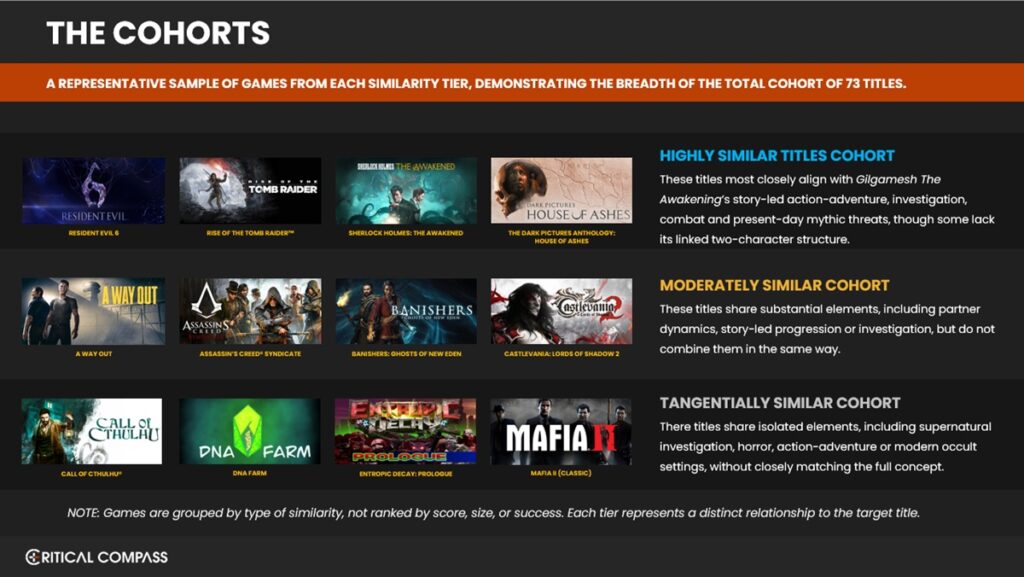 Gyld’s sample cohort page. Source: Gyld The round arrives during the games industry’s most punishing correction in decades — and positions Critical Compass squarely against the market-research establishment serving it.
“The games industry has never lacked market research; it has lacked market research
worth paying for,” said Emre Deniz, CEO of Gyld, in a statement. “Games are more
complex than just ‘genres’, and audiences are more than just abstract age groups or
genders. We built Critical Compass for our own deals, with our own money at risk, because we share the risks with our developers – we have to stand by our answers. The round lets us bring that same standard to the studios and investors who need it most — while there is still time to act.”
At the system’s foundation is a library of 200+ different analytical pipelines; each
representing research-based and scientifically validated models that range from simple
pricing optimization to complex codification of games. Critical Compass discards the
notion of ‘genre monoliths’; games are more complex than just ‘RPG’, ‘Action’, or ‘Shooter’, and instead have nuanced archetypes.
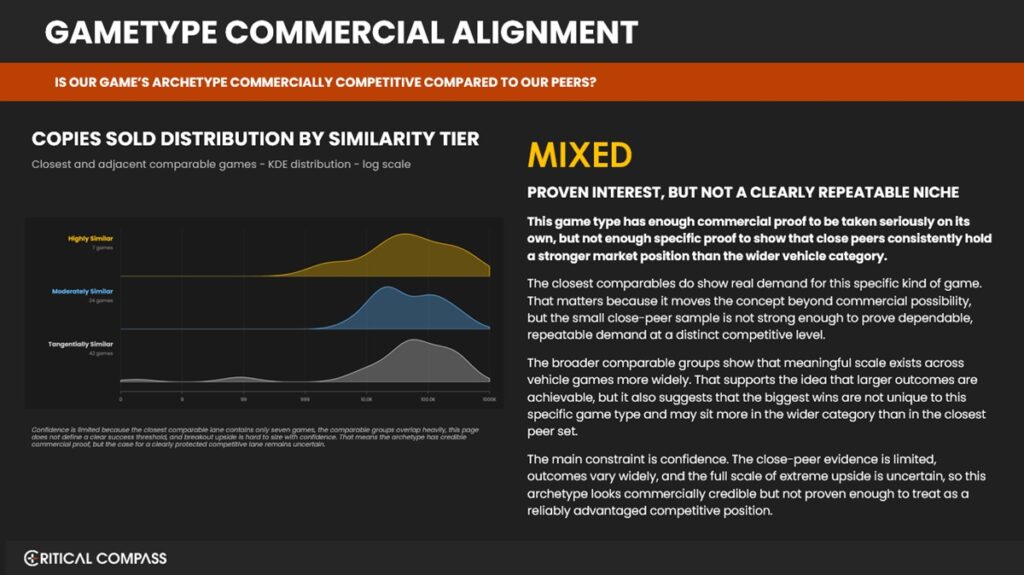 Gyld’s sample commercial alignment page. Source: Gyld Merging these models enables Critical Compass to paint a rich DNA of every title, their audiences, and historically relevant patterns or predictable risks.
Specialist games-industry AI agents investigate market, storefront, community, and
competitive evidence within frameworks built by Gyld’s data scientists; human analysts
interrogate the findings and remain accountable for every recommendation. Critical
Compass is built for decision support, not content generation — it does not produce game art, code, writing, or other creative assets, and it does not make production or investment decisions on a client’s behalf.
“Which games are genuinely our competitors? When should we launch, and at what price? Is this investment thesis actually supported by player behaviour?” said Lex Suurland, cofounder of Gyld, in a statement. “These are specific decisions about a specific game, audience, or business — they deserve specific evidence, not the same generic answer as every other title in the genre. For the first time, a five-person studio can afford that evidence.”
An early version of the platform informed Gyld’s decision to represent Sandfall
Interactive’s then-early prototype of Clair Obscur: Expedition 33.
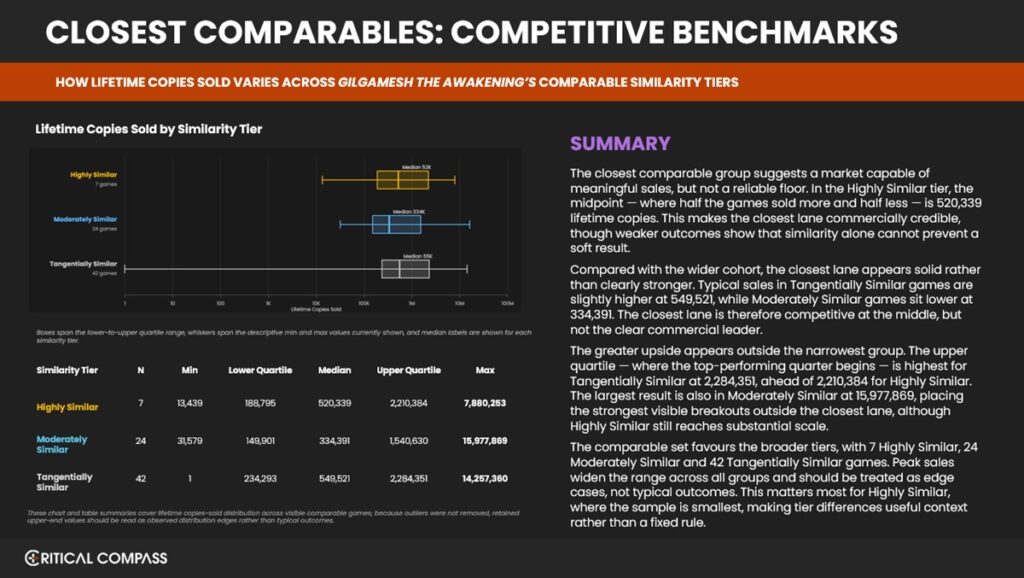 Gyld’s closest comparison sample page. Source: Gyld From Gamescom, developers, publishers, investors, and platform holders can commission Critical Compass reports and bespoke research engagements through Gyld. Critical Compass remains an internal Gyld research system rather than self-service software.
Critical Compass been in continuous development and private use since 2020, across real funding, publishing, development and greenlight decisions. Studios working with Gyld have added 84 new hires following Critical Compass-supported outcomes.
The post Gyld raises $1M to roll out Critical Compass games research appeared first on GamesBeat.
Kameha Ventures led the oversubscribed round with participation from industry angel investors at mod.io, indie.bi and ICO Partners.
The New Zealand company (which spells its name GYLD) said the round funds the wider rollout of Critical Compass, GYLD’s proprietary games research system, which has been in quiet use at Sega, Gameloft, and Amplitude Studios, among other major publishers and platform holders. The company will be at Gamescom in Germany next week.
Built in 2020 as Gyld’s internal system for evaluating which projects to back with its own
capital, Critical Compass has since supported more than $100 million in funding and
publishing outcomes across more than 45 projects.
The company said it holds a 100% success record on predicting failure for projects deemed commercially unviable — every one that proceeded without addressing its recommendations either failed to secure publishing or launched to poor commercial reception, validated through independent back-testing. Studios working with Gyld have added 84 new hires following Critical Compass-supported outcomes.
Gyld’s sample cohort page. Source: Gyld The round arrives during the games industry’s most punishing correction in decades — and positions Critical Compass squarely against the market-research establishment serving it.“The games industry has never lacked market research; it has lacked market research
worth paying for,” said Emre Deniz, CEO of Gyld, in a statement. “Games are more
complex than just ‘genres’, and audiences are more than just abstract age groups or
genders. We built Critical Compass for our own deals, with our own money at risk, because we share the risks with our developers – we have to stand by our answers. The round lets us bring that same standard to the studios and investors who need it most — while there is still time to act.”
At the system’s foundation is a library of 200+ different analytical pipelines; each
representing research-based and scientifically validated models that range from simple
pricing optimization to complex codification of games. Critical Compass discards the
notion of ‘genre monoliths’; games are more complex than just ‘RPG’, ‘Action’, or ‘Shooter’, and instead have nuanced archetypes.
Gyld’s sample commercial alignment page. Source: Gyld Merging these models enables Critical Compass to paint a rich DNA of every title, their audiences, and historically relevant patterns or predictable risks.Specialist games-industry AI agents investigate market, storefront, community, and
competitive evidence within frameworks built by Gyld’s data scientists; human analysts
interrogate the findings and remain accountable for every recommendation. Critical
Compass is built for decision support, not content generation — it does not produce game art, code, writing, or other creative assets, and it does not make production or investment decisions on a client’s behalf.
“Which games are genuinely our competitors? When should we launch, and at what price? Is this investment thesis actually supported by player behaviour?” said Lex Suurland, cofounder of Gyld, in a statement. “These are specific decisions about a specific game, audience, or business — they deserve specific evidence, not the same generic answer as every other title in the genre. For the first time, a five-person studio can afford that evidence.”
An early version of the platform informed Gyld’s decision to represent Sandfall
Interactive’s then-early prototype of Clair Obscur: Expedition 33.
Gyld’s closest comparison sample page. Source: Gyld From Gamescom, developers, publishers, investors, and platform holders can commission Critical Compass reports and bespoke research engagements through Gyld. Critical Compass remains an internal Gyld research system rather than self-service software.Critical Compass been in continuous development and private use since 2020, across real funding, publishing, development and greenlight decisions. Studios working with Gyld have added 84 new hires following Critical Compass-supported outcomes.
The post Gyld raises $1M to roll out Critical Compass games research appeared first on GamesBeat.
What's Your Reaction?








XINKER - Business and Income Tips
Explore XINKER, the ultimate platform for mastering business strategies, discovering passive income opportunities, and learning success principles. Join a community of thinkers dedicated to achieving financial freedom and entrepreneurial excellence.

![[Business Talk] Chagee: Opening 3,500 stores in 6 years](https://xinker.org/uploads/images/202410/image_140x98_671afce94bf91.webp)