



![[PRO Tips] Gold’s Bullish Revival: Seasonal Trends and Key Levels to Watch](https://xinker.org/uploads/images/202412/image_430x256_67724cc6ad0cd.webp)
![[PRO Tips] Gold Market Under Short-Term Pressure, Safe-Haven Demand and Central Bank Buying Support Long-Term Upside Potential](https://xinker.org/uploads/images/202412/image_430x256_676ffb4685287.webp)
![[PRO Tips] Analysis of 9 key points of differentiation strategy! Master differentiation to create a brand advantage that is unique in the world!](https://firebasestorage.googleapis.com/v0/b/xinker-tips.appspot.com/o/article_thumbnails%2Fscaled_differentiation%20strategy.png.png?alt=media&token=a1bfc3d2-e85a-4db7-8a6d-01c7274f8940)
![[PRO Tips] Will REITs regain growth momentum in 2024? 3 REITs ETFs you must know if you want to invest in real estate.](https://firebasestorage.googleapis.com/v0/b/xinker-tips.appspot.com/o/article_thumbnails%2Fscaled_REITs1.png.png?alt=media&token=8af4eb93-33ff-466f-8039-b6555fad52b4)
![[PRO Tips] Complete tutorial on how to make money in Adobe Stock!](https://firebasestorage.googleapis.com/v0/b/xinker-tips.appspot.com/o/article_thumbnails%2Fscaled_tut-adobe1.png.png?alt=media&token=0b2c8cf2-22bd-4142-883e-140ed1cbaf02)
![[Passive Income] Unlock the secret of passive income: 3 steps to apply for Google AdSense](https://xinker.org/uploads/images/202410/image_430x256_6717a4fb3052b.webp)
![[Passive Income] Earn over $200 a day with AI-generated articles!](https://firebasestorage.googleapis.com/v0/b/xinker-tips.appspot.com/o/article_thumbnails%2Fscaled_article1.png.png?alt=media&token=f61bf35b-8553-4719-826d-7360024adc70)
![[Passive Income] Earn over 20 USD per download with AI-generated images!](https://firebasestorage.googleapis.com/v0/b/xinker-tips.appspot.com/o/article_thumbnails%2Fscaled_adobe2.png.png?alt=media&token=3e20e76a-a907-45af-80aa-bf9b3600301f)
![[Passive Income] Earn 10 USD per new download by sharing CapCut!](https://firebasestorage.googleapis.com/v0/b/xinker-tips.appspot.com/o/article_thumbnails%2Fscaled_capcut2.png.png?alt=media&token=a04dec40-1fac-4857-86f2-19a8be02d38e)
![[Passive Income] Use your WiFi to create passive income in 5 minutes, and you can earn 4-6 U per day!](https://firebasestorage.googleapis.com/v0/b/xinker-tips.appspot.com/o/article_thumbnails%2Fscaled_Grassio.webp.png?alt=media&token=7659a95e-0e47-4f27-a17d-c942ac3cf7f4)


![[Business Talk] The Unique Theme of XINKER's Song: Beef Wellington and Business Mastery](https://xinker.org/uploads/images/202410/image_430x256_671afc155f47f.webp)
![[Business Talk] Chagee: Opening 3,500 stores in 6 years](https://xinker.org/uploads/images/202410/image_430x256_671afce80c5f9.webp)


"By God Alone" Dev Diary #5 - Investiture Controversy
Hello everyone! In today’s dev diary, we’ll explain how a historical conflict between the church and monarchs, known as the Investiture Controversy, is translated into Crusader Kings III, and also serves as one of the seven chapters in the new Christian Church situation of By God Alone.Your feedback from earlier dev diaries regarding this subject has been especially helpful, and we thank you all for your valuable contributions and suggestions. Now, let's move on to what has been in the works.A significant update is the new Conditional clerical appointment doctrine, adopted by Christian faiths at game start. Under Conditional appointment, neither secular rulers nor the clergy need permission to appoint clergymen within their jurisdictions, and either side can act on a disagreement immediately.Unlike the existing appointment doctrines, Conditional appointment lets both sides make these changes at the same time, reflecting the chaotic atmosphere surrounding clergy appointment within the historical period of the game.As a secular ruler under Conditional appointment, you can appoint a new court chaplain or the archbishop of the clerical region over your realm directly, without petitioning anyone. This stands in contrast to Spiritual appointment doctrines, which route these appointments through other interactionsChanging your court chaplain under Conditional appointment works exactly the same as how it already works with the existing Temporal doctrines; you simply click the button on your council member and appoint a new one from the list. As expected, doing so lowers the outgoing chaplain’s opinion of you and triggers catalysts pushing the Christian Church Situation towards the Investiture Controversy and Saeculum Obscurum chapters.Replacing a clerical title holder carries heavier consequences than replacing a court chaplain, however: doing so applies the “Meddling in Clerical Appointments” modifier and a larger opinion penalty with the replaced archbishop, and it lowers every clergy member’s opinion of you for a decade, on top of the Situation catalysts it triggers. As these appointments accumulate, secular rulers and the clergy find themselves at each other’s throats about this particular appointment issue, driving progress towards the chapter.Interfering with these undoubtedly legitimate actions over your clergy will eventually raise tensions to the chapter's threshold levels, as the church will grow weary of the secular rulers’ actions and choose to resolve the conflict permanently by finally entering the Investiture Controversy.Once the Chapter begins, a 30-year countdown starts and all relevant rulers are notified of an upcoming, unique ecumenical assembly: the Investiture Council. It’s a special version of the existing Ecumenical Council, but instead of discussing changes to tenets or doctrines, all clergy are expected to participate and vote on whether Christendom should uphold the Spiritual, Revocable doctrine or be forced to accept the Temporal, Revocable doctrine. It can never be triggered manually elsewhere.You can see the current overall voting trend from within the Situation interface. This allows you to monitor whether your efforts to sway or preserve votes are effective and whether the tide is turning as planned. We’re also considering showing more precise figures here, so this may change ahead of release.By default, a participating clergyman's vote is to support Spiritual, Revocable in the council. However, there are two ways a secular ruler can influence the outcome of the vote.One is through obtaining puppets, who then vote as their puppeteer directs them to. The other is the new Investiture Conflict casus belli, which allows both sides to compel a participant to vote for the winner’s side on victory. If you lose, however, you are compelled to vote for the defending winner’s side.There is no cap on how often this casus belli can be used, so both sides are expected to constantly strike at each other at every opportunity to make sure their side is the winning one throughout the 30-year countdown.A new one-time decision is also available for those who wish to pledge allegiance to the Pope, exclaiming that no matter what happens, they will cast a guaranteed vote toward Spiritual, Revocable in the council in exchange for improved standing with the PopeWhen the countdown ends and everyone is called to resolve the dispute, all invitees receive advance notice so they can plan their travel to the council. The default host for this activity is the Pope. If the Pope is a player, or an AI-controlled Pope is unavailable for any reason, a qualified archbishop will step in to begin preparations and distribute invitations.If the council host is disqualified partway through, another archbishop can take over and reorganize the council within a couple of months.The debate phase itself is deliberately quite simple, because the vote-changing mechanics resolve during preparation across the 30-year countdown, meanin
Hello everyone! In today’s dev diary, we’ll explain how a historical conflict between the church and monarchs, known as the Investiture Controversy, is translated into Crusader Kings III, and also serves as one of the seven chapters in the new Christian Church situation of By God Alone.
Your feedback from earlier dev diaries regarding this subject has been especially helpful, and we thank you all for your valuable contributions and suggestions. Now, let's move on to what has been in the works.

A significant update is the new Conditional clerical appointment doctrine, adopted by Christian faiths at game start. Under Conditional appointment, neither secular rulers nor the clergy need permission to appoint clergymen within their jurisdictions, and either side can act on a disagreement immediately.
Unlike the existing appointment doctrines, Conditional appointment lets both sides make these changes at the same time, reflecting the chaotic atmosphere surrounding clergy appointment within the historical period of the game.
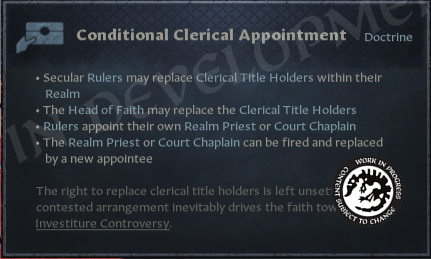
As a secular ruler under Conditional appointment, you can appoint a new court chaplain or the archbishop of the clerical region over your realm directly, without petitioning anyone. This stands in contrast to Spiritual appointment doctrines, which route these appointments through other interactions
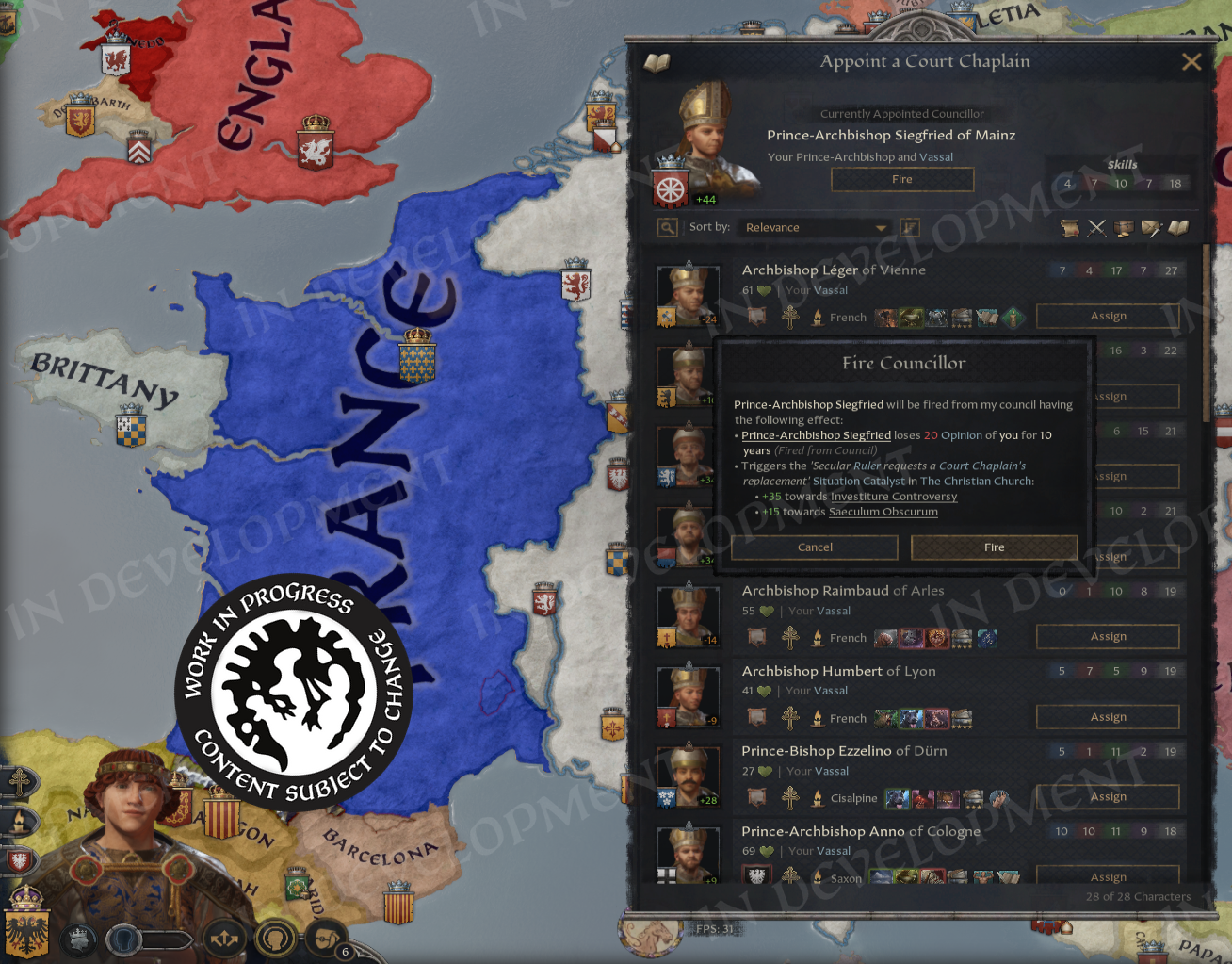
Changing your court chaplain under Conditional appointment works exactly the same as how it already works with the existing Temporal doctrines; you simply click the button on your council member and appoint a new one from the list. As expected, doing so lowers the outgoing chaplain’s opinion of you and triggers catalysts pushing the Christian Church Situation towards the Investiture Controversy and Saeculum Obscurum chapters.
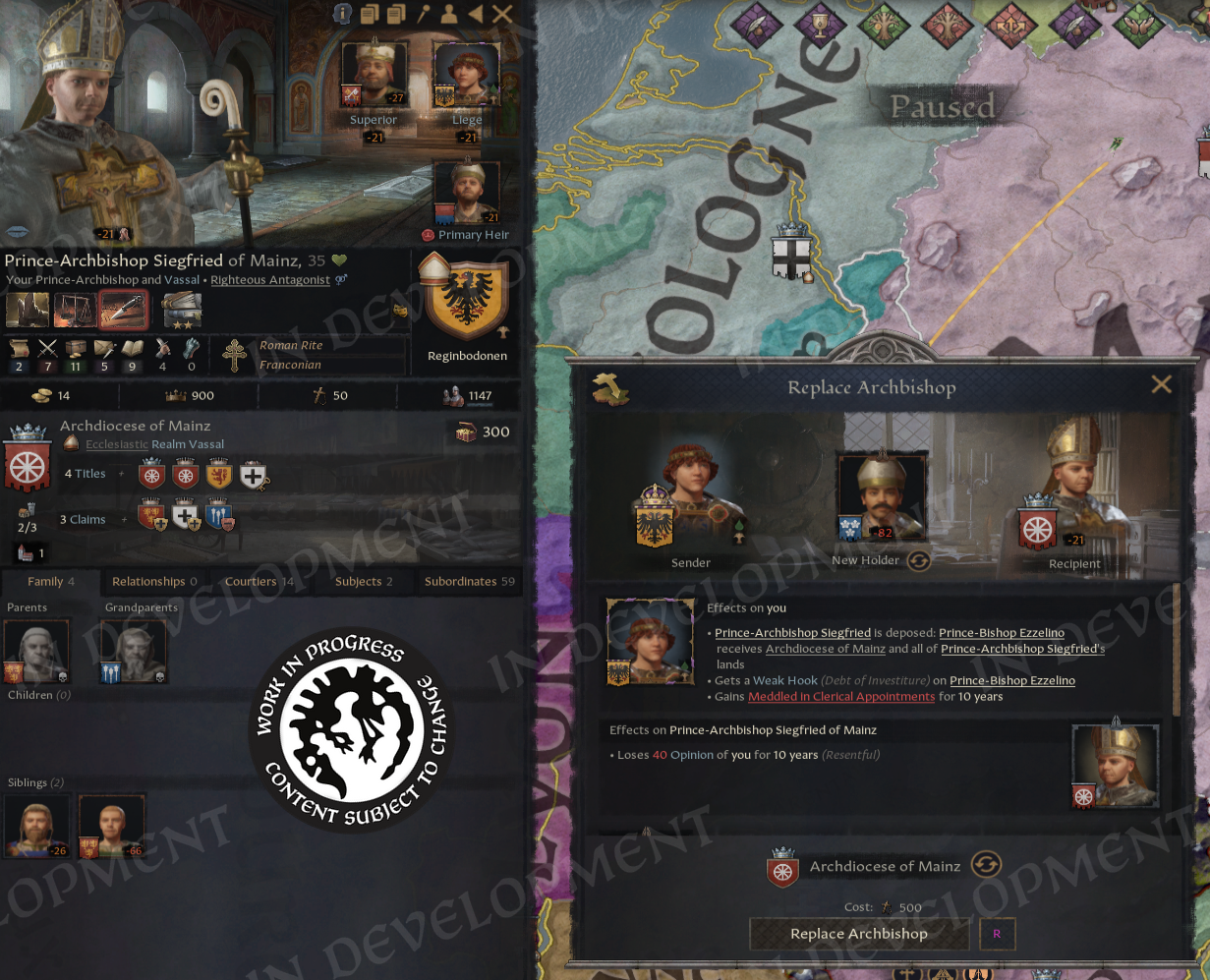
Replacing a clerical title holder carries heavier consequences than replacing a court chaplain, however: doing so applies the “Meddling in Clerical Appointments” modifier and a larger opinion penalty with the replaced archbishop, and it lowers every clergy member’s opinion of you for a decade, on top of the Situation catalysts it triggers. As these appointments accumulate, secular rulers and the clergy find themselves at each other’s throats about this particular appointment issue, driving progress towards the chapter.
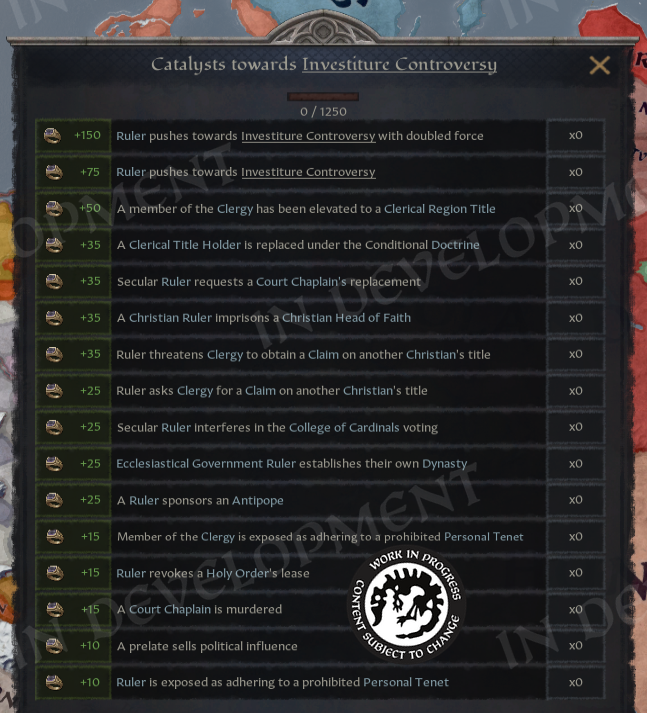
Interfering with these undoubtedly legitimate actions over your clergy will eventually raise tensions to the chapter's threshold levels, as the church will grow weary of the secular rulers’ actions and choose to resolve the conflict permanently by finally entering the Investiture Controversy.

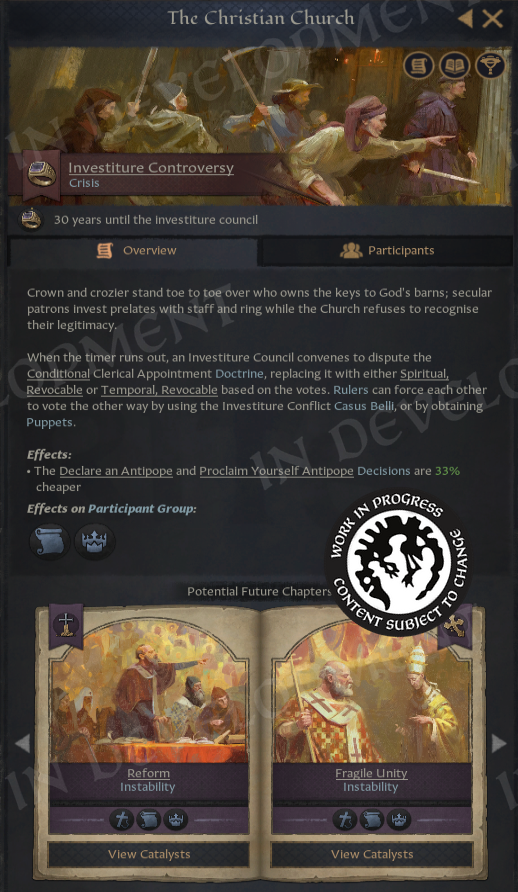
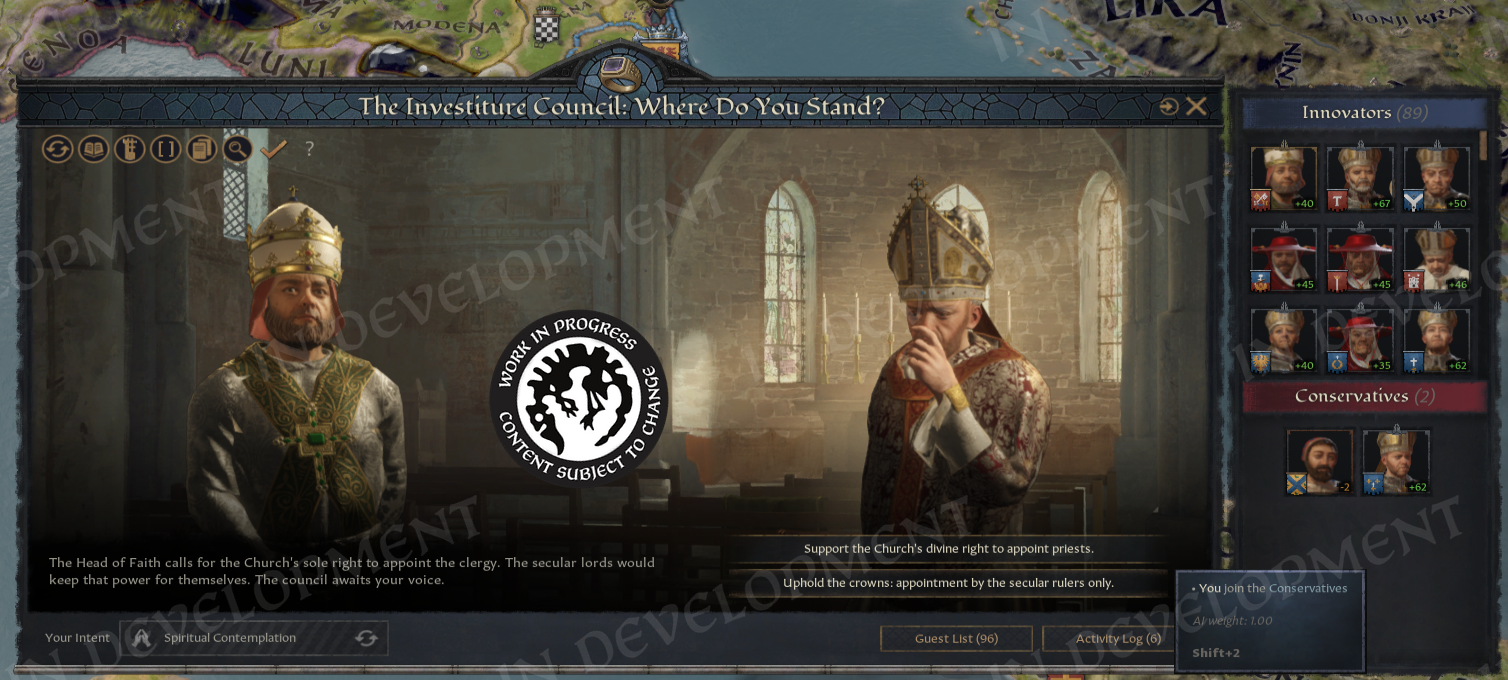
Once the Chapter begins, a 30-year countdown starts and all relevant rulers are notified of an upcoming, unique ecumenical assembly: the Investiture Council. It’s a special version of the existing Ecumenical Council, but instead of discussing changes to tenets or doctrines, all clergy are expected to participate and vote on whether Christendom should uphold the Spiritual, Revocable doctrine or be forced to accept the Temporal, Revocable doctrine. It can never be triggered manually elsewhere.
You can see the current overall voting trend from within the Situation interface. This allows you to monitor whether your efforts to sway or preserve votes are effective and whether the tide is turning as planned. We’re also considering showing more precise figures here, so this may change ahead of release.
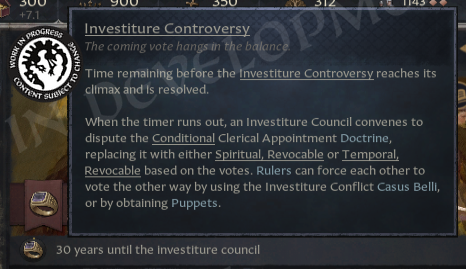
By default, a participating clergyman's vote is to support Spiritual, Revocable in the council. However, there are two ways a secular ruler can influence the outcome of the vote.
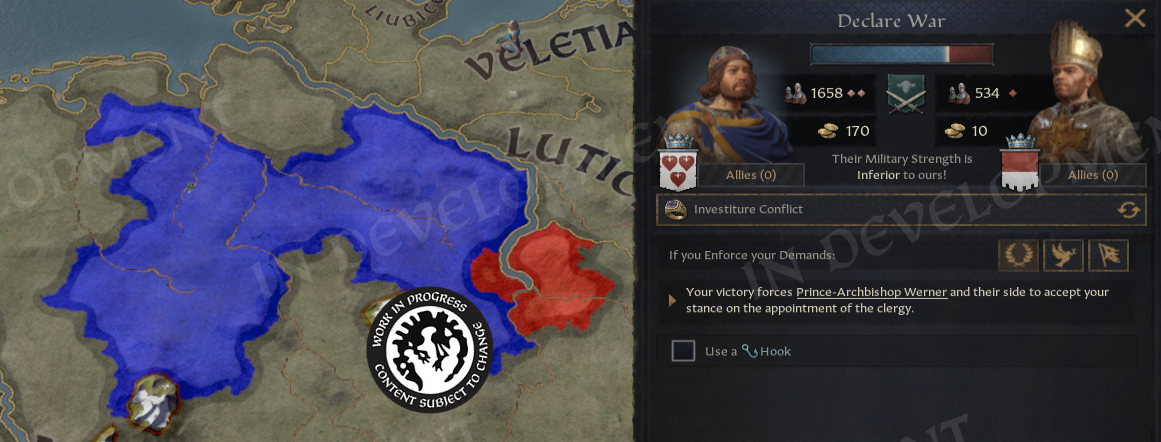
One is through obtaining puppets, who then vote as their puppeteer directs them to. The other is the new Investiture Conflict casus belli, which allows both sides to compel a participant to vote for the winner’s side on victory. If you lose, however, you are compelled to vote for the defending winner’s side.
There is no cap on how often this casus belli can be used, so both sides are expected to constantly strike at each other at every opportunity to make sure their side is the winning one throughout the 30-year countdown.
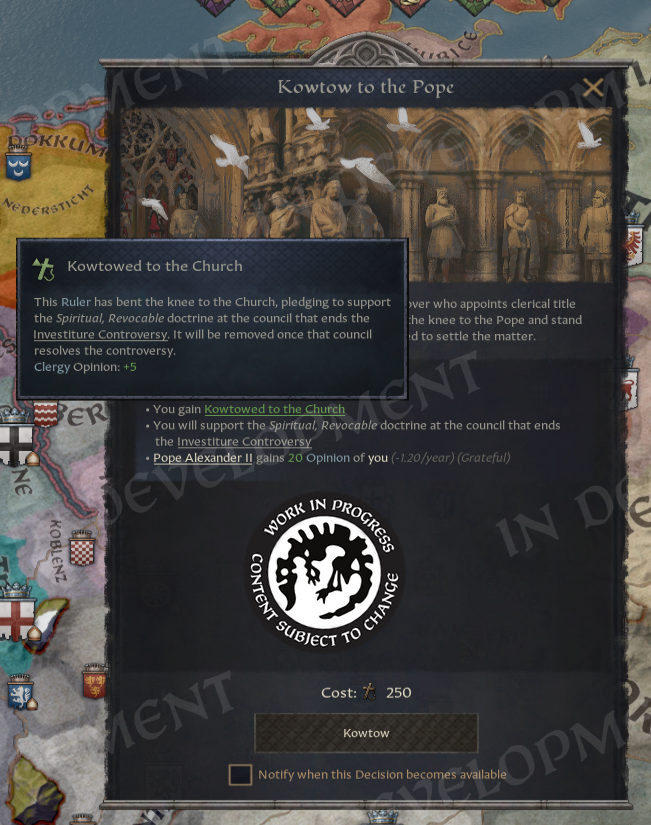
A new one-time decision is also available for those who wish to pledge allegiance to the Pope, exclaiming that no matter what happens, they will cast a guaranteed vote toward Spiritual, Revocable in the council in exchange for improved standing with the Pope
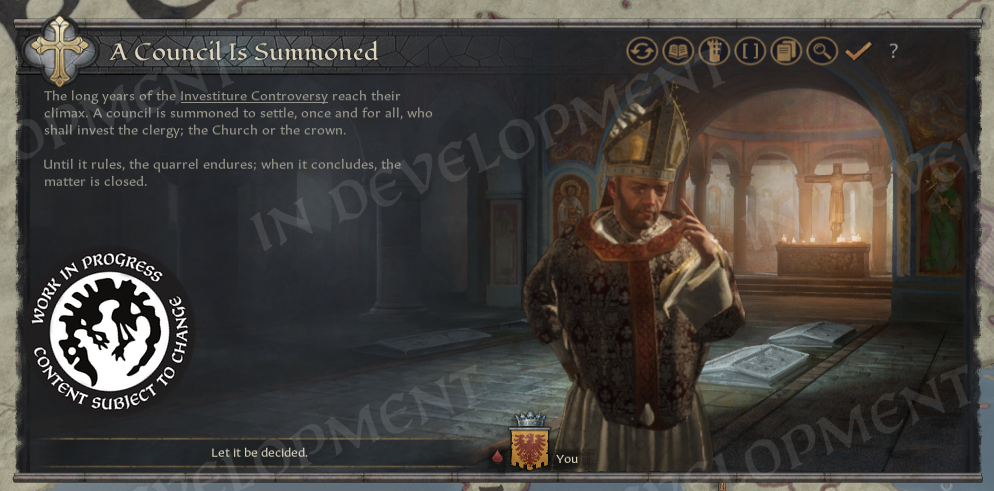
When the countdown ends and everyone is called to resolve the dispute, all invitees receive advance notice so they can plan their travel to the council. The default host for this activity is the Pope. If the Pope is a player, or an AI-controlled Pope is unavailable for any reason, a qualified archbishop will step in to begin preparations and distribute invitations.
If the council host is disqualified partway through, another archbishop can take over and reorganize the council within a couple of months.
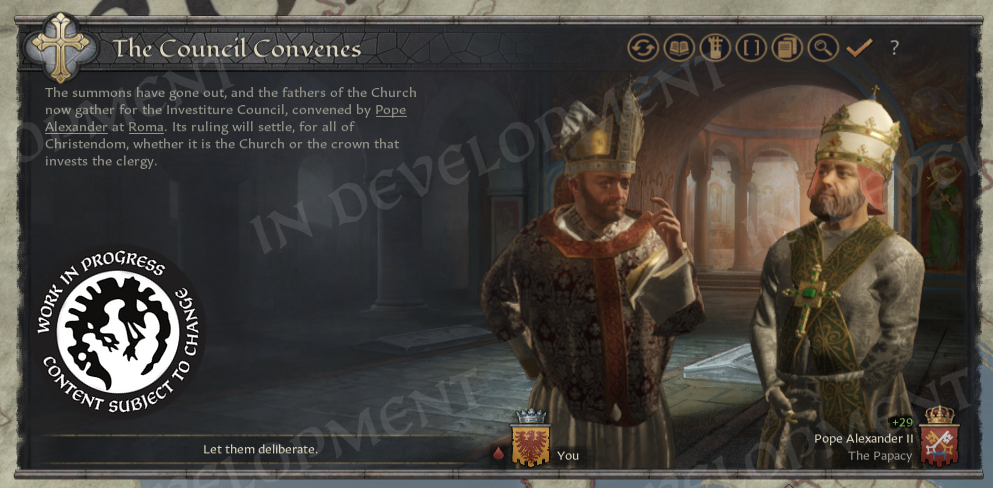
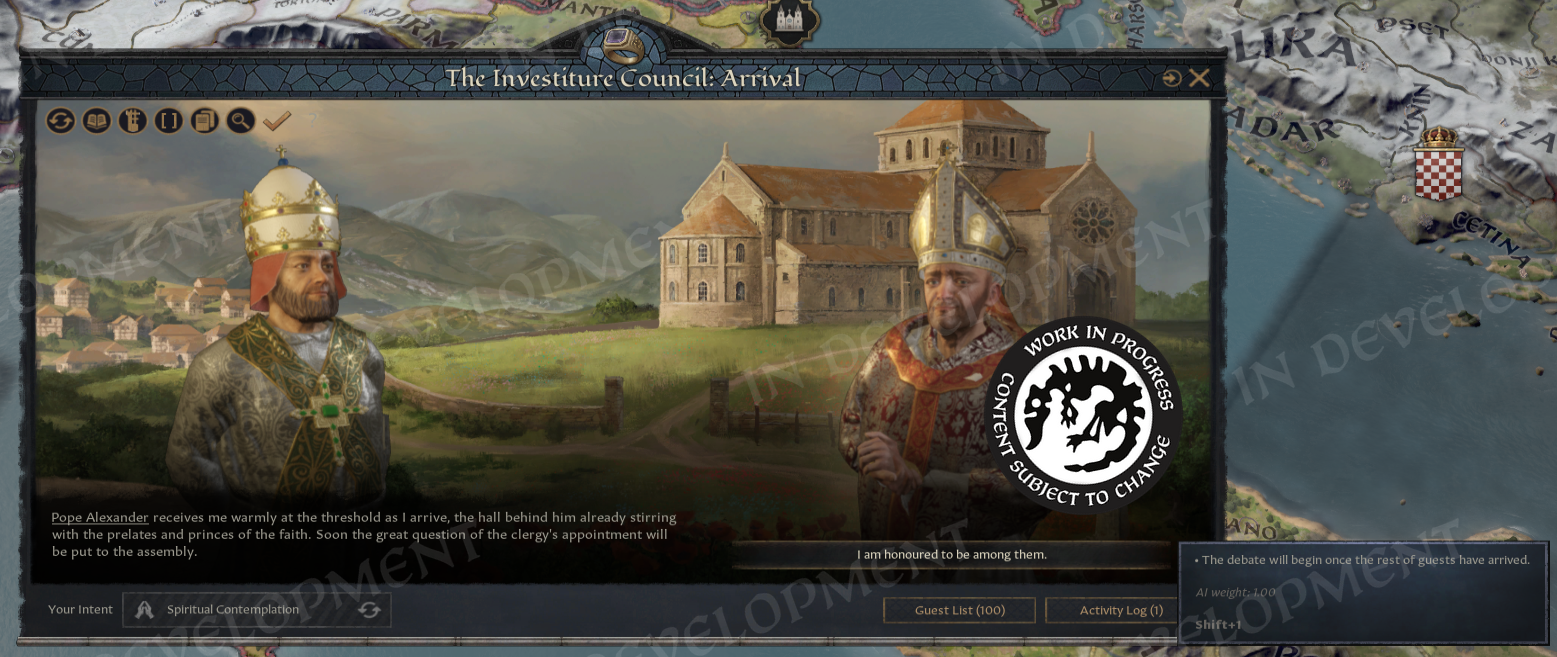
The debate phase itself is deliberately quite simple, because the vote-changing mechanics resolve during preparation across the 30-year countdown, meaning the participants arrive with their positions already decided.
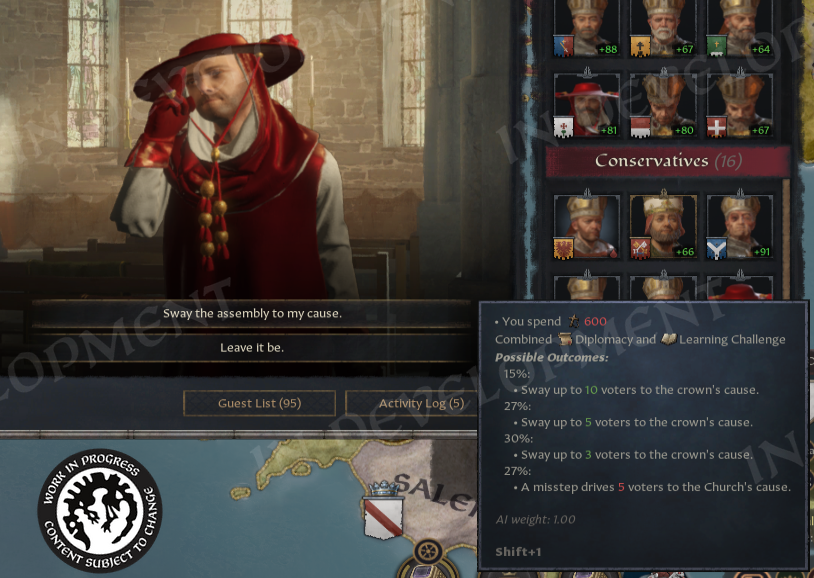
There is one notable exception to this, however: if you have some piety stored up, you have a handful of chances to sway your opponents and turn the votes in your favor before the votes are completely cast, ramping up in cost on each consecutive attempt. If you’re backing the side with fewer votes, the sway is a combined Diplomacy and Learning challenge.

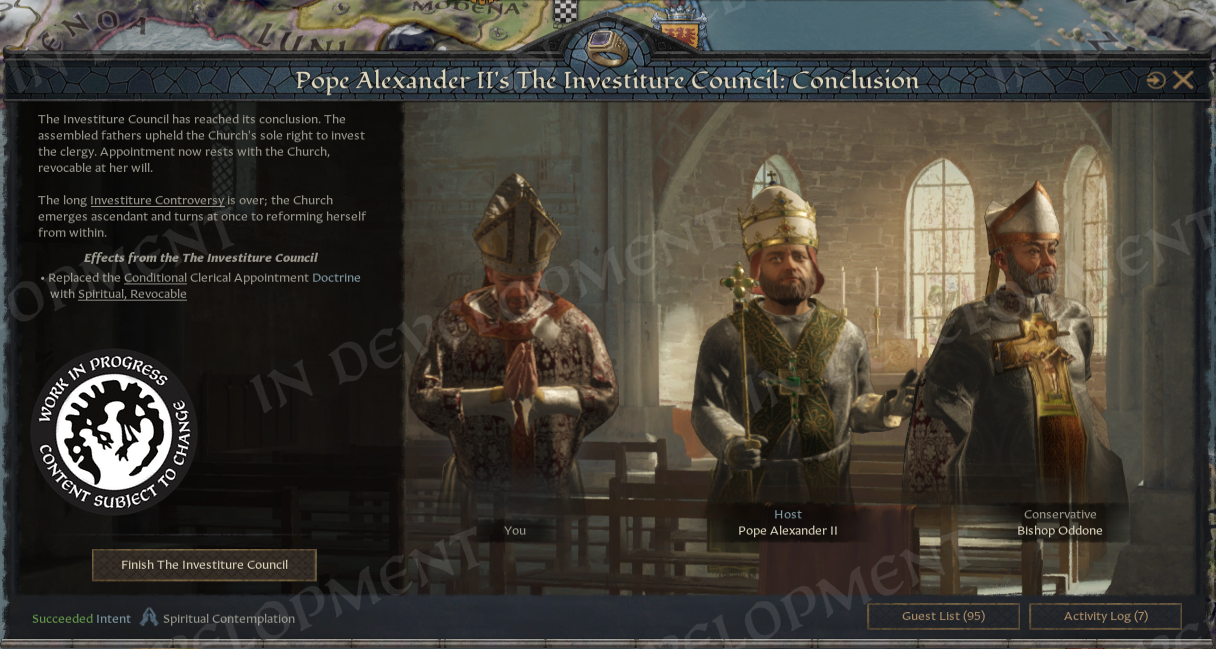
Ultimately, democracy prevails, and the side with the most votes enforces its preferred clerical appointment doctrine, resolving the question at the heart of the Investiture Controversy and ending the chapter. If Temporal, Revocable wins, the situation shifts to the Fragile Unity instability chapter. If Spiritual, Revocable wins (the more probable outcome), the situation moves to the Reform chapter for the Church's benefit.
No other chapter can be entered from the Investiture Controversy.
Previous discussions have highlighted the concern that secular rulers have limited influence over the appointment of court chaplains or archbishops, and this has been acknowledged.
We have taken notes on these points, and these updates aim to reflect that genuine conflict between the crown and the church in Crusader Kings III, especially in one of our important situation chapters. This concludes our coverage of the Investiture Controversy, and we welcome your feedback as always. Take care!
What's Your Reaction?











![[Business Talk] Chagee: Opening 3,500 stores in 6 years](https://xinker.org/uploads/images/202410/image_140x98_671afce94bf91.webp)