


![[PRO Tips] Gold’s Bullish Revival: Seasonal Trends and Key Levels to Watch](https://xinker.org/uploads/images/202412/image_430x256_67724cc6ad0cd.webp)
![[PRO Tips] Gold Market Under Short-Term Pressure, Safe-Haven Demand and Central Bank Buying Support Long-Term Upside Potential](https://xinker.org/uploads/images/202412/image_430x256_676ffb4685287.webp)
![[PRO Tips] Analysis of 9 key points of differentiation strategy! Master differentiation to create a brand advantage that is unique in the world!](https://firebasestorage.googleapis.com/v0/b/xinker-tips.appspot.com/o/article_thumbnails%2Fscaled_differentiation%20strategy.png.png?alt=media&token=a1bfc3d2-e85a-4db7-8a6d-01c7274f8940)
![[PRO Tips] Will REITs regain growth momentum in 2024? 3 REITs ETFs you must know if you want to invest in real estate.](https://firebasestorage.googleapis.com/v0/b/xinker-tips.appspot.com/o/article_thumbnails%2Fscaled_REITs1.png.png?alt=media&token=8af4eb93-33ff-466f-8039-b6555fad52b4)
![[PRO Tips] Complete tutorial on how to make money in Adobe Stock!](https://firebasestorage.googleapis.com/v0/b/xinker-tips.appspot.com/o/article_thumbnails%2Fscaled_tut-adobe1.png.png?alt=media&token=0b2c8cf2-22bd-4142-883e-140ed1cbaf02)
![[Passive Income] Unlock the secret of passive income: 3 steps to apply for Google AdSense](https://xinker.org/uploads/images/202410/image_430x256_6717a4fb3052b.webp)
![[Passive Income] Earn over $200 a day with AI-generated articles!](https://firebasestorage.googleapis.com/v0/b/xinker-tips.appspot.com/o/article_thumbnails%2Fscaled_article1.png.png?alt=media&token=f61bf35b-8553-4719-826d-7360024adc70)
![[Passive Income] Earn over 20 USD per download with AI-generated images!](https://firebasestorage.googleapis.com/v0/b/xinker-tips.appspot.com/o/article_thumbnails%2Fscaled_adobe2.png.png?alt=media&token=3e20e76a-a907-45af-80aa-bf9b3600301f)
![[Passive Income] Earn 10 USD per new download by sharing CapCut!](https://firebasestorage.googleapis.com/v0/b/xinker-tips.appspot.com/o/article_thumbnails%2Fscaled_capcut2.png.png?alt=media&token=a04dec40-1fac-4857-86f2-19a8be02d38e)
![[Passive Income] Use your WiFi to create passive income in 5 minutes, and you can earn 4-6 U per day!](https://firebasestorage.googleapis.com/v0/b/xinker-tips.appspot.com/o/article_thumbnails%2Fscaled_Grassio.webp.png?alt=media&token=7659a95e-0e47-4f27-a17d-c942ac3cf7f4)


![[Business Talk] The Unique Theme of XINKER's Song: Beef Wellington and Business Mastery](https://xinker.org/uploads/images/202410/image_430x256_671afc155f47f.webp)
![[Business Talk] Chagee: Opening 3,500 stores in 6 years](https://xinker.org/uploads/images/202410/image_430x256_671afce80c5f9.webp)
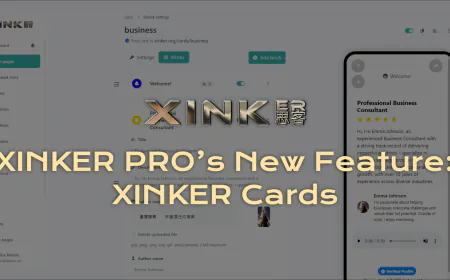

Victoria 3 – Dev Diary #177 – Ship Designer & More
Greetings Victorians,And a delightful Thursday to you!It’s Admiral Lino, speaking to you from the dockyards. Today I will go over the central mechanical feature of The Great Wave, the Ship Designer. Also we’ll talk about Flagships, a smaller feature, but cool nonetheless. And last but not least, I’ll walk you through Ship Purchase Treaties.To be clear, all of which I describe today is part of The Great Wave expansion, which is releasing alongside Update 1.13 on April 28.Let’s jump right into the water.Ship DesignerI’ve mentioned this previously, but will repeat here that our ambition for the Navy and the Ship Designer in particular was always to make it matter for your strategic ambitions, and not to get lost in the details with tactics for individual battles.So when we sat down for the design of it, we knew we wouldn’t want to replicate a Ship Designer as players might know it from Hearts of Iron 4 for example. So if that was your fear, I think it’s safe to say that that is not what we’re going with.Instead, we are focussing on a more Victoria-appropriate design, where you make the big picture decisions instead of deciding how many flak guns you’d like to have on your cruiser.And while doing so, we still wanted to improve upon historical accuracy a bit, add flavor wherever we can and—even accounting for abstractions—come up with something that is historically plausible.In order to try and achieve that, we had a long running consultation over multiple sessions with Drachinifel, who runs a YouTube channel and a podcast almost entirely dedicated to naval topics, much of it taking place in the 19th century.He has been instrumental in providing us with a lot of necessary information on all things to do with the ships themselves, from finalizing the list of different ship types with us, to providing good references for what ships to model ours after, to what different ship modification levels could look like given our constraints, and even the soundscape one would expect to hear.We are really happy to have had him on board with us (ha!), and he has done a tremendous job working with us.Well then, shall we get started on the Ship Designer? It all starts with Ship Modifications.Ship ModificationsShip Modifications modify key stats of ships, and are the tool you use to build a fleet that serves your strategic purpose. The attributes that are modified directly are: Armor, Damage, Speed and Supply Capacity. Armor, of course, determines how robust your ship is. Here, we want to make it very impactful compared to the past when steel hull ships are introduced. Historically, they made wooden ships pretty much obsolete immediately. We represent this by adding armor values to them that are high enough to block most attacks of the wooden ships, completely changing the progression of ships’ power in the game.Damage is Armor’s counterpart, and is (as you may have guessed) simply deducted by Armor values of the opponent’s ship.Speed determines the travelling speed on the world map.Supply Capacity is used to determine how much Supplies a ship can carry, allowing it to stay disconnected from the supply network for longer if necessary. It’s also closely related to the Supply Efficiency value which determines how much Supply is consumed per week.To modify these stats in the Ship Designer window, you can simply choose individually between three levels for each stat: high, medium and low. Depending on the ship type those can mean different things though of course, which we display as flavor text underneath the category.This is where a lot of Drachinifel and our dear designer Hansi’s work come inUpon changing a Ship Modification level, the 3D preview window will show the change accordingly, showing for example more or different types of guns on the ship.See the three images below for a demonstration of the progression.Visual changes exemplified by the beautiful Light Cruiser in this caseOf course these visual changes do not only apply in the preview window. They will be visible wherever this ship is going on the 3D map, including battles.In general, we have put in a pretty good amount of effort into better representing your fleet in the world.When you zoom in closer on a fleet, the ship representing your fleet will “unfold” and display more ships. These ships are proportionally showing your fleet composition. If you have a large percentage of dreadnoughts, your fleet will also be composed of those for example. We’ll likely show that off in the Art Dev Diary as well.But let’s come back to the Ship Modifications. Changing one of these stats can also implicitly affect another stat. For example, improving the propulsion of a ship will also improve their detection capabilities, which allows them to engage enemies more easily.But this can also incur negative effects. If you set the armor value of your Frigate to high, it will come at the expense of Speed for example. You can counter it by setting speed to high too, but this will further in
Greetings Victorians,
And a delightful Thursday to you!
It’s Admiral Lino, speaking to you from the dockyards. Today I will go over the central mechanical feature of The Great Wave, the Ship Designer. Also we’ll talk about Flagships, a smaller feature, but cool nonetheless. And last but not least, I’ll walk you through Ship Purchase Treaties.
To be clear, all of which I describe today is part of The Great Wave expansion, which is releasing alongside Update 1.13 on April 28.
Let’s jump right into the water.
I’ve mentioned this previously, but will repeat here that our ambition for the Navy and the Ship Designer in particular was always to make it matter for your strategic ambitions, and not to get lost in the details with tactics for individual battles.
So when we sat down for the design of it, we knew we wouldn’t want to replicate a Ship Designer as players might know it from Hearts of Iron 4 for example. So if that was your fear, I think it’s safe to say that that is not what we’re going with.
Instead, we are focussing on a more Victoria-appropriate design, where you make the big picture decisions instead of deciding how many flak guns you’d like to have on your cruiser.
And while doing so, we still wanted to improve upon historical accuracy a bit, add flavor wherever we can and—even accounting for abstractions—come up with something that is historically plausible.
In order to try and achieve that, we had a long running consultation over multiple sessions with Drachinifel, who runs a YouTube channel and a podcast almost entirely dedicated to naval topics, much of it taking place in the 19th century.
He has been instrumental in providing us with a lot of necessary information on all things to do with the ships themselves, from finalizing the list of different ship types with us, to providing good references for what ships to model ours after, to what different ship modification levels could look like given our constraints, and even the soundscape one would expect to hear.
We are really happy to have had him on board with us (ha!), and he has done a tremendous job working with us.
Well then, shall we get started on the Ship Designer? It all starts with Ship Modifications.
Ship Modifications modify key stats of ships, and are the tool you use to build a fleet that serves your strategic purpose. The attributes that are modified directly are: Armor, Damage, Speed and Supply Capacity.
Armor, of course, determines how robust your ship is. Here, we want to make it very impactful compared to the past when steel hull ships are introduced. Historically, they made wooden ships pretty much obsolete immediately. We represent this by adding armor values to them that are high enough to block most attacks of the wooden ships, completely changing the progression of ships’ power in the game.
Damage is Armor’s counterpart, and is (as you may have guessed) simply deducted by Armor values of the opponent’s ship.
Speed determines the travelling speed on the world map.
Supply Capacity is used to determine how much Supplies a ship can carry, allowing it to stay disconnected from the supply network for longer if necessary. It’s also closely related to the Supply Efficiency value which determines how much Supply is consumed per week.
To modify these stats in the Ship Designer window, you can simply choose individually between three levels for each stat: high, medium and low. Depending on the ship type those can mean different things though of course, which we display as flavor text underneath the category.
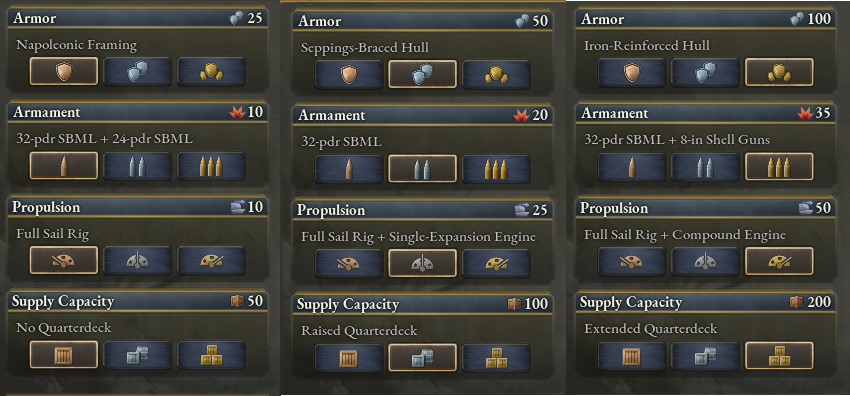
This is where a lot of Drachinifel and our dear designer Hansi’s work come in
Upon changing a Ship Modification level, the 3D preview window will show the change accordingly, showing for example more or different types of guns on the ship.
See the three images below for a demonstration of the progression.
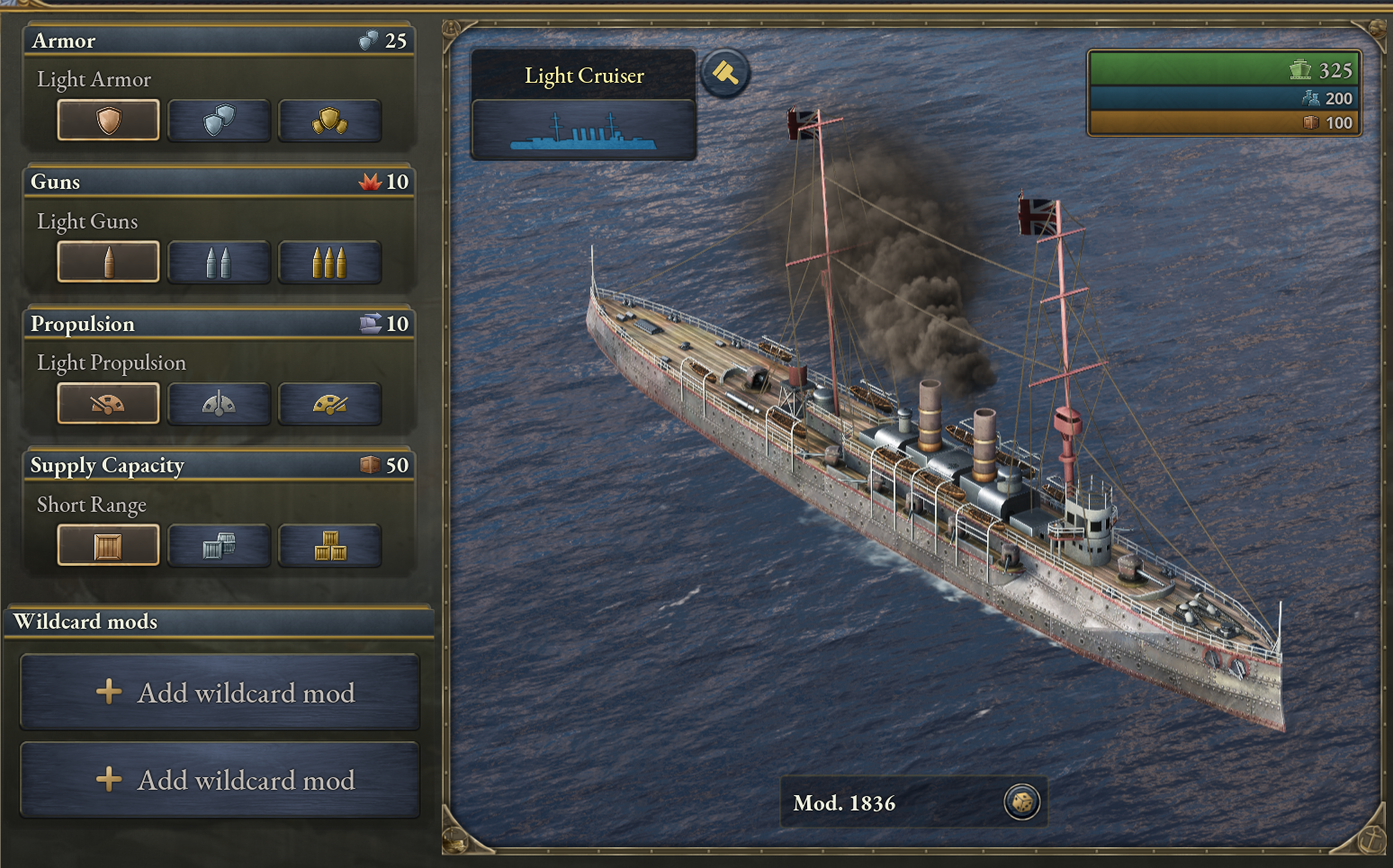
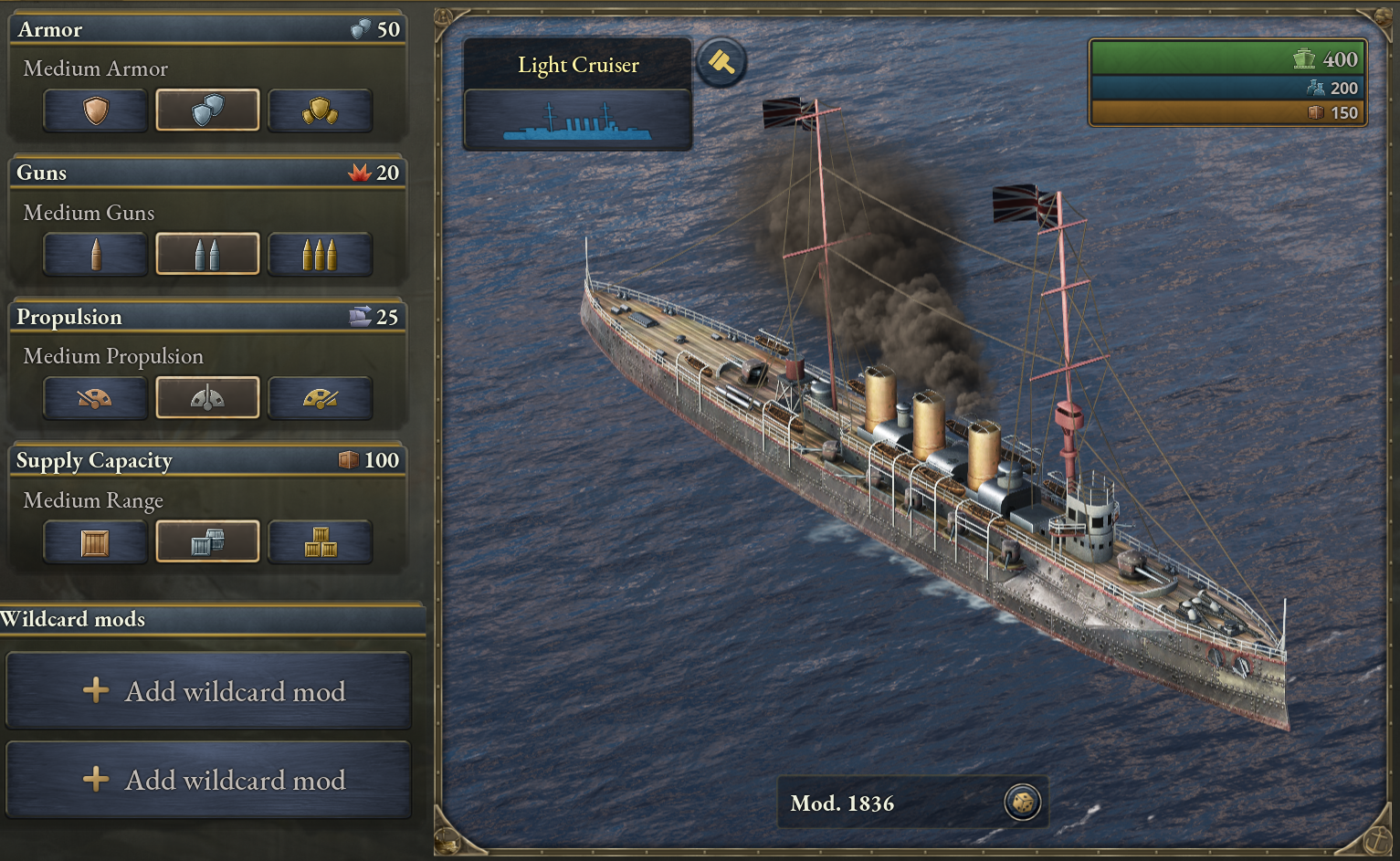
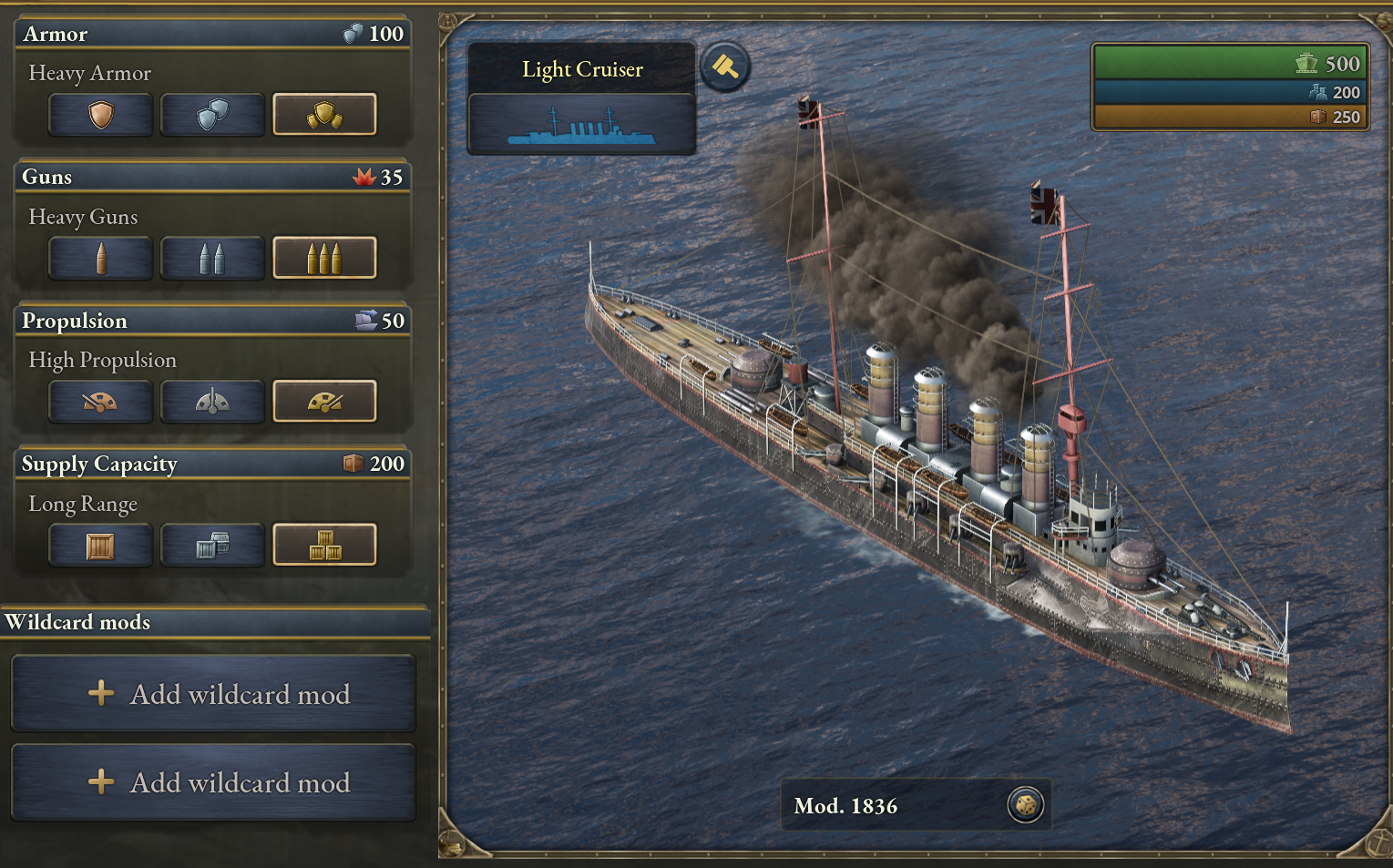 Visual changes exemplified by the beautiful Light Cruiser in this case
Of course these visual changes do not only apply in the preview window. They will be visible wherever this ship is going on the 3D map, including battles.
In general, we have put in a pretty good amount of effort into better representing your fleet in the world.
When you zoom in closer on a fleet, the ship representing your fleet will “unfold” and display more ships. These ships are proportionally showing your fleet composition. If you have a large percentage of dreadnoughts, your fleet will also be composed of those for example. We’ll likely show that off in the Art Dev Diary as well.
But let’s come back to the Ship Modifications. Changing one of these stats can also implicitly affect another stat. For example, improving the propulsion of a ship will also improve their detection capabilities, which allows them to engage enemies more easily.
But this can also incur negative effects. If you set the armor value of your Frigate to high, it will come at the expense of Speed for example. You can counter it by setting speed to high too, but this will further increase the production cost of the Frigate.
Because generally true across all ship types is: Increasing a value will also increase production (and maintenance) cost of the ship, whereas lowering it will make it cheaper.
Therefore, the main balance to pick between will be dependent on your country’s situation, and will be between Armor/Damage vs Speed/Supply, and generally effectiveness vs total cost.
But we wanted to add something else that reflects the increased design complexity when trying to fit all this thick armor and big guns and supplies and propulsion onto the same ship.
The costs to build a ship (and therefore also its maintenance costs) is scaled non-linearly with the levels of the Ship Modifications.
For that, we count how many Ship Modification levels are applied to the ship in total, low representing 1, medium 2, high 3. Each wildcard slot (which I’ll get to) also counts as 1.
Then those values are multiplied with the base cost of the Modifications with some exponential growth bits sprinkled on top.
With the current values this results in “all medium” ships being roughly twice as expensive as “all light” ones of the same type and “all high” being again twice as expensive as an “all medium” ship configuration. These values are placeholders, as always, but I wanted to give you an impression of where the journey is roughly going to go.
Since this is a very important aspect of constructing your fleet, we have this graph displayed in the Ship Designer to showcase this exponential cost increase. Also sporting a new icon for Ship Construction Point costs that caused some confusion on Steam previously.
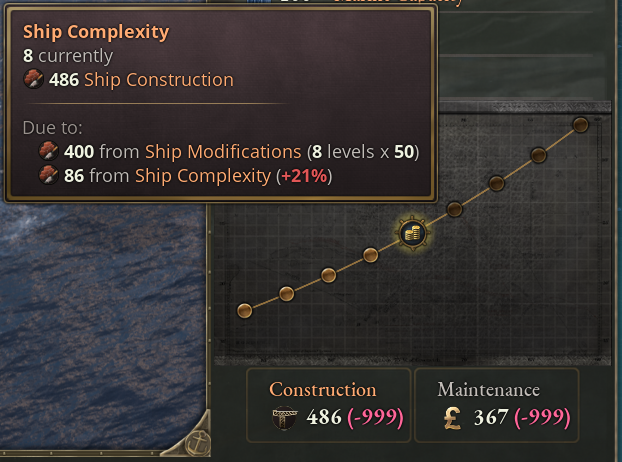
For this, we also added a new piece of tech to highlight a node on a graph, causing it to display a tooltip. We’ll likely make use of this in the future in other graphs across the game. For now though, only this one.
But how do you actually get these changed values to your ships?
In order to make any Ship Designer effective, you need to be able to construct both cheap frigates focussing on efficient supply consumption as well as heavily armored frigates with high firepower. That is what templates are used for - to save your own setups and construct different versions of the same ship type.
A template is determined by a ship type and all selected Ship Modifications for it.
To create a new template, you press the according button in the list of templates when choosing what ship to construct. Alternatively, you can go to the Navy tab in the Military panel, where you will find the “Create Ship Template” button that will also take you to the Ship Designer panel.
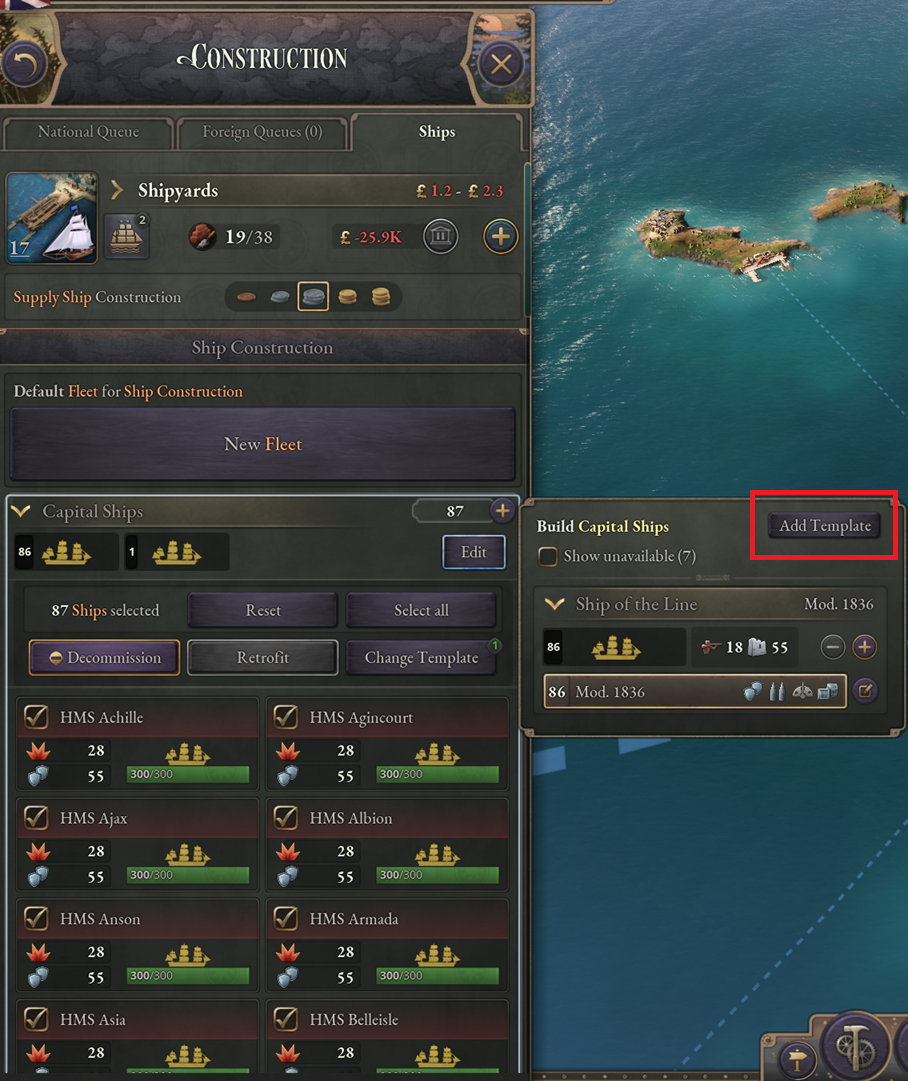 Many ways to enter the Ship Designer. Editing a template also gets you there!
All ship types have a default template set up from the start of the game, featuring the medium level Ship Modifications in all four groups.
This, in turn, is also the list of templates that you will have available to you if you don’t own The Great Wave. But it also serves the side benefit, that if you really don’t want to engage with customizing your fleet, you can simply stick to the default templates.
A template has a name—which you can change, of course—to make it easily identifiable. This name will also be repeated in all other relevant places in the interface that are referring to the template that a given ship is based on.
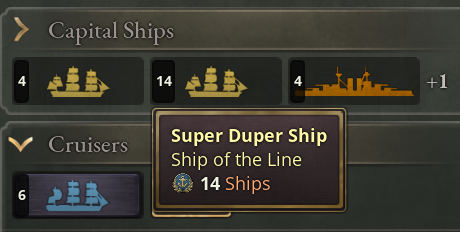
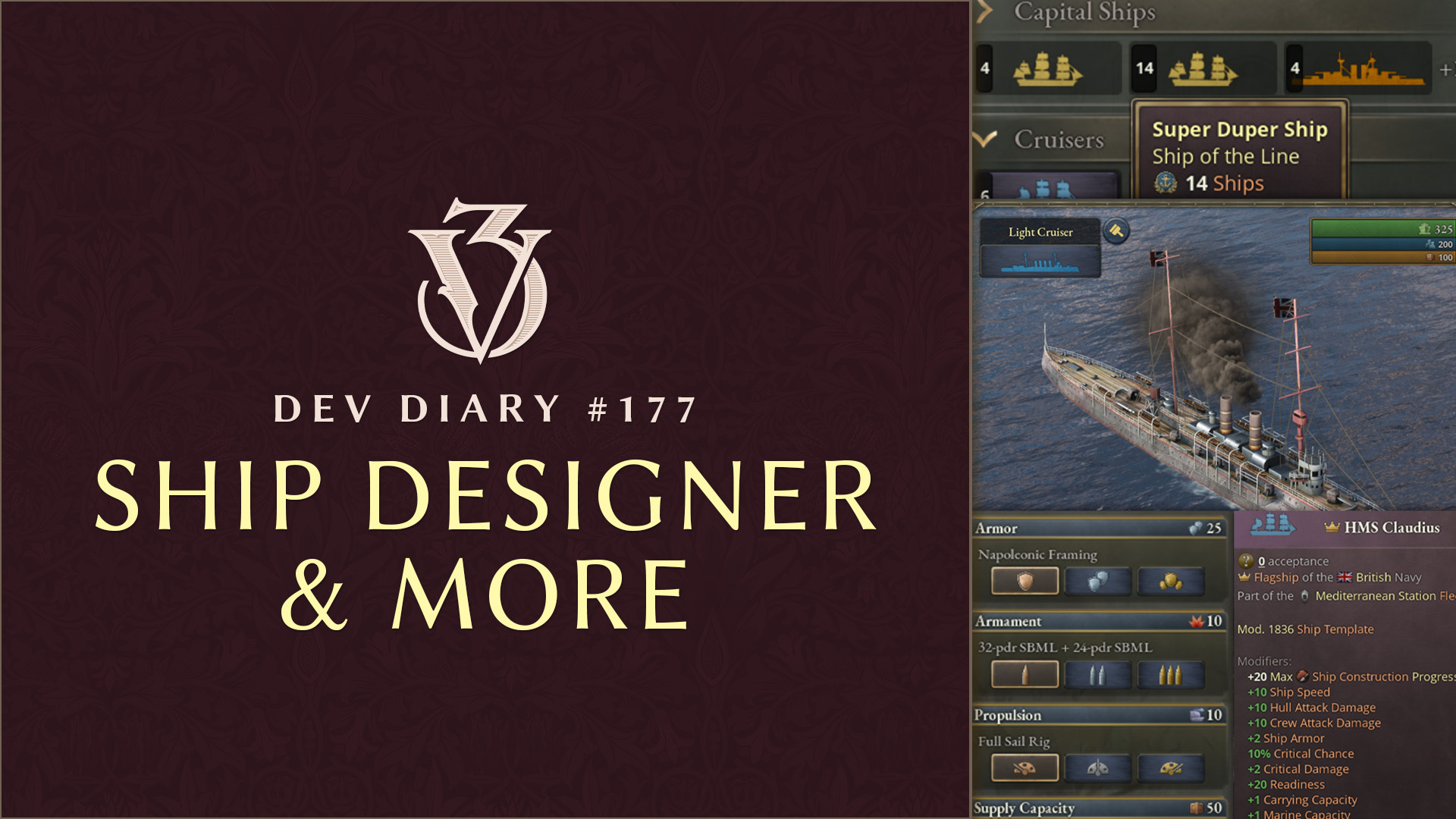
4 Ship of the Line of the Base Template, and 14 Super Duper Ships of the new template you created
But of course creating a new template is not the only way to navigate ship designs. You can just as well edit existing templates if you want your Frigates to get big guns, for example.
Once you edit the template of a ship that has been constructed already, all ships of that template will be marked as being outdated.
To apply a change in an existing template, a ship or group of ships has to be given a specific command to return to port and get it installed via a shipyard. The costs for this action depend on the modification, e.g. if the armor needs to be improved, the construction cost in terms of goods, time and Ship Construction Points depends on the specific cost of the armor, rather than the whole ship. Starting an upgrade/refitting process creates an entry in the ship construction queue like regular ship construction would.
Once completed, the ships in question will return to the fleet.
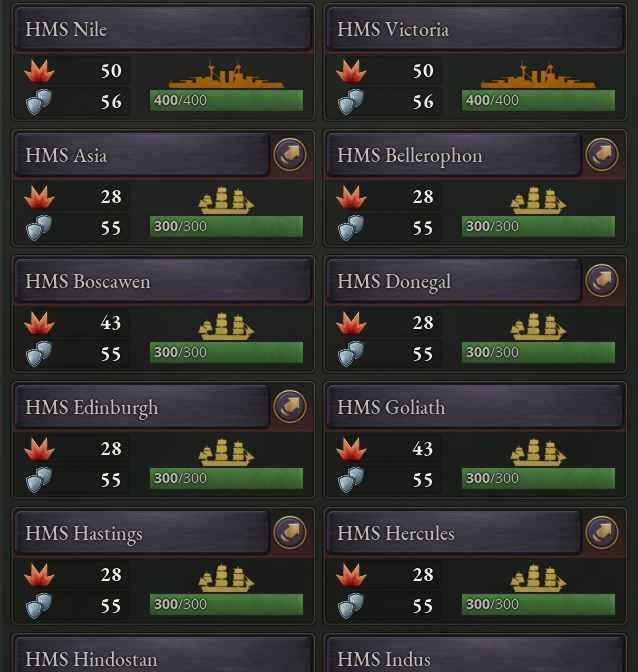
The arrows are not only indicating a possible change in the ship’s template, but also act as the button to send an individual ship to be retrofit
Last but not least, I want to quickly mention the Wildcard Modifications.
Depending on the ship type, you can install a few Wildcard options into your ships. These can be used to provide a particular specialization to a ship template in order to shape their role further.
Wildcards range from something like patrol boats which increase the ship’s blockade strength, to medical stations which reduce the crew damage suffered in combat, to fire suppression which reduces the damage of critical hits it suffered.
Many of these only become relevant for the more modern ship types, and generally the bigger the ship, the more wildcard slots it will have.
Each wildcard option you use of course also increases the construction cost for the ship as outlined before.
Alright, that’s it on the Ship Designer I think! From the flagship feature to another feature, Flagships.
Flagships are a special status which symbolizes the pride of your fleet. Your entire Navy can only have one Flagship at a time!
Designating one of your ships as your Flagship is easy. You can choose any of your existing ships, be her the most modern and badass ship (cough HMS Claudius cough) or the oldest ship that serves more of a nostalgic purpose - it’s up to you.
To do so, you open the individual ship panel of the ship you’d like to assign this special status.
On the bottom you will find the “Assign as Flagship” button, which is all you need.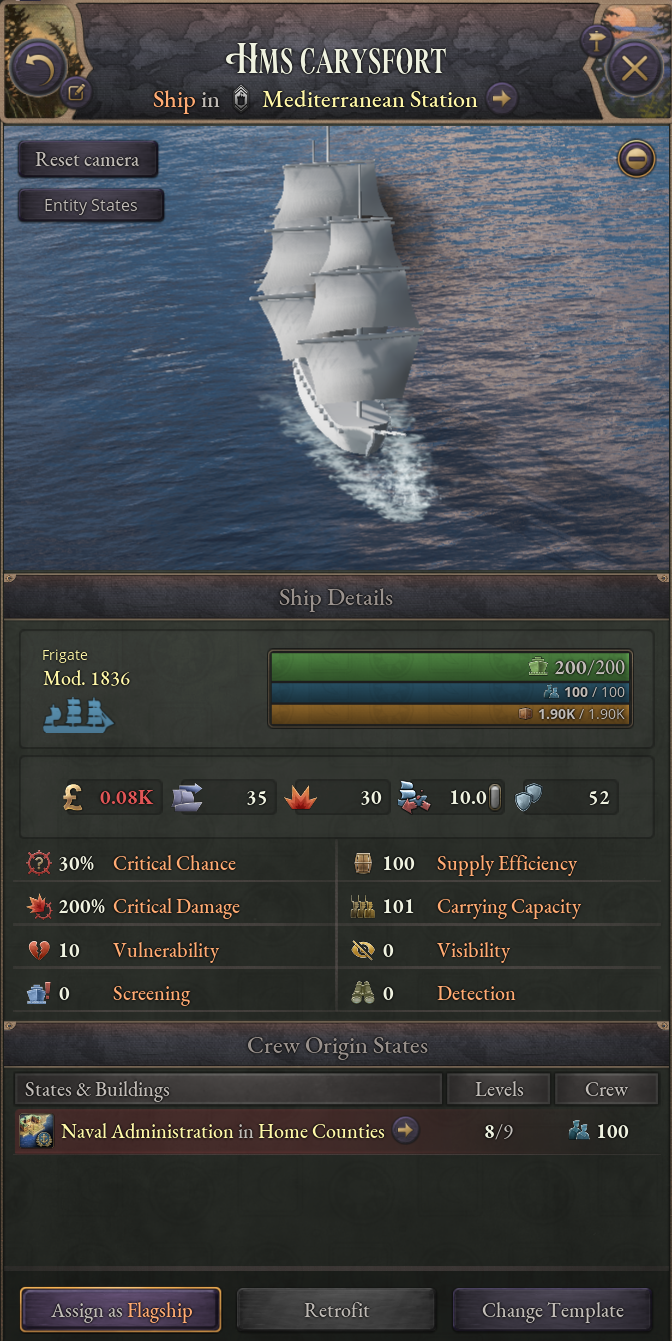
Go on, you know you want to press that shiny button. As last time, the textures are of course not final. In the Art Dev Diary, we will show off more final looks of the ships.
Congratulations, you now have a flagship!
In the same ship panel, you now get some options to customize the figurehead of your flagship. Sadly I can’t present the options yet, since the 3D models for them are still in development by our Art team.
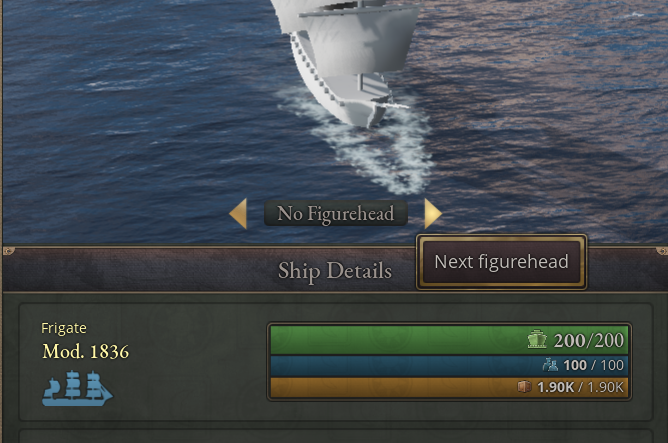
“They lead only as the carved wooden figurehead leads the ship”
In comments surrounding the last few Dev Diaries, I also saw some interesting suggestions for additional customization, which we will consider for after the release of the Update.
But what about the actual effects of Flagships?
Well, first of all, the presence of a Flagship in a Fleet increases the Involvement that is being generated by this fleet.
Involvement, as a reminder, is the value that you will need to increase to reach higher levels of Interest in a Strategic Region, as outlined in our Dev Diary.
Furthermore, the presence of the Flagship in naval battles plays a role. Specifically, the outcome of the battle. If your Flagship is present during a successful naval battle, you’ll earn some deserved Prestige for your country.
But the opposite is also true. If your Flagship is participating in a lost battle, your country is going to be made fun of at the expense of some Prestige.
And beware of your Flagship being sunk in battle. The shame of suffering such loss is a painful one.
The flagship status or presence in a fleet is presented in relevant places with this cute crown icon. 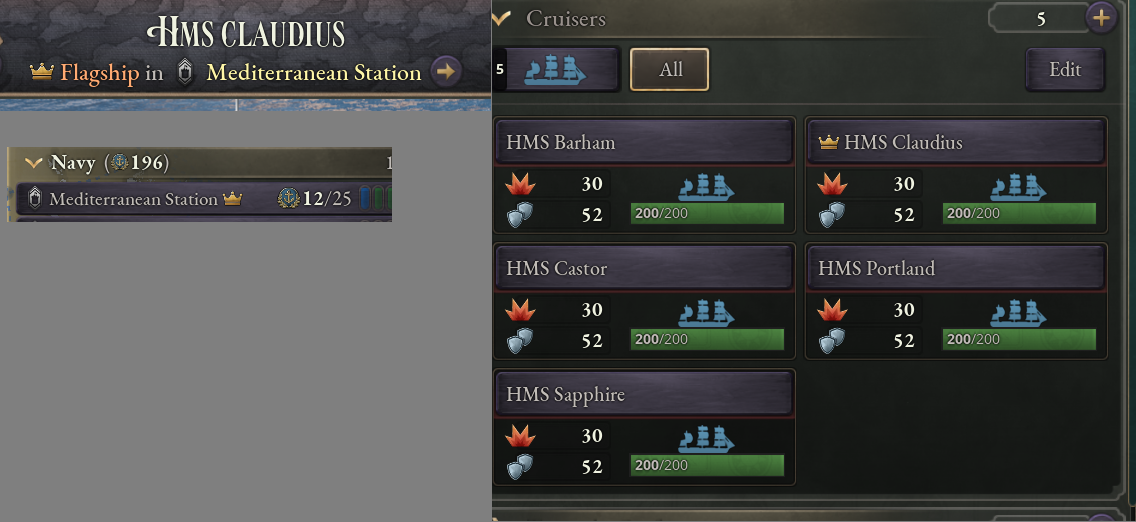 You made the right choice with the ship, she won’t disappoint you
Now, moving on to the next topic.
I would like to start with a note on ship commissioning, where you order a ship to be built by another country before it actually exists: We would of course have liked to do that, but it was simply not feasible. The added complexity for this is many many times more time consuming. Apart from needing to add foreign entries into your own ship construction queue (which is to this day a source of bugs in foreign investment), one would have to come up with custom code solutions for all of these questions and more around its edgecases:
What happens if the shipyards in the commissioned country get destroyed or occupied?
Can you deprioritize an entry you got from another country? Is that breaking the treaty? If so, what happens in that case?
What do you do with a half-finished ship entry if the treaty is nullified? Do you switch it to the building country's ownership?
Do you have to crew the ship to ferry it to its target destination?
I hope you can see that, unfortunately, it’s a bit more complicated than simply granting another country their ship construction points. Therefore this was out of reach for us.
To compensate for this lack of ordering, we’re making it so the AI will try to produce a small extra percentage of ships compared to how big they’d like their fleet to be, so that there should be enough options for ship purchasing.
So, let’s talk about what we are actually offering instead since some people in the comments of previous Dev Diaries have asked what you will do with your outdated ships, for example your wooden ones when steel ships are being established.
While you can always decommission them, a maybe better answer will be to sell them to other countries. These might still be interested due to their own technology or those of their rivals lagging behind, or simply because they are desperate.
Of course you can also sell your most modern ships, either because you don’t fear this coming to haunt you, you want to support a trusted ally, or simply because the other country is having particularly deep pockets.
In all cases, you will make use of the new “Ship Transfer” Treaty article that you use like any other. For this, we have made it possible to target ships as tradeable objects. Previously this was limited to goods and states.
When you select it, it opens a list of all ships you or the other country owns. You can use filters to shorten that list which may be useful if you’re dealing with Great Powers.
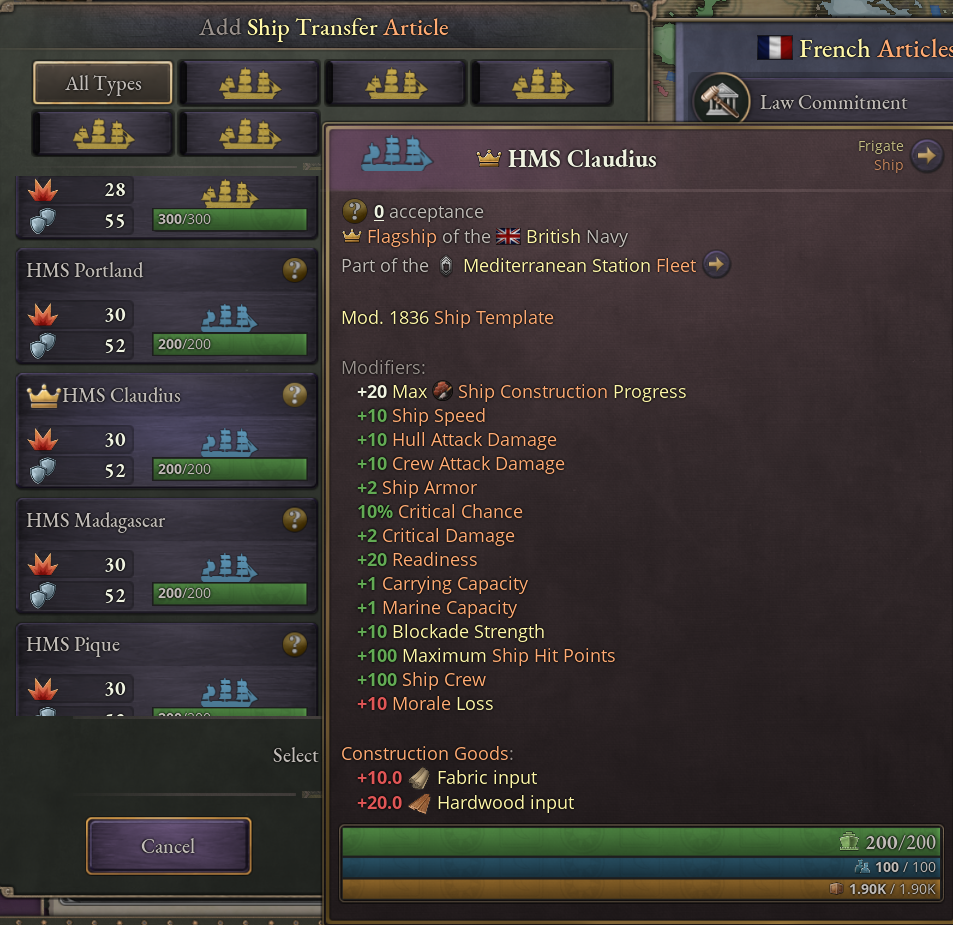 Oh you wouldn’t really give away the HMS Claudius, now would you?!
This way, you can add as many or few ships as you would like. Just like any other treaty, it can be composed of different articles as well, for example to get some money or investment rights in the target country.
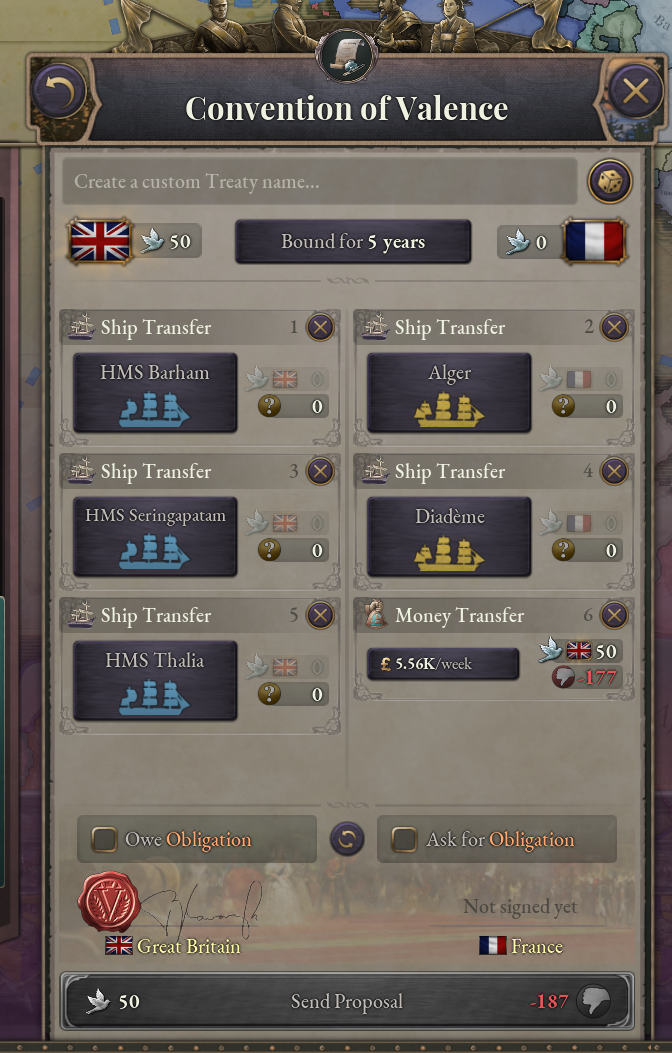
Really not sure that’s a good trade for them…
And that is how you can trade ships with other countries!
Alright folks, that’s all for today. We hope you enjoyed this look at the Ship Designer and other features.
Next Thursday, Cabin Boy Tunay will be back with a look at how Naval Combat changes in the 1.13 Update and also how Gunboat Diplomacy in The Great Wave will play out when it releases on April 28.
Until then, have a Happy Capitalized Thursday!
Schedule of our upcoming Dev Diaries:
April 02 - Naval Combat & Gunboat Diplomacy
April 09 - Narrative Content of The Great Wave
April 16 - Art & Music of The Great Wave
April 23 - Changelog & Achievements
April 28 - Release of The Great Wave and Update 1.13
What's Your Reaction?