





![[PRO Tips] Gold’s Bullish Revival: Seasonal Trends and Key Levels to Watch](https://xinker.org/uploads/images/202412/image_430x256_67724cc6ad0cd.webp)
![[PRO Tips] Gold Market Under Short-Term Pressure, Safe-Haven Demand and Central Bank Buying Support Long-Term Upside Potential](https://xinker.org/uploads/images/202412/image_430x256_676ffb4685287.webp)
![[PRO Tips] Analysis of 9 key points of differentiation strategy! Master differentiation to create a brand advantage that is unique in the world!](https://firebasestorage.googleapis.com/v0/b/xinker-tips.appspot.com/o/article_thumbnails%2Fscaled_differentiation%20strategy.png.png?alt=media&token=a1bfc3d2-e85a-4db7-8a6d-01c7274f8940)
![[PRO Tips] Will REITs regain growth momentum in 2024? 3 REITs ETFs you must know if you want to invest in real estate.](https://firebasestorage.googleapis.com/v0/b/xinker-tips.appspot.com/o/article_thumbnails%2Fscaled_REITs1.png.png?alt=media&token=8af4eb93-33ff-466f-8039-b6555fad52b4)
![[PRO Tips] Complete tutorial on how to make money in Adobe Stock!](https://firebasestorage.googleapis.com/v0/b/xinker-tips.appspot.com/o/article_thumbnails%2Fscaled_tut-adobe1.png.png?alt=media&token=0b2c8cf2-22bd-4142-883e-140ed1cbaf02)
![[Passive Income] Unlock the secret of passive income: 3 steps to apply for Google AdSense](https://xinker.org/uploads/images/202410/image_430x256_6717a4fb3052b.webp)
![[Passive Income] Earn over $200 a day with AI-generated articles!](https://firebasestorage.googleapis.com/v0/b/xinker-tips.appspot.com/o/article_thumbnails%2Fscaled_article1.png.png?alt=media&token=f61bf35b-8553-4719-826d-7360024adc70)
![[Passive Income] Earn over 20 USD per download with AI-generated images!](https://firebasestorage.googleapis.com/v0/b/xinker-tips.appspot.com/o/article_thumbnails%2Fscaled_adobe2.png.png?alt=media&token=3e20e76a-a907-45af-80aa-bf9b3600301f)
![[Passive Income] Earn 10 USD per new download by sharing CapCut!](https://firebasestorage.googleapis.com/v0/b/xinker-tips.appspot.com/o/article_thumbnails%2Fscaled_capcut2.png.png?alt=media&token=a04dec40-1fac-4857-86f2-19a8be02d38e)
![[Passive Income] Use your WiFi to create passive income in 5 minutes, and you can earn 4-6 U per day!](https://firebasestorage.googleapis.com/v0/b/xinker-tips.appspot.com/o/article_thumbnails%2Fscaled_Grassio.webp.png?alt=media&token=7659a95e-0e47-4f27-a17d-c942ac3cf7f4)


![[Business Talk] The Unique Theme of XINKER's Song: Beef Wellington and Business Mastery](https://xinker.org/uploads/images/202410/image_430x256_671afc155f47f.webp)
![[Business Talk] Chagee: Opening 3,500 stores in 6 years](https://xinker.org/uploads/images/202410/image_430x256_671afce80c5f9.webp)


Silk & Silver Dev Diary #4 - Republics Vision
Hello there!Today, we are going to take a look at republics. We talked a little bit about them in both the announcement video and the original Silk & Silver vision dev diary, but today we will go a bit more into the weeds. Without further ado, let’s get started.\[In the current iteration of the Republic screen, you can see we are still working on it; it isn’t… intended to be so pink by the time we release Silk & Silver]To start us off, what are republics? Republics in Silk & Silver are effectively small city-states, with all the “relevant” people who live there. That means whoever is the current ruler, and all patricians of the city. The patricians are landless nobility and burghers who are part of the assembly of the city, who can vote on matters, and who are (possibly) aiming to become the next head of the republic themselves. In other words, the patricians aren’t landed, but they are all rooted to the city and the politics of the realm. These city-states are inspired by many historical city-states of the Middle Ages, including republics such as Venice, Florence, the Swiss Republics, and the free cities of the Holy Roman Empire. There are different types of republics, but all of them will have patricians who trade in some fashion to fund their political endeavors. As a fun little side note, we also split the Vatican from the city of Rome, so if you want to play as a little manipulative controlling Roman Republic under the Pope, that is now a neat little opportunity in Silk & Silver. In real life, many of our more well-known republics had a tendency to start off as communal city-states, eventually turning into signorias, semi-tyrannical city-states led by a single family. That was our starting point as we went into this, and we wanted to depict this in the game. These smaller entities often punched above their weight in very specific, limited ways. We wanted families in the city-state to matter, and to both quabble and plot together. It was supposed to be a playstyle for people who didn’t want to go wide and build a huge realm, but rather focus on internal politicking, scheming, changing laws, and trade. The idea being that all patricians would have access to trade to fund their political schemes and careers. You would have the opportunity to start out in a small commune and, over time, turn it into your personal city-state, one you control entirely in all but name. House AmbitionsWe’re adding house ambitions, a type of house attribute (think like the Mandala Aspects or the House Aspiration in Japan) that defines the kind of idea your house has for the republic. It was one of the things we wanted early on, so we could get that immediate feel for what different houses care about. The idea being that as you set out on your republic journey, you’d have several “actors” in the republic (irrelevant of the characters themselves), so over time you’d start knowing specific families for their values and stances: “Ah, the Zorzi family, they always foil my plans!” Popular OpinionWe wanted Popular Opinion to play an important and special role in republics, serving as a way for the public to interact with the republic's ruler, which we felt was more important for republics than for most other landed forms of government in the game. As we are reworking the mechanic anyway, it seemed like a prime opportunity to do something extra. As you might imagine, being a very unpopular ruler in a republic might have some consequences for your health. As you are intrinsically linked to the city-state, so is progression in some ways. A smaller count-tier city-state can only sustain one family and have a limited amount of laws (more on them soon), and they don’t really become proper republics until they become duke-tier. Unlike regular rulers, republics don’t really use DeJure per se; they build their own titles as they grow in importance, but these are locked behind the prestige of their rulers, the size of their settlements (see vision dev diary for more about settlement size), and other factors. As they become a duke tier, more families will join the republic, and squabbling will begin in earnest to form the republic in whatever way the patricians want. And as they continue to grow, they will be able to spread their roots and become smaller merchant empires akin to Venice in real life. Now, before we move on to anything else, we should discuss the politics of the republic a little bit, and the Assembly mechanic we are adding in Silk & Silver. The Assembly is where the republic votes on public matters and the mechanics of the republic itself. Any assembly member can step up and propose law changes at any given time, and the whole assembly will then proceed to vote on said matter for the next 6 months. Before we move on, we should also mention that in the republic, we usually have elections as the succession law. Meaning that, similar to e.g. the Holy-Roman Empire, the title passes based on votes. If you are somewhat tyrannical, you

Hello there!
Today, we are going to take a look at republics. We talked a little bit about them in both the announcement video and the original Silk & Silver vision dev diary, but today we will go a bit more into the weeds. Without further ado, let’s get started.
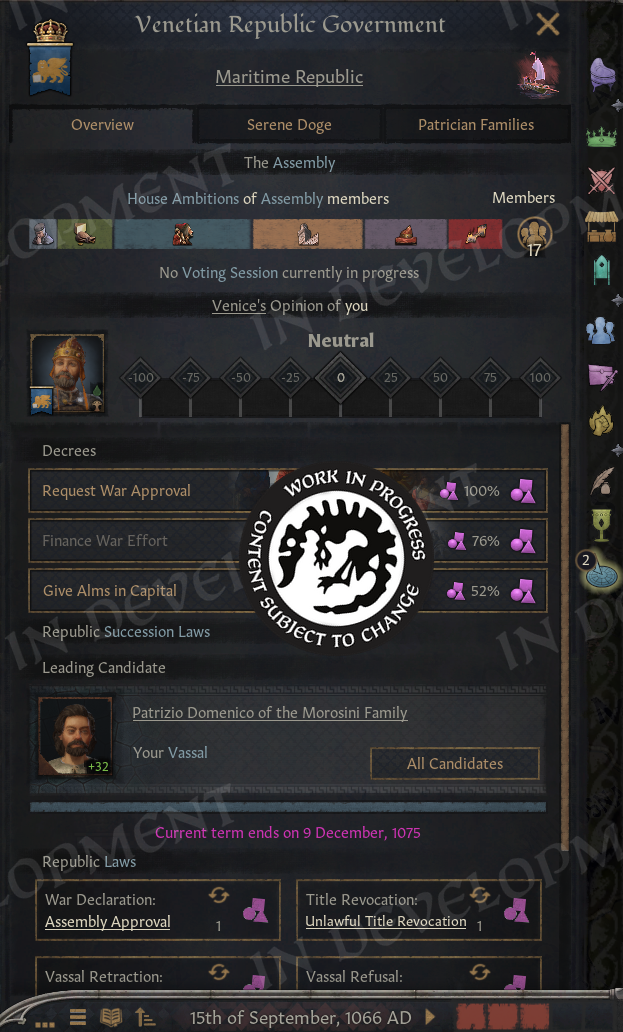
\[In the current iteration of the Republic screen, you can see we are still working on it; it isn’t… intended to be so pink by the time we release Silk & Silver]

To start us off, what are republics? Republics in Silk & Silver are effectively small city-states, with all the “relevant” people who live there. That means whoever is the current ruler, and all patricians of the city. The patricians are landless nobility and burghers who are part of the assembly of the city, who can vote on matters, and who are (possibly) aiming to become the next head of the republic themselves. In other words, the patricians aren’t landed, but they are all rooted to the city and the politics of the realm.
These city-states are inspired by many historical city-states of the Middle Ages, including republics such as Venice, Florence, the Swiss Republics, and the free cities of the Holy Roman Empire. There are different types of republics, but all of them will have patricians who trade in some fashion to fund their political endeavors. As a fun little side note, we also split the Vatican from the city of Rome, so if you want to play as a little manipulative controlling Roman Republic under the Pope, that is now a neat little opportunity in Silk & Silver.

In real life, many of our more well-known republics had a tendency to start off as communal city-states, eventually turning into signorias, semi-tyrannical city-states led by a single family. That was our starting point as we went into this, and we wanted to depict this in the game. These smaller entities often punched above their weight in very specific, limited ways.
We wanted families in the city-state to matter, and to both quabble and plot together. It was supposed to be a playstyle for people who didn’t want to go wide and build a huge realm, but rather focus on internal politicking, scheming, changing laws, and trade. The idea being that all patricians would have access to trade to fund their political schemes and careers. You would have the opportunity to start out in a small commune and, over time, turn it into your personal city-state, one you control entirely in all but name.
We’re adding house ambitions, a type of house attribute (think like the Mandala Aspects or the House Aspiration in Japan) that defines the kind of idea your house has for the republic. It was one of the things we wanted early on, so we could get that immediate feel for what different houses care about. The idea being that as you set out on your republic journey, you’d have several “actors” in the republic (irrelevant of the characters themselves), so over time you’d start knowing specific families for their values and stances: “Ah, the Zorzi family, they always foil my plans!”
We wanted Popular Opinion to play an important and special role in republics, serving as a way for the public to interact with the republic's ruler, which we felt was more important for republics than for most other landed forms of government in the game. As we are reworking the mechanic anyway, it seemed like a prime opportunity to do something extra.
As you might imagine, being a very unpopular ruler in a republic might have some consequences for your health.

As you are intrinsically linked to the city-state, so is progression in some ways. A smaller count-tier city-state can only sustain one family and have a limited amount of laws (more on them soon), and they don’t really become proper republics until they become duke-tier. Unlike regular rulers, republics don’t really use DeJure per se; they build their own titles as they grow in importance, but these are locked behind the prestige of their rulers, the size of their settlements (see vision dev diary for more about settlement size), and other factors.
As they become a duke tier, more families will join the republic, and squabbling will begin in earnest to form the republic in whatever way the patricians want. And as they continue to grow, they will be able to spread their roots and become smaller merchant empires akin to Venice in real life.

Now, before we move on to anything else, we should discuss the politics of the republic a little bit, and the Assembly mechanic we are adding in Silk & Silver. The Assembly is where the republic votes on public matters and the mechanics of the republic itself. Any assembly member can step up and propose law changes at any given time, and the whole assembly will then proceed to vote on said matter for the next 6 months.
Before we move on, we should also mention that in the republic, we usually have elections as the succession law. Meaning that, similar to e.g. the Holy-Roman Empire, the title passes based on votes. If you are somewhat tyrannical, you can change it to a despot succession down the line, if you feel like your family is the only one fit to rule.
Now, most parts of this assembly are in themselves put together by laws. So who is actually a part of the Assembly? Well, that’s a law. Currently, these are the alternatives:
Patrician Assembly: All patrician house heads
Governing Council: The ruler’s council members
General Assembly: All patrician house heads and republican vassals
Parliament: All patrician house heads and vassals (in general)
Now, how many votes do you need for something to pass? You guessed it, that’s a law. So it can be either a simple majority, a two-thirds majority, or a unanimous vote. That means that as you pass, you can, in theory, make a law setup that you are happy with, and then try to pass a unanimous vote to ensure that it sticks around in perpetuity.
Another part is, of course, what the Assembly can actually vote for. Yet again, that is another law. At most, they can vote on Laws, Decrees (more on that later), and Election Laws. At the very least, they can always vote for Election Laws.
Some other laws we have at the moment, though I don’t expect it to be final by the time we release Silk & Silver, as we are still looking into things to hook it into.
Term Length - How long the current ruler is going to sit (Minimum 5 years, maximum for life)
War Declaration - Whether the ruler has to have assembly approval for it or not
Title Revocation - If you can revoke titles from vassals
Vassal Retraction - If you can retract vassals from vassals
Vassal Refusal - If declining a revocation or retraction is considered criminal for the vassal
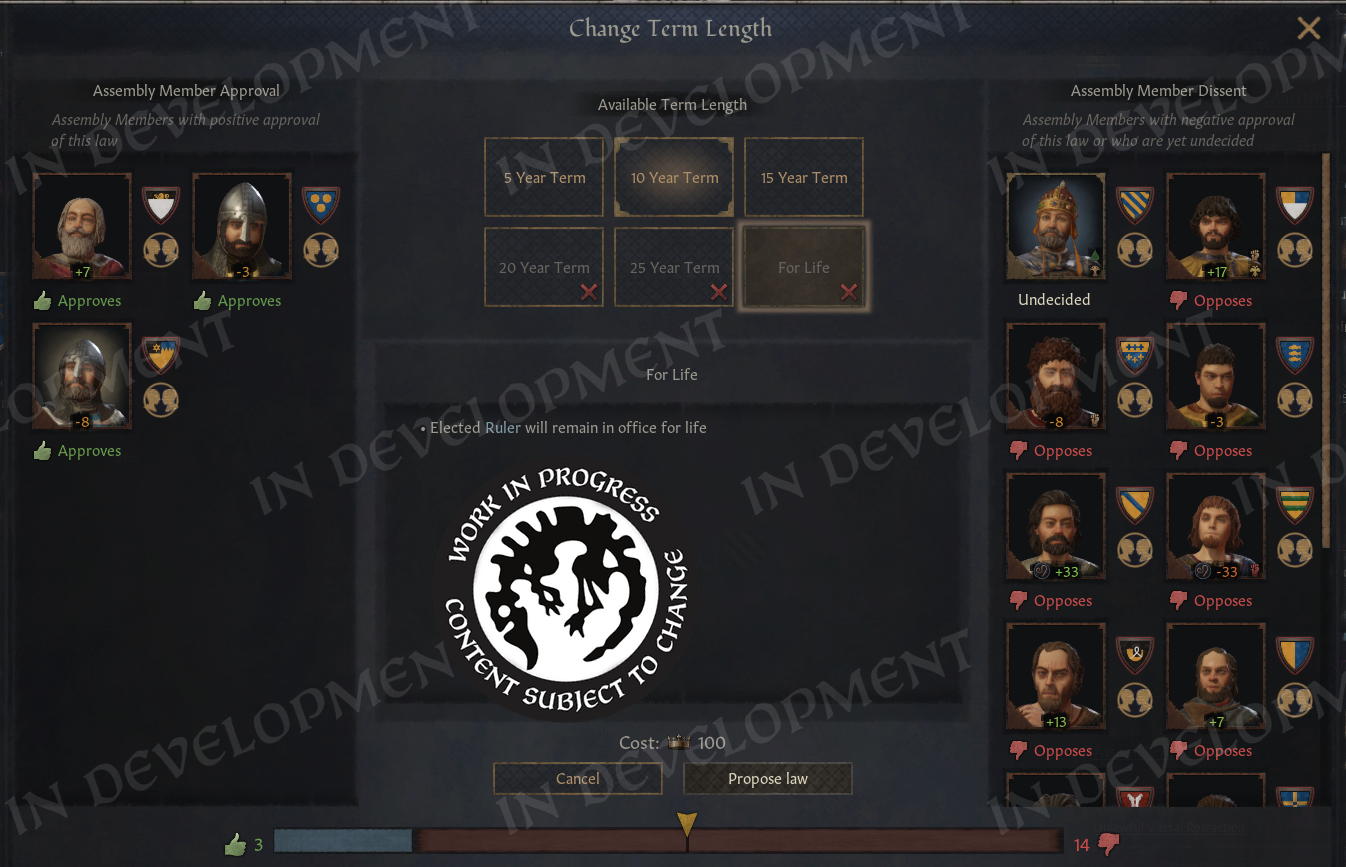
We mentioned decrees a bit earlier, but let’s go into what they actually are. Decrees are effectively government-specific decisions for republics that depend on the Assembly, usually detailing the use of the government treasury. For republics, treasuries will be used only by the head of the republic, and they will be used for buildings, decrees, and title men-at-arms, and gained by buildings and decrees.
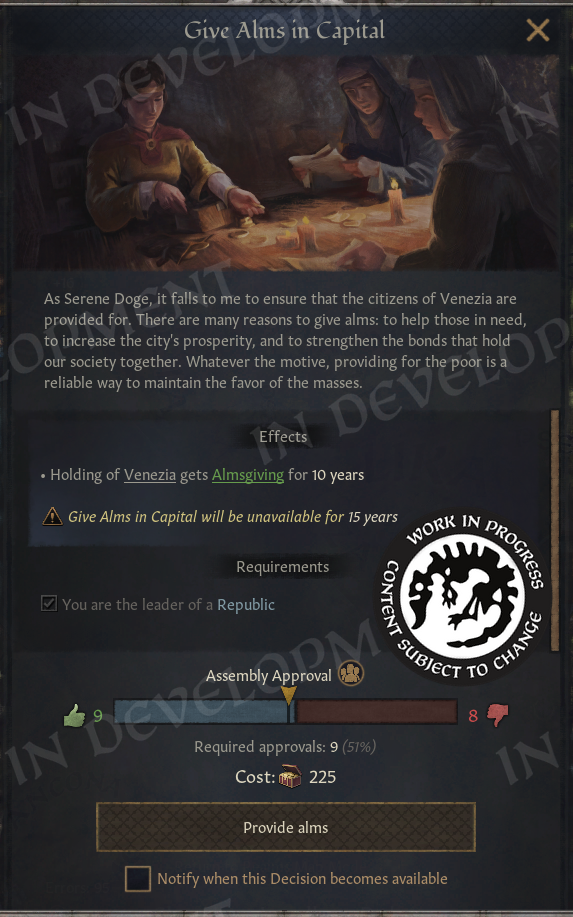
For a decree, as shown in the picture, you will usually be able to use the government treasury with the Assembly's approval. Of course, it comes down, yet again, to the laws of your republic, how many votes you need, who can vote, etc. But if you get approval, the decree is effectively like enacting a decision in the game, with a cost, an effect, and some requirements for it to be chosen.

In the vision Dev Diary, we talked a little bit about the new district & building system, and as part of that, we have also added a new district specific to Republics: the Trade Post. These are inspired by the Hanseatic Kontors and the Italian Fondachi, and they are effectively districts you hold in someone else’s lands. Every Patrician has a limit to how many trade posts they can hold at any given time, and every county in the world can have one trade post. Some areas, usually those far away from any republic character, will not see any, whereas other areas will have several characters flock and scheme to take trade posts from one another.
As republics are quite limited in how much land they can hold, this is another avenue where they can effectively expand to gain some more power, and it also gives them some neat benefits in other people’s lands, which can help them in different ways.
Within this district, we have some regular buildings that will just increase sell prices and decrease buy prices, for those who want to synergize with their ongoing trade routes or just increase their money-making in different ways. Besides those more simplistic ones, we also have buildings that let you negotiate an alliance with a local ruler, recruit culturally locked local men-at-arms, or increase your mercenary limit. Say, speaking of mercenary limits…

With Silk & Silver, we are introducing a new mercenary limit that caps the number of mercenaries that can be employed at any given time. It was always curious that people who had a lot of money could, in theory, just “money” away wars, by tossing enough of it at the problem. We have added a mercenary limit, so people who are actually good at war will be able to use and organize mercenaries more effectively than their richer counterparts, if they can afford them.
Like most modifiers, this can be adjusted by most places we hand out modifiers in the game, such as government types, cultural traditions, and lifestyles. For republics, they will start with a somewhat higher mercenary limit than regular rulers do, as they are otherwise a bit weaker militarily.

One of the republic fantasies of our time period is, of course, to be able to become the Hanseatic League. It was a powerful trade league that controlled trade through the Baltic Sea and had a significant impact on all its neighbors and trade partners.
Trade Leagues are confederations of republics that come together to pool their resources and monopolies, and ensure wealth for all participants. They are the ones who out-compete the regular merchants and the smaller republics in the area. As the league continues to grow more powerful and cohesive, it will eventually become more competitive and make a singular title through a new decision.
The idea is that forming large trade leagues should be a goal for players to achieve, which, in some ways, puts them at the very top of the food chain among merchants and republics.

Thanks for taking the time to read the dev diary about republics. There’s still a lot of work remaining. Of course, we will come back with more details later. One thing of note is that this is our last Silk & Silver dev diary planned before summer, so we will be back with more dev diaries in early August after our summer break. I hope you have all enjoyed our latest dev diaries on the work we are putting into the expansions this year, and that you are as stoked to play them as we are to release them!
What's Your Reaction?











![[Business Talk] Chagee: Opening 3,500 stores in 6 years](https://xinker.org/uploads/images/202410/image_140x98_671afce94bf91.webp)