

![[PRO Tips] Gold’s Bullish Revival: Seasonal Trends and Key Levels to Watch](https://xinker.org/uploads/images/202412/image_430x256_67724cc6ad0cd.webp)
![[PRO Tips] Gold Market Under Short-Term Pressure, Safe-Haven Demand and Central Bank Buying Support Long-Term Upside Potential](https://xinker.org/uploads/images/202412/image_430x256_676ffb4685287.webp)
![[PRO Tips] Analysis of 9 key points of differentiation strategy! Master differentiation to create a brand advantage that is unique in the world!](https://firebasestorage.googleapis.com/v0/b/xinker-tips.appspot.com/o/article_thumbnails%2Fscaled_differentiation%20strategy.png.png?alt=media&token=a1bfc3d2-e85a-4db7-8a6d-01c7274f8940)
![[PRO Tips] Will REITs regain growth momentum in 2024? 3 REITs ETFs you must know if you want to invest in real estate.](https://firebasestorage.googleapis.com/v0/b/xinker-tips.appspot.com/o/article_thumbnails%2Fscaled_REITs1.png.png?alt=media&token=8af4eb93-33ff-466f-8039-b6555fad52b4)
![[PRO Tips] Complete tutorial on how to make money in Adobe Stock!](https://firebasestorage.googleapis.com/v0/b/xinker-tips.appspot.com/o/article_thumbnails%2Fscaled_tut-adobe1.png.png?alt=media&token=0b2c8cf2-22bd-4142-883e-140ed1cbaf02)
![[Passive Income] Unlock the secret of passive income: 3 steps to apply for Google AdSense](https://xinker.org/uploads/images/202410/image_430x256_6717a4fb3052b.webp)
![[Passive Income] Earn over $200 a day with AI-generated articles!](https://firebasestorage.googleapis.com/v0/b/xinker-tips.appspot.com/o/article_thumbnails%2Fscaled_article1.png.png?alt=media&token=f61bf35b-8553-4719-826d-7360024adc70)
![[Passive Income] Earn over 20 USD per download with AI-generated images!](https://firebasestorage.googleapis.com/v0/b/xinker-tips.appspot.com/o/article_thumbnails%2Fscaled_adobe2.png.png?alt=media&token=3e20e76a-a907-45af-80aa-bf9b3600301f)
![[Passive Income] Earn 10 USD per new download by sharing CapCut!](https://firebasestorage.googleapis.com/v0/b/xinker-tips.appspot.com/o/article_thumbnails%2Fscaled_capcut2.png.png?alt=media&token=a04dec40-1fac-4857-86f2-19a8be02d38e)
![[Passive Income] Use your WiFi to create passive income in 5 minutes, and you can earn 4-6 U per day!](https://firebasestorage.googleapis.com/v0/b/xinker-tips.appspot.com/o/article_thumbnails%2Fscaled_Grassio.webp.png?alt=media&token=7659a95e-0e47-4f27-a17d-c942ac3cf7f4)


![[Business Talk] The Unique Theme of XINKER's Song: Beef Wellington and Business Mastery](https://xinker.org/uploads/images/202410/image_430x256_671afc155f47f.webp)
![[Business Talk] Chagee: Opening 3,500 stores in 6 years](https://xinker.org/uploads/images/202410/image_430x256_671afce80c5f9.webp)


Gambonanza review – Checkers, not chess
Chess is a classic game, and more popular than ever—also, crucially, fiendishly hard to innovate on. That hasn’t stopped people from trying, and you’d be surprised at how many chess-themed indie games are out there on Steam. From 5D Chess With Multiverse Time Travel for a sugar high to notable puzzle games like Chessformer and Chessarama, or outright roguelites like Pawnbarian and Shotgun King: The Final Checkmate, it’s tough to stand out. Our latest contender is Gambonanza, an indie game that aims to take some Balatro-esque gambling theming and apply it to a chess roguelike formula. Unfortunately, it creates way too many blunders along the way to make it worth recommending, even for the most casual chess fan.An elitist speaks out Part of what makes this review a genuine challenge for me is that I’m a decent competitive chess player, and my vantage point is therefore very different than that of a more casual fan looking for something vaguely chess-related for a good time. However, I’m confident in saying Gambonanza also has too many holes as a roguelite—from difficulty pacing to variety and interesting choices—to stand out. The game consists of a series of individual combat scenarios on a chessboard—five stages of five levels each and a corresponding boss—which mostly follow the basic rules of the royal game. You and your AI foe take turns one after another, and the pieces move and behave as you would expect in a normal chess game, at least before the various modifiers kick in. At the start of a stage, you get to see the composition and placement of the opponent’s chess pieces and can manually deploy yours on your side of the board in any way you see fit. The regular chess gameplay is modified by “gambits”—global, aura-level effects like “if you have a king and a rook on the board, you have a 1/3 chance to skip your opponent’s turn” or “your bishops can move like queens”—and various special tiles. Unfortunately, most of them are rather straightforward and not particularly interesting. Also known as almost-queens. Screenshot by Destructoid At the start of a fight, you can place three pieces on the chessboard and can have seven in reserve in your “stock,” but as the game goes on, you can upgrade your starting piece count. However, the board also widens by a row every stage. Unfortunately, there's no variation in the combat scenarios themselves. It seems every stage has a given piece configuration for you to go up against (or there are so few alternatives that they ran out too quickly). I was almost able to have chess opening-like set strategies for the early stages, which is not ideal for a roguelite. Gambonanza’s presentation is charming, with a clean lo-fi aesthetic and chill no-stress music, and small humanizing touches like a Metal Gear Solid-like exclamation mark appearing above a piece when it gets attacked, or them catching on fire after they captured multiple pieces in a row. The animations are crisp and neat, but they're a bit too long and get repetitive quickly, even after just a few hours of play. The same goes for the boppy music with its solo track, something that's gently pleasant at first but gets infuriating fast. It’s the same song loop in the menus, in combat, in the shop—everywhere. Token choices at best. Screenshot by Destructoid For a game called Gambonanza, it does very little with its theming beyond surface-level allusions to gambling (your random shop purchases are determined by slots, Pachinko machines, capsules, and the like), making it feel like poor clout-chasing in the post-Balatro world rather than a well-thought-out integration of chess and games of chance. These are but small issues, though: The main problem is that the game fundamentally doesn’t work for what it is trying to do.Artificial stupidity What does it say about Gambonanza’s design that the game could not function with a non-lobotomized AI? I think even the most amateur chess player would immediately recognize that having an invincible chess piece would quickly break proceedings in half. That's exactly the case in boss-fight scenarios, where the enemy has an “elite” piece that cannot be taken unless you have already hoovered up every single other one on their side. This effect is more powerful than almost anything you can conjure up with your combination of Gambits and modifiers, and these fights therefore often come down to how dumb the AI was feeling on that given day, at least on higher difficulties. Winning this will grant no satisfaction. Image via Sidekick Publishing Beating a boss offers no unique loot, just a bit of extra money—and the fact that they're interchangeable across stages makes them even less interesting on repeat encounters. On my first run, mechanized Magnus Carlsen, the best player in the world, was the second boss, and a mask-wearing Botez sister, one of the notable chess influencers, was the final challenge, which, well, insert your desired elitist comment here. You also can’t skip the boss in
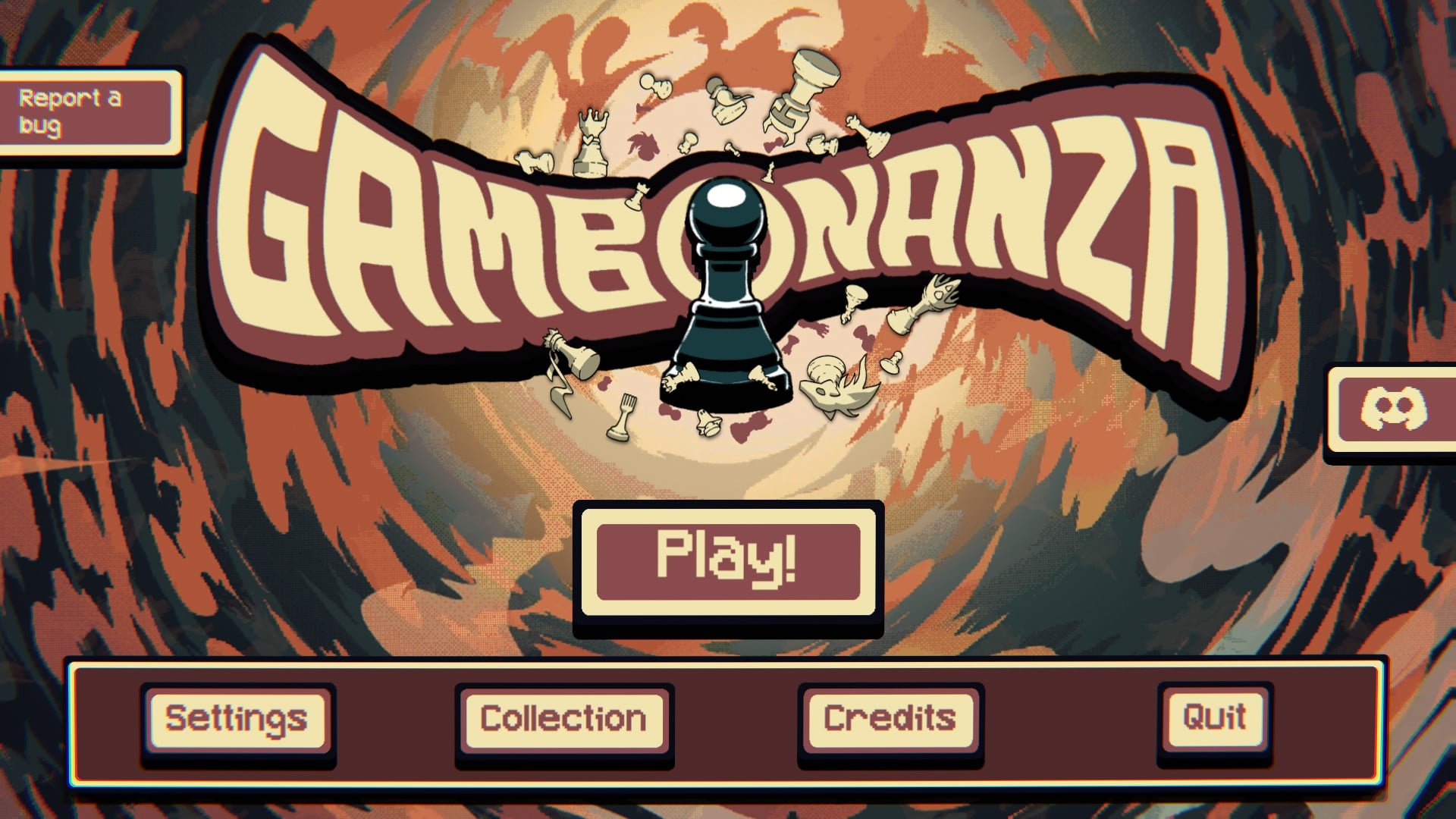
Chess is a classic game, and more popular than ever—also, crucially, fiendishly hard to innovate on. That hasn’t stopped people from trying, and you’d be surprised at how many chess-themed indie games are out there on Steam. From 5D Chess With Multiverse Time Travel for a sugar high to notable puzzle games like Chessformer and Chessarama, or outright roguelites like Pawnbarian and Shotgun King: The Final Checkmate, it’s tough to stand out.
Our latest contender is Gambonanza, an indie game that aims to take some Balatro-esque gambling theming and apply it to a chess roguelike formula. Unfortunately, it creates way too many blunders along the way to make it worth recommending, even for the most casual chess fan.
An elitist speaks out
Part of what makes this review a genuine challenge for me is that I’m a decent competitive chess player, and my vantage point is therefore very different than that of a more casual fan looking for something vaguely chess-related for a good time. However, I’m confident in saying Gambonanza also has too many holes as a roguelite—from difficulty pacing to variety and interesting choices—to stand out.The game consists of a series of individual combat scenarios on a chessboard—five stages of five levels each and a corresponding boss—which mostly follow the basic rules of the royal game. You and your AI foe take turns one after another, and the pieces move and behave as you would expect in a normal chess game, at least before the various modifiers kick in.
At the start of a stage, you get to see the composition and placement of the opponent’s chess pieces and can manually deploy yours on your side of the board in any way you see fit. The regular chess gameplay is modified by “gambits”—global, aura-level effects like “if you have a king and a rook on the board, you have a 1/3 chance to skip your opponent’s turn” or “your bishops can move like queens”—and various special tiles. Unfortunately, most of them are rather straightforward and not particularly interesting.
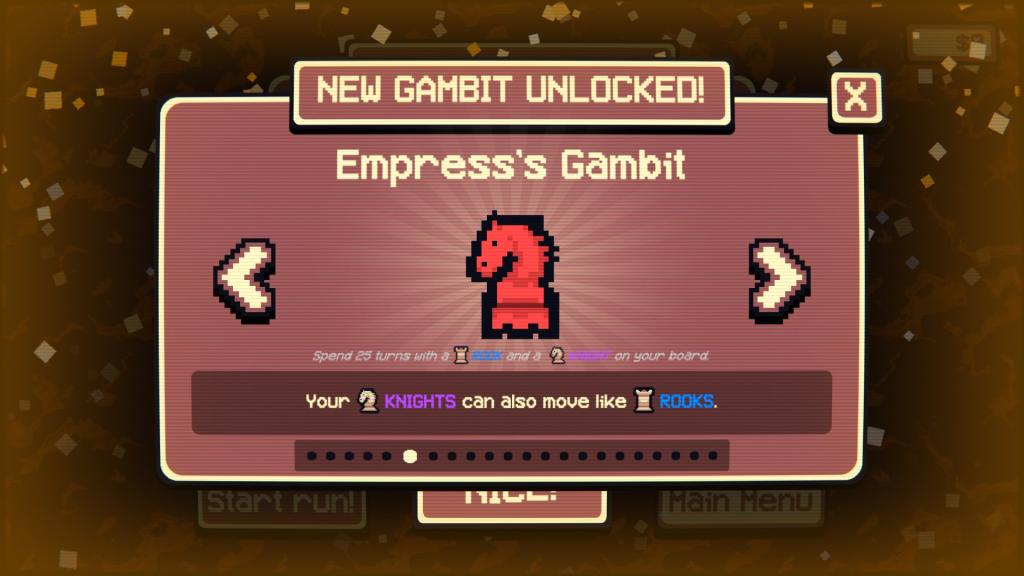 Also known as almost-queens. Screenshot by Destructoid At the start of a fight, you can place three pieces on the chessboard and can have seven in reserve in your “stock,” but as the game goes on, you can upgrade your starting piece count. However, the board also widens by a row every stage.
Unfortunately, there's no variation in the combat scenarios themselves. It seems every stage has a given piece configuration for you to go up against (or there are so few alternatives that they ran out too quickly). I was almost able to have chess opening-like set strategies for the early stages, which is not ideal for a roguelite.
Gambonanza’s presentation is charming, with a clean lo-fi aesthetic and chill no-stress music, and small humanizing touches like a Metal Gear Solid-like exclamation mark appearing above a piece when it gets attacked, or them catching on fire after they captured multiple pieces in a row. The animations are crisp and neat, but they're a bit too long and get repetitive quickly, even after just a few hours of play. The same goes for the boppy music with its solo track, something that's gently pleasant at first but gets infuriating fast. It’s the same song loop in the menus, in combat, in the shop—everywhere.
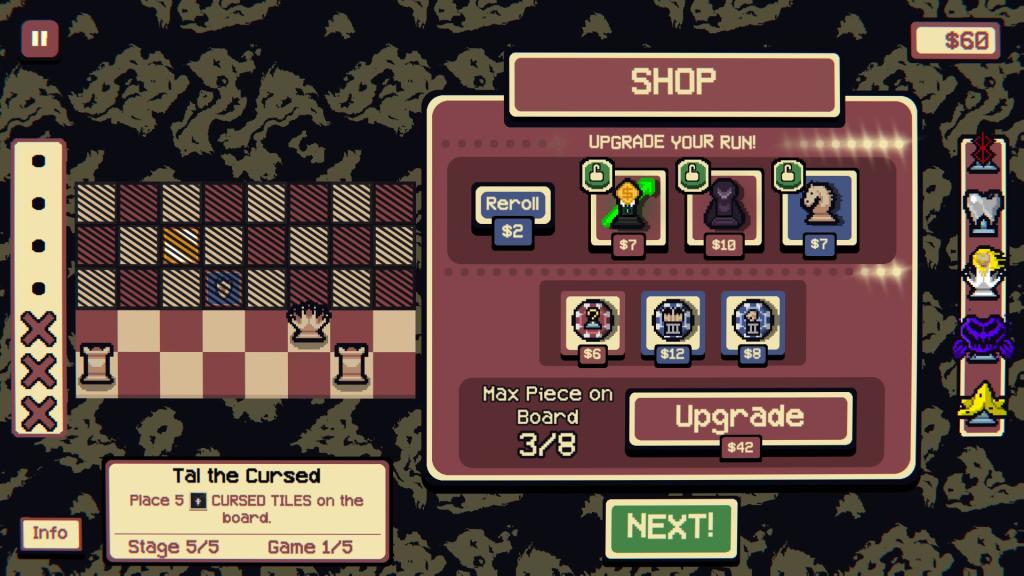 Token choices at best. Screenshot by Destructoid For a game called Gambonanza, it does very little with its theming beyond surface-level allusions to gambling (your random shop purchases are determined by slots, Pachinko machines, capsules, and the like), making it feel like poor clout-chasing in the post-Balatro world rather than a well-thought-out integration of chess and games of chance.
These are but small issues, though: The main problem is that the game fundamentally doesn’t work for what it is trying to do.
Artificial stupidity
What does it say about Gambonanza’s design that the game could not function with a non-lobotomized AI? I think even the most amateur chess player would immediately recognize that having an invincible chess piece would quickly break proceedings in half. That's exactly the case in boss-fight scenarios, where the enemy has an “elite” piece that cannot be taken unless you have already hoovered up every single other one on their side. This effect is more powerful than almost anything you can conjure up with your combination of Gambits and modifiers, and these fights therefore often come down to how dumb the AI was feeling on that given day, at least on higher difficulties.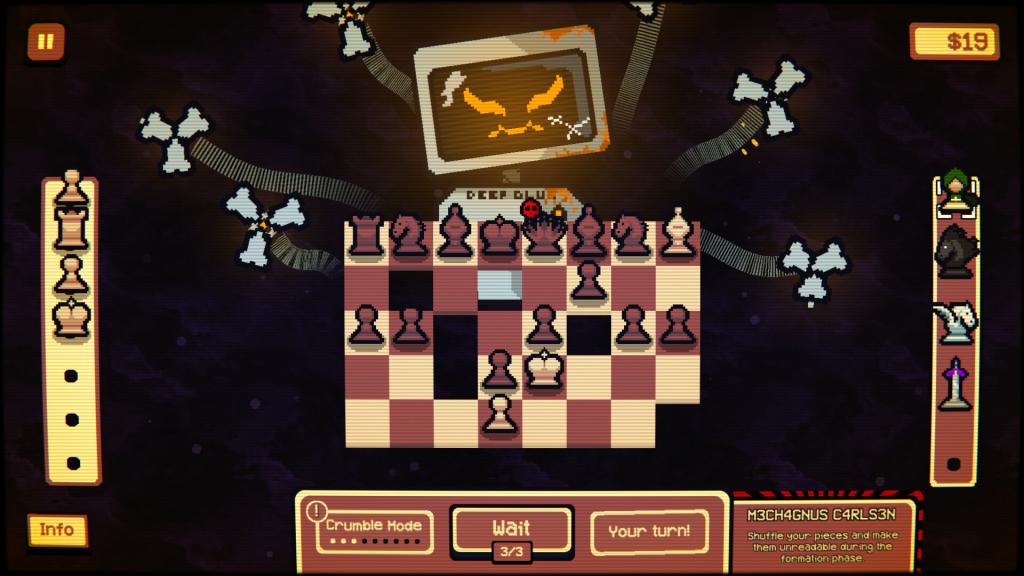 Winning this will grant no satisfaction. Image via
 Sidekick Publishing Beating a boss offers no unique loot, just a bit of extra money—and the fact that they're interchangeable across stages makes them even less interesting on repeat encounters. On my first run, mechanized Magnus Carlsen, the best player in the world, was the second boss, and a mask-wearing Botez sister, one of the notable chess influencers, was the final challenge, which, well, insert your desired elitist comment here. You also can’t skip the boss intro animations, which get excruciating after you have already played a handful of runs.
Even from a gameplay perspective, the interchangeability of bosses means that there are no balancing considerations made for their unique effects, which is flat-out incorrect. Kev Borclick, the boss which has two extra invincible pieces (yes, really) until you pass your turn three times (yes, really) can appear as your first-stage opponent—by which point the AI doesn’t have enough pieces in play to meaningfully leverage this incredible advantage—or the final boss with a near-full army on a board that is 10 rows wide, where you're simply at the mercy of artificial stupidity regardless of your build.
Perhaps this is the most damning part: even winning is not fun in Gambonanza.
A difficulty V
Rather than a curve, Gambonanza’s difficulty progression goes from “you actively have to try to lose” to “the AI has to actively try to lose” in the blink of an eye.The point of a roguelike, I suppose, is to assemble a devastating collection of items to create game-breaking combos, but when the base game is easy enough to defeat with vanilla elements, this point is rendered moot. When you always go first and can directly set up your pieces to get a free capture, or plan for gambits that repeatedly skip your opponent’s turn (like the one you are given in the tutorial run, which is an auto-win in all but name), playing the game feels rote rather than fun.
Gambonanza “levels up” after a successful run, opening up a new difficulty level, each throwing four successive negative modifiers on you alongside a marginal benefit. At first, these changes are small and uninteresting: a lower interest bonus, fewer shop items, limitations on your reserve chess pieces. Soon, you lose the ability to buy queens from the shop. And then, from “bishop difficulty” (which is the fourth out of six for some inexplicable reason), onwards, the AI gets the first move, not you.
And things kind of break there.
It’s not that the game becomes impossible from that point on—though it does get significantly harder—but you’re explicitly at the mercy of the AI and its near-random decision-making. From this point onwards, more wins of mine than not felt like the opponent’s poor choices bailed me out rather than any sort of strong strategy.
But again, it’s tough to formulate a strategy against an invincible piece you can use at any time you’d like.
The problem is compounded by the “crumble” mechanic: if five turns pass without a capture, squares start to fall off the board, with any piece on top of them falling into the void, too. Though the game tells you which squares will fall off on the very next turn, it is otherwise random and you can’t plan even further ahead, so if you end up in a scenario where the AI attacks one of your pieces and another happens to be on a square that is just revealed as one that’s about to fall off, you’ll have to say goodbye to something.
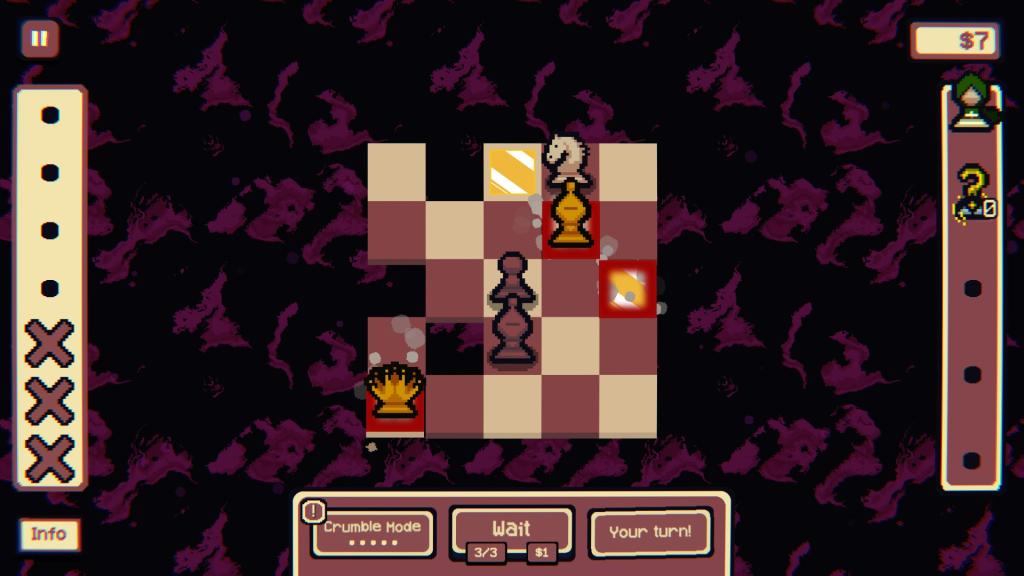 I guess I should have seen this coming somehow. Screenshot by Destructoid By “bishop difficulty” and beyond, crumble mode takes three squares off the board every turn rather than two, which is unfortunately one of the very few meaningful ways the game offers variance in its gameplay loop.
The early stages still remain elementary, even on higher difficulties, and the lack of variety in combat scenarios makes it a chore to replay them over and over again until you get to the challenging parts of the run—and the nature of said challenge at that point we've already dissected in detail.
Gambonanza’s theming fails to go beyond surface-level allusions to both its subject matters, and its gameplay is either elementary or wholly dependent on the baked-in incompetence of its AI. While its presentation does have some fleeting charm, it fails as a chess game, as a gambling game, and also as a roguelite, leaving very little to enjoy. Sometimes, the only winning move is not to play.
The post Gambonanza review – Checkers, not chess appeared first on Destructoid.
What's Your Reaction?








XINKER - Business and Income Tips
Explore XINKER, the ultimate platform for mastering business strategies, discovering passive income opportunities, and learning success principles. Join a community of thinkers dedicated to achieving financial freedom and entrepreneurial excellence.



![[Business Talk] Chagee: Opening 3,500 stores in 6 years](https://xinker.org/uploads/images/202410/image_140x98_671afce94bf91.webp)