




![[PRO Tips] Gold’s Bullish Revival: Seasonal Trends and Key Levels to Watch](https://xinker.org/uploads/images/202412/image_430x256_67724cc6ad0cd.webp)
![[PRO Tips] Gold Market Under Short-Term Pressure, Safe-Haven Demand and Central Bank Buying Support Long-Term Upside Potential](https://xinker.org/uploads/images/202412/image_430x256_676ffb4685287.webp)
![[PRO Tips] Analysis of 9 key points of differentiation strategy! Master differentiation to create a brand advantage that is unique in the world!](https://firebasestorage.googleapis.com/v0/b/xinker-tips.appspot.com/o/article_thumbnails%2Fscaled_differentiation%20strategy.png.png?alt=media&token=a1bfc3d2-e85a-4db7-8a6d-01c7274f8940)
![[PRO Tips] Will REITs regain growth momentum in 2024? 3 REITs ETFs you must know if you want to invest in real estate.](https://firebasestorage.googleapis.com/v0/b/xinker-tips.appspot.com/o/article_thumbnails%2Fscaled_REITs1.png.png?alt=media&token=8af4eb93-33ff-466f-8039-b6555fad52b4)
![[PRO Tips] Complete tutorial on how to make money in Adobe Stock!](https://firebasestorage.googleapis.com/v0/b/xinker-tips.appspot.com/o/article_thumbnails%2Fscaled_tut-adobe1.png.png?alt=media&token=0b2c8cf2-22bd-4142-883e-140ed1cbaf02)
![[Passive Income] Unlock the secret of passive income: 3 steps to apply for Google AdSense](https://xinker.org/uploads/images/202410/image_430x256_6717a4fb3052b.webp)
![[Passive Income] Earn over $200 a day with AI-generated articles!](https://firebasestorage.googleapis.com/v0/b/xinker-tips.appspot.com/o/article_thumbnails%2Fscaled_article1.png.png?alt=media&token=f61bf35b-8553-4719-826d-7360024adc70)
![[Passive Income] Earn over 20 USD per download with AI-generated images!](https://firebasestorage.googleapis.com/v0/b/xinker-tips.appspot.com/o/article_thumbnails%2Fscaled_adobe2.png.png?alt=media&token=3e20e76a-a907-45af-80aa-bf9b3600301f)
![[Passive Income] Earn 10 USD per new download by sharing CapCut!](https://firebasestorage.googleapis.com/v0/b/xinker-tips.appspot.com/o/article_thumbnails%2Fscaled_capcut2.png.png?alt=media&token=a04dec40-1fac-4857-86f2-19a8be02d38e)
![[Passive Income] Use your WiFi to create passive income in 5 minutes, and you can earn 4-6 U per day!](https://firebasestorage.googleapis.com/v0/b/xinker-tips.appspot.com/o/article_thumbnails%2Fscaled_Grassio.webp.png?alt=media&token=7659a95e-0e47-4f27-a17d-c942ac3cf7f4)


![[Business Talk] The Unique Theme of XINKER's Song: Beef Wellington and Business Mastery](https://xinker.org/uploads/images/202410/image_430x256_671afc155f47f.webp)
![[Business Talk] Chagee: Opening 3,500 stores in 6 years](https://xinker.org/uploads/images/202410/image_430x256_671afce80c5f9.webp)


Developer Diary | Siam
Sawasdee khrap! Today we will go through the focus tree for Siam, today known as Thailand.ContextBefore the start of the game Siam had lost territory, mainly against the French but also against the English. Large portions of Indochina were under some form of control from Bangkok, either as tributaries or under direct control. Still Siam remained unconquered, a stark contrast to the other Asian nations. Part of it can be attributed to Siam's efforts to Westernize, an effort to show the great powers that they weren't a nation to be conquered, but perhaps the most important factor was that Siam acted as a buffer zone between France and the UK.In 1936 Siam had just come out of several years of instability. The ruling party, the Khana Ratsadon, is a fragile alliance between different military and civilian cliques. This party had overthrown the absolute monarchy in 1932 via a bloodless coup. One year later the prime minister was overthrown, and barely a month later a royalist coup led by the prince Bowardej cast the country in chaos.While the government eventually prevailed, the country remained unstable, and by 1936 the government was divided between civilians led by Pridi Banomyong and the military clique, led by different generals, but mainly Plaek Phibunsongkhram (Phibun). The Khana RatsadonThe Khana Ratsadon is the main antagonistic force when playing as Siam. It is the only party in the country, and in game they are divided into the Civilian and Military clique. The two different cliques has their own opinion of you, the player, depending on what choices you make in the tree. For example if you hold a military parade you make the military clique happier while making the civilians annoyed. It is essentially their relation with you, regardless of who is in charge; of course putting a military dictator in power will make the military happier, as an example. If you piss off either clique for too long they might decide that they've had enough, and they will try to coup youYou will have a certain period of time to remedy the situation before escalating into a full civil war. I decided to not use the Balance of Power for this because it only moves on one axis and is better suited when there is a push and pull between two things. I wanted this to move two independent clique opinions of the players actions, rather than what the BoP is supposed to represent. You start activating the Khana Ratsadon. This is the entrypoint of the tree, separated into two main parts, one that is generally pro-civilian clique and one that is generally pro-military. Some of these focuses will either appease or piss-off one or the other clique. If one clique gets too angry it might be wise to take some actions to make them a bit happier. Historical (Fascism)The historical path follows Siams descent into fascism, modelled after the Italian state. After some scandals, Phraya Phahon (the current Siamese starting leader) resigned, and Phibun stepped into the power vacuum. After which the civilian wing got drastically less power, and Siam became more authoritarian. When Phibun comes to power Siam becomes fascist. The focus can be completed by either gaining enough fascism support via advisors, or by selling privy purse lands(the scandal mentioned) and letting the spirit time out. Either or will unlock his premiership.You can then proceed to suppress your opponents and turn on the propaganda, mirroring other fascist states like Italy or Germany. The Songsuradet rebellion (in reality a purge) will neuter your biggest military opponent, while the Thai Cultural Mandates are decisions that will influence Thai life, molding them after the state. This is also where Siam gets renamed to Thailand, a legacy of WW2 to drum up Thai unity.The first two decisions are free in this case, after which they start to cost political power.The Soviet style propaganda posters are also making a comeback, but this time as propaganda movies. The Sala Chaloem Thai Movie Theater was used for these means during Phibun's rule, and they work the same way as the Soviet version. I wanted to bring back an existing system that is familiar for players but tailor it specifically for SiamPan-Thaiism Shared with the monarchist branch is the Pan-Thaiism branch. Driven by the loss of territories to the great powers, Siam had a large influx of irredentism during WW2. This path allows you to retake some of the territories that were lost while also peace out without it remaining a permanent war. One of the criticisms from GoE was that it was too hard to do early expansions without it escalating into WW2 instantly. Hopefully this will allow for an easier time doing so.To start it just click on the icon for the country, in this case FranceYou now have X days to finish the limited war by occupying the targeted states. If you occupy them before the timer runs out the opposing country will sign a peace deal where you keep the states you conqueredAnd if you are more than 20% towards capitul
Sawasdee khrap! Today we will go through the focus tree for Siam, today known as Thailand.
Before the start of the game Siam had lost territory, mainly against the French but also against the English. Large portions of Indochina were under some form of control from Bangkok, either as tributaries or under direct control.
Still Siam remained unconquered, a stark contrast to the other Asian nations. Part of it can be attributed to Siam's efforts to Westernize, an effort to show the great powers that they weren't a nation to be conquered, but perhaps the most important factor was that Siam acted as a buffer zone between France and the UK.
In 1936 Siam had just come out of several years of instability. The ruling party, the Khana Ratsadon, is a fragile alliance between different military and civilian cliques. This party had overthrown the absolute monarchy in 1932 via a bloodless coup. One year later the prime minister was overthrown, and barely a month later a royalist coup led by the prince Bowardej cast the country in chaos.
While the government eventually prevailed, the country remained unstable, and by 1936 the government was divided between civilians led by Pridi Banomyong and the military clique, led by different generals, but mainly Plaek Phibunsongkhram (Phibun).
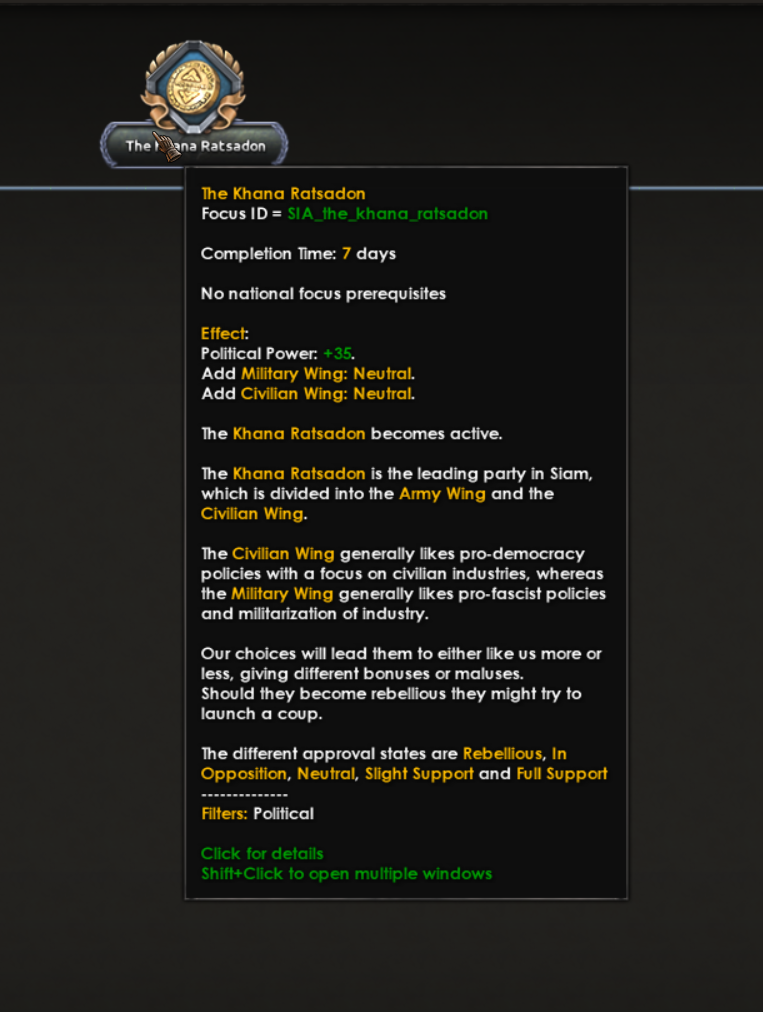 The Khana Ratsadon is the main antagonistic force when playing as Siam. It is the only party in the country, and in game they are divided into the Civilian and Military clique. The two different cliques has their own opinion of you, the player, depending on what choices you make in the tree.
 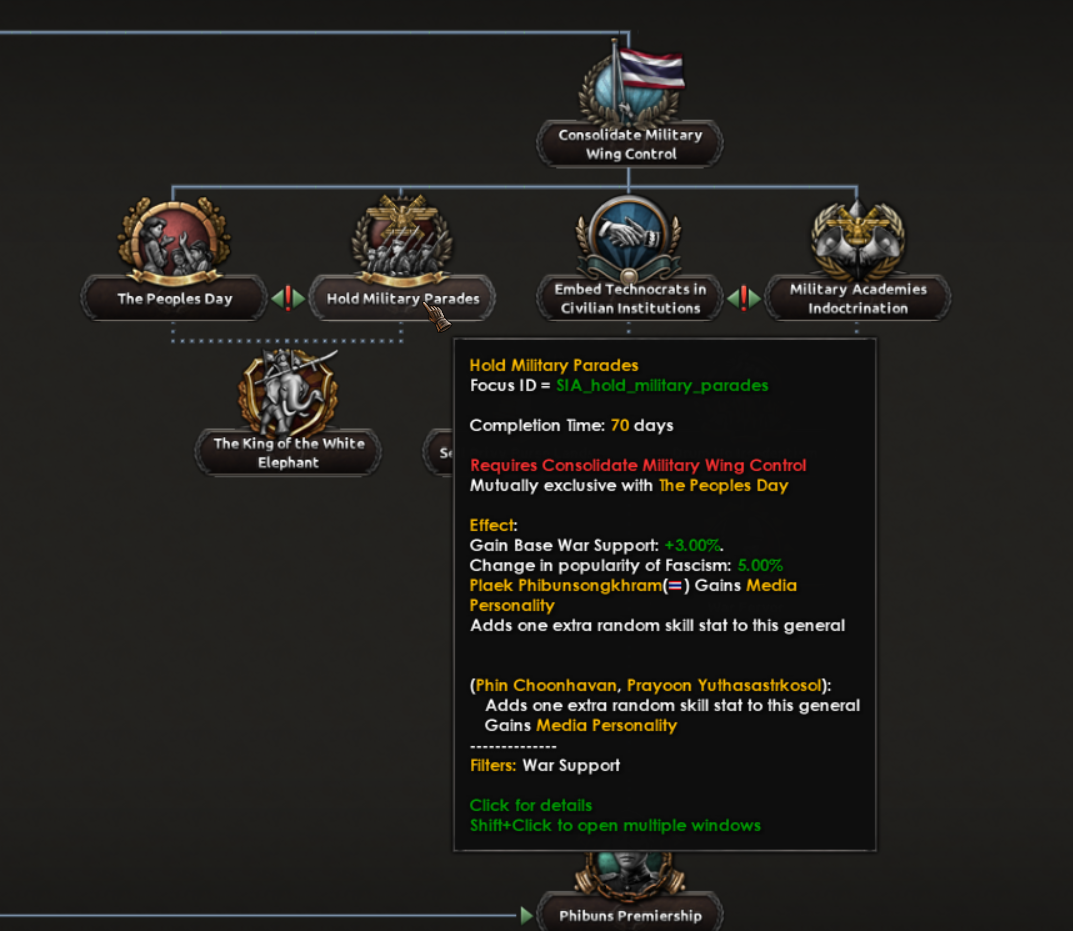 For example if you hold a military parade you make the military clique happier while making the civilians annoyed. It is essentially their relation with you, regardless of who is in charge; of course putting a military dictator in power will make the military happier, as an example.
If you piss off either clique for too long they might decide that they've had enough, and they will try to coup you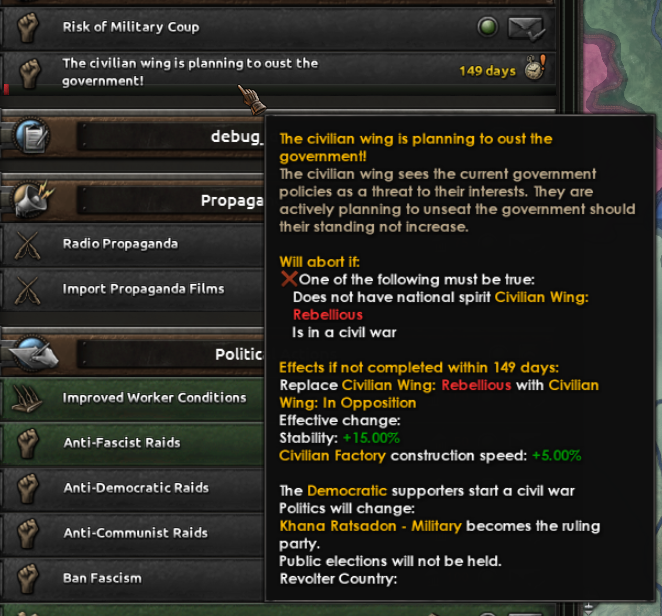 You will have a certain period of time to remedy the situation before escalating into a full civil war.
I decided to not use the Balance of Power for this because it only moves on one axis and is better suited when there is a push and pull between two things. I wanted this to move two independent clique opinions of the players actions, rather than what the BoP is supposed to represent. 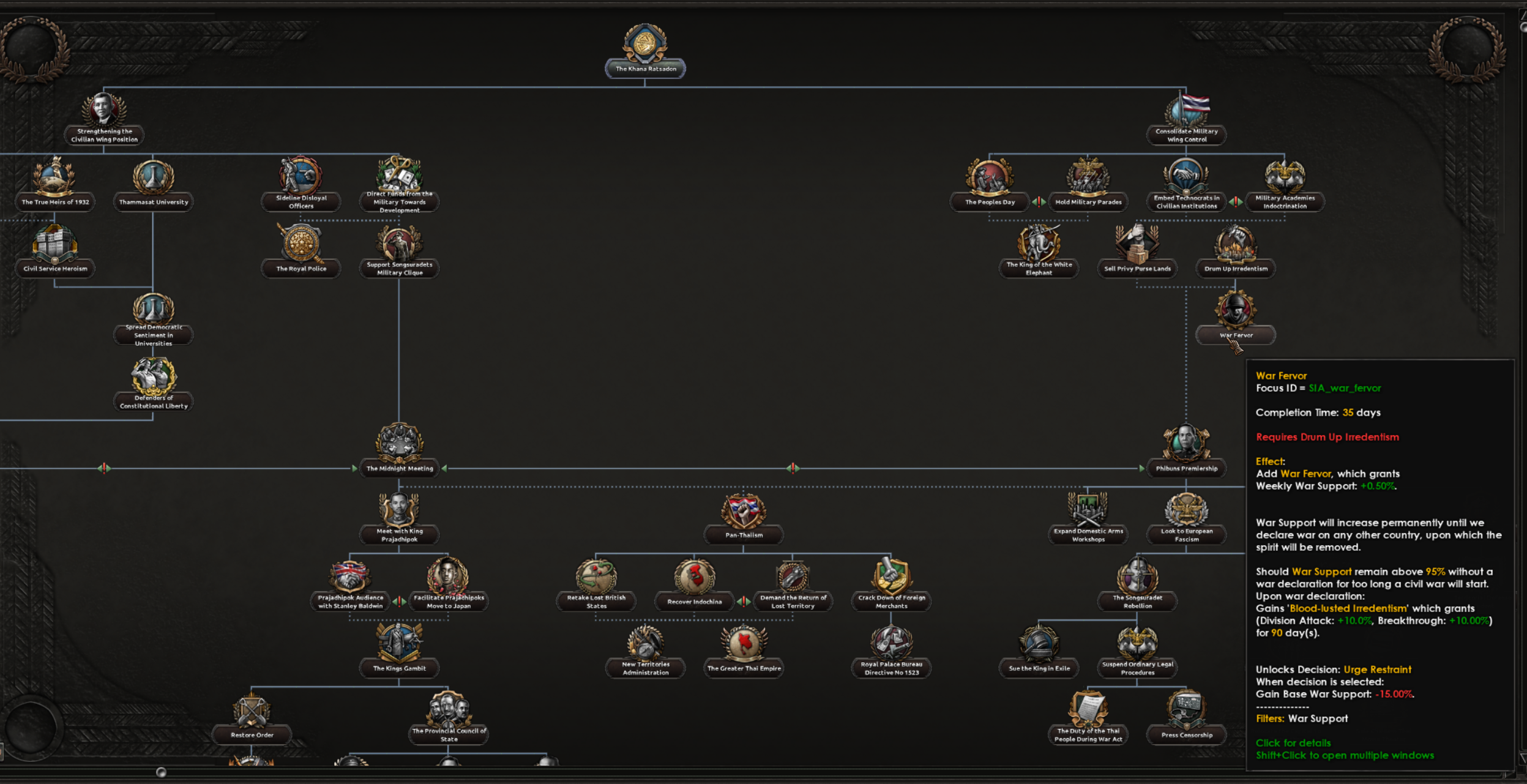 You start activating the Khana Ratsadon. This is the entrypoint of the tree, separated into two main parts, one that is generally pro-civilian clique and one that is generally pro-military. Some of these focuses will either appease or piss-off one or the other clique.
If one clique gets too angry it might be wise to take some actions to make them a bit happier.
The historical path follows Siams descent into fascism, modelled after the Italian state. After some scandals, Phraya Phahon (the current Siamese starting leader) resigned, and Phibun stepped into the power vacuum. After which the civilian wing got drastically less power, and Siam became more authoritarian. 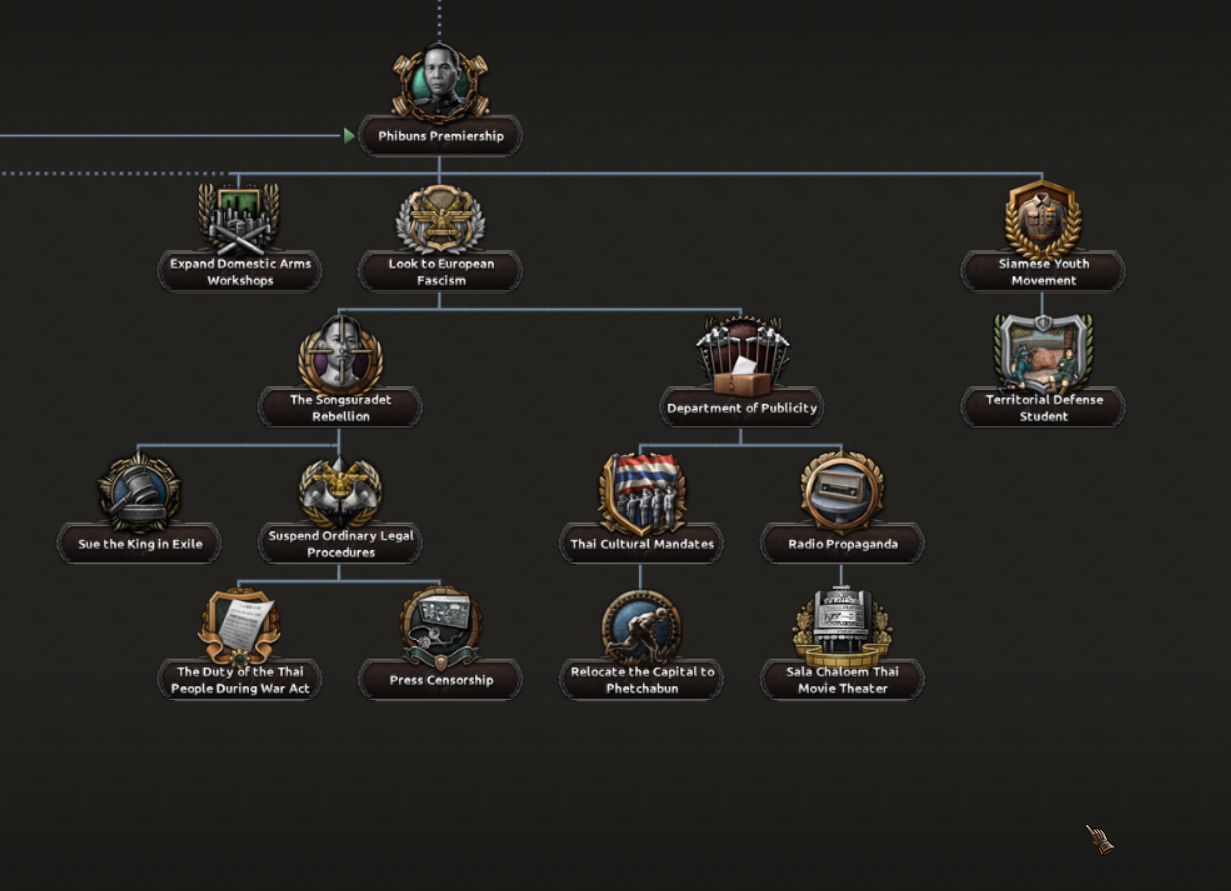 When Phibun comes to power Siam becomes fascist. The focus can be completed by either gaining enough fascism support via advisors, or by selling privy purse lands(the scandal mentioned) and letting the spirit time out. Either or will unlock his premiership.
You can then proceed to suppress your opponents and turn on the propaganda, mirroring other fascist states like Italy or Germany. The Songsuradet rebellion (in reality a purge) will neuter your biggest military opponent, while the Thai Cultural Mandates are decisions that will influence Thai life, molding them after the state. This is also where Siam gets renamed to Thailand, a legacy of WW2 to drum up Thai unity.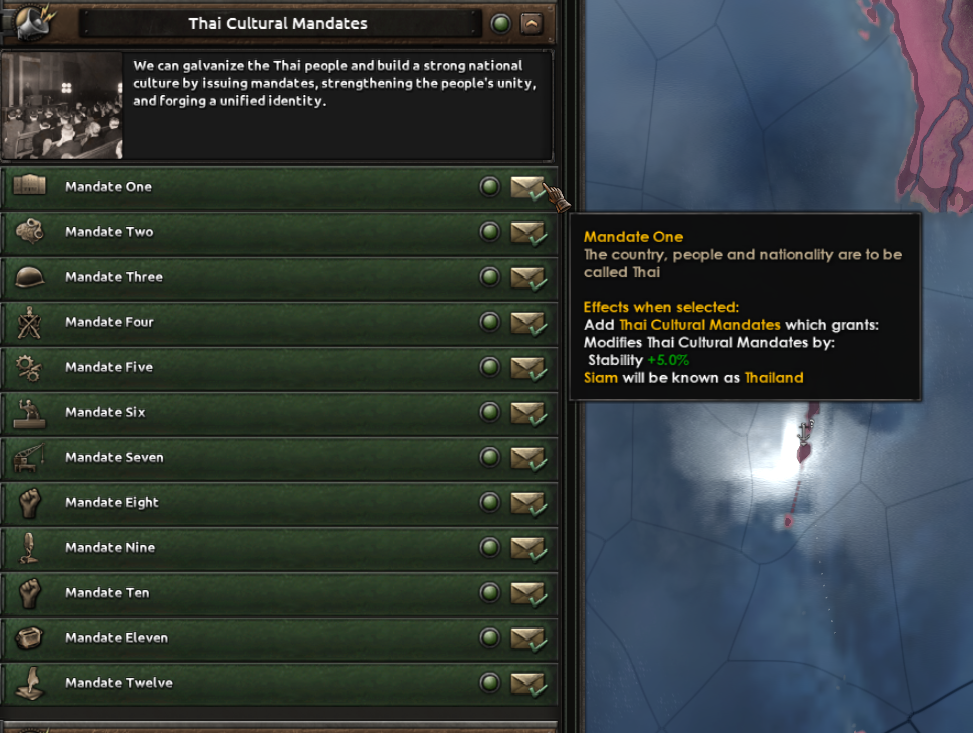 The first two decisions are free in this case, after which they start to cost political power.
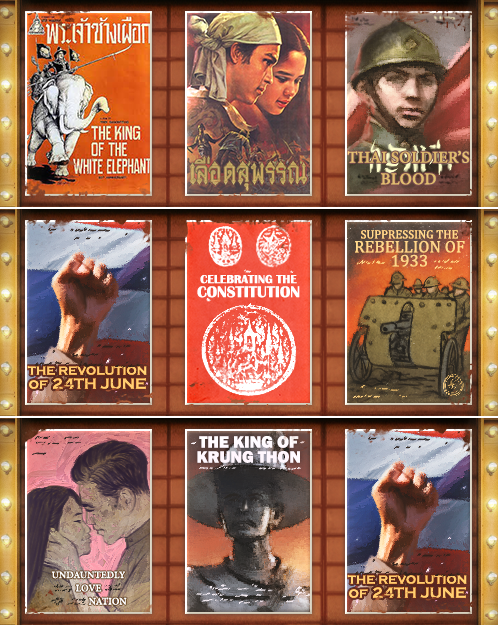 The Soviet style propaganda posters are also making a comeback, but this time as propaganda movies. The Sala Chaloem Thai Movie Theater was used for these means during Phibun's rule, and they work the same way as the Soviet version. I wanted to bring back an existing system that is familiar for players but tailor it specifically for Siam
Shared with the monarchist branch is the Pan-Thaiism branch. Driven by the loss of territories to the great powers, Siam had a large influx of irredentism during WW2. 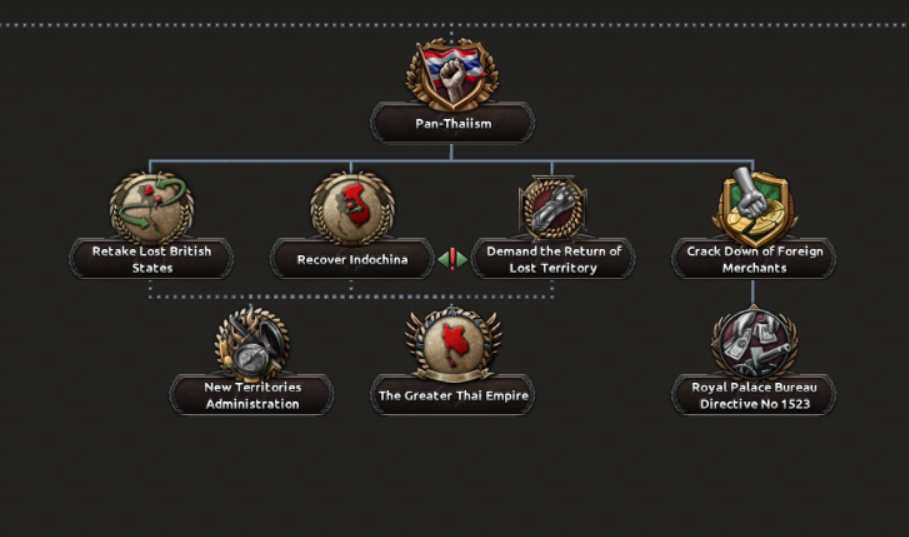 This path allows you to retake some of the territories that were lost while also peace out without it remaining a permanent war. One of the criticisms from GoE was that it was too hard to do early expansions without it escalating into WW2 instantly. Hopefully this will allow for an easier time doing so.
To start it just click on the icon for the country, in this case France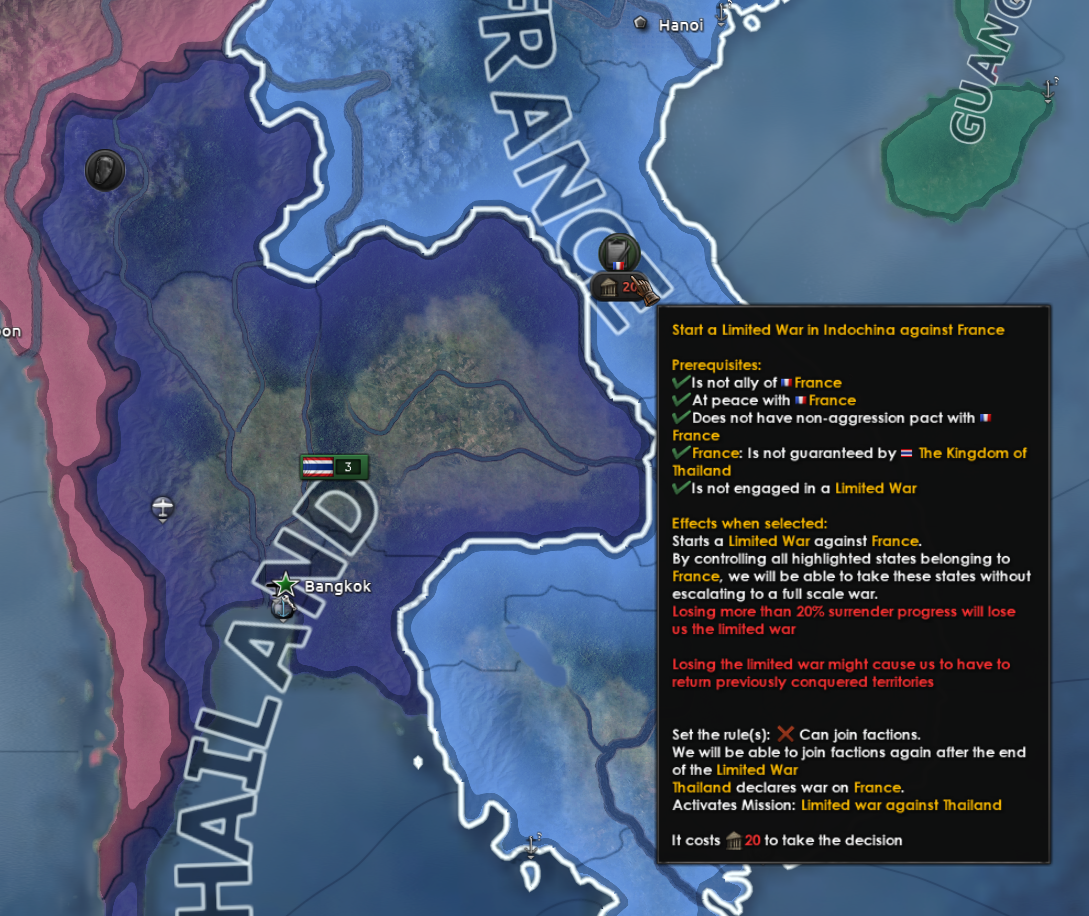 You now have X days to finish the limited war by occupying the targeted states. If you occupy them before the timer runs out the opposing country will sign a peace deal where you keep the states you conquered
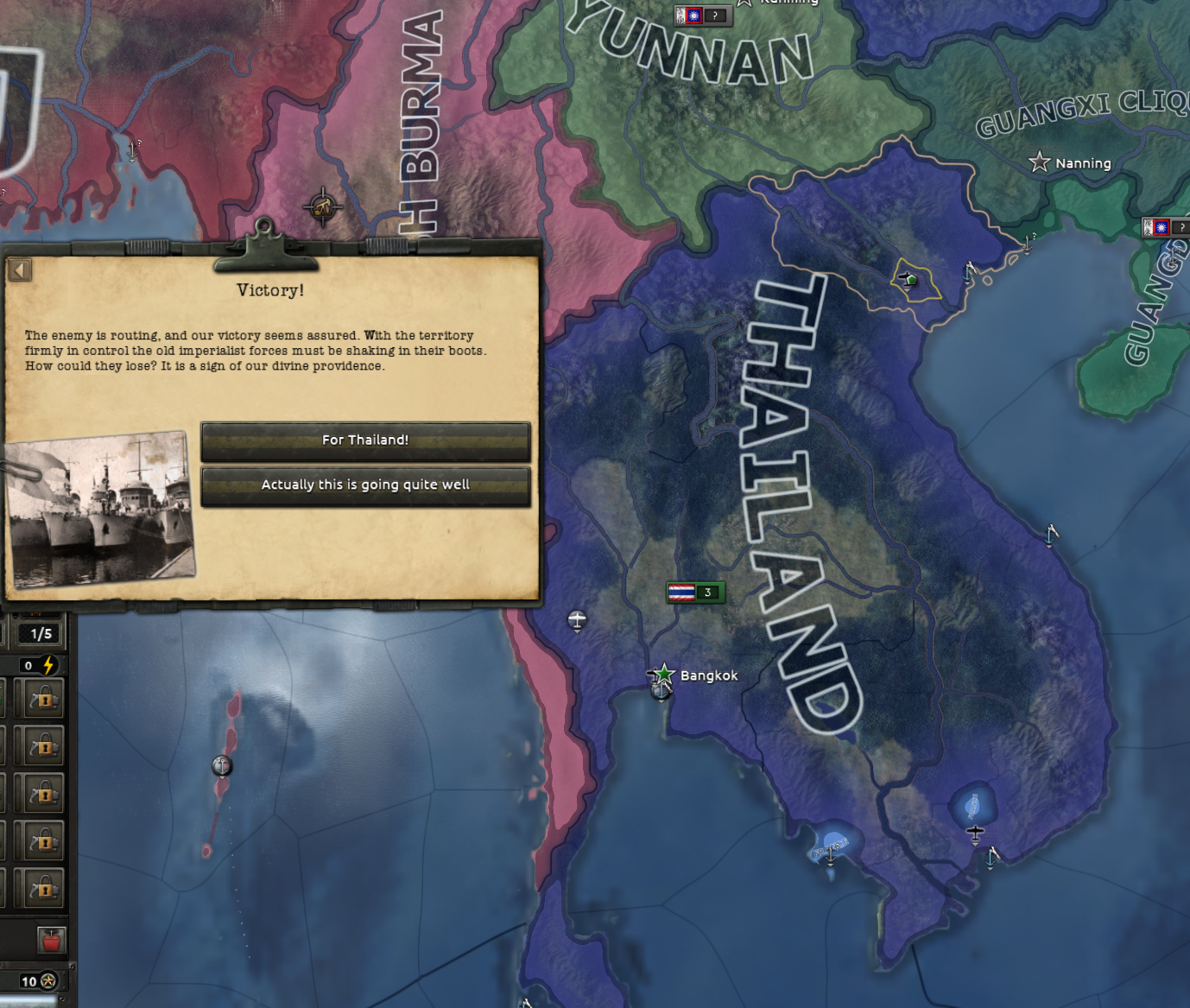 And if you are more than 20% towards capitulation you won' get annexed as normal, but you will get a penalty
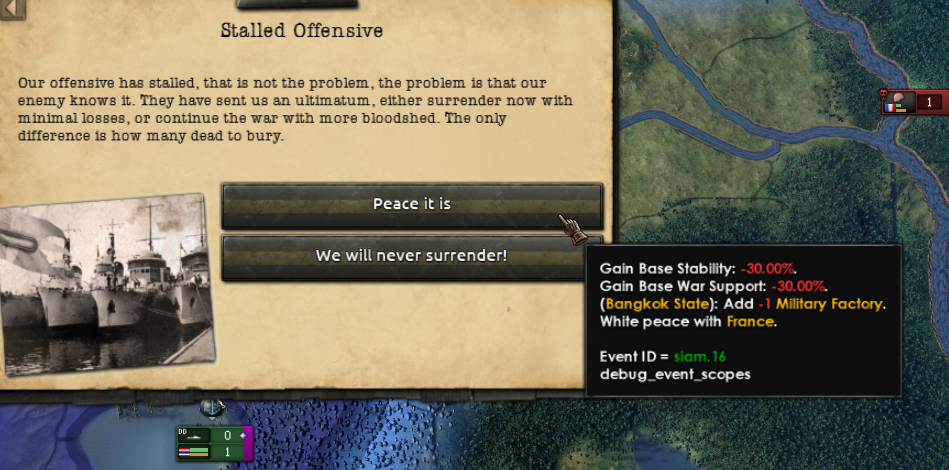 The hope is that it gives Siam an easier way to expand, either early on but even later after the big war kicks off. As a minor power it can sometimes be hard to field a large enough army early on, so I wanted to also have the opportunity to gain these territories after the big war kicked off.
 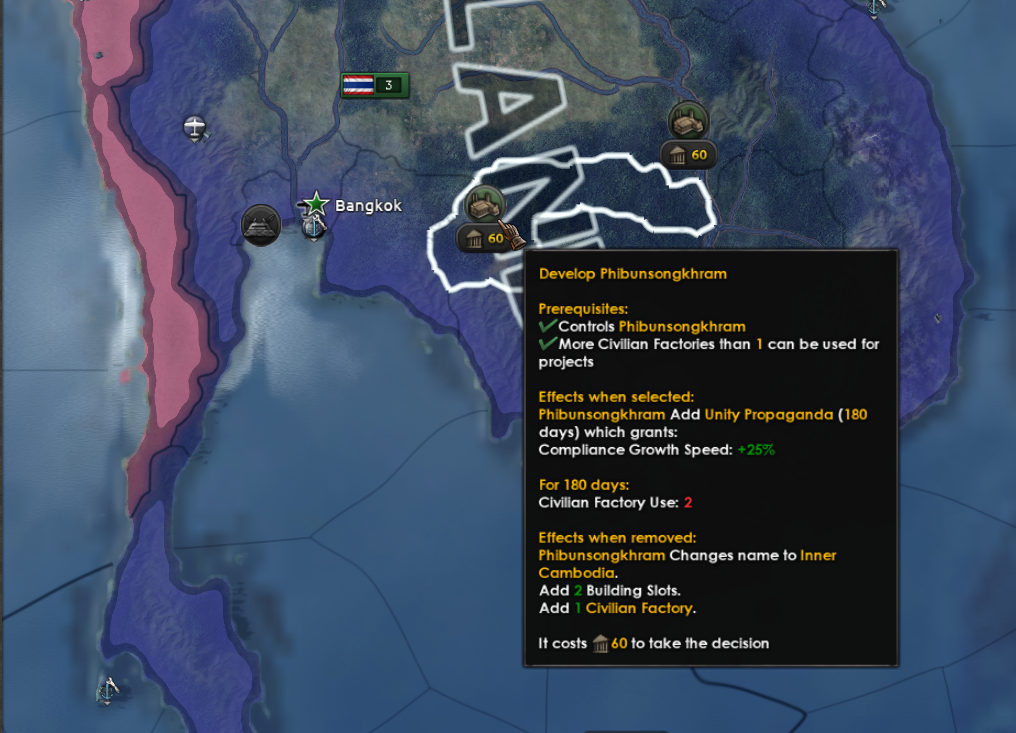 When you have gained your brand new territories you can develop them. Getting compliance high enough is important since it allows you to form the Greater Thai Empire, gaining cores on the territory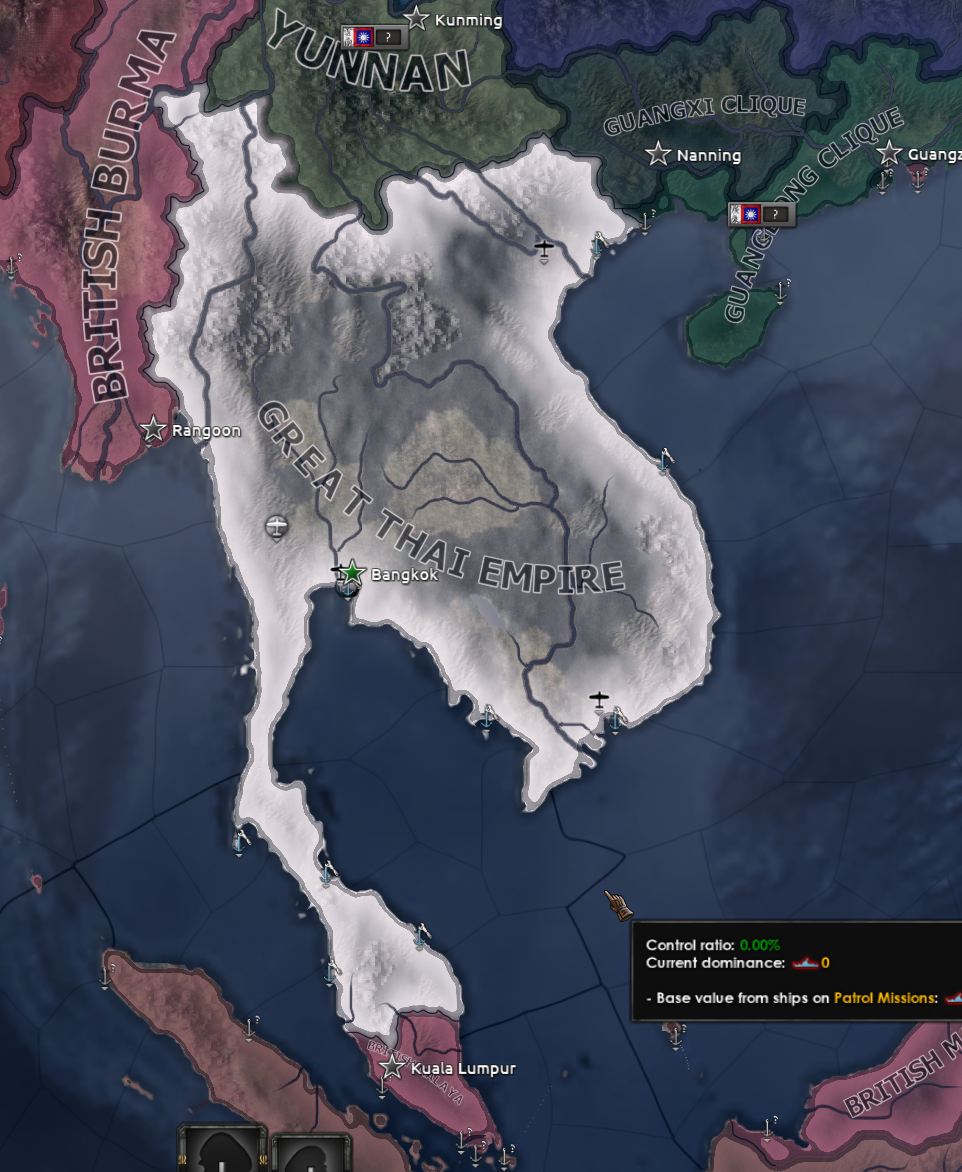
The absolute monarchy might have been overthrown in 1932, but Siam was (and still is to this day), a constitutional monarchy. Even though the princes did not exert the same amount of influence as before, they still had vestiges of power.
After Prajadhipok abdicated and exiled himself to the UK, a new king, Ananda, was chosen as his successor. At the start of the game Ananda is only 10 years old, studying in Switzerland.
Our divergence in this scenario starts with Field Marshal Songsuradet. He was a high ranking member of the Khana Ratsadon, and somewhat of a risk for Phibun, so historically he had Songsuradet exiled, during what was called The Songsuradet Rebellion.
In this timeline Songsuradet realizes he is about to be purged and forms an alliance with the remaining princes to overthrow Phibun. This clandestine meetings results in the schemers contacting the exiled king Prajadhipok 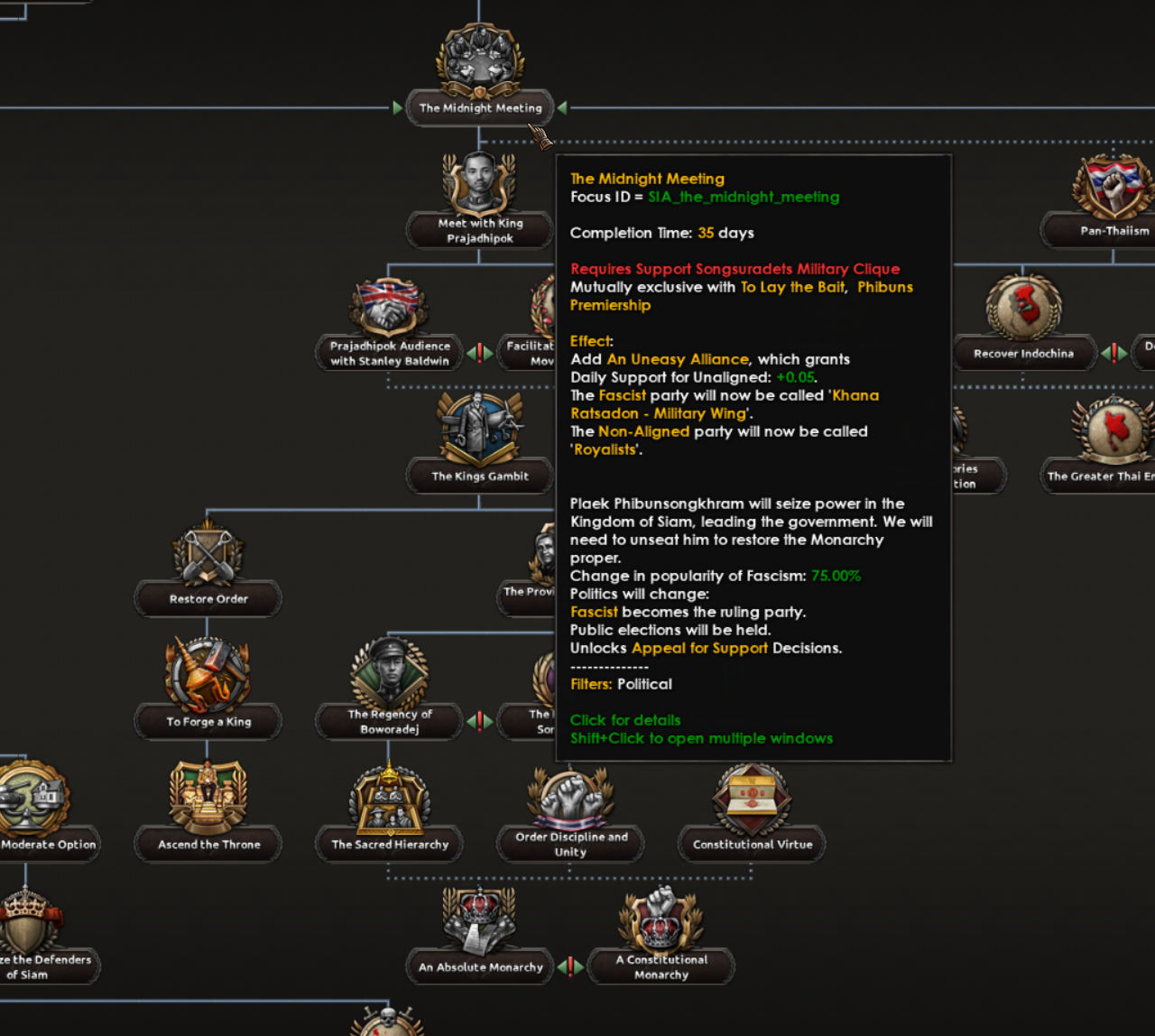 Using Prajadhipoks legitimacy, you can appeal for support from different cliques. Another return from the Swedish tree, but a bit expanded upon.
 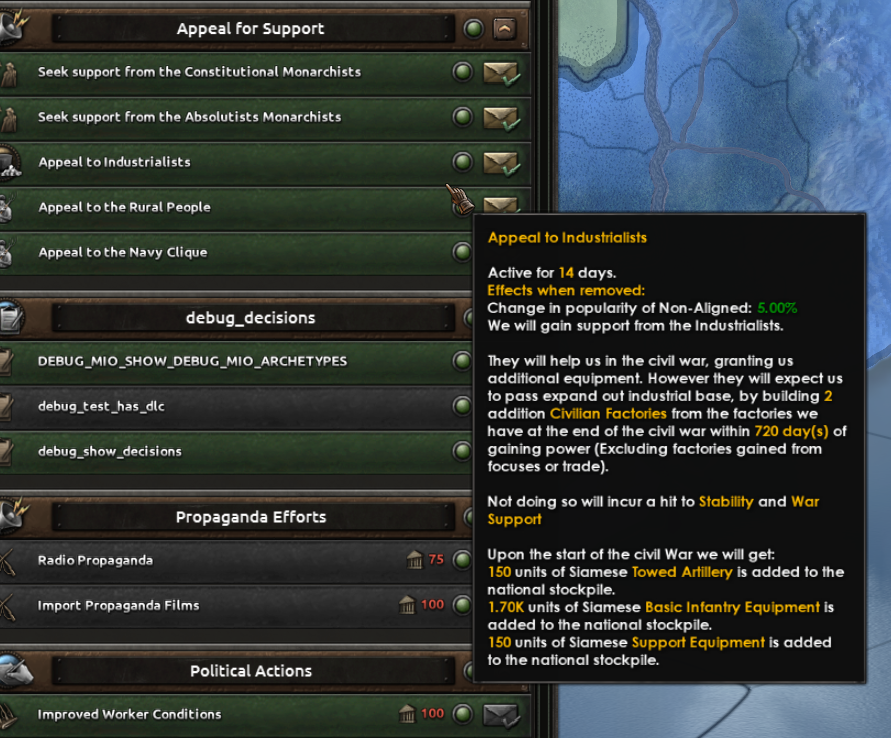 In this version you do not just pay a pp cost to appease the cliques, but rather have to do something in the game. The industrialists expect you to build 2 civ-factories, because it is in their interest. The Absolutist Monarchists want a return to absolute monarchy (shocker), while the constitutionalists want a more moderate option, these two cannot exist at the same time, so if you want support from both, you will eventually have to disappoint one of the cliques.
Prajadhipok can gather support from either Japan or the UK, framing the current administration as unstable. When the support is big enough the king can make his ultimate gambit. He will return to Bangkok, with the full expectation of being arrested by the government.
This gives him the legitimacy the King needs, pointing towards military overstepping, and with the supporters standing by, a civil war erupts. 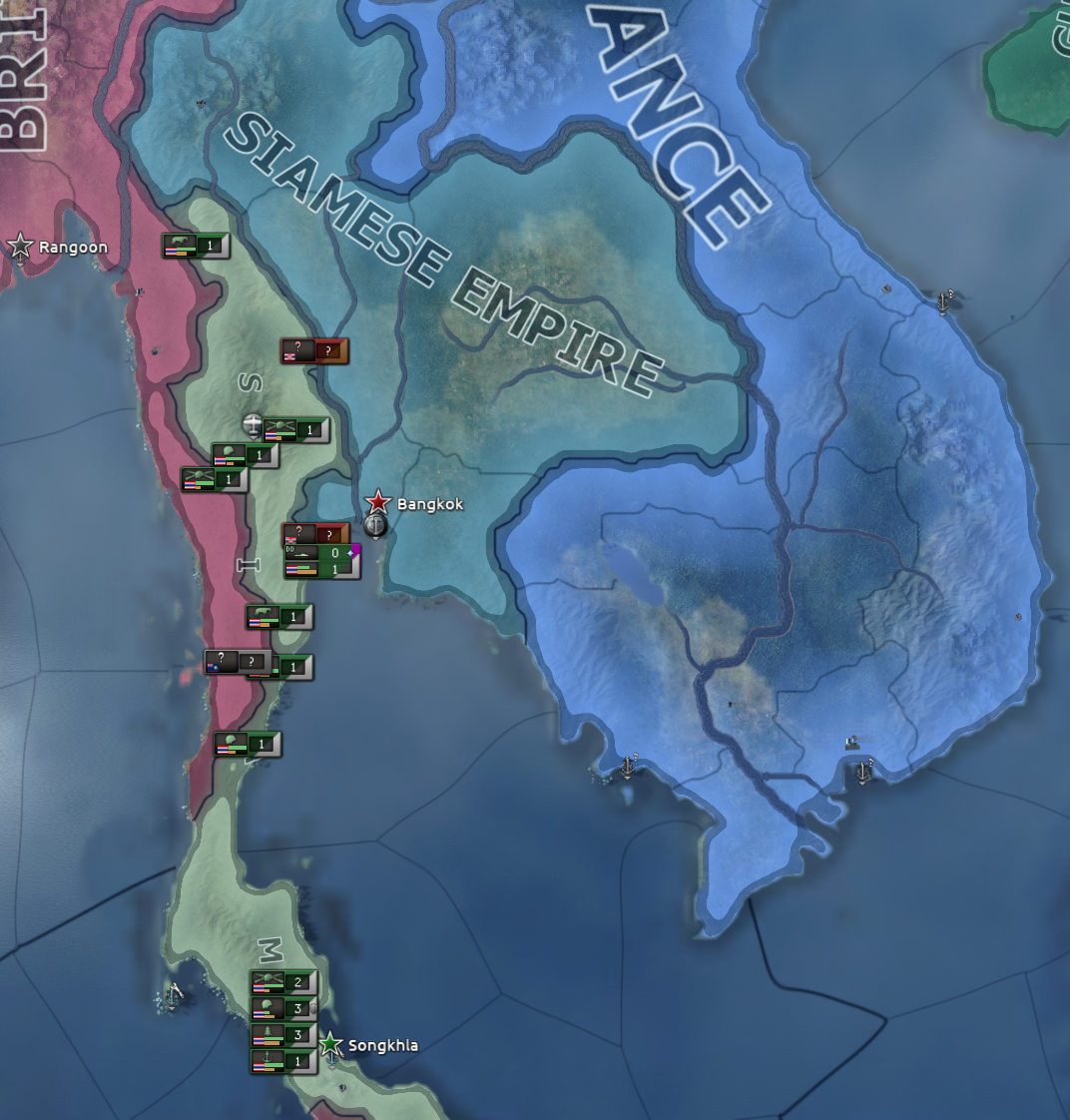 After the Royalist win and Phibun is ousted the question of "who is ruling" becomes a bit complicated. Ananda is still king, but underage,Prajadhipok is terminally ill with congestive heart failure, which will eventually lead to a heart attack, which means that a Reagent must step in until Ananda is fit to rule.
You can pick either Bowardej, the same prince that was exiled for an attempted coup a few years before, representing a more conservative, authoritarian version of monarchism. Songsuradet, the prime instigator, represents a middle ground between authoritarianism and progress with ties to the military. Finally Rangsit represents the constitutionalists who want to eventually return to democracy. 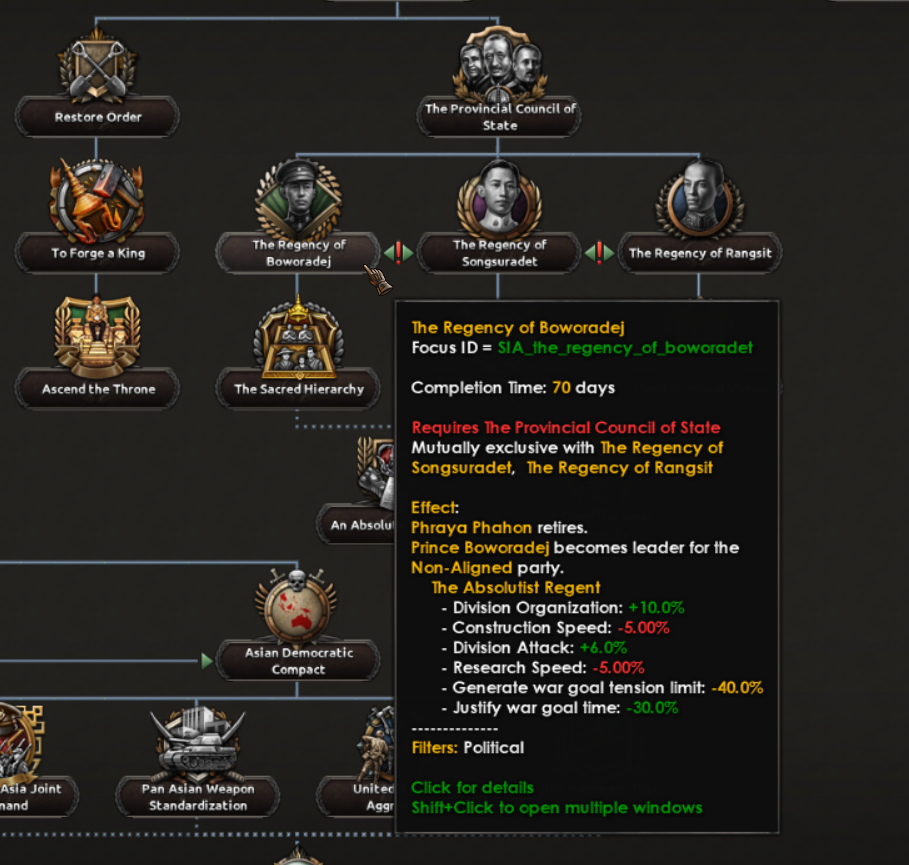
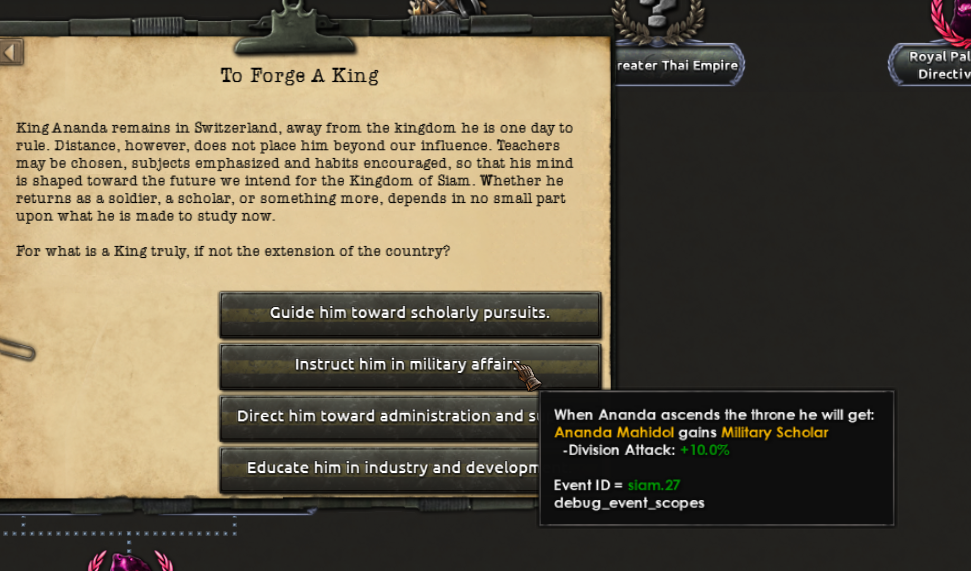 Eventually Ananda will become of age. The game tracks his age, and when he is at least 15 years old he can ascend the throne. Being young you get to influence him by steering his studies, molding him to become what you need for that playthrough.
Completing the focus To Forge a King, you get an event once a year where you get to dictate what he studies, influencing his trait. Don't worry about missing a year or two, if you do the game will automatically give you all missed events.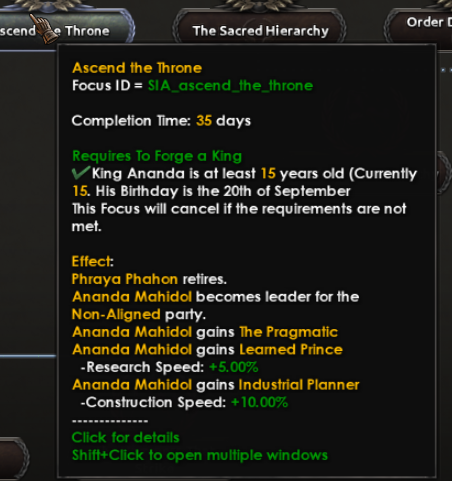 What is cool is that he gets a title depending on which trait combinations you pick. In this case I picked two industrial traits and one research trait, thus getting the Pragmatic title. There are 18 different title combinations currently. If you seek strength, the rest will follow.
Siam during WW2 was sometimes called "the Italy of the East", referring to its low industrial output compared to its counterpart (Italy - Germany, Siam - Japan), however comparing Siam to Italy would be an order of magnitude difference in output still.
Siam was mostly an agrarian country centered on Rice with a large population working in subsistence farming. It wasn't until after WW2 that Thailand started to grow massively in GDP, with some attributing the transformation due to the war itself.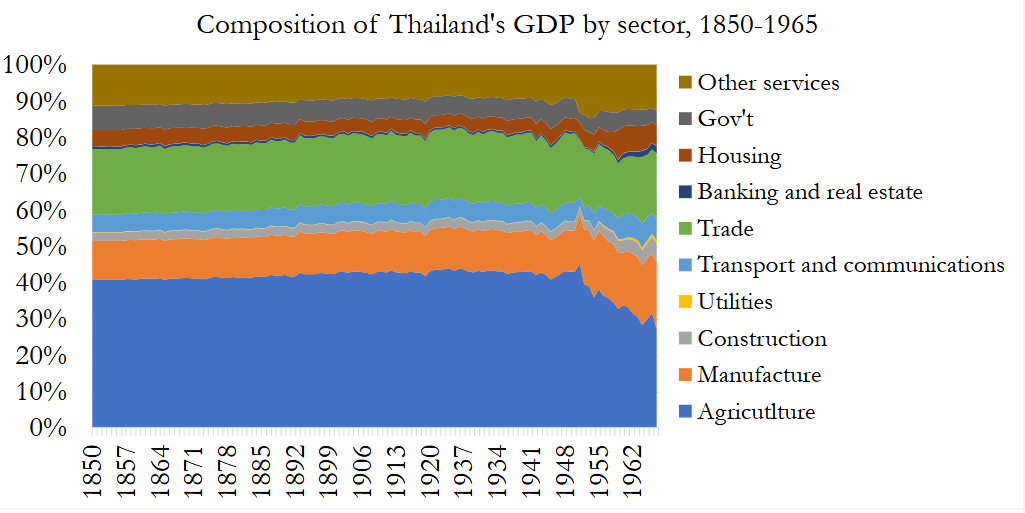 This led to Siam being unprepared for war, despite their posture after the fall of France.
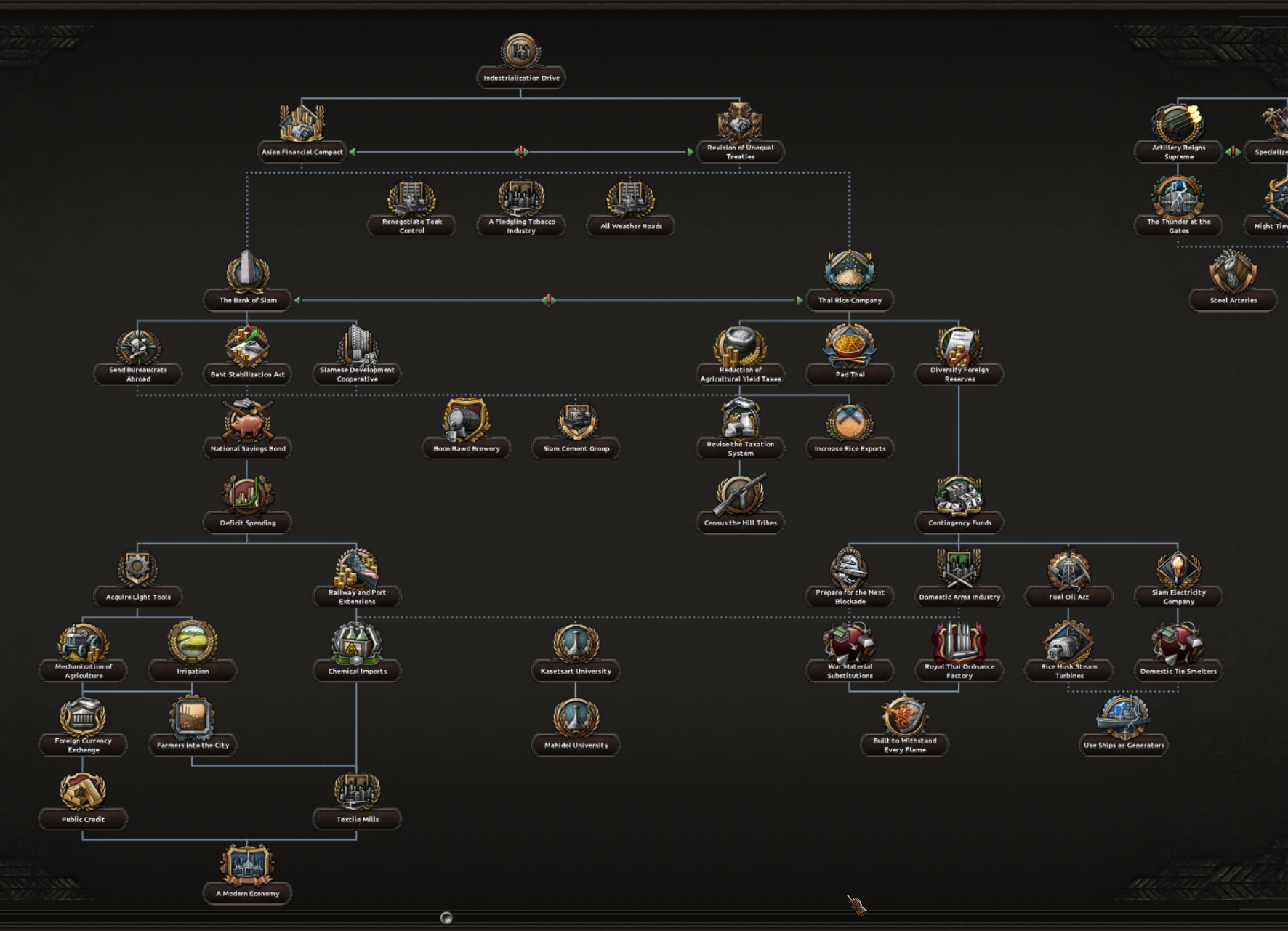
The industrial branch allows Siam to alter their industrial trajectory as compared to the past, while still keeping it grounded in history. There are two major branches, with some shared focuses in the middle
The left side follows a more aggressive expansion of civilian industry, mirroring the steps taken by Japan in the previous century to rapidly modernize. 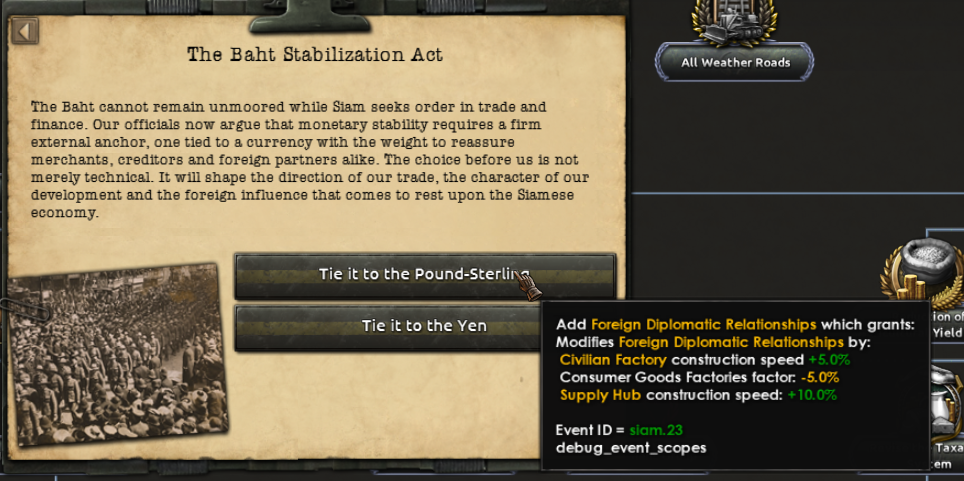 You start with looking to foreign expertise, sending your administrators abroad, tying the baht to a stable foreign currency and launching a foreign cooperative. This lays the foundation for the next step..
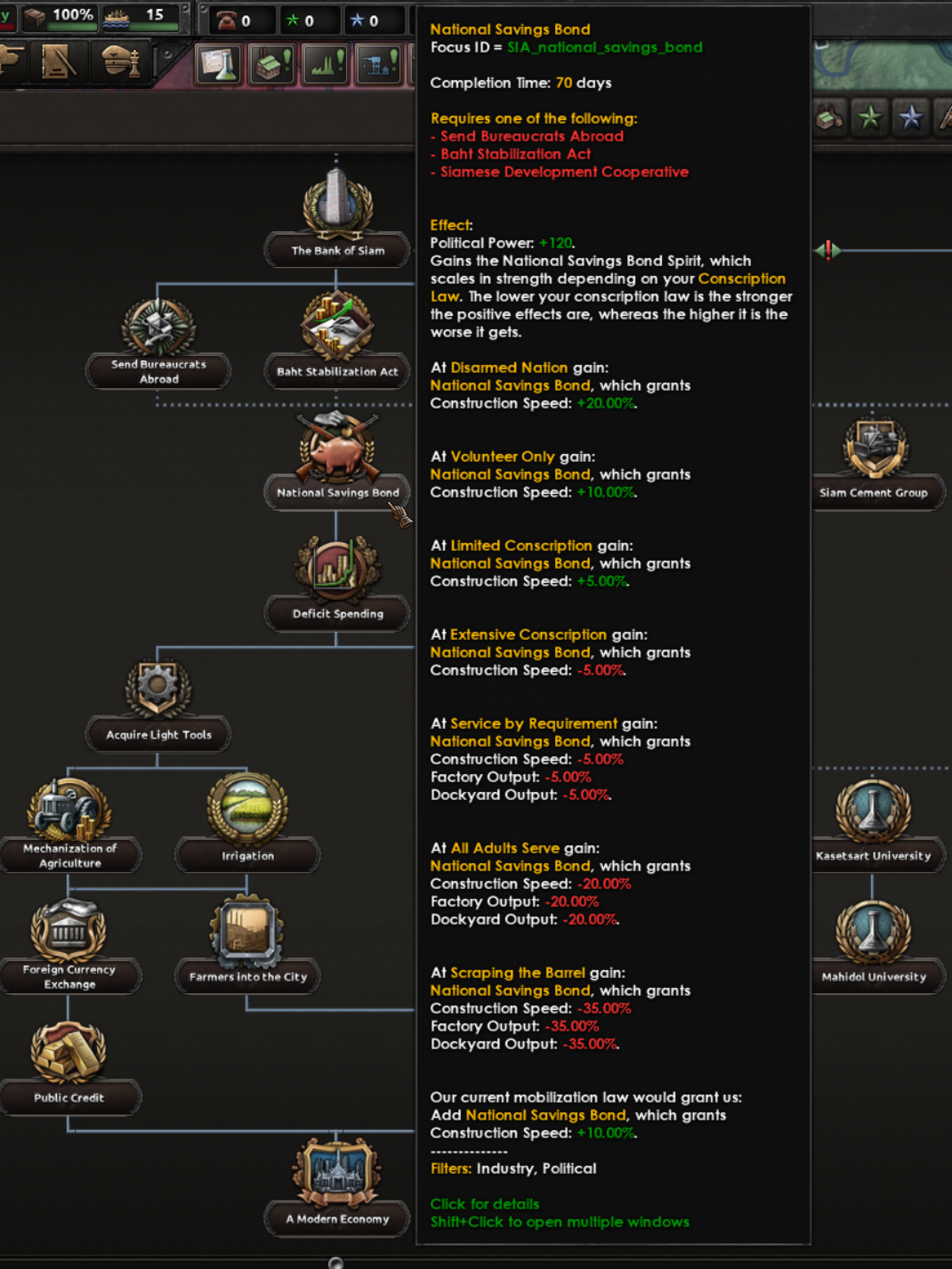 You can then launch a savings bond, giving bonuses depending on your conscription law. The lower you are the higher the bonus is, conversely the higher penalties you have to eat. The general ethos of the left path is that the bonuses are overall more direct in their power and allows you to reform the Thai Industry faster, but it also comes at a risk of collapse should something go wrong.
 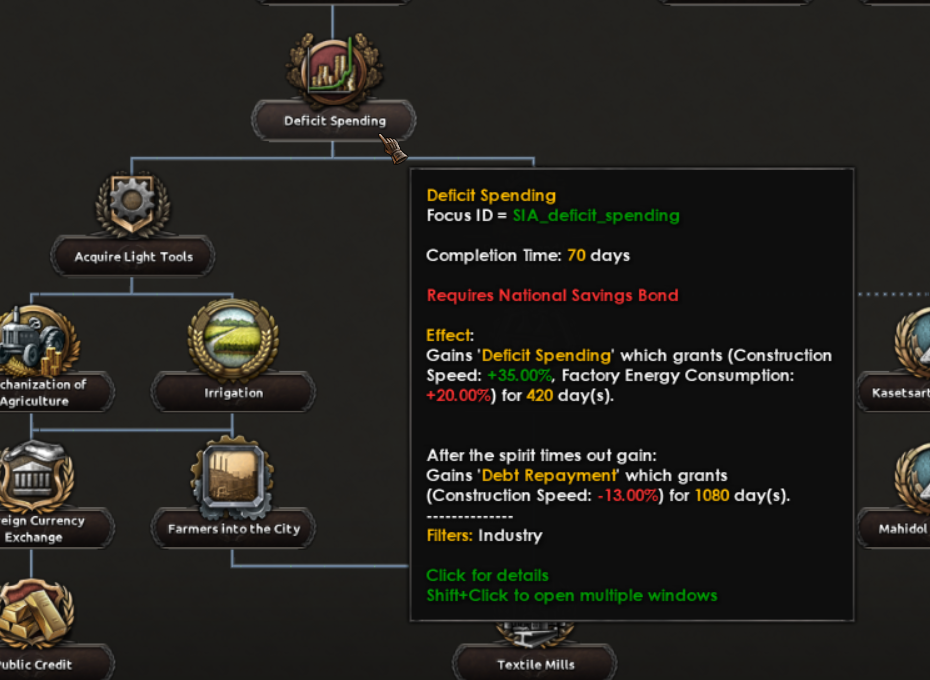 The next focus doubles down on this. Eating the factory energy consumption is probably fine as long as you have access to enough energy. This particular focus was thought of as a kickstart focus which would help Siam get its industrial ball rolling quickly, as they start with quite a low baseline.
 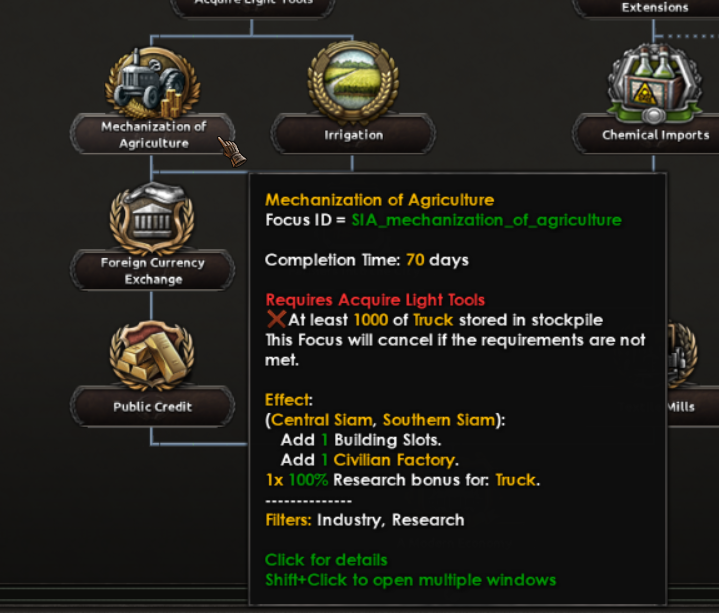 You can then start to expand the agricultural base with a mix of modernization. This focus specifically acts as a gate, locking the other focuses. The requirements aren't meant to be super hard to achieve, but the player needs to plan for it. Putting one mil on trucks early on should be enough, but if not it might take a little more time. It goes back to the risk/reward aspect of this path that if everything goes as planned its not an issue but if it does it might take a little longer.
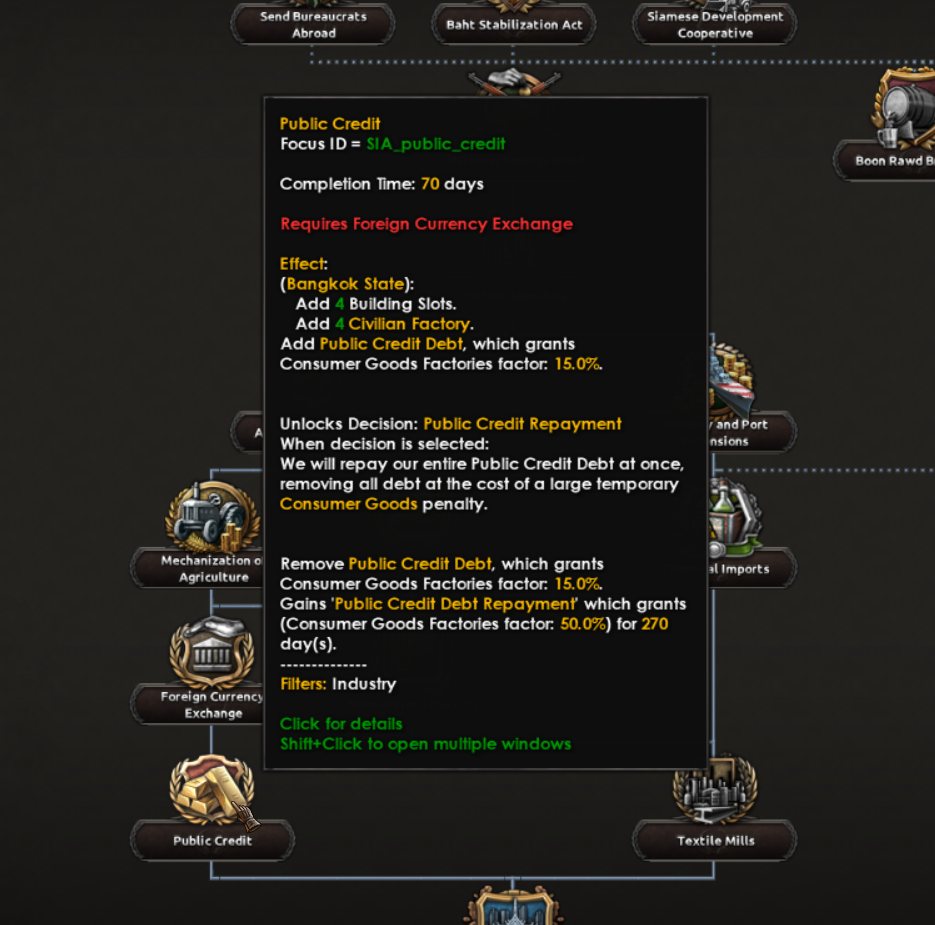 You can also take out a loan for a short injection, and either pay it off immediately or have a long low-interest repayment.
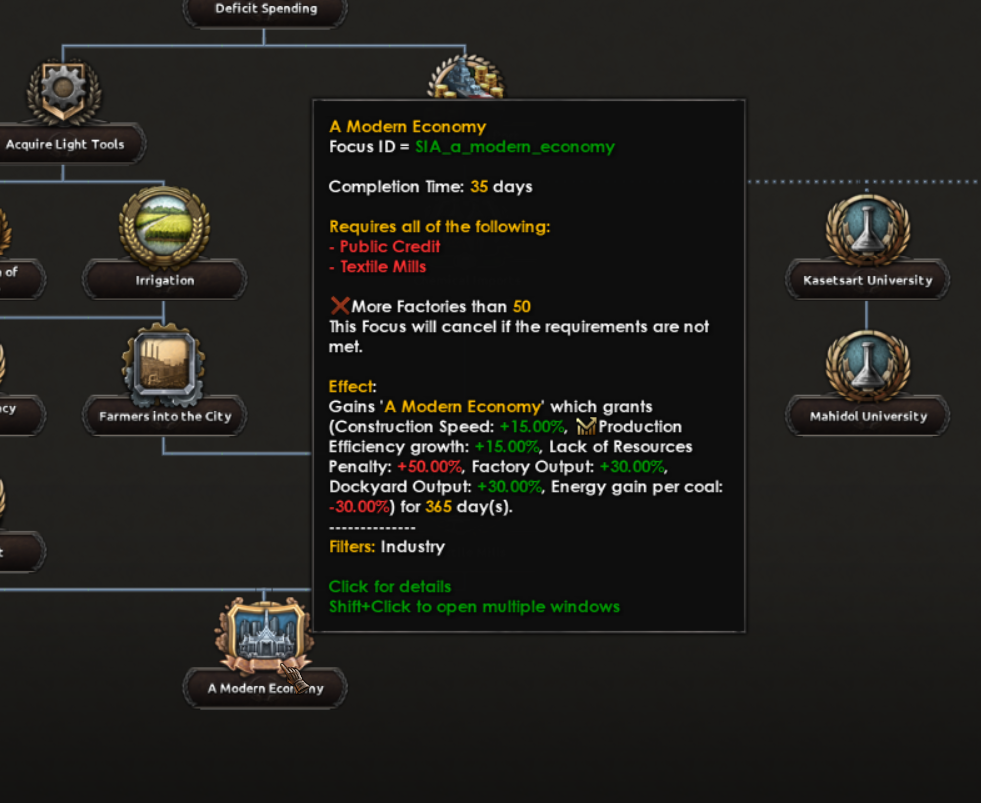 And at the end of the tree you get a massive boost to production, if you have the proper resources for it.
The right side is intended to be more of a slow burn compared to the left side, which is more aggressive, but is more resilient towards external perturbations. This is more closely modelled after Siam's historical situation, where their reliance on rice shielded them somewhat against the worst economic effects of the war.
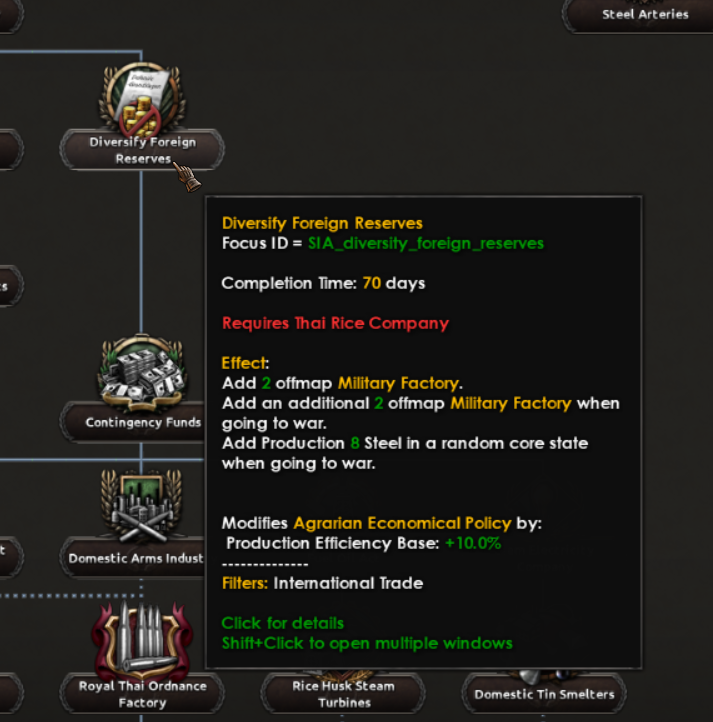
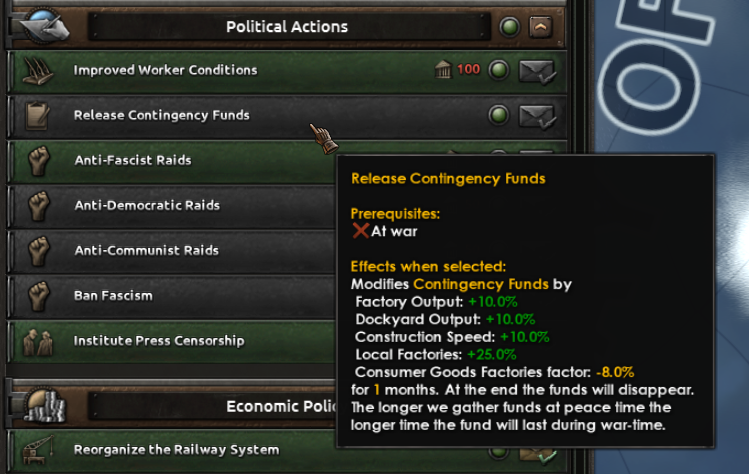
Instead of forming the Bank of Siam, you form the Thai Rice Company, with more focus on Agrarianism and shielding the country when the war hits. As you can see, delicious Pad Thai is here, which is said to have been made during this time as a way to boost unity among the Thais, especially after a flood destroyed a large amount of rice.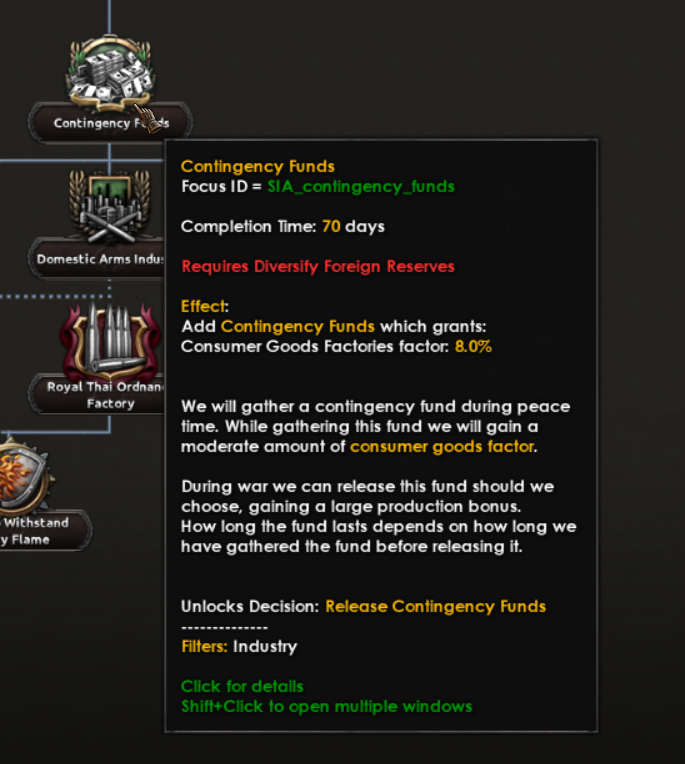 You are able to put some of your current output into a "rainy day fund", where you can release a large influx of output while at war, its length depending on how long you have saved for before releasing it.
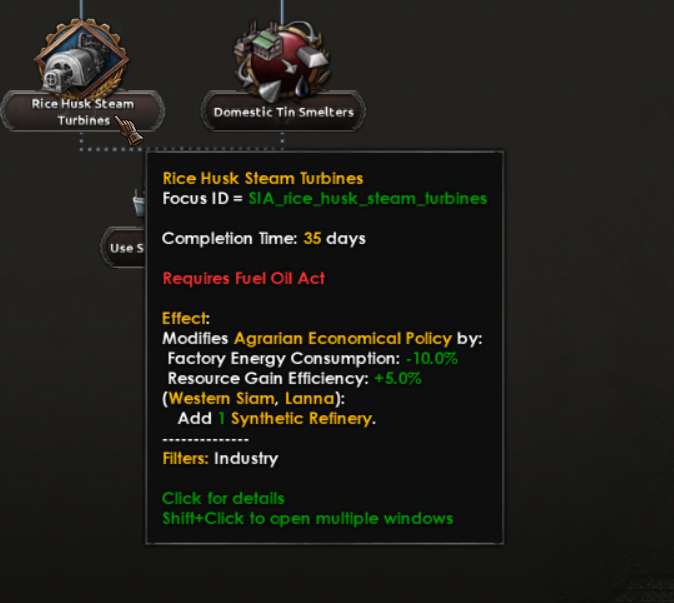
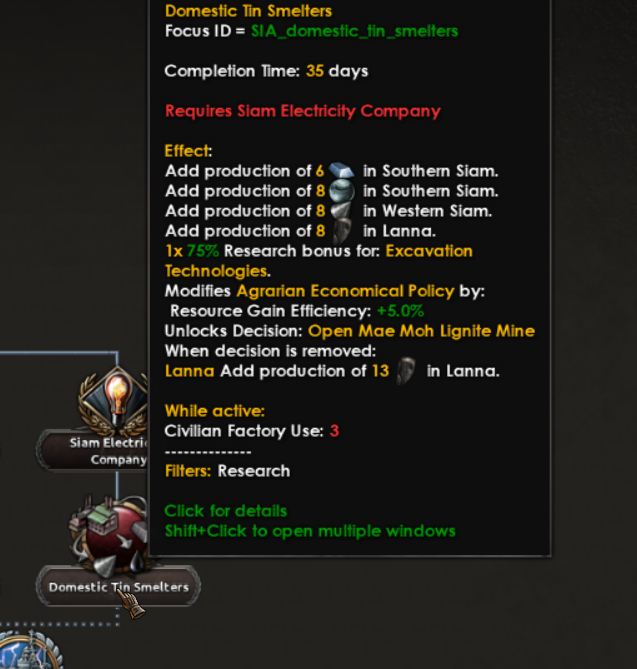
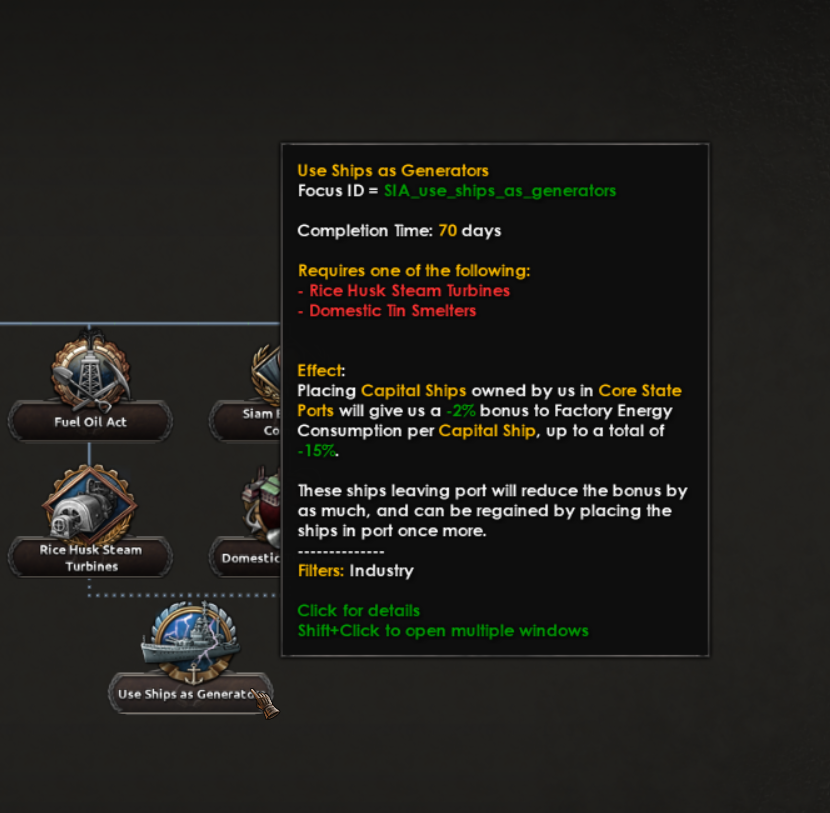 This one I'm particularly happy about. This actually happened in real life, when the allies bombed Bangkok the government used the ships Thonburis engines as a backup power source to run the tram.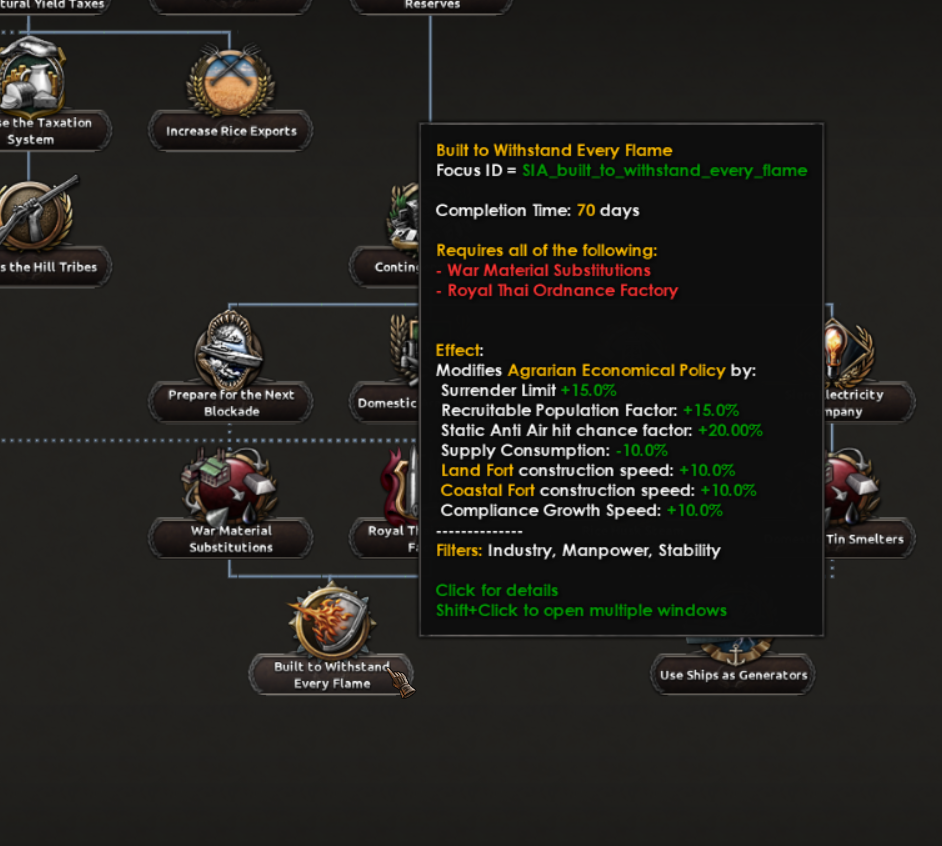
And as others this ends in a powerful focus. This path also is a bit more geared towards military production than the other.
The full path:
Taking a step back, to the democratic path. As mentioned before, Pridi was the main counterweight towards the military led by Phibun.
Pridi wanted a more ambitious reform, called the Yellow Dossier. This sweeping set of reforms was decried as communist in nature by King Prajadhipok, and some argue that it was this that led to the Bowardej rebellion in 1933.
Pridi would eventually lose the struggle for power against the military, only ousting Phibun via the Seri-Thai at the tail end of the war. In this alternative world however, he makes a play for power.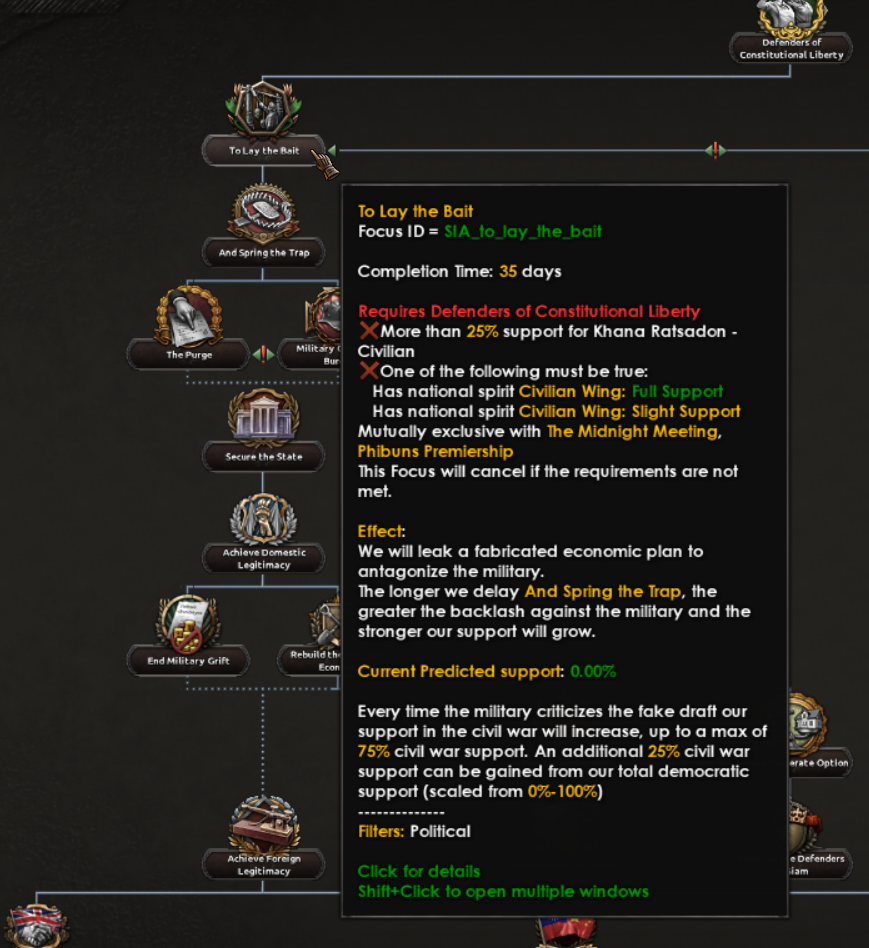 In our alternative world, Pridi realizes that he isn't strong enough to challenge the military head on, so the civilians devise a plan. They will leak a new fake version of the Yellow Dossier to military affiliates, intended to be pushed in the general assembly, the military will overreact, denounce it to the public as communist (again), and when a more moderate version of the draft is presented, the military will be made to look like fools.
In practical terms this means that when you trigger the focus "To lay the bait" the military will publicly denounce the actions of the player. 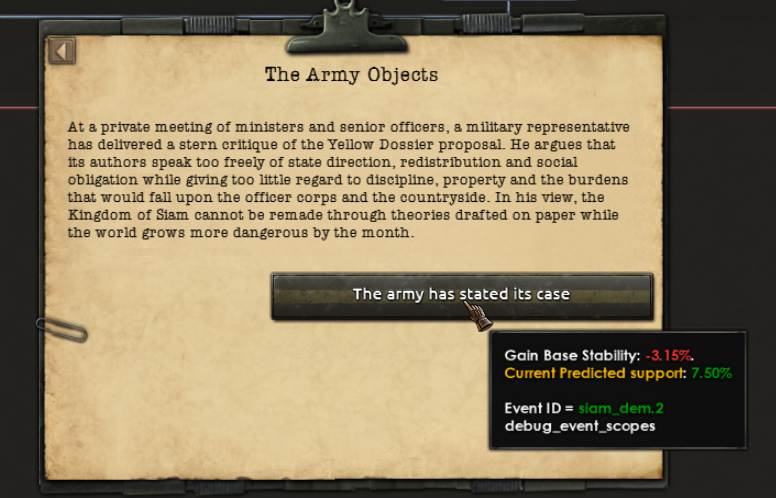 The more you let the military criticize the fake plan, the harsher the blowback will be towards them, the higher support the player will actually get when the civil war to oust Phibun is triggered. It comes at the cost of some negative outcomes though.
 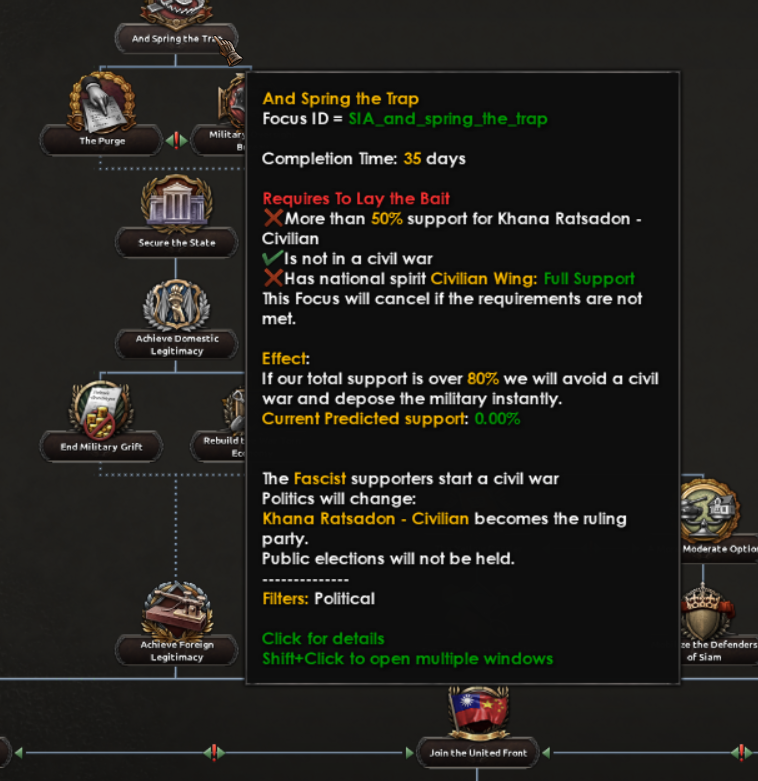 If the players total support (25% of it comes from democratic support, 75% from the militarys overreaction score) is over 80%, no civil war is triggered.
 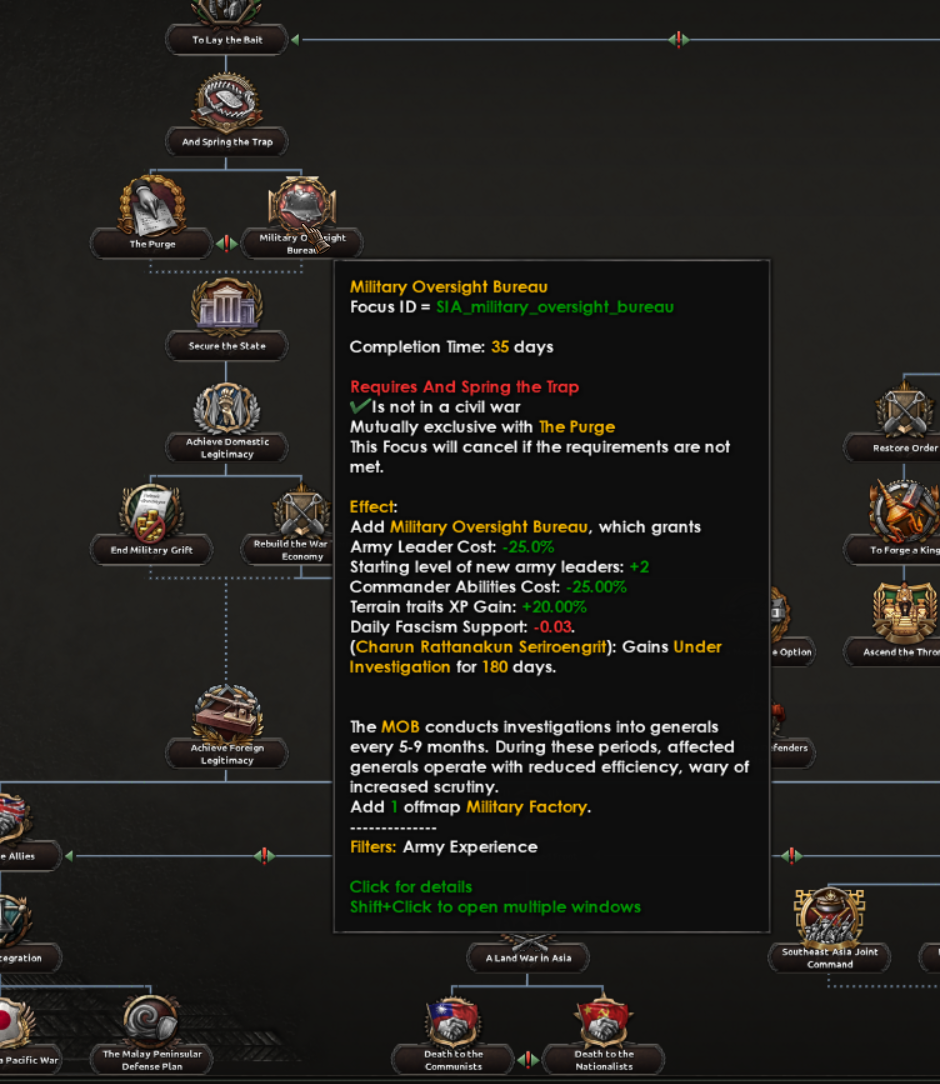 After Phibun and the military is deposed, it is time to secure the state. Doing so means either purging the military (Stalin style) or putting them under close surveillance.
 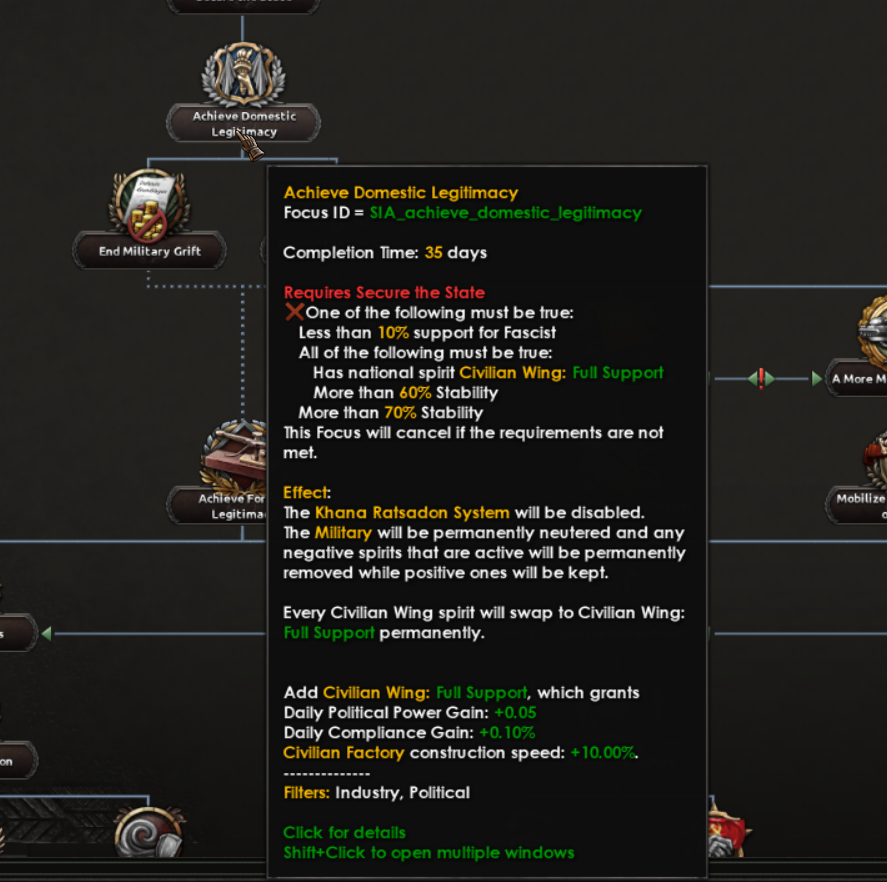 You will also have to reach outwards to get global legitimacy.
You then have the option of getting into the allies. This path is more fashioned at navy and marines, where you tackle an incoming Japanese threat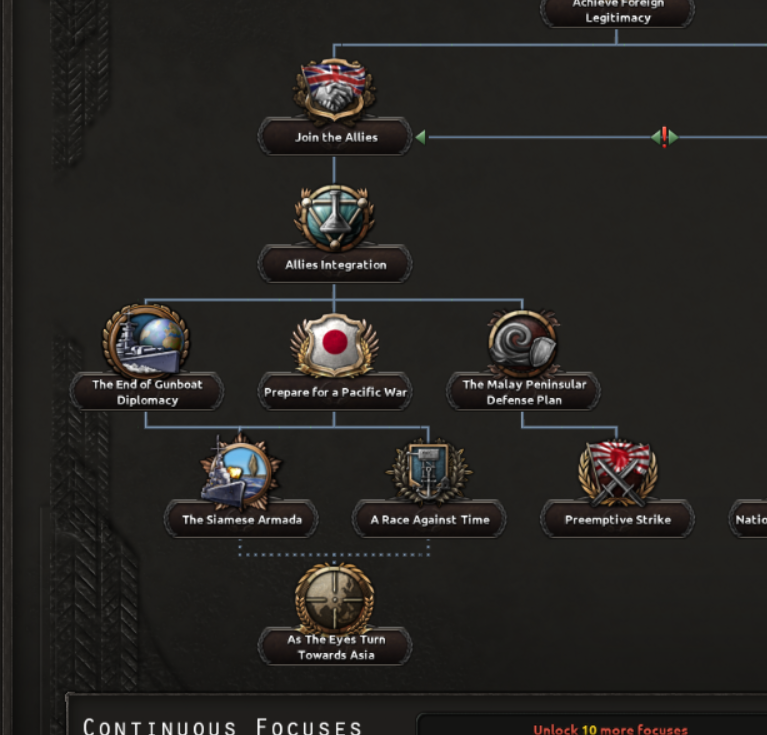 Some of the issues that the minors without a strong starting fleet is that its very hard to catch up. So this tree is trying to alleviate some of the hurdles. While not having a massive fleet it should still be possible to get an ok navy up and going
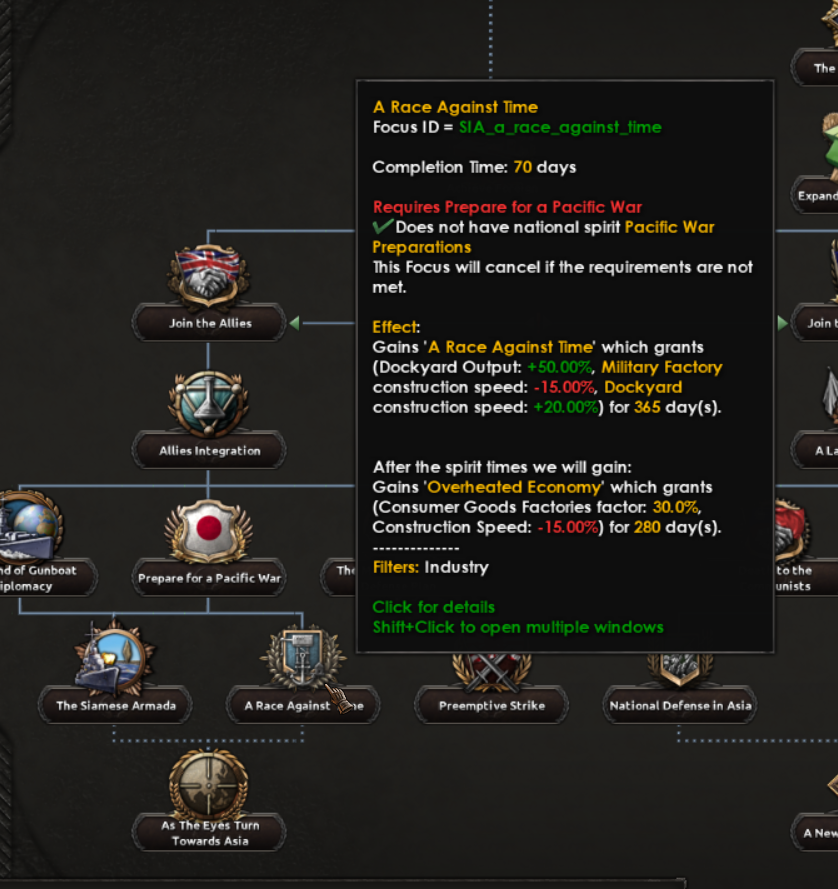 If navy isn't your cup of tea, you can join the Chinese united front directly in the land war against Japan
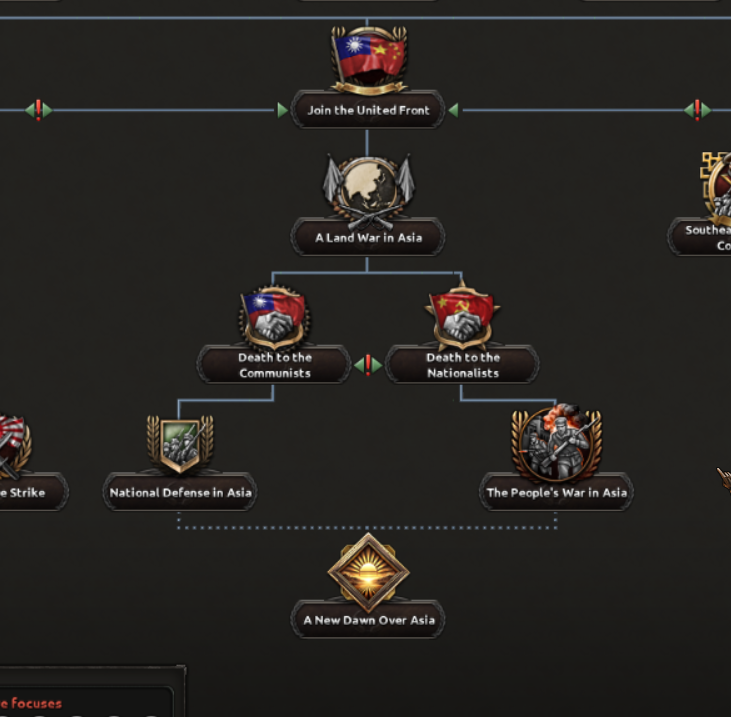 When the fighting is over you have the option to be a kingmaker against either the Nationalists or the Communist.
There is also the option to form your own democratic Bloc. While there aren't many independent nations around Asia at the start, you get the option to demand their release and invite them to the bloc. The bigger the block is the stronger your bonuses get.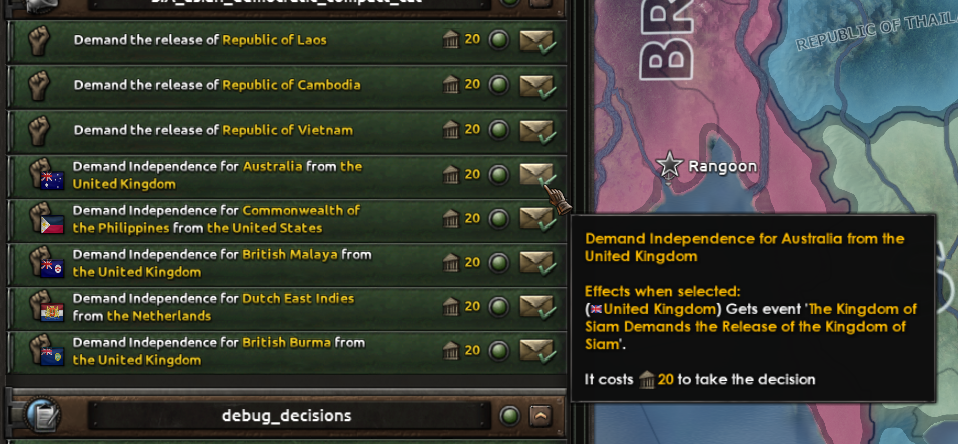 As the strength of the faction grows, so does everyone in it.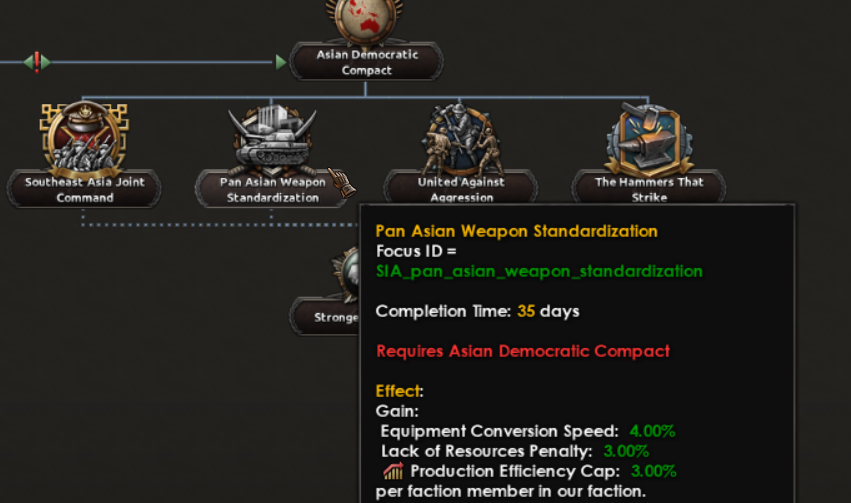
Siam wasn't exactly a willing participant in WW2, at least not in the beginning. Japan invaded Siam to get access to the Malaysian Peninsula, upon which Phibun, instead of resisting, joined the Co-Prospherity Sphere.
At first it looked like a good deal, as the Japanese helped Siam get back land, but it turned out to be a devil's bargain. Japan demanded more and more from the Thai people, both in terms of resources but also currency, which could be converted to yen. Phibun was eventually deposed by the Seri-Thai, or Free Thai, a 50k strong force, partially led by his rival, Pridi. Siam would then switch to the allies and face little repercussions after the war as a result.
The player gets the same choice. When you are first attacked by a major you get the option of either standing your ground, and fight the invaders. 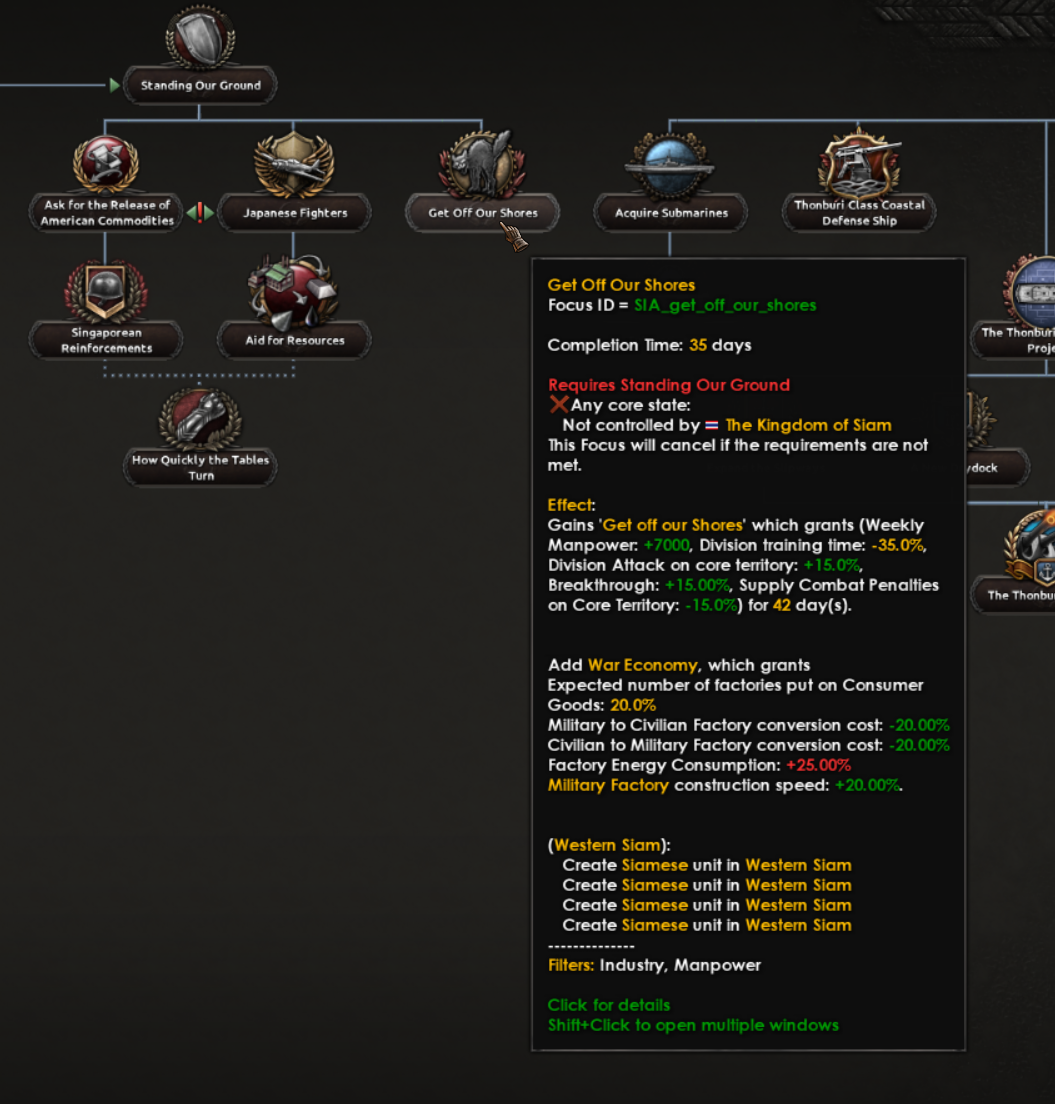 This gives lots of boosts for rapidly defending against an oncoming invasion.
If you then decide to fold, you get either the choice of completely supporting the invader, or secretly planning to flip to the allies. If you support the invader (Japan) you will be expected to pay some of their occupation cost. This will increase slowly over time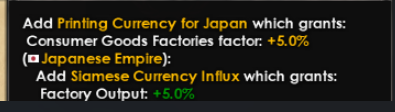
However it can be ended by getting enough war score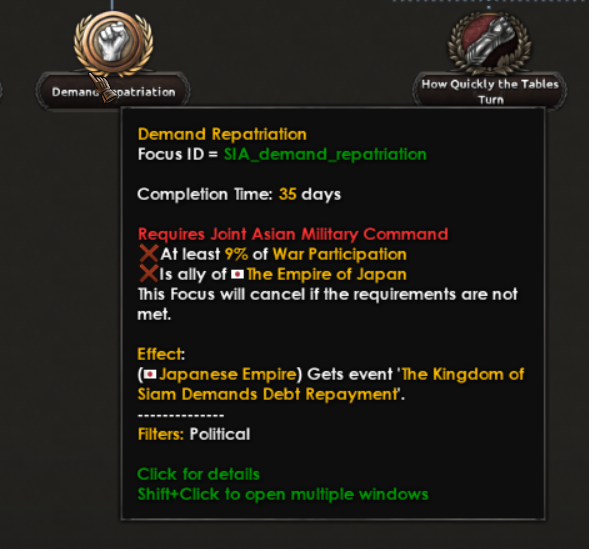
Which will force Japan to repay you
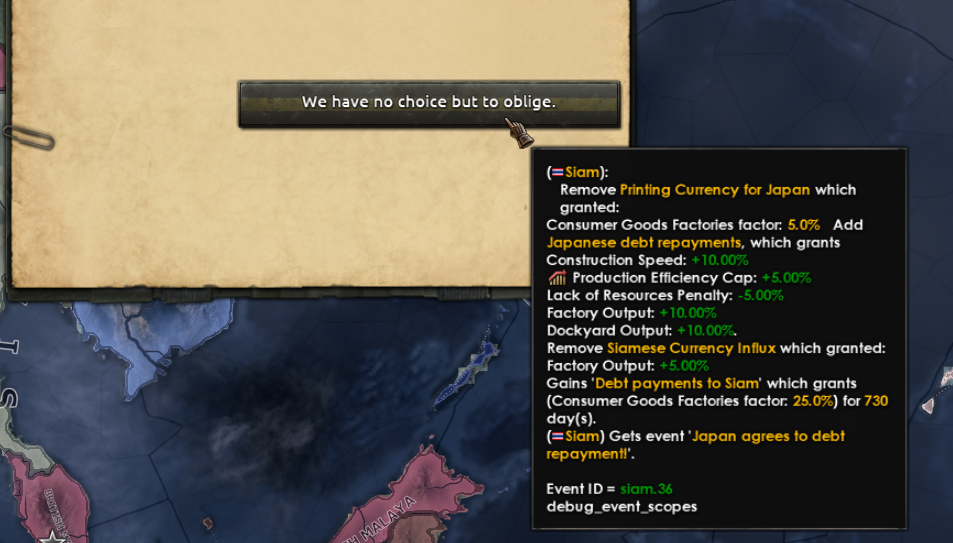
If you are planning to not stay with Japan indefinitely, you can do a Romania and switch sides via the Seri-Thai path, which will eventually depose Phibunand join the allies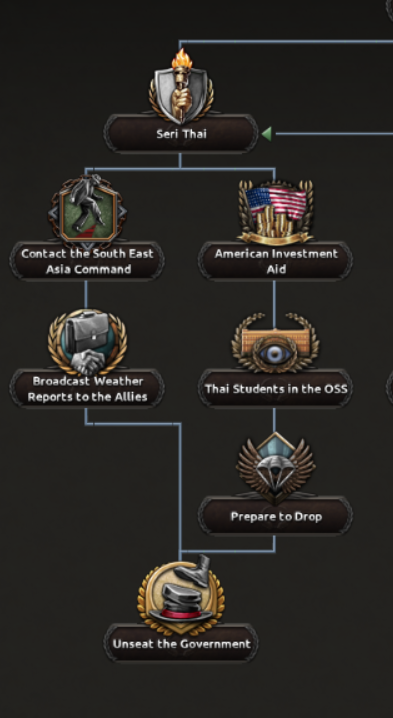
In the army tree you can decide what type of war you want to focus on, a long war, short war or an intermediate solution.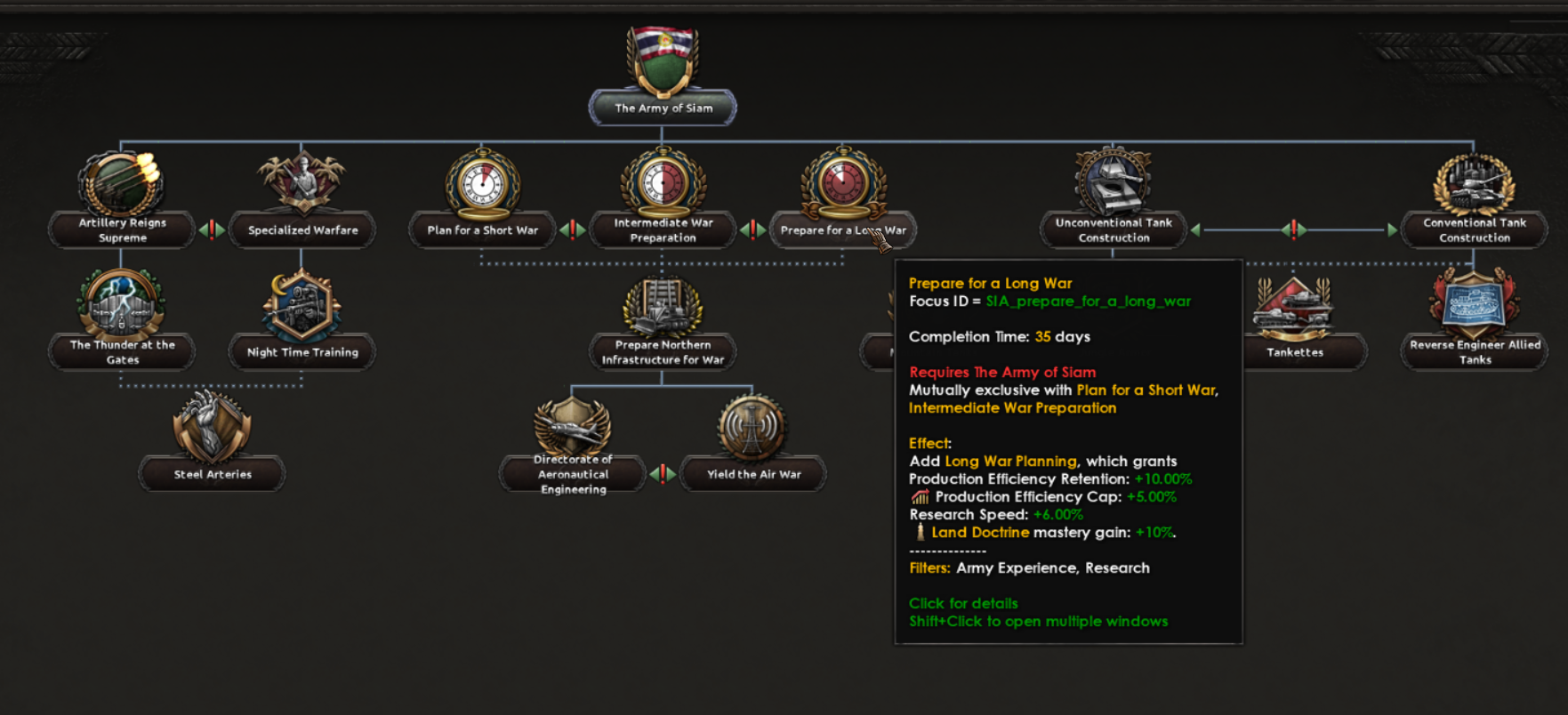
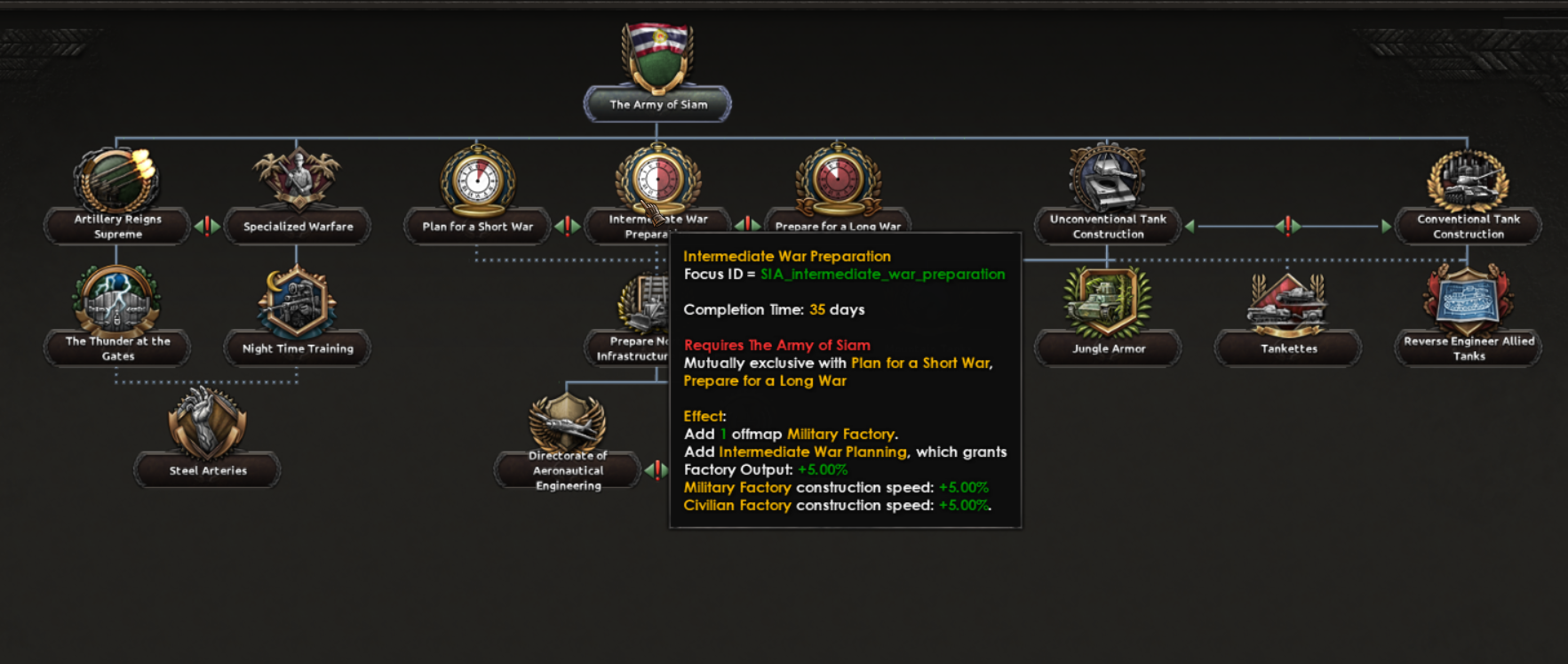
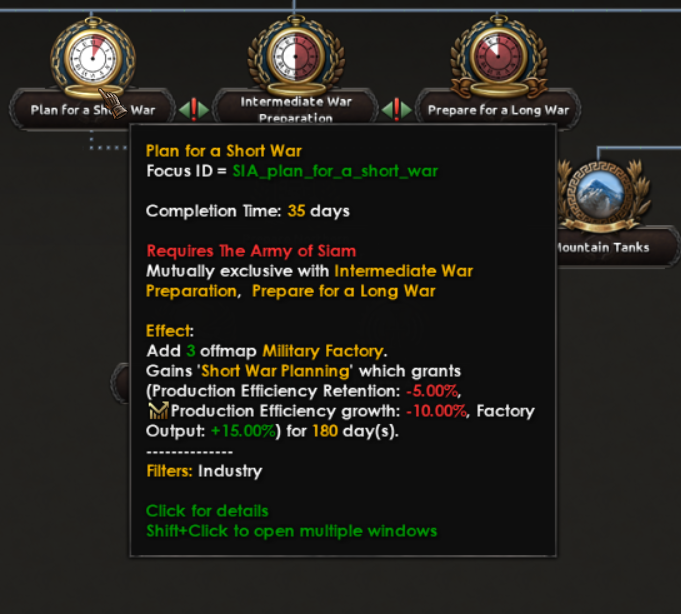
You also get to specialize in either artillery or a more specialized type of warfare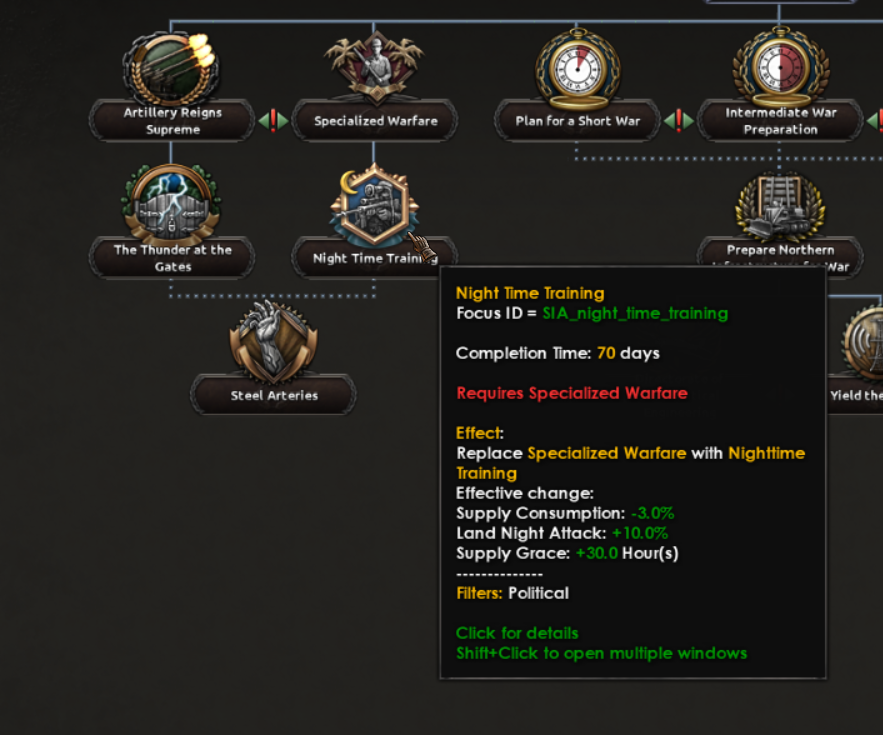
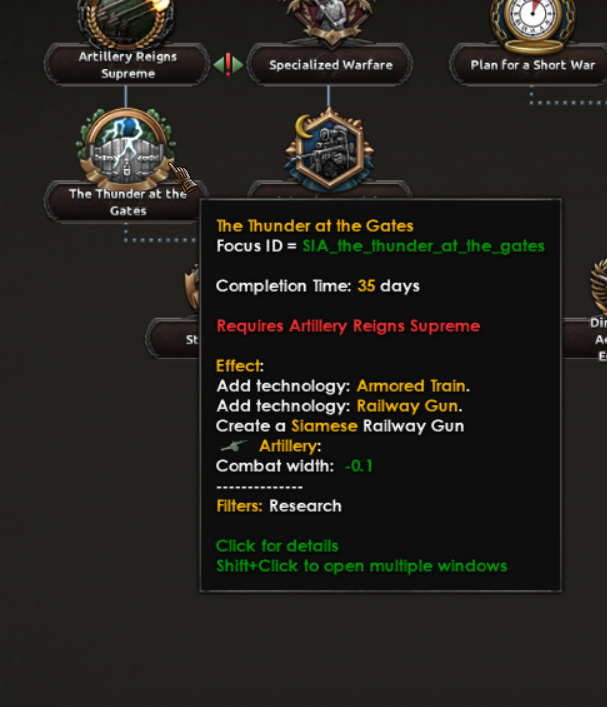 The tradition of having a focus name for the DLC continues
The tank part focuses on mostly light tanks, which is what Siam could afford, but one is more…controversial, whereas the other one is more traditional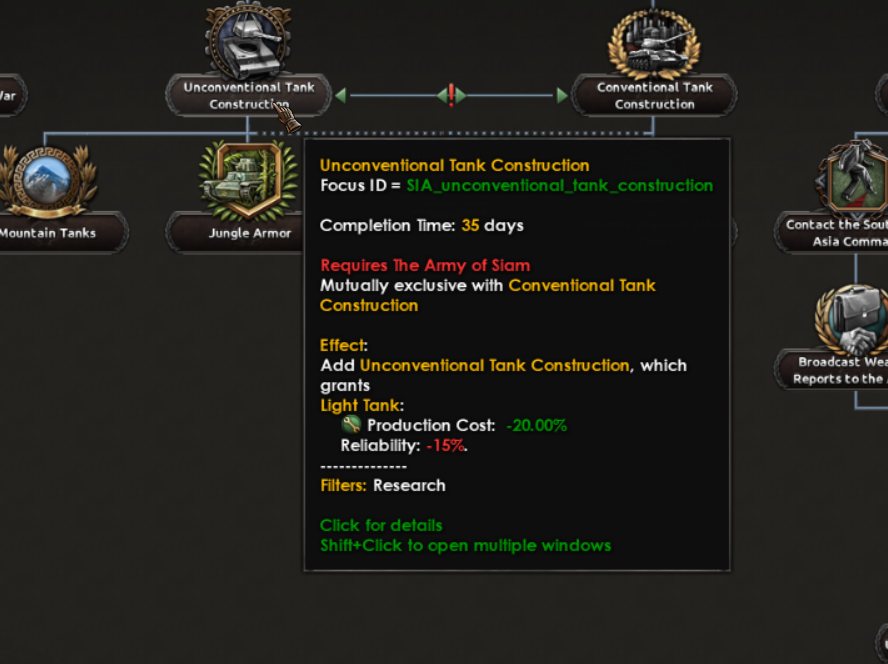
And lastly the navy branch. It is divided into two main branches. One is a more classical path which focuses on building up the navy via dockyards and bonuses. What I did want to do however with this is that it also gives some bonuses towards the other industry, so even if you don't feel like engaging with the navy there is reason to eventually go down here.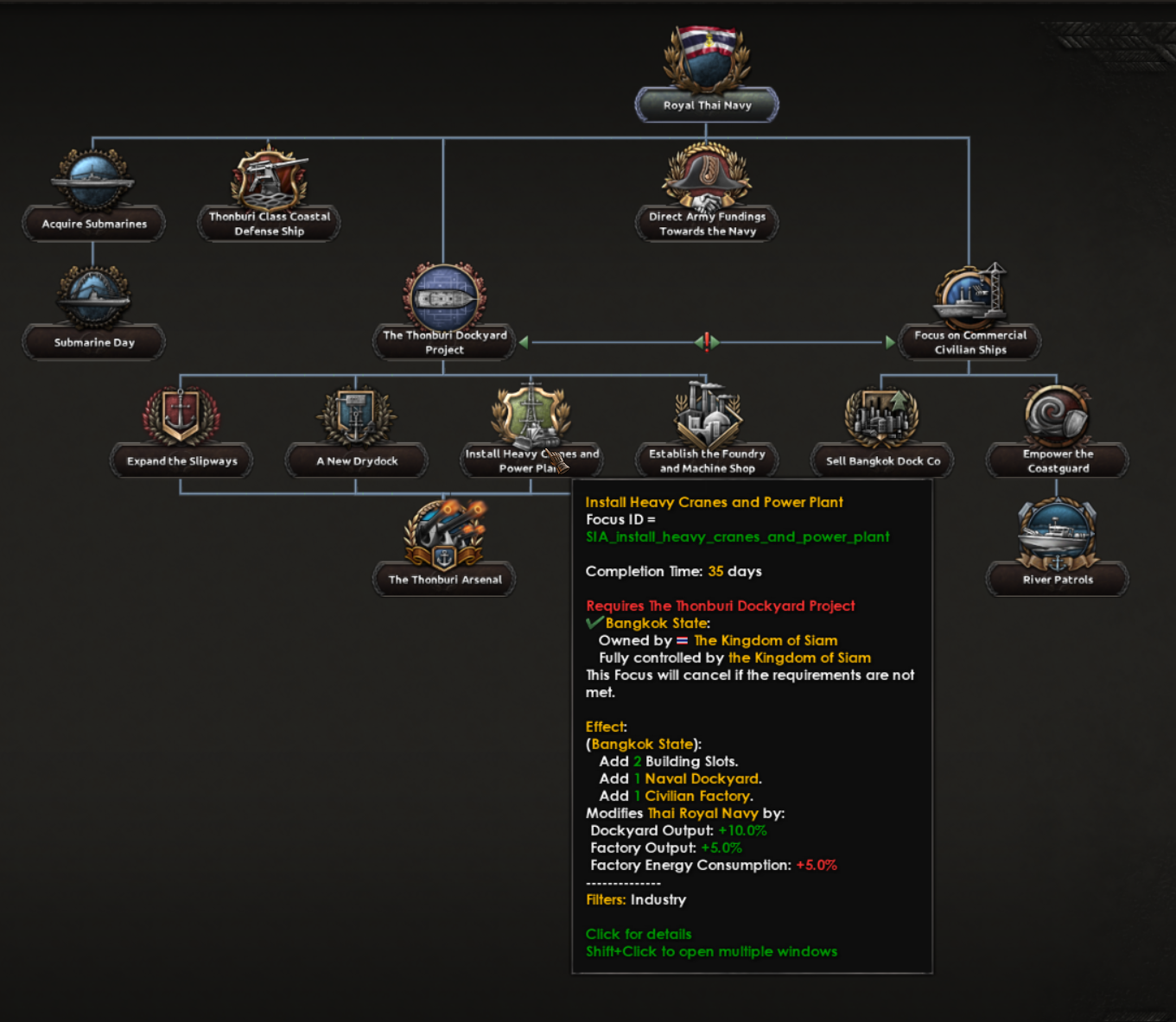
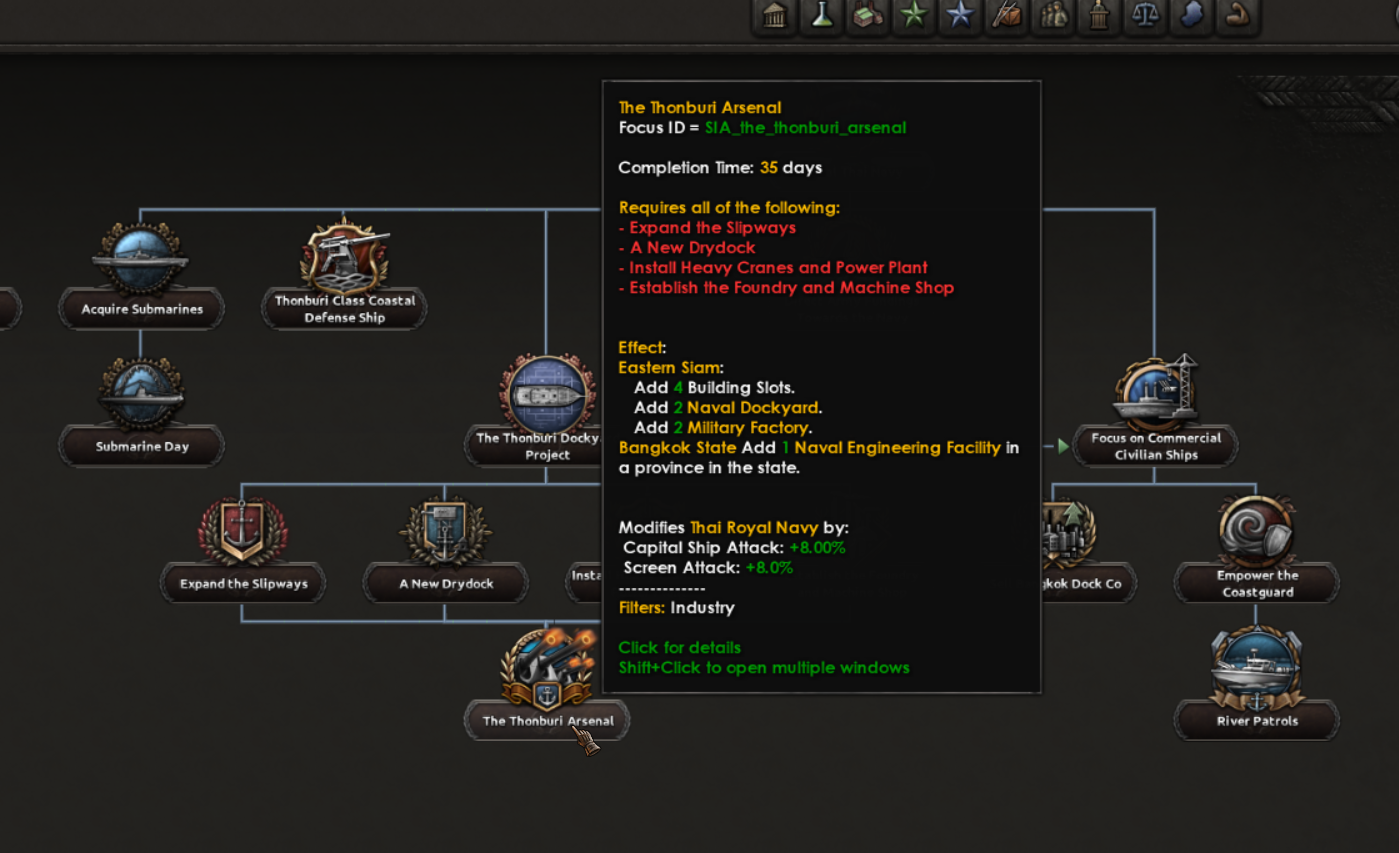 If you do not want to engage with the navy branch at all there is a shorter branch which basically sells of all the dockyards for some civilian industrial bonuses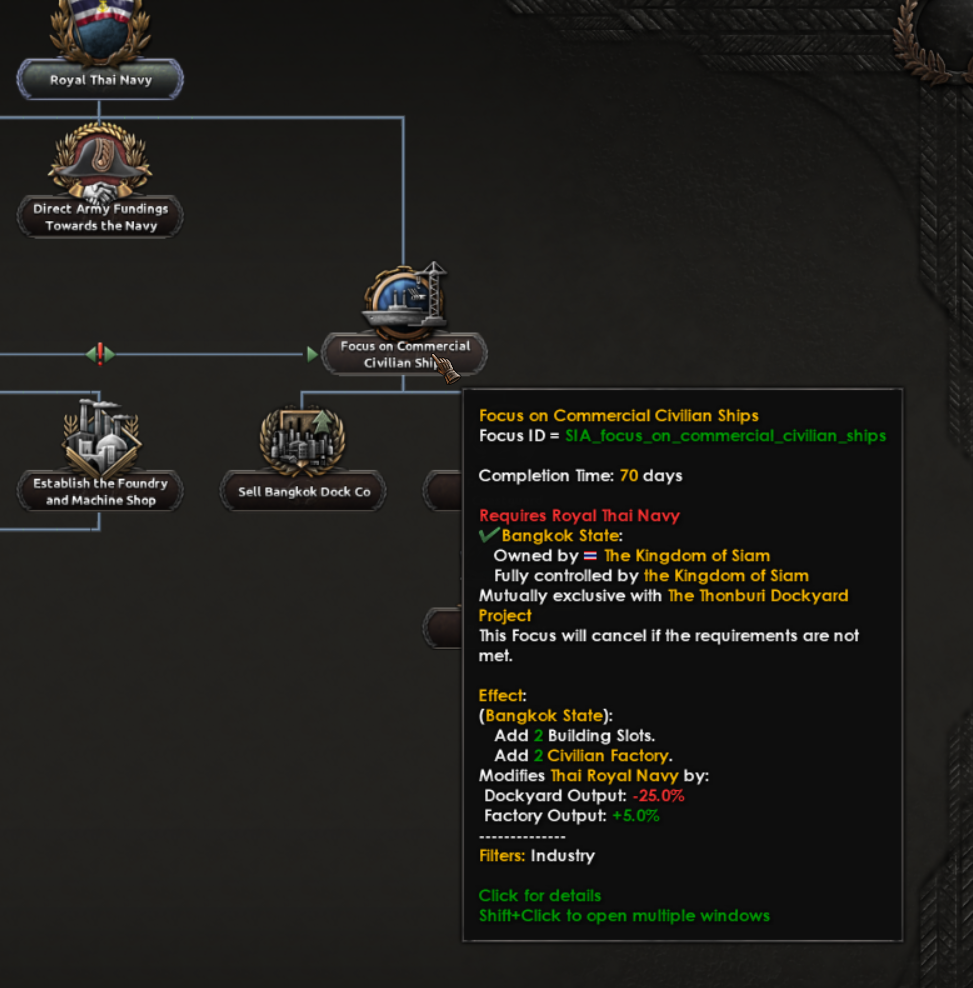
And with that I am done! That is what is coming for Siam in Thunder at our Gates. If you have any questions or feedback, I'll be reading them.
Best regards,
What's Your Reaction?









![[Business Talk] Chagee: Opening 3,500 stores in 6 years](https://xinker.org/uploads/images/202410/image_140x98_671afce94bf91.webp)