


![[PRO Tips] Gold’s Bullish Revival: Seasonal Trends and Key Levels to Watch](https://xinker.org/uploads/images/202412/image_430x256_67724cc6ad0cd.webp)
![[PRO Tips] Gold Market Under Short-Term Pressure, Safe-Haven Demand and Central Bank Buying Support Long-Term Upside Potential](https://xinker.org/uploads/images/202412/image_430x256_676ffb4685287.webp)
![[PRO Tips] Analysis of 9 key points of differentiation strategy! Master differentiation to create a brand advantage that is unique in the world!](https://firebasestorage.googleapis.com/v0/b/xinker-tips.appspot.com/o/article_thumbnails%2Fscaled_differentiation%20strategy.png.png?alt=media&token=a1bfc3d2-e85a-4db7-8a6d-01c7274f8940)
![[PRO Tips] Will REITs regain growth momentum in 2024? 3 REITs ETFs you must know if you want to invest in real estate.](https://firebasestorage.googleapis.com/v0/b/xinker-tips.appspot.com/o/article_thumbnails%2Fscaled_REITs1.png.png?alt=media&token=8af4eb93-33ff-466f-8039-b6555fad52b4)
![[PRO Tips] Complete tutorial on how to make money in Adobe Stock!](https://firebasestorage.googleapis.com/v0/b/xinker-tips.appspot.com/o/article_thumbnails%2Fscaled_tut-adobe1.png.png?alt=media&token=0b2c8cf2-22bd-4142-883e-140ed1cbaf02)
![[Passive Income] Unlock the secret of passive income: 3 steps to apply for Google AdSense](https://xinker.org/uploads/images/202410/image_430x256_6717a4fb3052b.webp)
![[Passive Income] Earn over $200 a day with AI-generated articles!](https://firebasestorage.googleapis.com/v0/b/xinker-tips.appspot.com/o/article_thumbnails%2Fscaled_article1.png.png?alt=media&token=f61bf35b-8553-4719-826d-7360024adc70)
![[Passive Income] Earn over 20 USD per download with AI-generated images!](https://firebasestorage.googleapis.com/v0/b/xinker-tips.appspot.com/o/article_thumbnails%2Fscaled_adobe2.png.png?alt=media&token=3e20e76a-a907-45af-80aa-bf9b3600301f)
![[Passive Income] Earn 10 USD per new download by sharing CapCut!](https://firebasestorage.googleapis.com/v0/b/xinker-tips.appspot.com/o/article_thumbnails%2Fscaled_capcut2.png.png?alt=media&token=a04dec40-1fac-4857-86f2-19a8be02d38e)
![[Passive Income] Use your WiFi to create passive income in 5 minutes, and you can earn 4-6 U per day!](https://firebasestorage.googleapis.com/v0/b/xinker-tips.appspot.com/o/article_thumbnails%2Fscaled_Grassio.webp.png?alt=media&token=7659a95e-0e47-4f27-a17d-c942ac3cf7f4)


![[Business Talk] The Unique Theme of XINKER's Song: Beef Wellington and Business Mastery](https://xinker.org/uploads/images/202410/image_430x256_671afc155f47f.webp)
![[Business Talk] Chagee: Opening 3,500 stores in 6 years](https://xinker.org/uploads/images/202410/image_430x256_671afce80c5f9.webp)


Dev Diary #64 - Empire Tree Update
Hey there, Emperors and Empresses! Welcome back to another Dev Diary. I’m Bas, senior game designer at Triumph Studios, and this time, I’ll be taking you through the rework of the Empire Development Tree—excitingly anticipated, a huge undertaking and, frankly, very scary! Let’s start at its very roots!The Roots of the Tree (Design Origins)In the early development stages of Age of Wonders 4, a need for a system arose that allowed players to represent the affinities of their empire in a more global way. We already had Tome Skills to add pieces on top of a player’s empire, but no real way to fully modify the general playstyle of an empire based on its affinities, especially on a strategic level.Out came the first version of the Empire Development Tree. Each affinity had a skill path that would gradually unlock as the game progressed by accumulating affinity. The skills in each path would be designed to focus on strategic systems or mechanics that represented that affinity, such as pillaging for Chaos, spellcasting for Astral, diplomacy for Order, and so on.Later on, Rites were added as fire and forget skills, mainly for the purpose of giving the players additional instant tools that fit the affinity, such as giving a specific resource or spawning a specific unit. In addition, the generic branch was added to add skills that didn’t necessarily fit into a single affinity and were more universally useful but had to be paced out.The skills of the empire tree were unlocked by accumulating affinity points and spending imperium. Imperium was used as a secondary cost to make sure you don’t simply want to rush tomes for the sake of getting more affinity points and thereby unlock empire skills faster, giving research a sort of double purpose of progression.And so there we were at release, with the Empire Development Tree defining certain playstyles for empires based on affinity! Some of the skills even became fan favorites, such as the diabolical Balor with Power From Slaughter.Barking up the Right Tree (The Feedback)The Empire Tree from release has seen several changes over the years. With certain skills being reworked, tweaked and some of its pacing altered. But over time, more pressing issues with the Tree’s overall design philosophy became apparent. The following 3 big points prompted us to look for a general review and rework of the Empire Tree:First off, the Tree did not offer much in the way of choices once you went down an affinity path. You only had one line of skills to pick from per affinity branch. The only real choice you had was whether you were willing to pay the imperium for it. This wasn’t great, especially since the core pillars of Age of Wonders 4 were Player Expression and Replayability, both defined by meaningful choices the player can make during gameplay.Secondly, we couldn’t fit the various niche identities of each affinity in the limited amount of skills each branch had. This meant some player fantasies associated with affinities couldn’t be fulfilled with the empire tree.Thirdly, once you reached the end of a branch, that was it. There was no purpose for any excess imperium or affinity points. This was especially bad for mono-affinity empires.Lastly, a design principle of the first iterations of the Empire Tree was to focus each affinity branch into particular resource types, such as Mana for Astral. This sounded good on paper, but as the game evolved, resource types shifted a lot in balance in relation to each other. This meant that certain Empire Development Tree branches became very strong or weak due to the resource type they focused on. Knowledge for Shadow was considered strong, while Food for Nature was considered weak.As can be seen, there’s very few sources in Nature for resource types other than Food and Population.Several key goals were established for a rework based on the previous feedback points:Increase replay value by adding mutual exclusive choicesAdd and rework existing skills to fulfil more player fantasies per affinityRemove the extreme focus of one resource type per affinity branchMake Rites repeating, so that accumulating affinity and imperium can be spent once a branch reaches the end.These points sound simple, but this would be a huge undertaking as we also have to consider balance and the fact that we’d be putting some skills on the cutting block while some players may have appreciated them. It took various iterations and design discussions to come to a first version that we were comfortable enough to implement for testing.Let’s go through the major steps that the design process took!Pruning the Tree (Removing Skills)One of the first steps to this new Tree was to look carefully at each existing skill and Rite and decide whether to cut it, or keep it either in its existing slot or moved around. The main criteria were:Do we need and can we fill the space left behind if the skill was removed?Does the skill fulfil the new design philosophy of the tree?Certain skills or rites
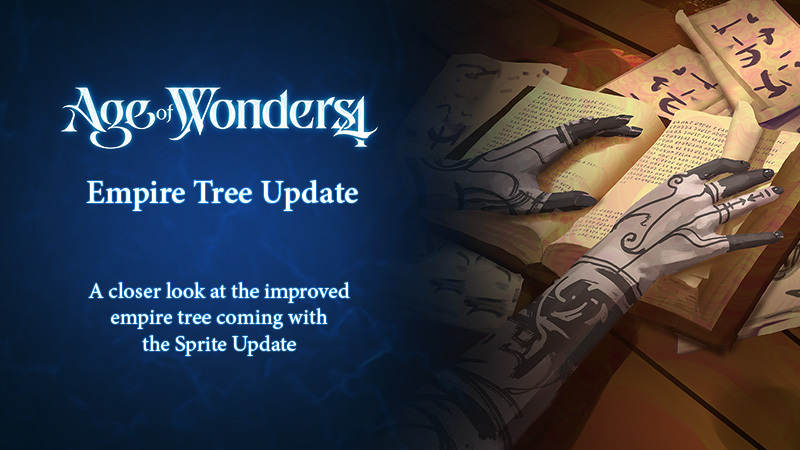

Hey there, Emperors and Empresses! Welcome back to another Dev Diary. I’m Bas, senior game designer at Triumph Studios, and this time, I’ll be taking you through the rework of the Empire Development Tree—excitingly anticipated, a huge undertaking and, frankly, very scary! Let’s start at its very roots!

In the early development stages of Age of Wonders 4, a need for a system arose that allowed players to represent the affinities of their empire in a more global way. We already had Tome Skills to add pieces on top of a player’s empire, but no real way to fully modify the general playstyle of an empire based on its affinities, especially on a strategic level.
Out came the first version of the Empire Development Tree. Each affinity had a skill path that would gradually unlock as the game progressed by accumulating affinity. The skills in each path would be designed to focus on strategic systems or mechanics that represented that affinity, such as pillaging for Chaos, spellcasting for Astral, diplomacy for Order, and so on.
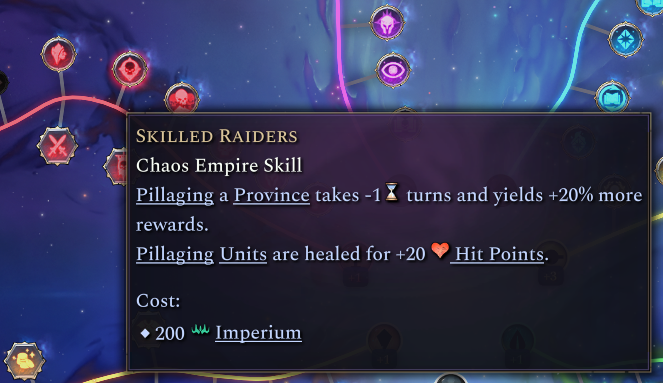
Later on, Rites were added as fire and forget skills, mainly for the purpose of giving the players additional instant tools that fit the affinity, such as giving a specific resource or spawning a specific unit. In addition, the generic branch was added to add skills that didn’t necessarily fit into a single affinity and were more universally useful but had to be paced out.
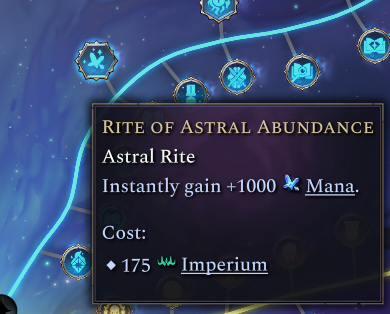
The skills of the empire tree were unlocked by accumulating affinity points and spending imperium. Imperium was used as a secondary cost to make sure you don’t simply want to rush tomes for the sake of getting more affinity points and thereby unlock empire skills faster, giving research a sort of double purpose of progression.
And so there we were at release, with the Empire Development Tree defining certain playstyles for empires based on affinity! Some of the skills even became fan favorites, such as the diabolical Balor with Power From Slaughter.
The Empire Tree from release has seen several changes over the years. With certain skills being reworked, tweaked and some of its pacing altered. But over time, more pressing issues with the Tree’s overall design philosophy became apparent. The following 3 big points prompted us to look for a general review and rework of the Empire Tree:
First off, the Tree did not offer much in the way of choices once you went down an affinity path. You only had one line of skills to pick from per affinity branch. The only real choice you had was whether you were willing to pay the imperium for it. This wasn’t great, especially since the core pillars of Age of Wonders 4 were Player Expression and Replayability, both defined by meaningful choices the player can make during gameplay.
Secondly, we couldn’t fit the various niche identities of each affinity in the limited amount of skills each branch had. This meant some player fantasies associated with affinities couldn’t be fulfilled with the empire tree.
Thirdly, once you reached the end of a branch, that was it. There was no purpose for any excess imperium or affinity points. This was especially bad for mono-affinity empires.
Lastly, a design principle of the first iterations of the Empire Tree was to focus each affinity branch into particular resource types, such as Mana for Astral. This sounded good on paper, but as the game evolved, resource types shifted a lot in balance in relation to each other. This meant that certain Empire Development Tree branches became very strong or weak due to the resource type they focused on. Knowledge for Shadow was considered strong, while Food for Nature was considered weak.
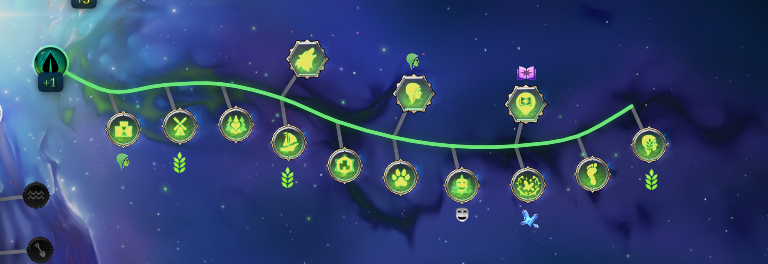
As can be seen, there’s very few sources in Nature for resource types other than Food and Population.
Several key goals were established for a rework based on the previous feedback points:
Increase replay value by adding mutual exclusive choices
Add and rework existing skills to fulfil more player fantasies per affinity
Remove the extreme focus of one resource type per affinity branch
Make Rites repeating, so that accumulating affinity and imperium can be spent once a branch reaches the end.
These points sound simple, but this would be a huge undertaking as we also have to consider balance and the fact that we’d be putting some skills on the cutting block while some players may have appreciated them. It took various iterations and design discussions to come to a first version that we were comfortable enough to implement for testing.
Let’s go through the major steps that the design process took!
One of the first steps to this new Tree was to look carefully at each existing skill and Rite and decide whether to cut it, or keep it either in its existing slot or moved around. The main criteria were:
Do we need and can we fill the space left behind if the skill was removed?
Does the skill fulfil the new design philosophy of the tree?
Certain skills or rites, like the formerly mentioned famous Balor with Power from Slaughter, were unfortunately cut due to no longer having a good place in the new Tree.
Especially unique unit unlocks were great for players that were going down a specific path, such as a demonic empire. But what about players that still wanted to tread the path of chaos without specifically going into demonology? Rites and Skills in the new Tree needed to be broad enough to fulfil multiple player fantasies, not just one.
So, the majority of skills were removed due to being too specific, making them irrelevant for some players but also feeling bad if you didn’t pick them. After all, even with the added mutual exclusivity, players don't have a lot of alternatives.
Worry not though, since for every slot opened, new skills and rites would be designed to fill them! So what was the process there?
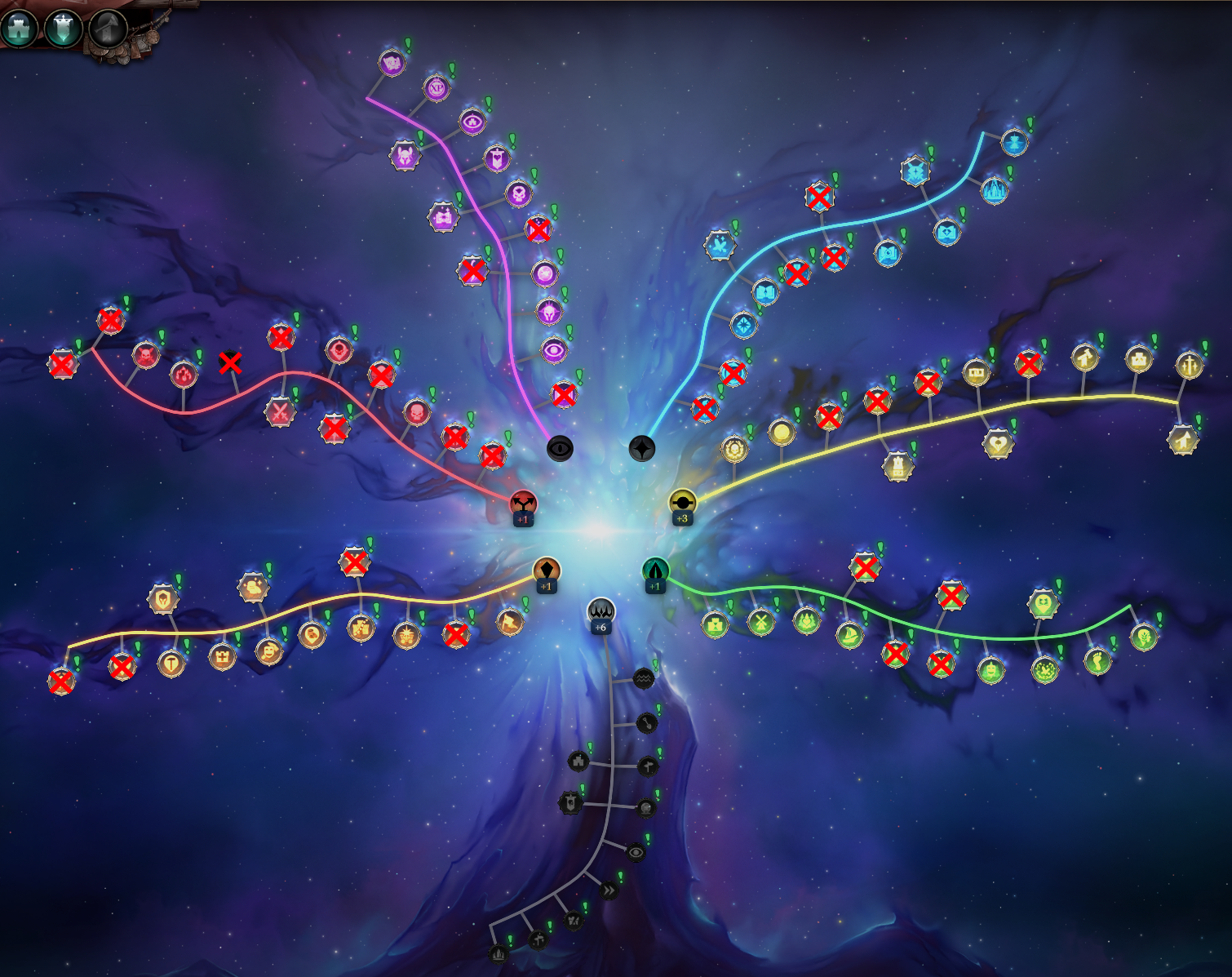
As you might’ve noted in the image below, the new tree has a whopping 44 additional nodes in it. But that’s not even the total amount of skills or rites that were added or changed! These new or reworked skills were designed with varying purposes in mind, so that each skill was more widely applicable to player fantasies.
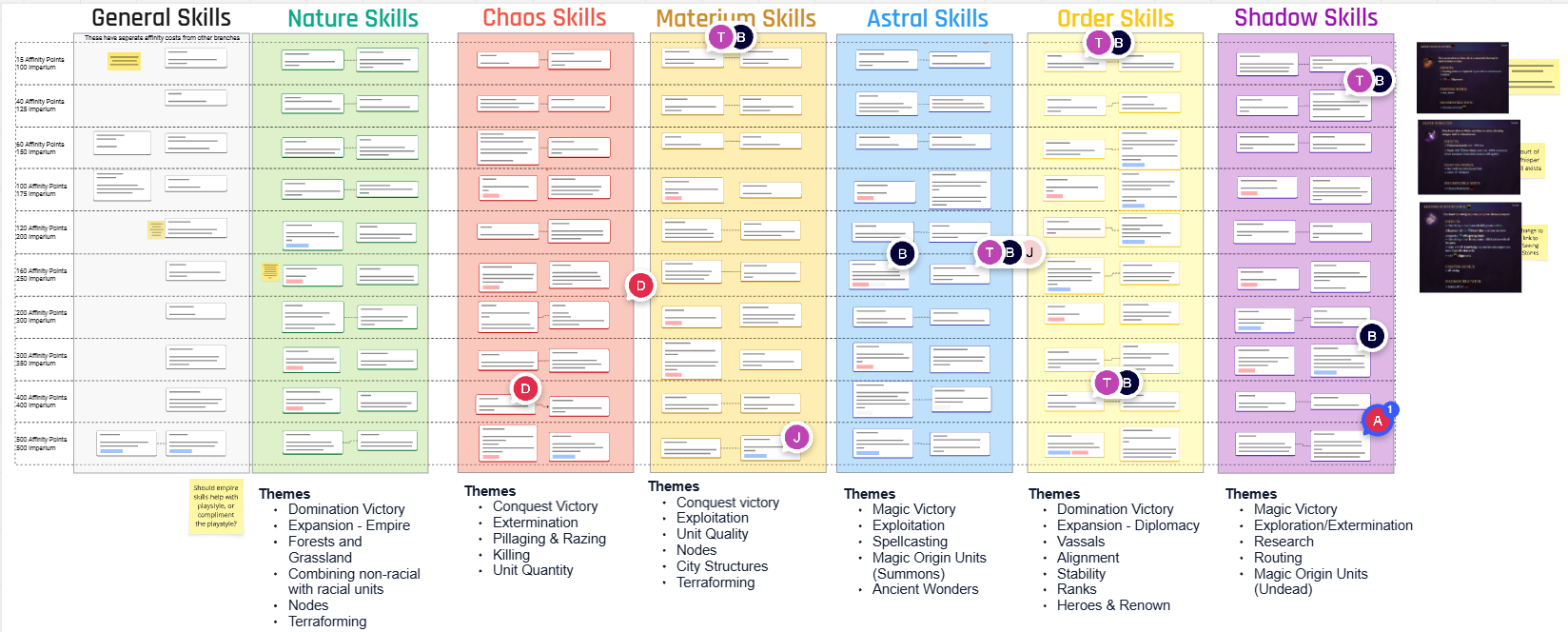 A glimpse of the design board of the new Empire Tree during development
Some examples are the various Infrastructure skills, present in all affinity branches. They grant discounts to structures that provide specific types of income. It doesn’t matter if you’re a druidic, bestial or floral kind of nature empire, the skill remains relevant.
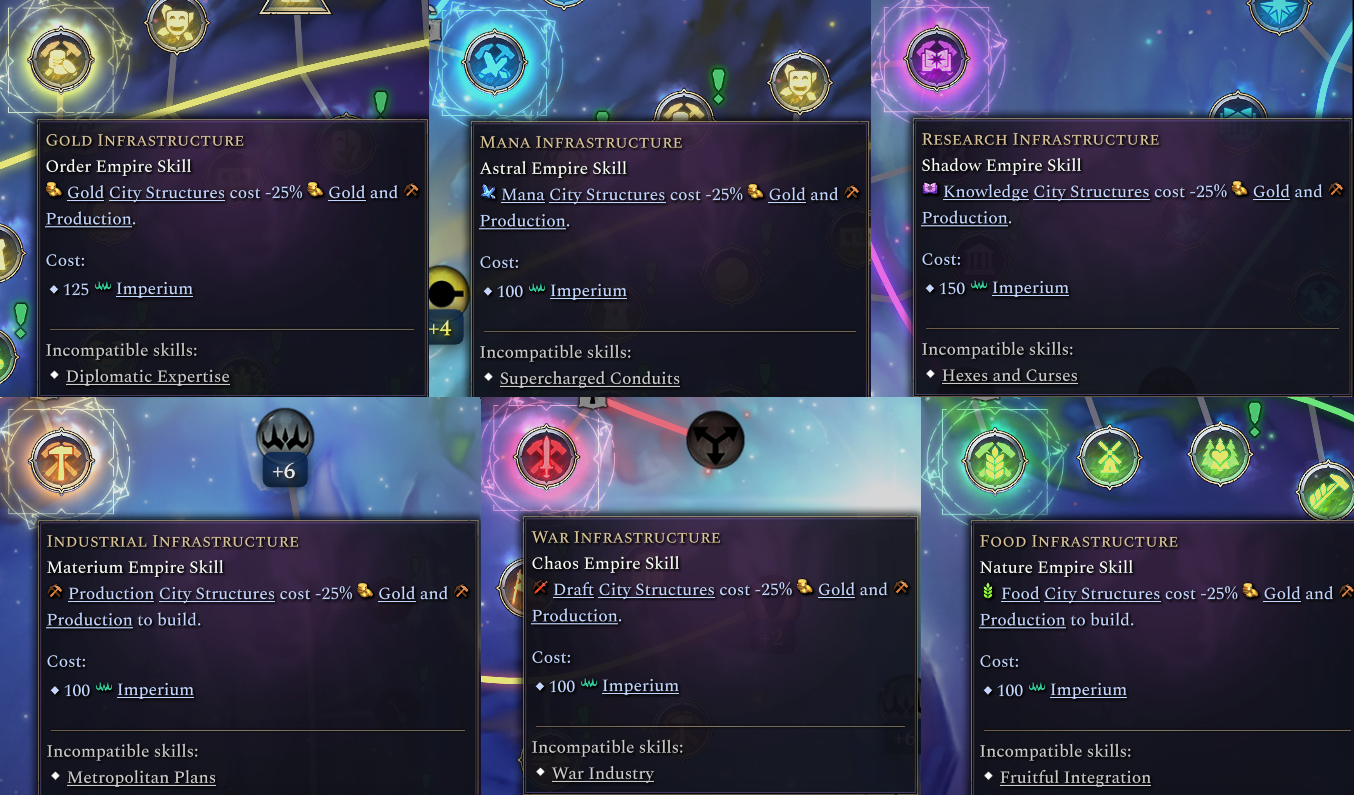
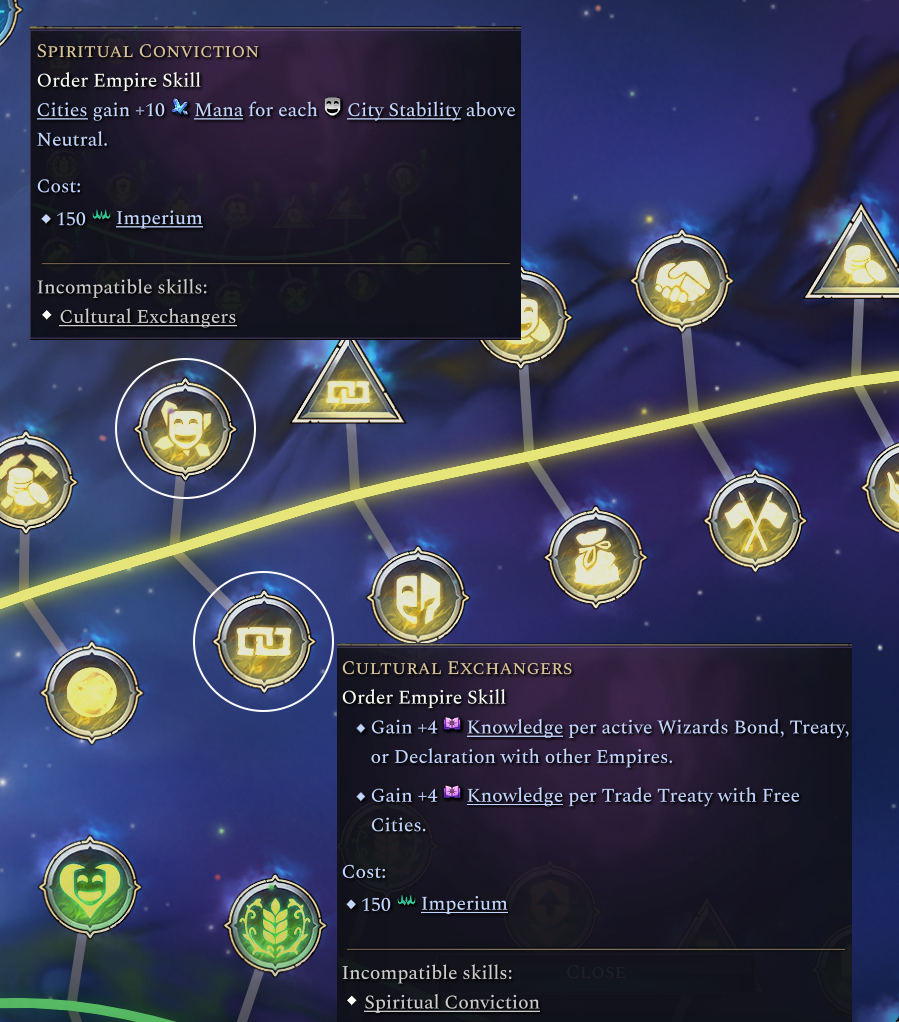
We have still retained or created new more complicated skills. Especially where we felt like particular player experiences related to affinities couldn’t be fulfilled via tome skills, but were sought after regardless. These often come paired with a more straightforward skill, to offer a generic alternative to a more niche skill.
For example, Cultural Exchangers in the Order Branch grants Knowledge for each treaty you have. This opens up an avenue of faster research and a focus on diplomacy for an Order Empire, but it relies on friendly empires and free cities being around. So it is paired with the more universally applicable Spiritual Conviction, which provides mana for maintaining stable cities.
For Rites, we’ve either changed or updated all of them to become repeatable! Each Rite increases in Imperium cost and affinity point requirement per use. This meant some more unique rites were once again reworked into something more universal, such as the famous Breastplate of the Champion rite in Materium instead granting Essence and Fragments for the Item Forge (I’m sure someone will argue that they do in fact want 5x Breastplates of the Champion).
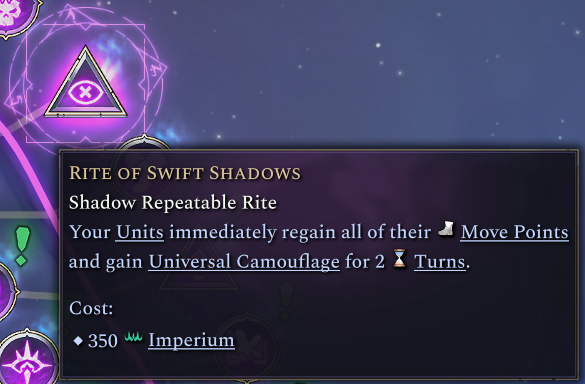
Rite of Swift Shadows can be used multiple times in a playthrough to launch sudden offenses or retreat your armies out of vulnerable positions.
This was not a one and done kind of process, in fact, there is still iteration to be done. Theorizing and creating formulas to calculate value is something us Game Designers do to help with creating content, but a lot also comes down to feeling and interpretation, since the Empire Tree lives in an everchanging context. It was honestly a very daunting task to have done this rework and some people may notice they miss some old skills.
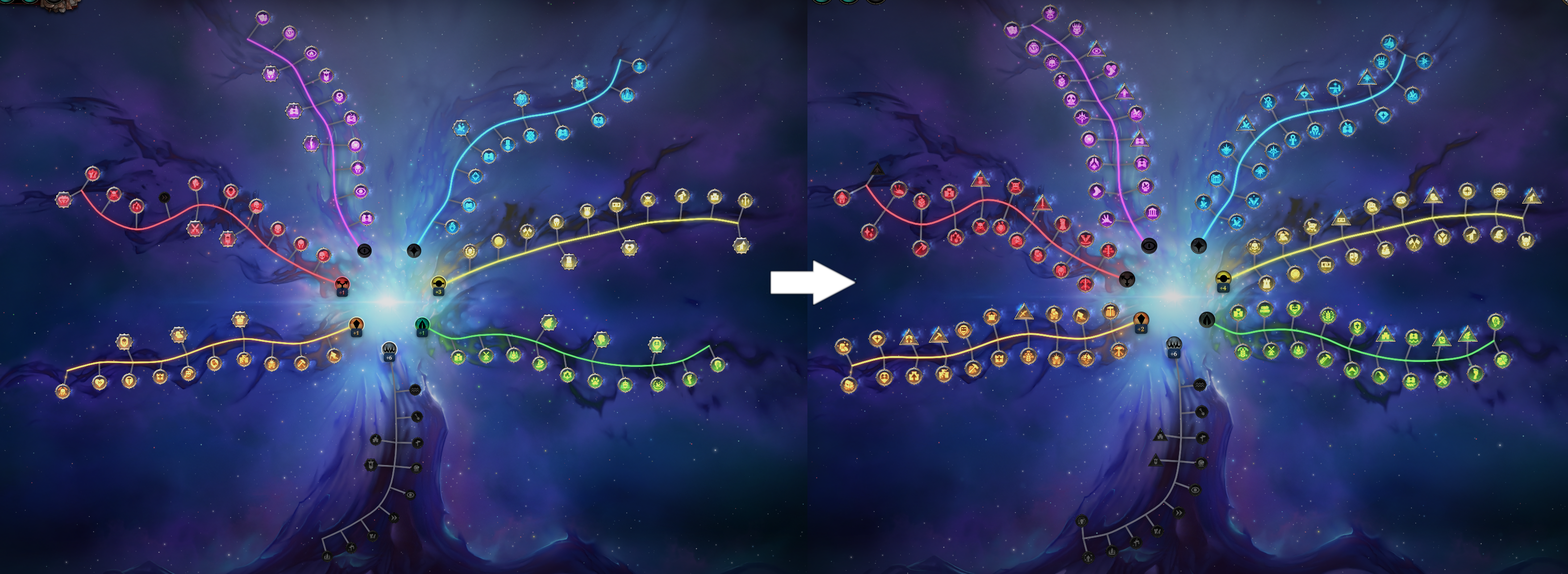
But in the end we landed on a tree that we feel is more expansive, allows for more replayability and more widely supports the player fantasies each affinity can represent. It is a tree you can build your empire on. And so we hope you’ll have a great time exploring all the new options and builds available in the free update that came alongside Secrets of the Archmages!
PS: a huge shoutout to our 2D artists, who have made a boatload of new icons for the new and changed skills and rites!
Until next time, mighty Empire builders!
https://store.steampowered.com/app/3976440?snr=1_2108_9__2107
Follow us and be the first to know when we drop new content!
What's Your Reaction?










![[Business Talk] Chagee: Opening 3,500 stores in 6 years](https://xinker.org/uploads/images/202410/image_140x98_671afce94bf91.webp)