

![[PRO Tips] Gold’s Bullish Revival: Seasonal Trends and Key Levels to Watch](https://xinker.org/uploads/images/202412/image_430x256_67724cc6ad0cd.webp)
![[PRO Tips] Gold Market Under Short-Term Pressure, Safe-Haven Demand and Central Bank Buying Support Long-Term Upside Potential](https://xinker.org/uploads/images/202412/image_430x256_676ffb4685287.webp)
![[PRO Tips] Analysis of 9 key points of differentiation strategy! Master differentiation to create a brand advantage that is unique in the world!](https://firebasestorage.googleapis.com/v0/b/xinker-tips.appspot.com/o/article_thumbnails%2Fscaled_differentiation%20strategy.png.png?alt=media&token=a1bfc3d2-e85a-4db7-8a6d-01c7274f8940)
![[PRO Tips] Will REITs regain growth momentum in 2024? 3 REITs ETFs you must know if you want to invest in real estate.](https://firebasestorage.googleapis.com/v0/b/xinker-tips.appspot.com/o/article_thumbnails%2Fscaled_REITs1.png.png?alt=media&token=8af4eb93-33ff-466f-8039-b6555fad52b4)
![[PRO Tips] Complete tutorial on how to make money in Adobe Stock!](https://firebasestorage.googleapis.com/v0/b/xinker-tips.appspot.com/o/article_thumbnails%2Fscaled_tut-adobe1.png.png?alt=media&token=0b2c8cf2-22bd-4142-883e-140ed1cbaf02)
![[Passive Income] Unlock the secret of passive income: 3 steps to apply for Google AdSense](https://xinker.org/uploads/images/202410/image_430x256_6717a4fb3052b.webp)
![[Passive Income] Earn over $200 a day with AI-generated articles!](https://firebasestorage.googleapis.com/v0/b/xinker-tips.appspot.com/o/article_thumbnails%2Fscaled_article1.png.png?alt=media&token=f61bf35b-8553-4719-826d-7360024adc70)
![[Passive Income] Earn over 20 USD per download with AI-generated images!](https://firebasestorage.googleapis.com/v0/b/xinker-tips.appspot.com/o/article_thumbnails%2Fscaled_adobe2.png.png?alt=media&token=3e20e76a-a907-45af-80aa-bf9b3600301f)
![[Passive Income] Earn 10 USD per new download by sharing CapCut!](https://firebasestorage.googleapis.com/v0/b/xinker-tips.appspot.com/o/article_thumbnails%2Fscaled_capcut2.png.png?alt=media&token=a04dec40-1fac-4857-86f2-19a8be02d38e)
![[Passive Income] Use your WiFi to create passive income in 5 minutes, and you can earn 4-6 U per day!](https://firebasestorage.googleapis.com/v0/b/xinker-tips.appspot.com/o/article_thumbnails%2Fscaled_Grassio.webp.png?alt=media&token=7659a95e-0e47-4f27-a17d-c942ac3cf7f4)


![[Business Talk] The Unique Theme of XINKER's Song: Beef Wellington and Business Mastery](https://xinker.org/uploads/images/202410/image_430x256_671afc155f47f.webp)
![[Business Talk] Chagee: Opening 3,500 stores in 6 years](https://xinker.org/uploads/images/202410/image_430x256_671afce80c5f9.webp)
Clarifying Amazon role in the game business — it’s not a retreat | Jeff Gattis interview
Jeff Gattis has had to explain Amazon’s role in the game business, particularly after it dismantled a lot of the e-commerce company’s efforts in game development. And no. His explanation is not that you can call Amazon the Tomb Raider company. Despite some well publicized layoffs, Amazon still has real business in gaming, including its Amazon Luna cloud gaming service, Prime Games store for free games for Prime members, Amazon Game Studios, Amazon Web Services for hosting games, and the Twitch livestreaming business. Gattis runs the game business, particularly Luna and Amazon Game Studios. For sure, it seemed like the company was tearing things down. The massively multiplayer online gaming business has seen huge cutbacks, with the closing of the New World MMO and the discontinuation of development on an MMO for The Lord of The Rings. At the same time, Amazon acquired the James Bond game license and 007 First Light game from Delphi Interactive and it also commissioned Crystal Dynamics to make Tomb Raider: Catalyst, an all new adventure; and Tomb Raider: Legacy of Atlantis, a remake of the original Lara Croft game coming from Crystal Dynamics and Flying Wild Hog. Legacy of Atlantis comes out on February 27, 2027. We sorted through the Amazon games strategy at Summer Game Fest in Los Angeles, where I caught up with Gattis, head of games at Amazon. I also played a short bit of the new game, Tomb Raider: Legacy of Atlantis, and tried to solve a puzzle set at a beautiful waterfall. Here’s an edited transcript of our interview. Jeff Gettis is head of games at Amazon. Source: GamesBeat/Dean Takahashi GamesBeat: Tell us what you are doing.A strategic retreat? Jeff Gattis: I’ve been at Amazon about a year now. I came from Xbox. One thing I’ve found in some of our conversations at GDC or other places where I talked to analysts or journalists–I find two things. Amazon’s gaming strategy is either misunderstood or not understood at all. They have no idea what they’re doing. Neither of those are good for us. That’s entirely our fault, because what we put out in the press has been–games get shut down. Layoffs. We haven’t done a good job of articulating what it is that we’re doing. The public perception is that Amazon is retreating from the gaming space. As an insider–I just got here. I hope we’re not retreating. That’s not what I plan to do. But really, nothing could be further from the truth. We’ve gotten, I’d like to think, a lot of clarity in our strategy. Maybe for the first time in a long time, we know what we’re doing and why we’re doing it, and what we’re not doing. I just wanted to give a little history on it and share what we’re doing going forward. It goes without saying, Amazon has a checkered history in gaming over the years. Part of that stems from just the way we’ve been organized. When I got here, we had three different gaming groups, not counting Twitch. We had Amazon Game Studio making games, mostly MMOs, kind of operating as a stand-alone business. You had the Luna team that had built this cloud gaming technology and platform. They sat in a totally different group, a devices group inside Amazon. Then you had the Prime gaming team, which was effectively a benefit for Prime members that gave away in-game content and codes that you’d go redeem on other platforms like Xbox and PlayStation and Epic Game Store. None of these groups worked with each other. GamesBeat: Wasn’t it even more than that? I think of the game services– Gattis: Right, AWS also has a big gaming arm.https://www.youtube.com/embed/fn1EREGsdFg?feature=oembed GamesBeat: Even briefly there was something about a game engine. Gattis: There was Lumberyard, yes. That was actually inside of the Amazon Game Studios umbrella. But yes, there were lots of different efforts, with varying degrees of success or failure. The core thing is none of these groups worked with one another. That’s one of the first things we’ve done under new leadership. We’ve consolidated all of those into one organization. I look after the gaming business. You have two pillars now. You have Luna, our gaming platform, and Amazon Game Studios, where we develop and publish games. Not unlike Xbox, Xbox Game Studios. Lara Croft takes on a T-Rex. Source: Amazon That’s allowed us to think a lot more coherently about the strategy. The big question for me getting here was, why does Amazon exist in the game space? What value do we bring? What gap do we fill? If you look at it objectively, previously I don’t know that we were filling a gap. Luna’s strategy was initially like the Xbox xCloud strategy. No console required. We’re just going to magically get console players and PC players to stop buying hardware. Everyone is going to come over to the cloud. When they do they’ll come to Amazon. That doesn’t quite wash out. We haven’t seen this magical inflection point. With core gamers as a whole, of which I’d count myself as one, I love my hardware. I love my console. I love my gaming PC. I s

Jeff Gattis has had to explain Amazon’s role in the game business, particularly after it dismantled a lot of the e-commerce company’s efforts in game development. And no. His explanation is not that you can call Amazon the Tomb Raider company.
Despite some well publicized layoffs, Amazon still has real business in gaming, including its Amazon Luna cloud gaming service, Prime Games store for free games for Prime members, Amazon Game Studios, Amazon Web Services for hosting games, and the Twitch livestreaming business. Gattis runs the game business, particularly Luna and Amazon Game Studios.
For sure, it seemed like the company was tearing things down. The massively multiplayer online gaming business has seen huge cutbacks, with the closing of the New World MMO and the discontinuation of development on an MMO for The Lord of The Rings.
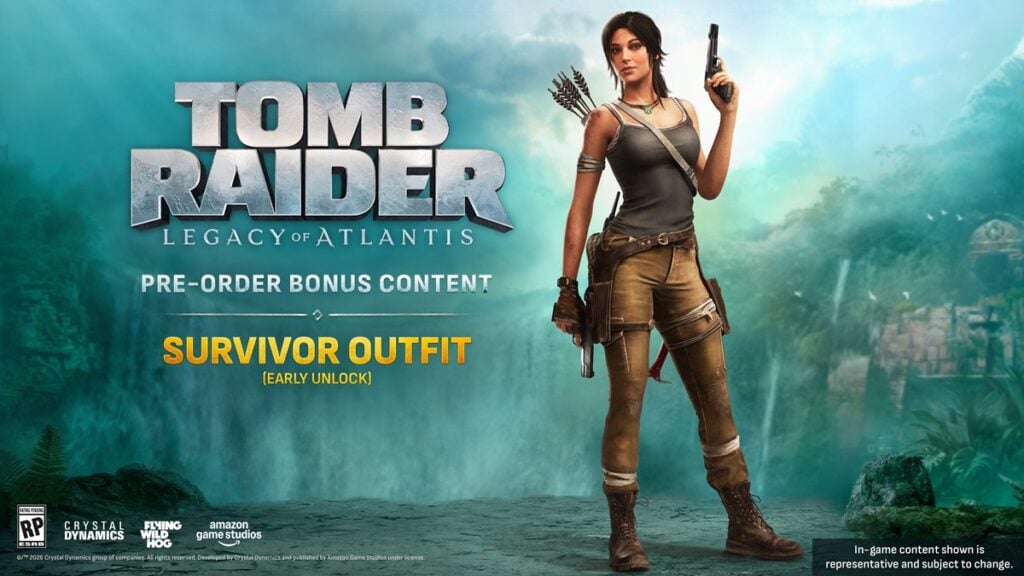
At the same time, Amazon acquired the James Bond game license and 007 First Light game from Delphi Interactive and it also commissioned Crystal Dynamics to make Tomb Raider: Catalyst, an all new adventure; and Tomb Raider: Legacy of Atlantis, a remake of the original Lara Croft game coming from Crystal Dynamics and Flying Wild Hog. Legacy of Atlantis comes out on February 27, 2027.
We sorted through the Amazon games strategy at Summer Game Fest in Los Angeles, where I caught up with Gattis, head of games at Amazon. I also played a short bit of the new game, Tomb Raider: Legacy of Atlantis, and tried to solve a puzzle set at a beautiful waterfall.
Here’s an edited transcript of our interview.
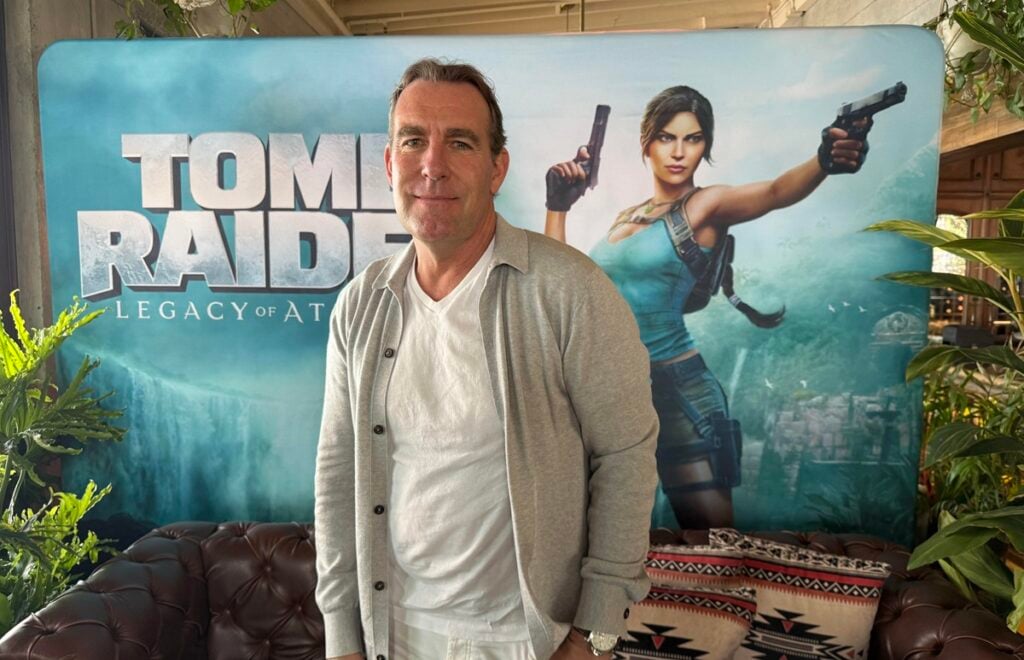 Jeff Gettis is head of games at Amazon. Source: GamesBeat/Dean Takahashi GamesBeat: Tell us what you are doing.
We haven’t done a good job of articulating what it is that we’re doing. The public perception is that Amazon is retreating from the gaming space. As an insider–I just got here. I hope we’re not retreating. That’s not what I plan to do.
But really, nothing could be further from the truth. We’ve gotten, I’d like to think, a lot of clarity in our strategy. Maybe for the first time in a long time, we know what we’re doing and why we’re doing it, and what we’re not doing. I just wanted to give a little history on it and share what we’re doing going forward.
It goes without saying, Amazon has a checkered history in gaming over the years. Part of that stems from just the way we’ve been organized. When I got here, we had three different gaming groups, not counting Twitch. We had Amazon Game Studio making games, mostly MMOs, kind of operating as a stand-alone business. You had the Luna team that had built this cloud gaming technology and platform. They sat in a totally different group, a devices group inside Amazon. Then you had the Prime gaming team, which was effectively a benefit for Prime members that gave away in-game content and codes that you’d go redeem on other platforms like Xbox and PlayStation and Epic Game Store. None of these groups worked with each other.
GamesBeat: Wasn’t it even more than that? I think of the game services–
Gattis: Right, AWS also has a big gaming arm.
https://www.youtube.com/embed/fn1EREGsdFg?feature=oembed GamesBeat: Even briefly there was something about a game engine.
Gattis: There was Lumberyard, yes. That was actually inside of the Amazon Game Studios umbrella. But yes, there were lots of different efforts, with varying degrees of success or failure. The core thing is none of these groups worked with one another. That’s one of the first things we’ve done under new leadership. We’ve consolidated all of those into one organization. I look after the gaming business. You have two pillars now. You have Luna, our gaming platform, and Amazon Game Studios, where we develop and publish games. Not unlike Xbox, Xbox Game Studios.
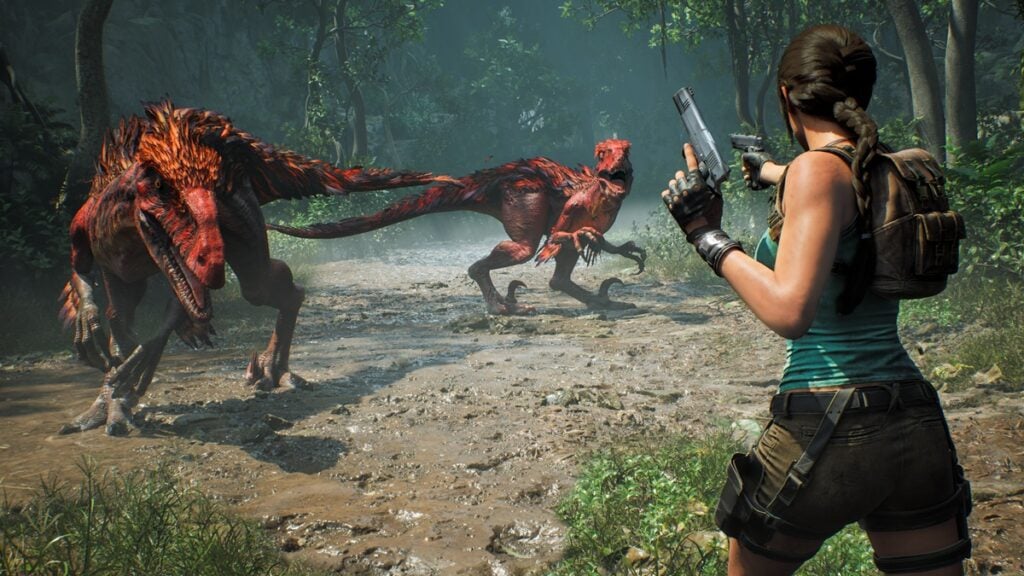
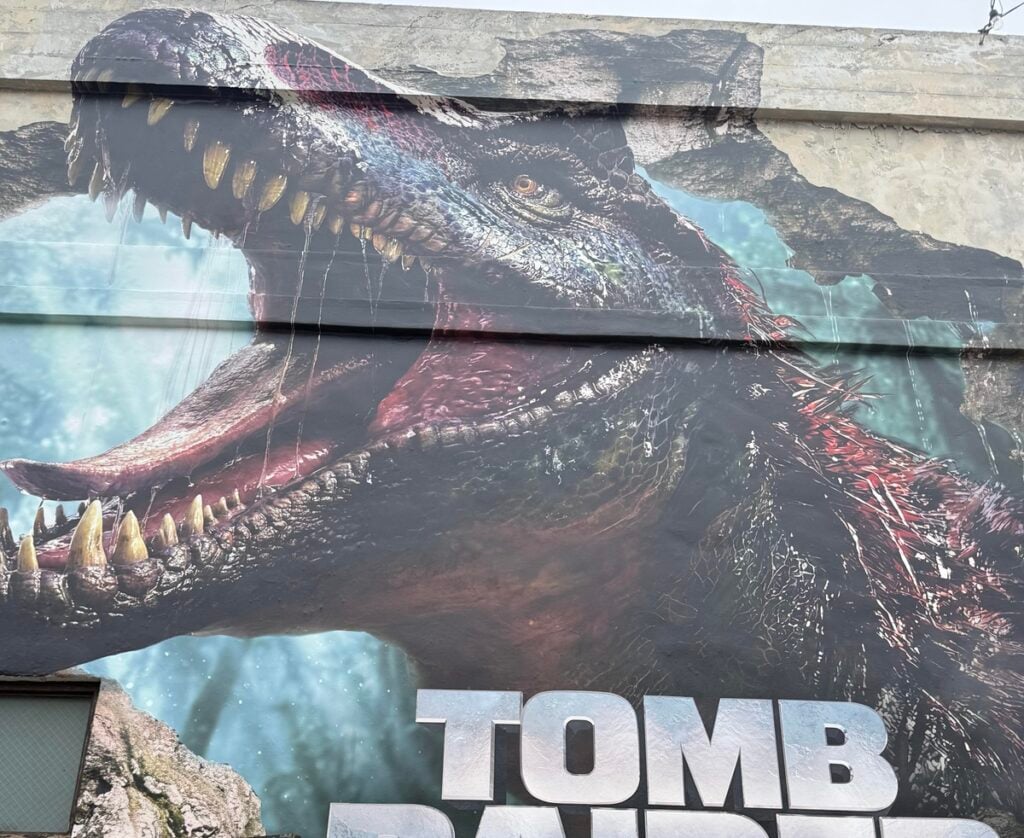 Lara Croft takes on a T-Rex. Source: Amazon That’s allowed us to think a lot more coherently about the strategy. The big question for me getting here was, why does Amazon exist in the game space? What value do we bring? What gap do we fill? If you look at it objectively, previously I don’t know that we were filling a gap. Luna’s strategy was initially like the Xbox xCloud strategy. No console required. We’re just going to magically get console players and PC players to stop buying hardware. Everyone is going to come over to the cloud. When they do they’ll come to Amazon. That doesn’t quite wash out. We haven’t seen this magical inflection point.
With core gamers as a whole, of which I’d count myself as one, I love my hardware. I love my console. I love my gaming PC. I spent a lot of money on it, so I’m not just emotionally invested. I’m literally invested in it. In many ways, of the audiences to come to cloud gaming, that core group is probably going to be the last one, if they do at all. That was one of the first realizations. Let’s not focus on high-end core gamers who play competitive multiplayer shooters and things like that, where every millisecond matters.
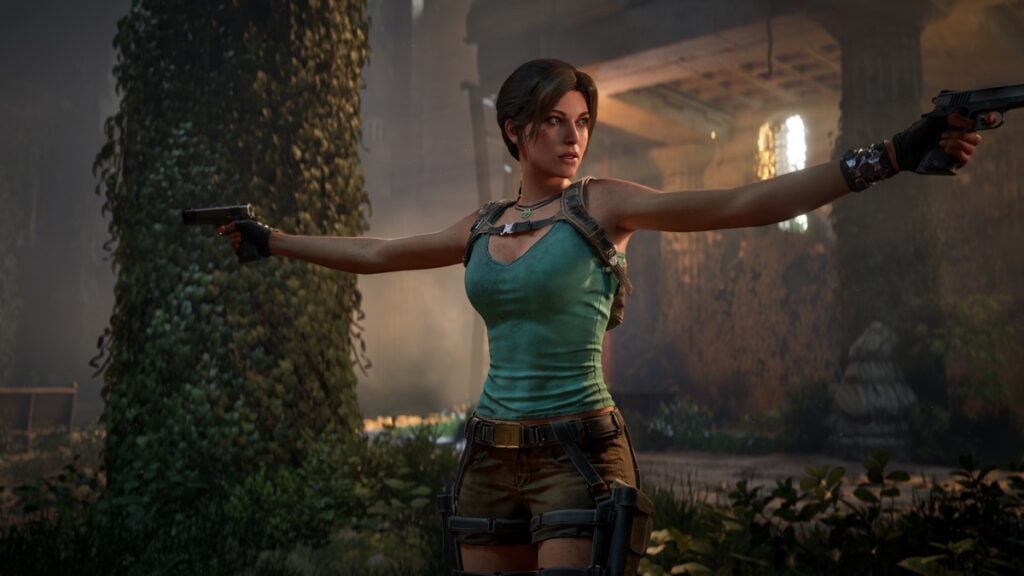 Lara Croft wields dual guns in Tomb Raider: Legacy of Atlantis. Source: Amazon GamesBeat: What is the focus?
Gettis: We see a massive opportunity when it comes back to looking at the assets Amazon has and what Amazon does well. We see a massive opportunity outside of that core group. That’s the 2.5 billion people in the world who play games and don’t own dedicated gaming hardware. That group hasn’t been well served to date. A lot of them play mobile games. Some of them probably want to graduate up, but they don’t have the ability to play console games, because they’re not invested in the hardware. The hardware is only getting more expensive, as we know. That’s where we think there’s a space. Using the tools of Amazon, including Amazon Prime, by pushing value and games into Prime, by using the cloud tech where people don’t have to buy additional hardware. You can just instantly play. That’s where we think we have a unique position. Not a lot of other companies can do that, just put a bunch of value in Prime and call it a day.
That’s what we’ve done. We kind of relaunched Luna last October. But the big shift for us was, instead of making people subscribe to Luna for $10 a month, we pushed almost all the value into what we call Luna Standard, which is the Prime benefit. If you’re a Prime member today – there’s a couple of hundred million worldwide – you have access to close to 100 games that are in there. They range from triple-A all the way down to casual games you can play with your controller. EA FC, the World Cup starts next week. We have FC26. If you’re a Prime member you can play that for free. Nobody knows about it. That’s the problem. We have a lot of work to do. Hogwarts Legacy in there. Indiana Jones is in there with the latest DLC. All the way down to a bunch of casual games.
We’ve gotten a lot of good traction in the past three or four months with people who don’t own controllers, but still want to play Angry Birds on Luna. There’s game shows and trivia and things like that. We’re finding good traction. There’s an audience. Much like you see with Netflix. Trying to focus on more casual people.
GamesBeat: It seems like there’s still an opportunity with memory prices going so high. It’s discouraging console launches, discouraging people from buying new gaming PCs. Cloud gaming might have a chance in this moment to get more core gamers because it’s not a bad value proposition.
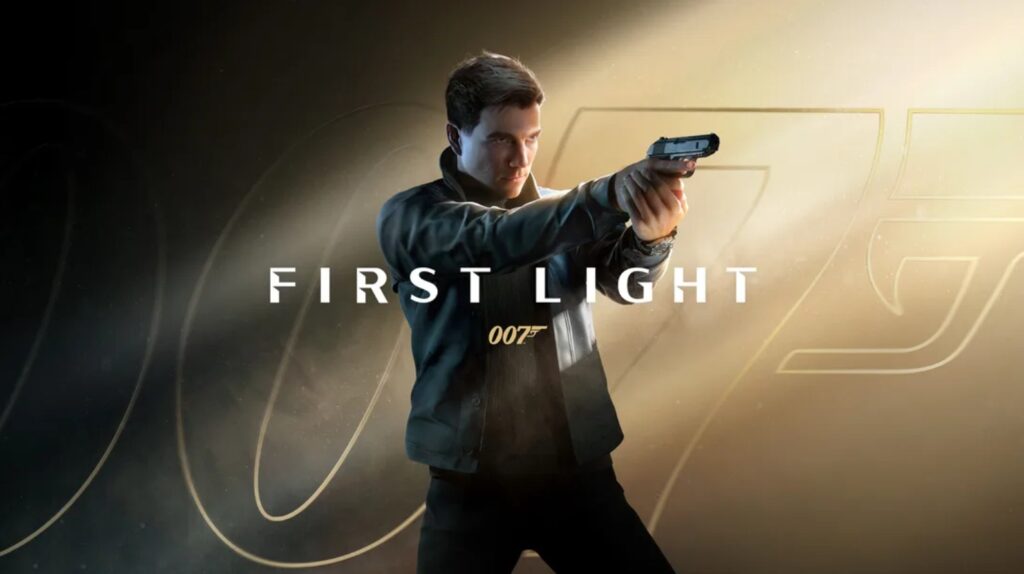 A young James Bond is selling well. 007 First Light. Source: IO Interactive/Amazon Gattis: I agree. Our strategy isn’t predicated on that happening, but if it does happen, it’ll just accelerate our growth. When I was at Xbox and we were launching and pushing xCloud, the problem with xCloud is you still had to have a Game Pass membership. It still effectively cost $20 a month. If you do the math, you could buy an Xbox Series S for probably $150 at GameStop used. The total cost of ownership was actually much higher for cloud. That’s very different, though, when consoles are $1,000 or $1,500, and gaming PCs–I don’t even know now. The last card I bought was $3,000.
So I do think that’s true, but for us, we’re just saying that we’ll let that market evolve. We’re thinking much more about how we can grow the pool of players. I’d argue that the PlayStations and Xboxes and Steams of the world are effectively fighting for the same players, 300 to 500 million of them. That pool isn’t really growing. For the industry – not just Amazon – we think what we’re doing is a way to bring more people in, new players, to play games that they would otherwise not have been able to play. That’s our big thesis.
We’re trying to then map that to our IP strategy and our distribution strategy. A big part of our thesis is this notion that TV and movies and video games can become more integrated as an overall thing. This is back to the question of where Amazon adds value. Amazon has a ton of IP through MGM and shows on Prime Video. You’ll see a lot more of us building video games – first-party and third-party – that align with TV shows. Tomb Raider, when it launches, we’ll have the Tomb Raider TV show on Prime Video. You might have a Tomb Raider page where the show exists, the movie exists, the video game exists, you can buy Tomb Raider merchandise. We’re trying to use the powers of Amazon to do some pretty unique things.
GamesBeat: Is it getting easier to align a game launch with that kind of TV opportunity?
Gattis: Obviously game development is such an unknown in terms of time and cost. We just, on Friday–it was a smaller game, but on Friday the Masters of the Universe film dropped in theaters, and we dropped the Masters of the Universe: Legends Unite game into Luna, day and date. Now, that wasn’t a game that took five years to make. It’s a deck-builder, Slay the Spire kind of game. But that’s an example. That’s what we want to do much more of going forward.
It’s always tricky. But in the future we see opportunities to make games, or I’ll call them experiences, that are more extensions of video. You watch a show and you can engage with your favorite characters or re-create a scene in a game. I don’t think it always has to be triple-A games. It can be. But there are other kinds of extensions and experiences we can make.
 The Lost Valley in Tomb Raider: Legacy of Atlantis. Source: Amazon GamesBeat: Backing up to the MMOs, did those just lose their audience? Did they become too hard to make? I’m not sure why dropping out of MMOs fit this new strategy.
Gattis: A couple things. MMOs are very expensive to make and to maintain. There’s always a business conversation behind all of these things. We’re continuing to update Throne and Liberty and Lost Ark. We haven’t walked away. But I do think, when you think about our overall strategy and the audience we’re trying to reach, we don’t see a great overlap with the MMO audience. When I think of Luna I look at the distribution of the entire gaming market. If you draw a line in the middle, your mid-core players–Xbox and PlayStation are sort of mid-core up to core core. We’re trying to focus on mid-core down to casual. You could argue that this is where Netflix–we share a similar vision around the market opportunity.
The MMOs are a bit too core. At Luna we’ve had much more success–triple-A works on Luna, but it works when it’s familiar, approachable IP with relatively easy game mechanics. Hogwarts Legacy has done great on the service. Everyone loves the IP. The game itself is not overly complicated to play. I’d say the same thing about Indiana Jones. Even Tomb Raider will fit that bill. Some of the more complex RPGs, MMOs, they’re just a different audience.
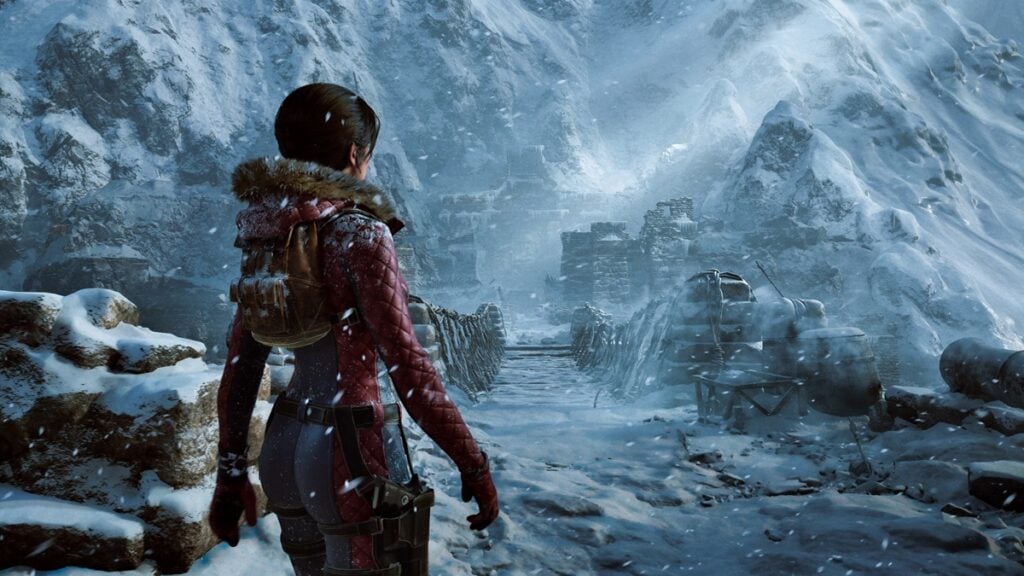
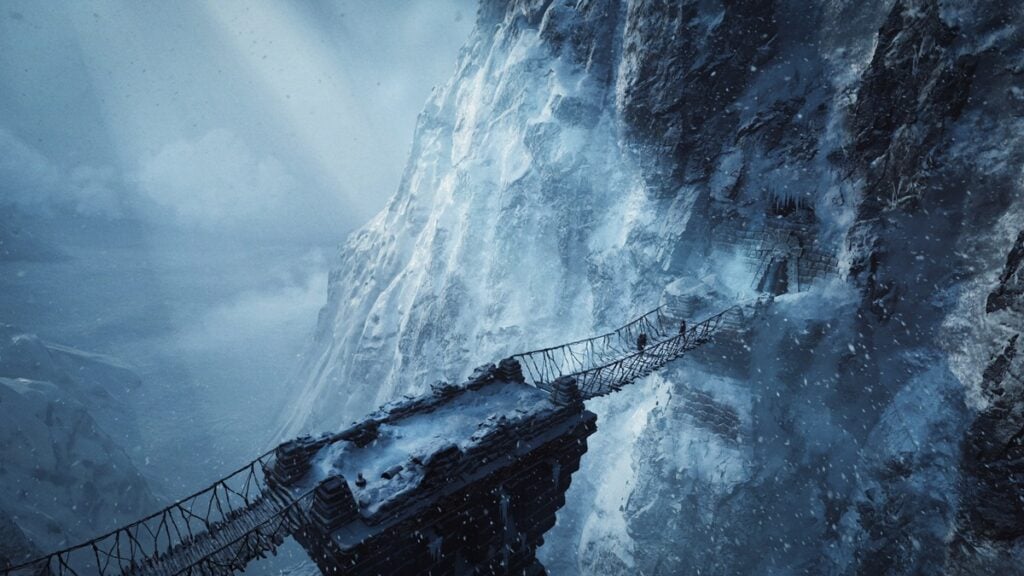 A collapsed bridge in Tomb Raider: Legacy of Atlantis. Source: Amazon GamesBeat: I remember John Smedley said that when he talked to Jeff Bezos, Bezos said, “I want you to make computationally ridiculous games.” It reflected Amazon’s infrastructure ambitions, but it didn’t necessarily reach the customer.
Gattis: We should remember that “customer obsessed” is one of the Amazon leadership principles. This is not an Amazon statement, but I think that any time you’re creatively making things to justify another business or infrastructure need, that’s a slippery slope.
If there’s opportunity to innovate–we think about it the same way we think about our own game development strategy. Where can we as Amazon take some risks? When we try to push innovation in an industry that I would argue has not seen a lot of innovation in 10, 15, 20 years–Fortnite? PUBG? The game mechanics all seem the same. The industry is in a state where no one is really trying anything new anymore. You’ll see us invest a lot more into trying to push boundaries a bit on new types of games that can be made. A simple example is our courtroom game with Snoop Dogg as a celebrity judge. That’s a game where Snoop trained an LLM. Game made by humans, but using AI to make a different type of game that couldn’t have been made three or five years ago. That’s a tip of the iceberg example. I think you can use generative AI tools not to build games, but actually make different types of games.
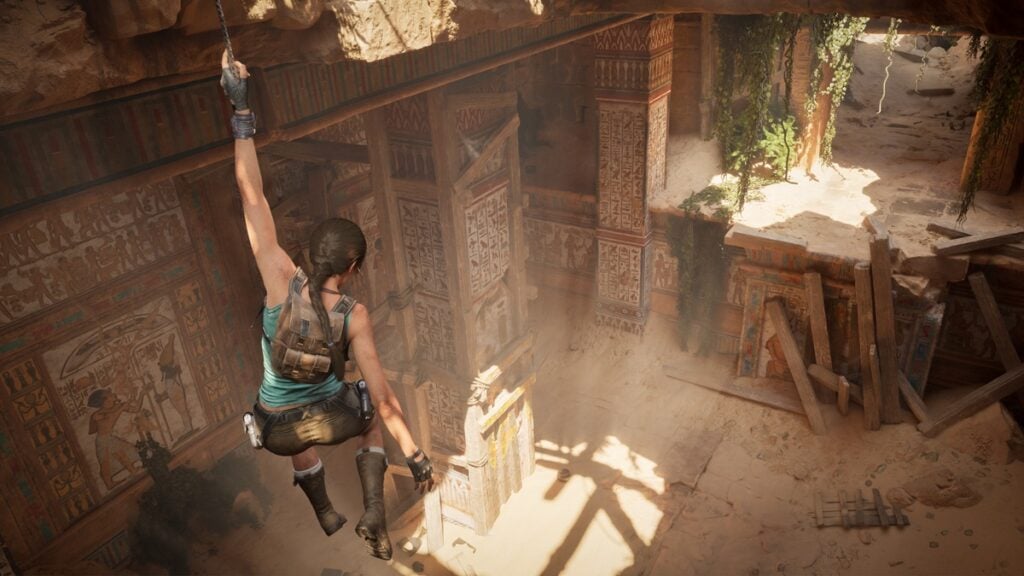 Hanging around with Lara Croft. Source: Amazon GamesBeat: Do you see the opportunity that others are looking at, like Samsung and Netflix, in new ways to control games? For the audience that won’t pick up a controller.
Gattis: Back in October when we relaunched Luna, we launched a segment of games we call Game Night. About 30 at the time, I think up to 50 now. It’s all games that use a phone as the controller. It’s not just putting A-B-X-Y on your phone. It’s almost custom apps or applets that are designed for the game at hand. It’s with that same notion. A lot of people in the audience we’re going after don’t own controllers. We want them to be able to play. We’ve found a lot of traction. A lot of people like playing shorter, quicker games. They might even be core gamers, but it’s fun to sit down with your phone and play Who Wants to Be a Millionaire, answer some trivia questions.
That’s Netflix’s approach. We’ll continue to do that. The difference with us and Netflix, at least to date, is we still believe very much in triple-A controller-based games. Luna still has a variety of games, a mixture of both. The idea is to have something for all styles of player.
 Tomb Raider: Legacy of Atlantis is a beautiful game. Source: Amazon GamesBeat: With Tomb Raider: Legacy of Atlantis, what category of game would you say that is in?
Gattis: Crystal Dynamics is our partner on developing the game. This particular game is not an Amazon IP, even though we do have the TV show coming. Amazon Game Studios is the publisher of the game. But there’s a lot more–future Bond IPs owned by Amazon, we haven’t made any decisions on who is going to develop or publish games like that, but Amazon does have the rights to the Bond franchise through the MGM acquisition. I do think you’ll see a lot more from us.
GamesBeat: I thought the Delphi people had the license from–
Gattis: The way it worked, Delphi bought the license. I think that was back in 2020. Delphi then partnered with IO Interactive. [Dean’s note: Based on what I’ve learned, Delphi eventually sold their stake in the game to IO Interactive]. Delphi still has a credit on the game itself. I don’t know all the mechanics of that relationship. But that was all prior to Amazon acquiring the Bond franchise. Going forward, Amazon owns the IP and can make decisions about who will make the next game.
GamesBeat: You can choose, and you could choose IO Interactive still.
Gattis: It seems like a logical thing to do given the success of the game. For some reason it was reported–they made it seem like we weren’t going to choose IO to do it.
GamesBeat: But Delphi, going forward, doesn’t have any say.
Gattis: They don’t. Not on that. But going forward, the goal for us to try to leverage a lot more of the broader film and video IP in some of our first-party games, particularly if it’s MGM IP. Going back to this notion of having all those forms of entertainment in one space.
GamesBeat: In some ways you’re still coordinating a strategy where–Invincible VS is owned by Skybound, the game and the IP, but it’s a Prime show. Can Amazon be involved in making something like that successful in games?
Gattis: There are always different IP relationships. Obviously the Masters of the Universe film and the game that we made, that’s Mattel’s IP. There’s a close relationship between our game side and the Prime Video side. We coordinate and collaborate all the time on IP for games. If we want to take a show that they’re making and turn it into a game, usually we all have to coordinate together on that. You’ll see a tighter coupling around those things going forward.
 Lara Croft is fighting for attention. Source: Amazon GamesBeat: Matthew Ball had his slide deck about the attention war. He’s been pointing out that there’s so much competition for games, and there are places where gaming is pushing back against that competition, as it goes from subculture to mass culture. Part of that is going into movies and TV. Games compete with the time people spend on movies on TV, but if those things are game-related, like The Last of Us or Tomb Raider, that’s a win for games. People become aware of a property and they go play the game.
Gattis: I think it works in both directions. Prime Video wants to have all the attention coming to one place. If you’re watching a show, great. If you’re not watching a show, we don’t want you to be playing games on someone else’s platform if we can have that happen right here. We can capture that audience. I obviously can’t speak for Netflix, but I’m sure that’s part of their thinking as well. These things should all live together as forms of entertainment instead of being thought of as completely different, bifurcated experiences.
GamesBeat: I talked to Dan Prigg at Paramount last week. He was saying that they’re establishing a game division because they’re thinking more like games should be the centerpiece. Games are the biggest place for fandom to take root, because the engagement is so much higher compared to everything else. You might as well make games more central rather than thinking of it as making a game based on a movie.
Gattis: The step we’re taking at Amazon right now is we’re acknowledging that these are two massive forms of entertainment and they’re coming together. Where it goes from here, who knows? But I do think Paramount is on to something there. It doesn’t hurt our stature inside Amazon when we see Paramount doing things, when we see Netflix doing things. It does give our folks a bit of an eye-opener moment.
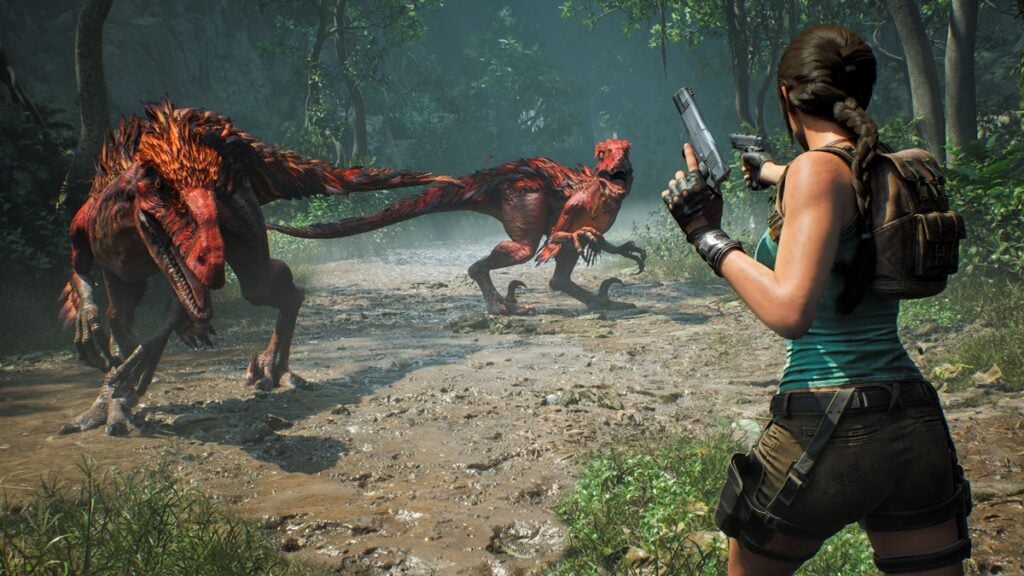 Little dinosaurs don’t scare Lara Croft. Source: Amazon GamesBeat: Do you still need some kind of triple-A core, even though there is a different audience you want to find?
Gattis: Triple-A in general I think has mass appeal overall. Whether it’s Tomb Raider or Hogwarts Legacy or Indiana Jones or Bond, those all fit into triple-A and they’re mass appeal. I don’t think they’re core games per se. With those titles you’ll get a fair amount of core gamers that will be more willing to try a cloud gaming service, especially if it’s included in their Prime membership.
The way I think our business in the long term, we’re building the platform right now. We’re more or less still a startup. We have to earn our way up the stack to have the right even to think about competing for a core player. That’s certainly not out of the question for our long-range vision. We just don’t want to focus on that right now, because I don’t think there’s a lot of unique value we bring right now. We’re probably more bullish on triple-A than Netflix right now, but all these services, as audience builds, you establish a baseline. Again, I think there’s a massive audience that both Netflix and us can go after. As those things are successful, you start to creep up a little bit.
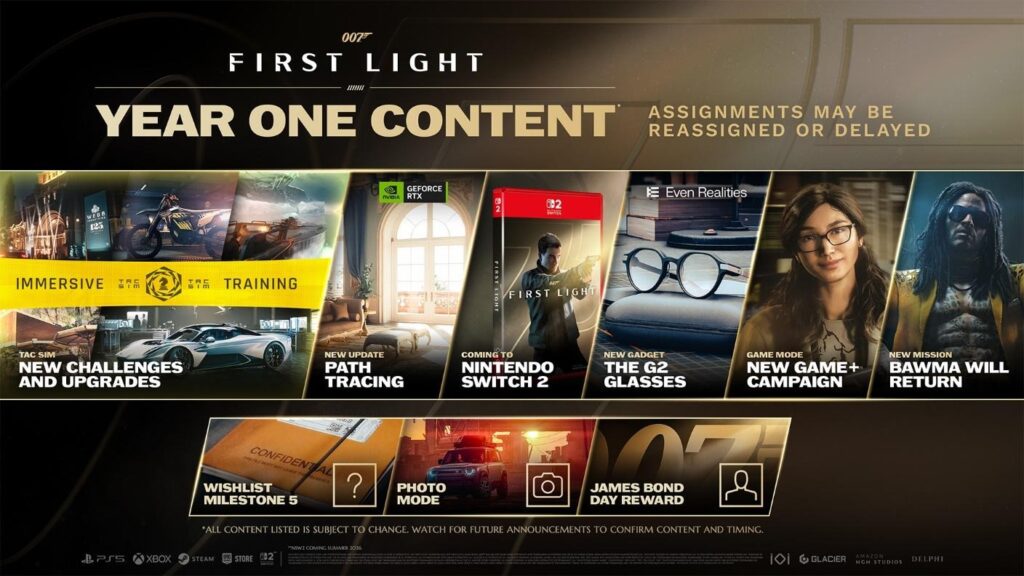 Year one plan for 007 First Light from IO Interactive and Amazon MGM Studios. GamesBeat: Do you feel like you need to acquire more in the game space?
Gattis: Maybe? We look at all kinds of big ideas. That’s always an interesting way to think about it. It’s probably more on the IP side. If the right IP presented itself, that would be something to look at. It’s always hard to say what the right IP is.
GamesBeat: Is there something you want to communicate about what happens next for Bond? IO Interactive had their press event this week. But that was all about extensions of First Light.
Gattis: We’re letting First Light breathe. In due time we’ll start to have conversations about Bond next. It’s been awesome to see the success of this game. Let’s let it have its moment. We’ll do the right thing with the franchise. That’s the objective here. That’s why it was kind of crazy to see some of the stuff that was written last week. Why would we take a great game that’s doing so well and pull it away? We’re not idiots, I hope.
GamesBeat: What becomes your next move along this strategy?
Gattis: No news to break today, but I’ve talked at the outset about all these properties across Amazon we have to tap into. Twitch is a massive opportunity for us. To be totally fair and objective, we’ve not done a good job of leveraging Twitch to help build the gaming business. There’s a lot of stuff we’re exploring internally about that. Perhaps that’s the next big place where we can get Luna in front of more audiences.
One of the benefits of cloud gaming, if you’re watching a video, watching a stream, you can literally click to play. You don’t have to download anything. Can we do that in a stateless manner so you don’t even have to be logged in? Eventually we’re going to collect login information and make sure you’re entitled to the service, but–it’s the notion of, how do we get Luna in more places? How do we get more people to know they have this benefit? How do we make it easier for people to play? Whether that’s access or cost or content. That’s going to be our focus in the next couple of years. Obviously we have to execute the strategy. But we feel like we have good clarity right now.
And of course making great games. We still do believe in original, exclusive content. That’s really the only way to build an entertainment platform, whether it’s PlayStation or HBO. You have to have a solid baseline of things that people can’t get, or at least can’t get first, anywhere else.
GamesBeat: You have leadership in place. Do you still have a lot of production people, a lot of game people still?
Gattis: We’re still making games, yeah. We literally have more games in development at Amazon now than we’ve had at any point in our history. A lot of people don’t know that. I’m not saying they’re all triple-A games. There are some. We have two Tomb Raider games. There’s a bunch of lighter Game Night phone-as-controller things. There’s a lot of development going on. We’re still actively looking for third-party partners.
Amazon notoriously has always been comfortable playing the long game here. I can’t say that the 15 or whatever years of Amazon in gaming has been a roaring success. But that doesn’t mean we can’t be successful.
The post Clarifying Amazon role in the game business — it’s not a retreat | Jeff Gattis interview appeared first on GamesBeat.
Despite some well publicized layoffs, Amazon still has real business in gaming, including its Amazon Luna cloud gaming service, Prime Games store for free games for Prime members, Amazon Game Studios, Amazon Web Services for hosting games, and the Twitch livestreaming business. Gattis runs the game business, particularly Luna and Amazon Game Studios.
For sure, it seemed like the company was tearing things down. The massively multiplayer online gaming business has seen huge cutbacks, with the closing of the New World MMO and the discontinuation of development on an MMO for The Lord of The Rings.
At the same time, Amazon acquired the James Bond game license and 007 First Light game from Delphi Interactive and it also commissioned Crystal Dynamics to make Tomb Raider: Catalyst, an all new adventure; and Tomb Raider: Legacy of Atlantis, a remake of the original Lara Croft game coming from Crystal Dynamics and Flying Wild Hog. Legacy of Atlantis comes out on February 27, 2027.
We sorted through the Amazon games strategy at Summer Game Fest in Los Angeles, where I caught up with Gattis, head of games at Amazon. I also played a short bit of the new game, Tomb Raider: Legacy of Atlantis, and tried to solve a puzzle set at a beautiful waterfall.
Here’s an edited transcript of our interview.
Jeff Gettis is head of games at Amazon. Source: GamesBeat/Dean Takahashi GamesBeat: Tell us what you are doing.A strategic retreat?
Jeff Gattis: I’ve been at Amazon about a year now. I came from Xbox. One thing I’ve found in some of our conversations at GDC or other places where I talked to analysts or journalists–I find two things. Amazon’s gaming strategy is either misunderstood or not understood at all. They have no idea what they’re doing. Neither of those are good for us. That’s entirely our fault, because what we put out in the press has been–games get shut down. Layoffs. We haven’t done a good job of articulating what it is that we’re doing. The public perception is that Amazon is retreating from the gaming space. As an insider–I just got here. I hope we’re not retreating. That’s not what I plan to do.
But really, nothing could be further from the truth. We’ve gotten, I’d like to think, a lot of clarity in our strategy. Maybe for the first time in a long time, we know what we’re doing and why we’re doing it, and what we’re not doing. I just wanted to give a little history on it and share what we’re doing going forward.
It goes without saying, Amazon has a checkered history in gaming over the years. Part of that stems from just the way we’ve been organized. When I got here, we had three different gaming groups, not counting Twitch. We had Amazon Game Studio making games, mostly MMOs, kind of operating as a stand-alone business. You had the Luna team that had built this cloud gaming technology and platform. They sat in a totally different group, a devices group inside Amazon. Then you had the Prime gaming team, which was effectively a benefit for Prime members that gave away in-game content and codes that you’d go redeem on other platforms like Xbox and PlayStation and Epic Game Store. None of these groups worked with each other.
GamesBeat: Wasn’t it even more than that? I think of the game services–
Gattis: Right, AWS also has a big gaming arm.
https://www.youtube.com/embed/fn1EREGsdFg?feature=oembed GamesBeat: Even briefly there was something about a game engine.
Gattis: There was Lumberyard, yes. That was actually inside of the Amazon Game Studios umbrella. But yes, there were lots of different efforts, with varying degrees of success or failure. The core thing is none of these groups worked with one another. That’s one of the first things we’ve done under new leadership. We’ve consolidated all of those into one organization. I look after the gaming business. You have two pillars now. You have Luna, our gaming platform, and Amazon Game Studios, where we develop and publish games. Not unlike Xbox, Xbox Game Studios.
Lara Croft takes on a T-Rex. Source: Amazon That’s allowed us to think a lot more coherently about the strategy. The big question for me getting here was, why does Amazon exist in the game space? What value do we bring? What gap do we fill? If you look at it objectively, previously I don’t know that we were filling a gap. Luna’s strategy was initially like the Xbox xCloud strategy. No console required. We’re just going to magically get console players and PC players to stop buying hardware. Everyone is going to come over to the cloud. When they do they’ll come to Amazon. That doesn’t quite wash out. We haven’t seen this magical inflection point.With core gamers as a whole, of which I’d count myself as one, I love my hardware. I love my console. I love my gaming PC. I spent a lot of money on it, so I’m not just emotionally invested. I’m literally invested in it. In many ways, of the audiences to come to cloud gaming, that core group is probably going to be the last one, if they do at all. That was one of the first realizations. Let’s not focus on high-end core gamers who play competitive multiplayer shooters and things like that, where every millisecond matters.
The big opportunity
Lara Croft wields dual guns in Tomb Raider: Legacy of Atlantis. Source: Amazon GamesBeat: What is the focus?Gettis: We see a massive opportunity when it comes back to looking at the assets Amazon has and what Amazon does well. We see a massive opportunity outside of that core group. That’s the 2.5 billion people in the world who play games and don’t own dedicated gaming hardware. That group hasn’t been well served to date. A lot of them play mobile games. Some of them probably want to graduate up, but they don’t have the ability to play console games, because they’re not invested in the hardware. The hardware is only getting more expensive, as we know. That’s where we think there’s a space. Using the tools of Amazon, including Amazon Prime, by pushing value and games into Prime, by using the cloud tech where people don’t have to buy additional hardware. You can just instantly play. That’s where we think we have a unique position. Not a lot of other companies can do that, just put a bunch of value in Prime and call it a day.
That’s what we’ve done. We kind of relaunched Luna last October. But the big shift for us was, instead of making people subscribe to Luna for $10 a month, we pushed almost all the value into what we call Luna Standard, which is the Prime benefit. If you’re a Prime member today – there’s a couple of hundred million worldwide – you have access to close to 100 games that are in there. They range from triple-A all the way down to casual games you can play with your controller. EA FC, the World Cup starts next week. We have FC26. If you’re a Prime member you can play that for free. Nobody knows about it. That’s the problem. We have a lot of work to do. Hogwarts Legacy in there. Indiana Jones is in there with the latest DLC. All the way down to a bunch of casual games.
We’ve gotten a lot of good traction in the past three or four months with people who don’t own controllers, but still want to play Angry Birds on Luna. There’s game shows and trivia and things like that. We’re finding good traction. There’s an audience. Much like you see with Netflix. Trying to focus on more casual people.
GamesBeat: It seems like there’s still an opportunity with memory prices going so high. It’s discouraging console launches, discouraging people from buying new gaming PCs. Cloud gaming might have a chance in this moment to get more core gamers because it’s not a bad value proposition.
A young James Bond is selling well. 007 First Light. Source: IO Interactive/Amazon Gattis: I agree. Our strategy isn’t predicated on that happening, but if it does happen, it’ll just accelerate our growth. When I was at Xbox and we were launching and pushing xCloud, the problem with xCloud is you still had to have a Game Pass membership. It still effectively cost $20 a month. If you do the math, you could buy an Xbox Series S for probably $150 at GameStop used. The total cost of ownership was actually much higher for cloud. That’s very different, though, when consoles are $1,000 or $1,500, and gaming PCs–I don’t even know now. The last card I bought was $3,000.So I do think that’s true, but for us, we’re just saying that we’ll let that market evolve. We’re thinking much more about how we can grow the pool of players. I’d argue that the PlayStations and Xboxes and Steams of the world are effectively fighting for the same players, 300 to 500 million of them. That pool isn’t really growing. For the industry – not just Amazon – we think what we’re doing is a way to bring more people in, new players, to play games that they would otherwise not have been able to play. That’s our big thesis.
We’re trying to then map that to our IP strategy and our distribution strategy. A big part of our thesis is this notion that TV and movies and video games can become more integrated as an overall thing. This is back to the question of where Amazon adds value. Amazon has a ton of IP through MGM and shows on Prime Video. You’ll see a lot more of us building video games – first-party and third-party – that align with TV shows. Tomb Raider, when it launches, we’ll have the Tomb Raider TV show on Prime Video. You might have a Tomb Raider page where the show exists, the movie exists, the video game exists, you can buy Tomb Raider merchandise. We’re trying to use the powers of Amazon to do some pretty unique things.
GamesBeat: Is it getting easier to align a game launch with that kind of TV opportunity?
Gattis: Obviously game development is such an unknown in terms of time and cost. We just, on Friday–it was a smaller game, but on Friday the Masters of the Universe film dropped in theaters, and we dropped the Masters of the Universe: Legends Unite game into Luna, day and date. Now, that wasn’t a game that took five years to make. It’s a deck-builder, Slay the Spire kind of game. But that’s an example. That’s what we want to do much more of going forward.
It’s always tricky. But in the future we see opportunities to make games, or I’ll call them experiences, that are more extensions of video. You watch a show and you can engage with your favorite characters or re-create a scene in a game. I don’t think it always has to be triple-A games. It can be. But there are other kinds of extensions and experiences we can make.
Exiting MMOs
The Lost Valley in Tomb Raider: Legacy of Atlantis. Source: Amazon GamesBeat: Backing up to the MMOs, did those just lose their audience? Did they become too hard to make? I’m not sure why dropping out of MMOs fit this new strategy.Gattis: A couple things. MMOs are very expensive to make and to maintain. There’s always a business conversation behind all of these things. We’re continuing to update Throne and Liberty and Lost Ark. We haven’t walked away. But I do think, when you think about our overall strategy and the audience we’re trying to reach, we don’t see a great overlap with the MMO audience. When I think of Luna I look at the distribution of the entire gaming market. If you draw a line in the middle, your mid-core players–Xbox and PlayStation are sort of mid-core up to core core. We’re trying to focus on mid-core down to casual. You could argue that this is where Netflix–we share a similar vision around the market opportunity.
The MMOs are a bit too core. At Luna we’ve had much more success–triple-A works on Luna, but it works when it’s familiar, approachable IP with relatively easy game mechanics. Hogwarts Legacy has done great on the service. Everyone loves the IP. The game itself is not overly complicated to play. I’d say the same thing about Indiana Jones. Even Tomb Raider will fit that bill. Some of the more complex RPGs, MMOs, they’re just a different audience.
New boundaries for gaming
A collapsed bridge in Tomb Raider: Legacy of Atlantis. Source: Amazon GamesBeat: I remember John Smedley said that when he talked to Jeff Bezos, Bezos said, “I want you to make computationally ridiculous games.” It reflected Amazon’s infrastructure ambitions, but it didn’t necessarily reach the customer.Gattis: We should remember that “customer obsessed” is one of the Amazon leadership principles. This is not an Amazon statement, but I think that any time you’re creatively making things to justify another business or infrastructure need, that’s a slippery slope.
If there’s opportunity to innovate–we think about it the same way we think about our own game development strategy. Where can we as Amazon take some risks? When we try to push innovation in an industry that I would argue has not seen a lot of innovation in 10, 15, 20 years–Fortnite? PUBG? The game mechanics all seem the same. The industry is in a state where no one is really trying anything new anymore. You’ll see us invest a lot more into trying to push boundaries a bit on new types of games that can be made. A simple example is our courtroom game with Snoop Dogg as a celebrity judge. That’s a game where Snoop trained an LLM. Game made by humans, but using AI to make a different type of game that couldn’t have been made three or five years ago. That’s a tip of the iceberg example. I think you can use generative AI tools not to build games, but actually make different types of games.
Cloud games without controllers on Connected TVs
Hanging around with Lara Croft. Source: Amazon GamesBeat: Do you see the opportunity that others are looking at, like Samsung and Netflix, in new ways to control games? For the audience that won’t pick up a controller.Gattis: Back in October when we relaunched Luna, we launched a segment of games we call Game Night. About 30 at the time, I think up to 50 now. It’s all games that use a phone as the controller. It’s not just putting A-B-X-Y on your phone. It’s almost custom apps or applets that are designed for the game at hand. It’s with that same notion. A lot of people in the audience we’re going after don’t own controllers. We want them to be able to play. We’ve found a lot of traction. A lot of people like playing shorter, quicker games. They might even be core gamers, but it’s fun to sit down with your phone and play Who Wants to Be a Millionaire, answer some trivia questions.
That’s Netflix’s approach. We’ll continue to do that. The difference with us and Netflix, at least to date, is we still believe very much in triple-A controller-based games. Luna still has a variety of games, a mixture of both. The idea is to have something for all styles of player.
The Tomb Raider franchise
Tomb Raider: Legacy of Atlantis is a beautiful game. Source: Amazon GamesBeat: With Tomb Raider: Legacy of Atlantis, what category of game would you say that is in?Gattis: Crystal Dynamics is our partner on developing the game. This particular game is not an Amazon IP, even though we do have the TV show coming. Amazon Game Studios is the publisher of the game. But there’s a lot more–future Bond IPs owned by Amazon, we haven’t made any decisions on who is going to develop or publish games like that, but Amazon does have the rights to the Bond franchise through the MGM acquisition. I do think you’ll see a lot more from us.
GamesBeat: I thought the Delphi people had the license from–
Gattis: The way it worked, Delphi bought the license. I think that was back in 2020. Delphi then partnered with IO Interactive. [Dean’s note: Based on what I’ve learned, Delphi eventually sold their stake in the game to IO Interactive]. Delphi still has a credit on the game itself. I don’t know all the mechanics of that relationship. But that was all prior to Amazon acquiring the Bond franchise. Going forward, Amazon owns the IP and can make decisions about who will make the next game.
GamesBeat: You can choose, and you could choose IO Interactive still.
Gattis: It seems like a logical thing to do given the success of the game. For some reason it was reported–they made it seem like we weren’t going to choose IO to do it.
GamesBeat: But Delphi, going forward, doesn’t have any say.
Gattis: They don’t. Not on that. But going forward, the goal for us to try to leverage a lot more of the broader film and video IP in some of our first-party games, particularly if it’s MGM IP. Going back to this notion of having all those forms of entertainment in one space.
GamesBeat: In some ways you’re still coordinating a strategy where–Invincible VS is owned by Skybound, the game and the IP, but it’s a Prime show. Can Amazon be involved in making something like that successful in games?
Gattis: There are always different IP relationships. Obviously the Masters of the Universe film and the game that we made, that’s Mattel’s IP. There’s a close relationship between our game side and the Prime Video side. We coordinate and collaborate all the time on IP for games. If we want to take a show that they’re making and turn it into a game, usually we all have to coordinate together on that. You’ll see a tighter coupling around those things going forward.
The Attention War
Lara Croft is fighting for attention. Source: Amazon GamesBeat: Matthew Ball had his slide deck about the attention war. He’s been pointing out that there’s so much competition for games, and there are places where gaming is pushing back against that competition, as it goes from subculture to mass culture. Part of that is going into movies and TV. Games compete with the time people spend on movies on TV, but if those things are game-related, like The Last of Us or Tomb Raider, that’s a win for games. People become aware of a property and they go play the game.Gattis: I think it works in both directions. Prime Video wants to have all the attention coming to one place. If you’re watching a show, great. If you’re not watching a show, we don’t want you to be playing games on someone else’s platform if we can have that happen right here. We can capture that audience. I obviously can’t speak for Netflix, but I’m sure that’s part of their thinking as well. These things should all live together as forms of entertainment instead of being thought of as completely different, bifurcated experiences.
GamesBeat: I talked to Dan Prigg at Paramount last week. He was saying that they’re establishing a game division because they’re thinking more like games should be the centerpiece. Games are the biggest place for fandom to take root, because the engagement is so much higher compared to everything else. You might as well make games more central rather than thinking of it as making a game based on a movie.
Gattis: The step we’re taking at Amazon right now is we’re acknowledging that these are two massive forms of entertainment and they’re coming together. Where it goes from here, who knows? But I do think Paramount is on to something there. It doesn’t hurt our stature inside Amazon when we see Paramount doing things, when we see Netflix doing things. It does give our folks a bit of an eye-opener moment.
Is there room for triple-A gaming?
Little dinosaurs don’t scare Lara Croft. Source: Amazon GamesBeat: Do you still need some kind of triple-A core, even though there is a different audience you want to find?Gattis: Triple-A in general I think has mass appeal overall. Whether it’s Tomb Raider or Hogwarts Legacy or Indiana Jones or Bond, those all fit into triple-A and they’re mass appeal. I don’t think they’re core games per se. With those titles you’ll get a fair amount of core gamers that will be more willing to try a cloud gaming service, especially if it’s included in their Prime membership.
The way I think our business in the long term, we’re building the platform right now. We’re more or less still a startup. We have to earn our way up the stack to have the right even to think about competing for a core player. That’s certainly not out of the question for our long-range vision. We just don’t want to focus on that right now, because I don’t think there’s a lot of unique value we bring right now. We’re probably more bullish on triple-A than Netflix right now, but all these services, as audience builds, you establish a baseline. Again, I think there’s a massive audience that both Netflix and us can go after. As those things are successful, you start to creep up a little bit.
Will Amazon buy more game companies?
Year one plan for 007 First Light from IO Interactive and Amazon MGM Studios. GamesBeat: Do you feel like you need to acquire more in the game space?Gattis: Maybe? We look at all kinds of big ideas. That’s always an interesting way to think about it. It’s probably more on the IP side. If the right IP presented itself, that would be something to look at. It’s always hard to say what the right IP is.
GamesBeat: Is there something you want to communicate about what happens next for Bond? IO Interactive had their press event this week. But that was all about extensions of First Light.
Gattis: We’re letting First Light breathe. In due time we’ll start to have conversations about Bond next. It’s been awesome to see the success of this game. Let’s let it have its moment. We’ll do the right thing with the franchise. That’s the objective here. That’s why it was kind of crazy to see some of the stuff that was written last week. Why would we take a great game that’s doing so well and pull it away? We’re not idiots, I hope.
GamesBeat: What becomes your next move along this strategy?
Gattis: No news to break today, but I’ve talked at the outset about all these properties across Amazon we have to tap into. Twitch is a massive opportunity for us. To be totally fair and objective, we’ve not done a good job of leveraging Twitch to help build the gaming business. There’s a lot of stuff we’re exploring internally about that. Perhaps that’s the next big place where we can get Luna in front of more audiences.
One of the benefits of cloud gaming, if you’re watching a video, watching a stream, you can literally click to play. You don’t have to download anything. Can we do that in a stateless manner so you don’t even have to be logged in? Eventually we’re going to collect login information and make sure you’re entitled to the service, but–it’s the notion of, how do we get Luna in more places? How do we get more people to know they have this benefit? How do we make it easier for people to play? Whether that’s access or cost or content. That’s going to be our focus in the next couple of years. Obviously we have to execute the strategy. But we feel like we have good clarity right now.
And of course making great games. We still do believe in original, exclusive content. That’s really the only way to build an entertainment platform, whether it’s PlayStation or HBO. You have to have a solid baseline of things that people can’t get, or at least can’t get first, anywhere else.
GamesBeat: You have leadership in place. Do you still have a lot of production people, a lot of game people still?
Gattis: We’re still making games, yeah. We literally have more games in development at Amazon now than we’ve had at any point in our history. A lot of people don’t know that. I’m not saying they’re all triple-A games. There are some. We have two Tomb Raider games. There’s a bunch of lighter Game Night phone-as-controller things. There’s a lot of development going on. We’re still actively looking for third-party partners.
Amazon notoriously has always been comfortable playing the long game here. I can’t say that the 15 or whatever years of Amazon in gaming has been a roaring success. But that doesn’t mean we can’t be successful.
The post Clarifying Amazon role in the game business — it’s not a retreat | Jeff Gattis interview appeared first on GamesBeat.
What's Your Reaction?








XINKER - Business and Income Tips
Explore XINKER, the ultimate platform for mastering business strategies, discovering passive income opportunities, and learning success principles. Join a community of thinkers dedicated to achieving financial freedom and entrepreneurial excellence.


![[Business Talk] Chagee: Opening 3,500 stores in 6 years](https://xinker.org/uploads/images/202410/image_140x98_671afce94bf91.webp)