





![[PRO Tips] Gold’s Bullish Revival: Seasonal Trends and Key Levels to Watch](https://xinker.org/uploads/images/202412/image_430x256_67724cc6ad0cd.webp)
![[PRO Tips] Gold Market Under Short-Term Pressure, Safe-Haven Demand and Central Bank Buying Support Long-Term Upside Potential](https://xinker.org/uploads/images/202412/image_430x256_676ffb4685287.webp)
![[PRO Tips] Analysis of 9 key points of differentiation strategy! Master differentiation to create a brand advantage that is unique in the world!](https://firebasestorage.googleapis.com/v0/b/xinker-tips.appspot.com/o/article_thumbnails%2Fscaled_differentiation%20strategy.png.png?alt=media&token=a1bfc3d2-e85a-4db7-8a6d-01c7274f8940)
![[PRO Tips] Will REITs regain growth momentum in 2024? 3 REITs ETFs you must know if you want to invest in real estate.](https://firebasestorage.googleapis.com/v0/b/xinker-tips.appspot.com/o/article_thumbnails%2Fscaled_REITs1.png.png?alt=media&token=8af4eb93-33ff-466f-8039-b6555fad52b4)
![[PRO Tips] Complete tutorial on how to make money in Adobe Stock!](https://firebasestorage.googleapis.com/v0/b/xinker-tips.appspot.com/o/article_thumbnails%2Fscaled_tut-adobe1.png.png?alt=media&token=0b2c8cf2-22bd-4142-883e-140ed1cbaf02)
![[Passive Income] Unlock the secret of passive income: 3 steps to apply for Google AdSense](https://xinker.org/uploads/images/202410/image_430x256_6717a4fb3052b.webp)
![[Passive Income] Earn over $200 a day with AI-generated articles!](https://firebasestorage.googleapis.com/v0/b/xinker-tips.appspot.com/o/article_thumbnails%2Fscaled_article1.png.png?alt=media&token=f61bf35b-8553-4719-826d-7360024adc70)
![[Passive Income] Earn over 20 USD per download with AI-generated images!](https://firebasestorage.googleapis.com/v0/b/xinker-tips.appspot.com/o/article_thumbnails%2Fscaled_adobe2.png.png?alt=media&token=3e20e76a-a907-45af-80aa-bf9b3600301f)
![[Passive Income] Earn 10 USD per new download by sharing CapCut!](https://firebasestorage.googleapis.com/v0/b/xinker-tips.appspot.com/o/article_thumbnails%2Fscaled_capcut2.png.png?alt=media&token=a04dec40-1fac-4857-86f2-19a8be02d38e)
![[Passive Income] Use your WiFi to create passive income in 5 minutes, and you can earn 4-6 U per day!](https://firebasestorage.googleapis.com/v0/b/xinker-tips.appspot.com/o/article_thumbnails%2Fscaled_Grassio.webp.png?alt=media&token=7659a95e-0e47-4f27-a17d-c942ac3cf7f4)


![[Business Talk] The Unique Theme of XINKER's Song: Beef Wellington and Business Mastery](https://xinker.org/uploads/images/202410/image_430x256_671afc155f47f.webp)
![[Business Talk] Chagee: Opening 3,500 stores in 6 years](https://xinker.org/uploads/images/202410/image_430x256_671afce80c5f9.webp)


Average age of gamers hits 37 while 67% of Americans play | ESA CEO interview
The average of American gamers is 37, and 67% of us play games. Those are the essential facts from the latest report from the Entertainment Software Association, the lobbying group that represents game companies. But the ESA’s latest report is so much more than that, as it attempts to decipher the habits of the 212 million Americans who play video games. The annual report, Essential Facts About the U.S. Video Game Industry, is a comprehensive look at the state of video games nationwide. It’s an important subject this year, as analyst Matthew Ball, now chief strategy officer at Xbox, wrote a report this year that questioned whether the amount of time that gamers spend playing games has begun to decline, thanks to a perceived rise in demand for addiction industries, from Only Fans to prediction markets. Sadly, we don’t get an easy answer about whether this is true or not. But Ball’s work helped me frame my interview with Stanley Pierre-Louis, CEO of the ESA.The results in detail Conducted in partnership with YouGov, the latest report reveals that video game play continues to grow in popularity across generations, with the average age of players rising to 37. With 67% of Americans (ages 5-90) now playing video games one or more hours per week, video games have cemented themselves as one of the country’s preferred choices for entertainment. These and dozens of other compelling findings in this year’s report explore video game preferences across different demographics, regions, employment status and more. “Video games play an integral role in American life today, with a large majority of Americans now playing regularly,” said Pierre-Louis. “Video games have become a powerful cultural force, while providing mental stimulation, stress relief and meaningful social connection for people of all ages.” Breaking stereotypes More folks are playing games. Source: ESA Featured findings from the 2026 Essential Facts About the U.S. Video Game Industry report include: Players continue to break stereotypes for who is a “gamer.” 212.3 million Americans play video games every week, up 3% (7.2 million) compared to 2025. The gender of players is split fairly equally between men and women, with 53% of men and 46% of women actively playing. Slightly more boys and men play than girls and women in all generations except Boomers (ages 62-80) where 52% of Boomer women play games compared to 47% of men. Video games are for everyone, not just kids. Stanley Pierre-Louis, CEO of the ESA. While more than 80% of Gen Alpha (age 5-13) and Gen Z (age 14-29) play video games, the majority of adults are powering up as well: 71% of Millennials (age 30-45), 56% of Gen X (age 45-61) and 50% of Boomers (age 62-80) say they play weekly. Even 32% of the silent generation (age 81-90) are joining in on the fun. Adult players are more likely to be employed full-time (39%) or to have children (35%) compared to the general U.S. population – 34% and 30%, respectively. Parents prefer their kids play video games, and love playing with them, too. The majority of American parents (75%) actively play video games each week, with most (81%) saying they also game with their children (52% at least weekly). Nearly half (49%) of parents whose children play video games believe playing games teaches important skills to their children, such as problem solving and creative thinking. Two thirds of parents say they use parental controls with that number jumping to 70% forparents of kids 12 and under. Americans feel overwhelmingly positive about video games. Most American adults recognize the positive benefits of playing video games, such as them being fun (85%), bringing joy (81%), offering stress relief (78%), and providing mental stimulation (79%). Younger players (Gen Z) especially believe that video games offer a great way to bring people together (88%) and build relationships (87%). Most adults agree that playing video games helps develop problem-solving skills (76%) and teamwork/collaboration (67%), as well as adaptability/resilience (58%) and STEAM (53%) and communication skills (52%). Nearly nine-in-ten (89%) players who play a sport both on-screen and in real life say playing the video game version of their sport improves their real-world performance. Mobile leads the way, with people playing across genres and platforms. Th ESA delved into why players play on mobile. Source: ESA Playing on a mobile device is the most popular across all age groups (80%), while PC and console gameplay is more common with Gen Alpha, Gen Z and Millennials. Puzzle, primarily driven by older players, is the top genre on mobile (66%) and PC (60%) but falls behind action (66%), shooter (60%) and arcade (60%) games on console.Americans believe video games offer the most value for their money. A majority of players (63%) report that video games deliver the most entertainment value fortheir money, compared to video streaming services for music, TV and movies, as well as books, magazines an

The average of American gamers is 37, and 67% of us play games. Those are the essential facts from the latest report from the Entertainment Software Association, the lobbying group that represents game companies.
But the ESA’s latest report is so much more than that, as it attempts to decipher the habits of the 212 million Americans who play video games. The annual report, Essential Facts About the U.S. Video Game Industry, is a comprehensive look at the state of video games nationwide.
It’s an important subject this year, as analyst Matthew Ball, now chief strategy officer at Xbox, wrote a report this year that questioned whether the amount of time that gamers spend playing games has begun to decline, thanks to a perceived rise in demand for addiction industries, from Only Fans to prediction markets.
Sadly, we don’t get an easy answer about whether this is true or not. But Ball’s work helped me frame my interview with Stanley Pierre-Louis, CEO of the ESA.
With 67% of Americans (ages 5-90) now playing video games one or more hours per week, video games have cemented themselves as one of the country’s preferred choices for entertainment. These and dozens of other compelling findings in this year’s report explore video game preferences across different demographics, regions, employment status and more.
“Video games play an integral role in American life today, with a large majority of Americans now playing regularly,” said Pierre-Louis. “Video games have become a powerful cultural force, while providing mental stimulation, stress relief and meaningful social connection for people of all ages.”
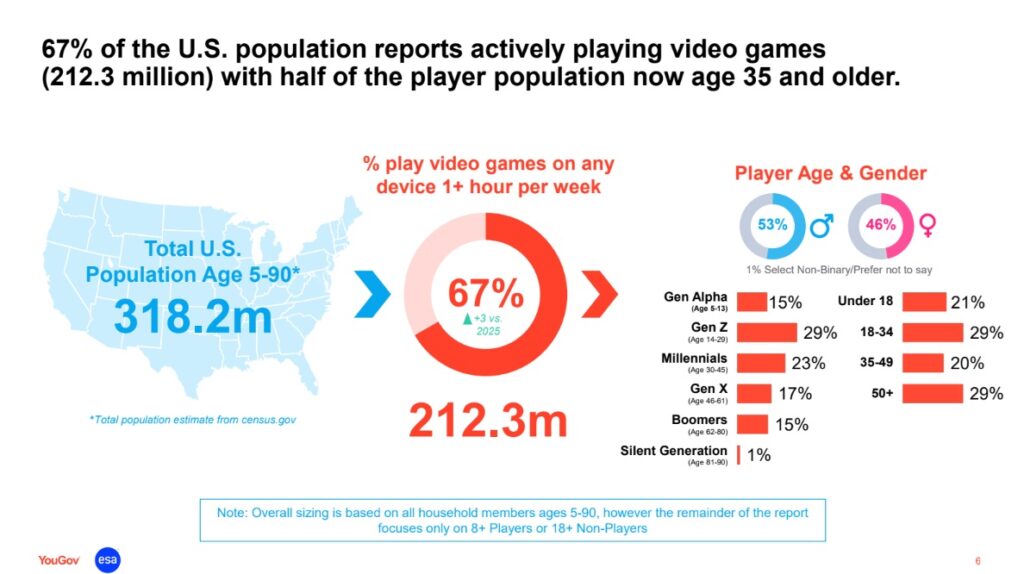 More folks are playing games. Source: ESA Featured findings from the 2026 Essential Facts About the U.S. Video Game Industry report include:
Players continue to break stereotypes for who is a “gamer.”
212.3 million Americans play video games every week, up 3% (7.2 million) compared to 2025. The gender of players is split fairly equally between men and women, with 53% of men and 46% of women actively playing. Slightly more boys and men play than girls and women in all generations except Boomers (ages 62-80) where 52% of Boomer women play games compared to 47% of men.
Video games are for everyone, not just kids.
 Stanley Pierre-Louis, CEO of the ESA. While more than 80% of Gen Alpha (age 5-13) and Gen Z (age 14-29) play video games, the majority of adults are powering up as well: 71% of Millennials (age 30-45), 56% of Gen X (age 45-61) and 50% of Boomers (age 62-80) say they play weekly. Even 32% of the silent generation (age 81-90) are joining in on the fun.
Adult players are more likely to be employed full-time (39%) or to have children (35%) compared to the general U.S. population – 34% and 30%, respectively. Parents prefer their kids play video games, and love playing with them, too.
The majority of American parents (75%) actively play video games each week, with most (81%) saying they also game with their children (52% at least weekly).
Nearly half (49%) of parents whose children play video games believe playing games teaches important skills to their children, such as problem solving and creative thinking.
Two thirds of parents say they use parental controls with that number jumping to 70% for
parents of kids 12 and under.
Americans feel overwhelmingly positive about video games.
Most American adults recognize the positive benefits of playing video games, such as them being fun (85%), bringing joy (81%), offering stress relief (78%), and providing mental stimulation (79%). Younger players (Gen Z) especially believe that video games offer a great way to bring people together (88%) and build relationships (87%).
Most adults agree that playing video games helps develop problem-solving skills (76%) and teamwork/collaboration (67%), as well as adaptability/resilience (58%) and STEAM (53%) and communication skills (52%).
Nearly nine-in-ten (89%) players who play a sport both on-screen and in real life say playing the video game version of their sport improves their real-world performance.
Mobile leads the way, with people playing across genres and platforms.
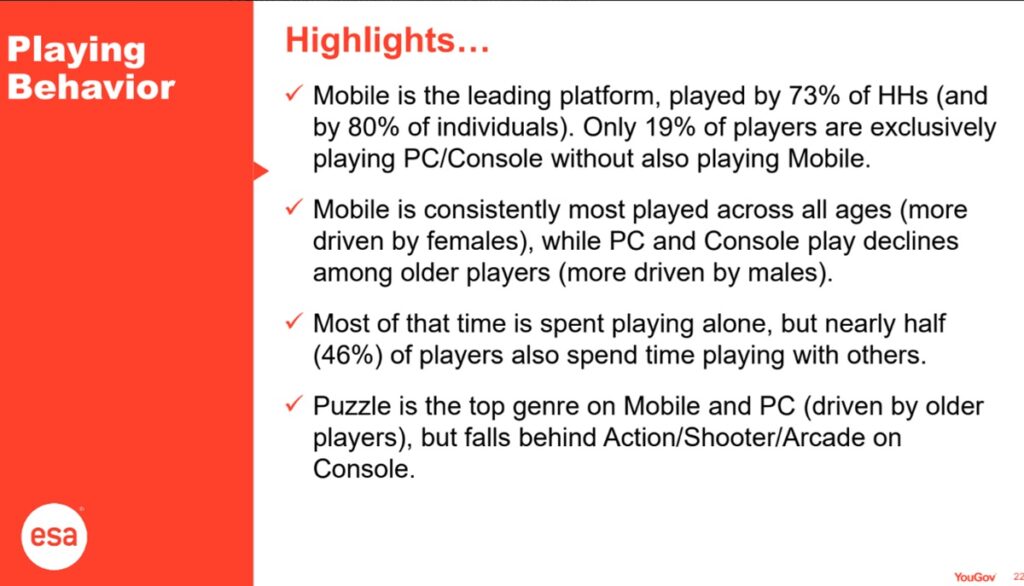 Th ESA delved into why players play on mobile. Source: ESA Playing on a mobile device is the most popular across all age groups (80%), while PC and console gameplay is more common with Gen Alpha, Gen Z and Millennials.
Puzzle, primarily driven by older players, is the top genre on mobile (66%) and PC (60%) but falls behind action (66%), shooter (60%) and arcade (60%) games on console.
Americans believe video games offer the most value for their money.
A majority of players (63%) report that video games deliver the most entertainment value for
their money, compared to video streaming services for music, TV and movies, as well as books, magazines and news articles.
Most Gen Alpha (69%), Gen Z (78%) and Millennial (67%) players have purchased in-game
content, typically spending $20 per month (median).
Parents also purchase in-game content for their children (54%). Of those that do, nearly all of
them (93%) require approval for in-games purchases made by their kids.
More than half (58%) of players downloaded a game for free in the past 12 months, while 43%
purchased a game, 35% purchased a game subscription and 19% borrowed a game.
The full Essential Facts About the U.S. Video Game Industry report is now available.
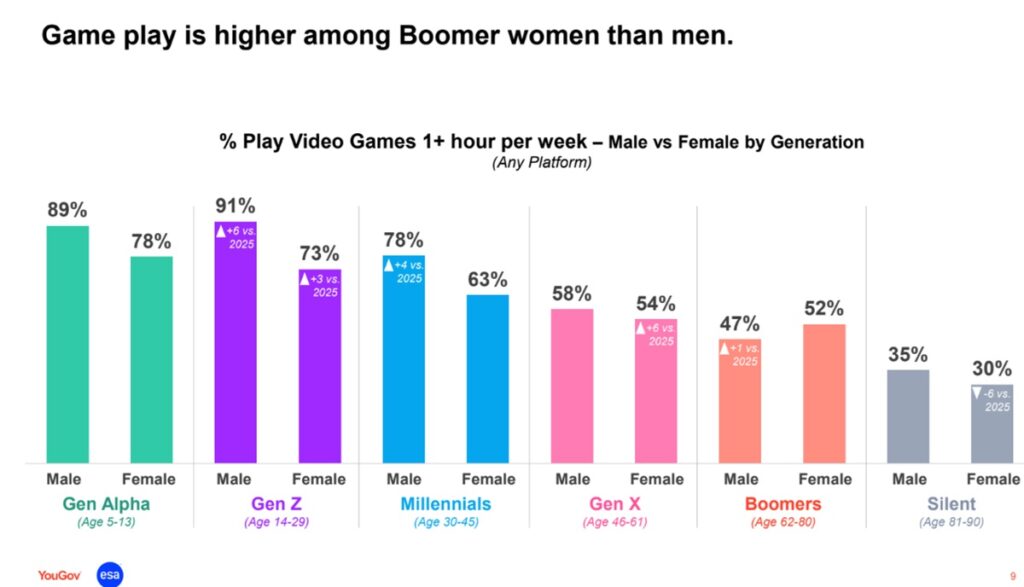 Women are playing more than many men. Source: ESA YouGov and ESA conducted a 20-minute online survey in the U.S. from February 11-25 among 13,545 total respondents recruited from YouGov’s proprietary online panel. Data is weighted to be representative of the overall US population in terms of age, gender, ethnicity, education, state, census region, and the distribution of gamers vs. non-gamers, as defined above. 18+ respondents were asked about all members of their household in order to size gamers as young as 5 years old. Gamers aged 8-17 were asked to complete the survey under the supervision of a parent.
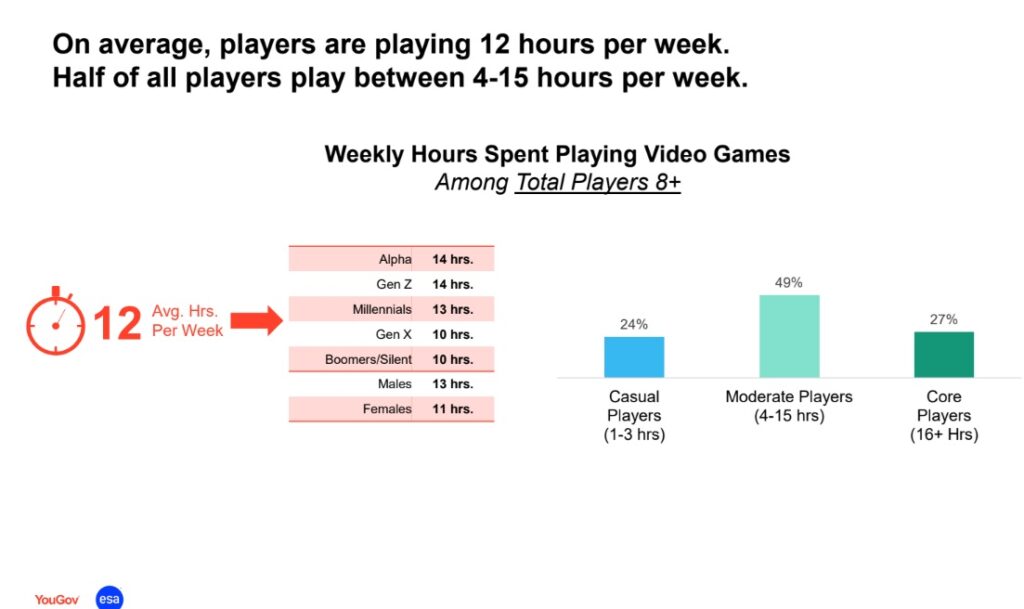 Hours per week of gaming. Source: ESA “We find it very useful for the industry and for policymakers and for the general public to understand what’s happening. This year’s results provided a lot of great insights, as well as a few surprises in terms of the demographics,” said Pierre-Louis said.
He noted the average age and the percentage of people playing. The gender split is nearly even, with 47% of gamers being female and 52% male.
“That just shows that the continued staying power of video games in every demographic group, but then the surprises began to emerge within some of the data, particularly when you look at who’s playing by age,” Pierre-Louis said. “So if you look at the overall pie, 23% of those playing are under 18, but 28% of those playing are 50 years old and older. So you’ve got a much larger population of 50-year-old-plus players than you have under 18, which just speaks to the state of games for players throughout their lives, but also those who pick it up later in life and continue to play.”
He added, “If you look at generation alpha, roughly ages five to 12 today, they have the highest percentage of players of those in that category who play at about 83%,” he said. “But as you go up in range, you just have more people at high numbers. I thought it was interesting to see that nearly half of boomers are playing video games, but that women in the boomer generation are playing more than men.”
He noted about 36% of people in the silent generation, 80 years old and up, are playing games. That’s up 6% from last year.
“We saw growth occurring in that group over the past five to 10 years. But if you look since COVID, it’s really risen dramatically each year and and I would say we’re getting some more notable players, particularly in that Boomer range,” Pierre-Louis said.
There was a story out of Chicago about how John Prevost played Wordle and Words With Friends with his brother, Robert Francis. And so now we have Pope Leo as the most famous gamer in the world, Pierre-Louis said.
“No one had that on their bingo card, but it just shows the range of kinds of games and and how people engage, both to get a reprieve from everyday life, but also to stay connected with friends and family,” Pierre-Louis said.
I noted that the non-gamers are aging out more as younger gamers with higher percentage of play are taking their places. Doesn’t that suggest inexorable growth?
“More people are playing earlier in their lives, and video game play is part of who they are, as a hobby, as self expression, as a communication tool, as a way to connect with friends and family. So it’s becoming commonplace. It has been commonplace for some time,” Pierre-Louis said. “But we’re recognizing it as a common occurrence more and more. But seeing how people maintain that passion for games and finding different games that meet their needs as they play through different stages of their lives has been important.”
Pierre-Louis said that speaks to the growth of game development, the growth of scope of kinds of games that people are playing, and how games fit into your lives in a different way as you age into different categories. Some of the taste for games depends on the amount of time you have or the kinds of interests you have as a player.
“There’s some people who love certain games, and they play those games with their friends throughout but many players progress to different kinds of games, and there really is a game for everyone, and we’re finding that out in our surveys,” Pierre-Louis said.
I noted the demographics keep getting better for gaming, but the economics still go up and down as we still have down cycles.
“Well, I would say if you look at our industry going back five, 10, 15, or 20 years, you’ll see a growth trajectory, generally speaking. Obviously, during the COVID cycle, there was a spike in video game play as people stayed home and were looking for outlets and for ways to stay connected,” Pierre-Louis said ” And so since COVID, both in terms of player engagement and revenue, there’s been an adjustment to what the trend would have been. But if you take out COVID and follow the trend lines, which are in the report, you will see that it is generally upward moving, and it’s been exponential in several years, but it continues to trend in the right direction.”
He said that it’s a matter of how you maintain the pace of games that players demand, and that’s what companies are working through in a very deliberate way.
“They want to put out games that meet and exceed expectations, and that’s what we’re seeing with the games that come out, whether they’re games that people expect to be big or games that are smaller but captivate the imagination of players,” he said.
In different phases of life, players look for different outcomes from games. They may look for fun, or to keep their minds sharp if they’re older. They may want to be more competitive, connect with others, or just relax.
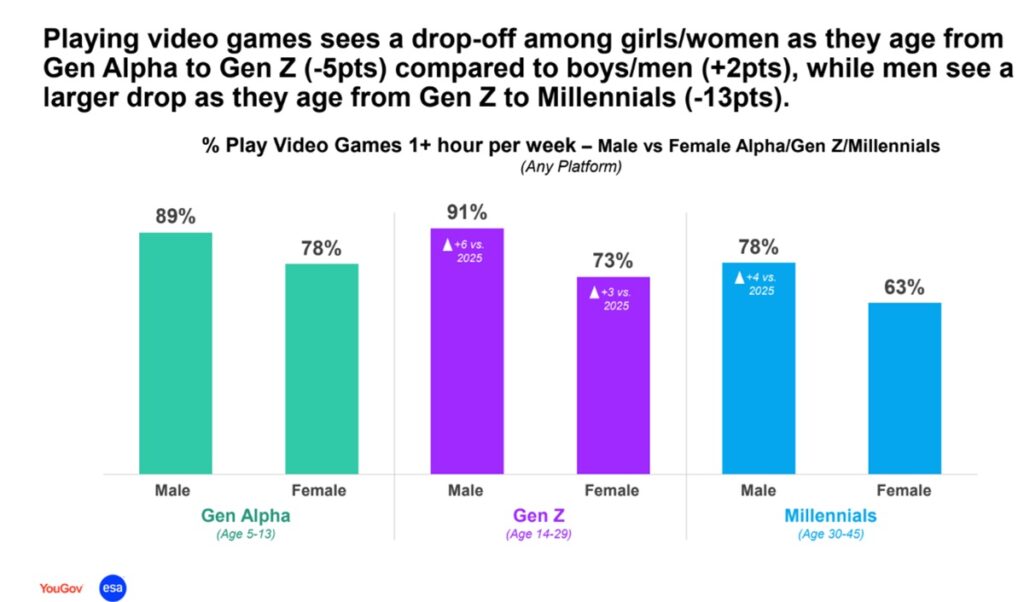 Data on girls and gaming. Source: ESA “In different phases, the rationale changes, but we are beginning to see if you trended over years, there are certain categories of anticipation or behavioral expectations from players, and they might shift depending on the the stage each player might be going through in life, but they point to a lot of similarities about how play is great for emotional development and emotional well being,” he said.
He added, “Play is great for relaxation and stimulation. It’s great to release anxiety. And in fact, there are, you know, scientific studies that others do that point to the fact that 10 to 15 year olds who play games are just less stressed because it’s a great outlet. So more and more we’re seeing that these emotional releases and opportunities for players hold true, but they have different impact on different age groups overall.”
And he said another thing that was interesting was how parents are more likely to play video games than the overall population. About 70% of parents play games, and of those parents, 82% play games with their kids.
“And they do that for a number of reasons. It’s fun, and everyone enjoys it. It’s a good opportunity to socialize with their kids, and it’s great to spend family time together doing this,” Pierre-Louis said “And so those high levels seem to suggest that games are a great way for families to bond, and that 70% of parents would prefer their children spend time playing video games than on social media. And the experience the parents have on playing games and on social media probably point to the fact that games are interactive, there’s a goal, they’re competitive, and they’re a way to connect, and social media tends to be a one way street.”
As far as devices go, when you look at the generation alpha, their number one device is consoles. The easiest to play as a family on a console, as opposed to a mobile device or having two or three computers set up, Pierre-Louis said.
Games are also busting up into mass culture, rising up from a subculture.
There are blockbuster movies and television shows being developed from video game content. And at the same time, you have musicians releasing new music or hosting concerts on video game platforms, and so now, more and more, particularly with Gen Z and millennials, Pierre-Louis said.
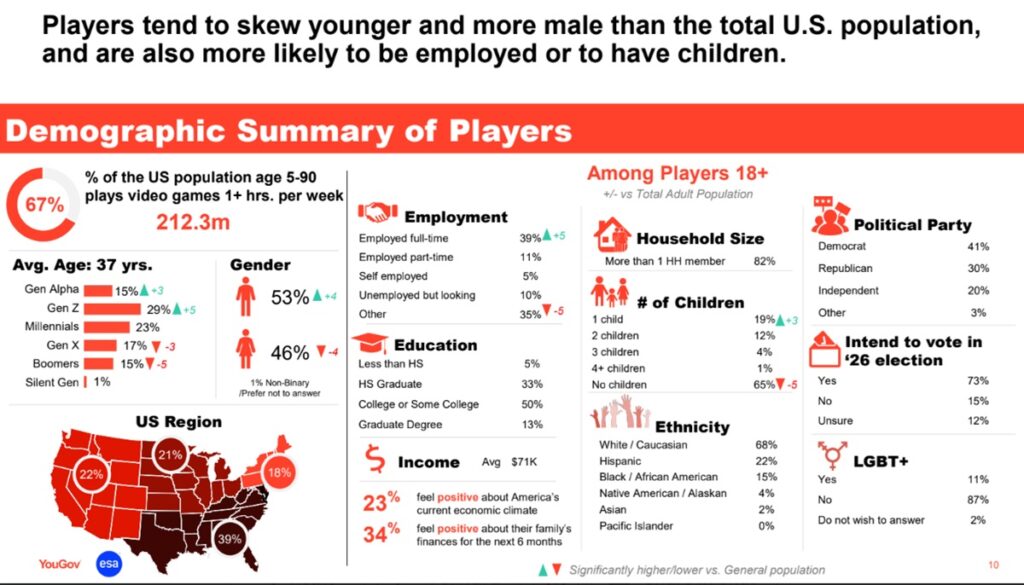 Demographics of gamers. Source: ESA “Gamers are reporting finding new songs and television shows and movies from the games that they played right there. They’re learning more about other entertainment content through video games and more of a personal anecdote than stats, the younger generation seems to prefer playing a video game than watching a television show or a movie straight up, or simply listening to music without doing something else,” Pierre-Louis said.
And so video games end up being a platform that really reaches that new audience that other entertainment categories want to use. Pierre-Louis said that 56% of adults who play real life sports play a video game version of that sport, and 87% of them believe it improves their real life performance.
“So that’s an interesting stat to see that video games are influencing how people view their real life performance in a sport. And if you if you look at some of the games, it makes some sense, because it provides essentially a simulation of the game,” Pierre-Louis said
“If you look at a show like The Last of Us, even the way it’s filmed, it’s almost feels like an RPG as you’re following a character. So more and more you’re seeing a video game format informing and cross pollinating with the television show or the streaming series or the movie, in a way that’s appealing to both audiences,” Pierre-Louis said.
He added, “But it takes that sensibility to understand that it’s a different kind of content that has to be filled differently. So, you know, so I think that adds to why those games are so popular among the fans of the game and fans to be of the game.”
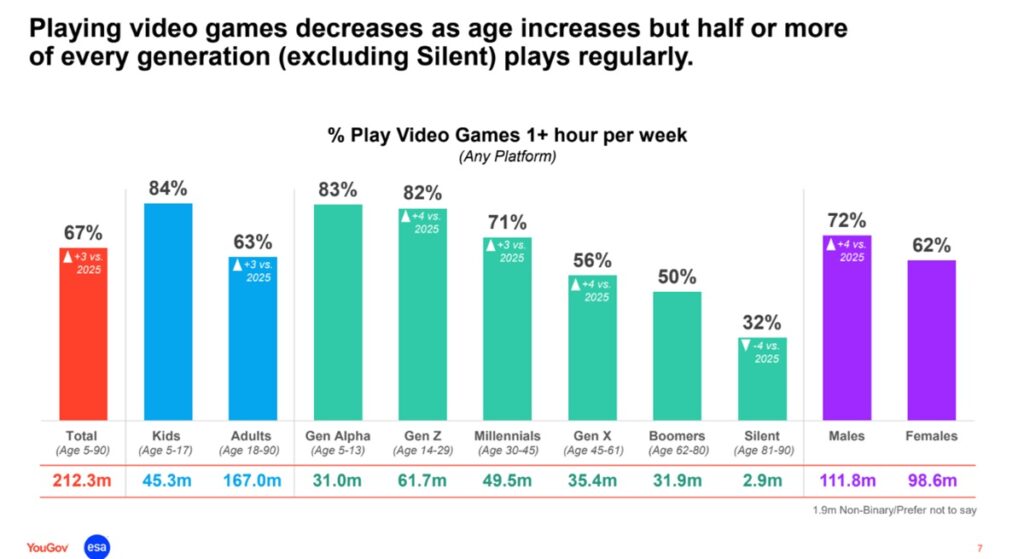 The silent generation of gamers. Source: ESA It’s been a tough few years with a lot of layoffs among game companies. I asked Pierre-Louis if he saw optimism in the report.
“Seeing the continued growth of the video game audience is exciting. Seeing how older generations are playing games serves as another example of why so much of the misconceptions around games shouldn’t exist,” Pierre-Louis said. “So, in other words, the data we see this year continues to dispel myths and stereotypes about who plays games. The truth is, everyone’s playing, and there’s a game for everyone, and games form different parts of our lives and mean different things in our lives, at different stages of our lives, and that’s what this year’s data points to.”
There are trends that could be viewed from multiple points of view. It’s a negative trend to see people playing older games for a much longer time. The result is that they aren’t buying as many new games and that hurts sales. But there are is a positive in that players are investing a lot of time into their favorite games and those hit games have a longer life..
“If people watch Netflix today, they may be watching shows that were filmed before their era, but they’re enjoying them now. You know, Friends continues to be a very popular streaming show,” Pierre-Louis said. “Well made content wears well through any generation in any era, and one of the reasons people continue to love some of the games that that have been out for a while is that they were really well made games. They told a great story. The visuals were compelling, and the ability to play with others and connect may have enhanced that experience. So I think it’s a win win.”
At the same time, new games like Clair Obscur: Expedition 33 hit players in the right way and the right time, and they became big hits. That shows “there is room for large scale games, newer indie games and everything in between,” Pierre-Louis said.
I have some ideas for the ESA to ask more questions. I think it could ask about retro games and why they’re popular across generations. I think it would also be good to see where the competition is and ask how much time people spend playing games versus other pursuits.
“There’s a game for everyone at every age, and the proof is in the survey,” Pierre-Louis said.
The post Average age of gamers hits 37 while 67% of Americans play | ESA CEO interview appeared first on GamesBeat.
But the ESA’s latest report is so much more than that, as it attempts to decipher the habits of the 212 million Americans who play video games. The annual report, Essential Facts About the U.S. Video Game Industry, is a comprehensive look at the state of video games nationwide.
It’s an important subject this year, as analyst Matthew Ball, now chief strategy officer at Xbox, wrote a report this year that questioned whether the amount of time that gamers spend playing games has begun to decline, thanks to a perceived rise in demand for addiction industries, from Only Fans to prediction markets.
Sadly, we don’t get an easy answer about whether this is true or not. But Ball’s work helped me frame my interview with Stanley Pierre-Louis, CEO of the ESA.
The results in detail
Conducted in partnership with YouGov, the latest report reveals that video game play continues to grow in popularity across generations, with the average age of players rising to 37.With 67% of Americans (ages 5-90) now playing video games one or more hours per week, video games have cemented themselves as one of the country’s preferred choices for entertainment. These and dozens of other compelling findings in this year’s report explore video game preferences across different demographics, regions, employment status and more.
“Video games play an integral role in American life today, with a large majority of Americans now playing regularly,” said Pierre-Louis. “Video games have become a powerful cultural force, while providing mental stimulation, stress relief and meaningful social connection for people of all ages.”
Breaking stereotypes
More folks are playing games. Source: ESA Featured findings from the 2026 Essential Facts About the U.S. Video Game Industry report include: Players continue to break stereotypes for who is a “gamer.”
212.3 million Americans play video games every week, up 3% (7.2 million) compared to 2025. The gender of players is split fairly equally between men and women, with 53% of men and 46% of women actively playing. Slightly more boys and men play than girls and women in all generations except Boomers (ages 62-80) where 52% of Boomer women play games compared to 47% of men.
Video games are for everyone, not just kids.
Stanley Pierre-Louis, CEO of the ESA. While more than 80% of Gen Alpha (age 5-13) and Gen Z (age 14-29) play video games, the majority of adults are powering up as well: 71% of Millennials (age 30-45), 56% of Gen X (age 45-61) and 50% of Boomers (age 62-80) say they play weekly. Even 32% of the silent generation (age 81-90) are joining in on the fun.Adult players are more likely to be employed full-time (39%) or to have children (35%) compared to the general U.S. population – 34% and 30%, respectively. Parents prefer their kids play video games, and love playing with them, too.
The majority of American parents (75%) actively play video games each week, with most (81%) saying they also game with their children (52% at least weekly).
Nearly half (49%) of parents whose children play video games believe playing games teaches important skills to their children, such as problem solving and creative thinking.
Two thirds of parents say they use parental controls with that number jumping to 70% for
parents of kids 12 and under.
Americans feel overwhelmingly positive about video games.
Most American adults recognize the positive benefits of playing video games, such as them being fun (85%), bringing joy (81%), offering stress relief (78%), and providing mental stimulation (79%). Younger players (Gen Z) especially believe that video games offer a great way to bring people together (88%) and build relationships (87%).
Most adults agree that playing video games helps develop problem-solving skills (76%) and teamwork/collaboration (67%), as well as adaptability/resilience (58%) and STEAM (53%) and communication skills (52%).
Nearly nine-in-ten (89%) players who play a sport both on-screen and in real life say playing the video game version of their sport improves their real-world performance.
Mobile leads the way, with people playing across genres and platforms.
Th ESA delved into why players play on mobile. Source: ESA Playing on a mobile device is the most popular across all age groups (80%), while PC and console gameplay is more common with Gen Alpha, Gen Z and Millennials.Puzzle, primarily driven by older players, is the top genre on mobile (66%) and PC (60%) but falls behind action (66%), shooter (60%) and arcade (60%) games on console.
Americans believe video games offer the most value for their money.
A majority of players (63%) report that video games deliver the most entertainment value for
their money, compared to video streaming services for music, TV and movies, as well as books, magazines and news articles.
Most Gen Alpha (69%), Gen Z (78%) and Millennial (67%) players have purchased in-game
content, typically spending $20 per month (median).
Parents also purchase in-game content for their children (54%). Of those that do, nearly all of
them (93%) require approval for in-games purchases made by their kids.
More than half (58%) of players downloaded a game for free in the past 12 months, while 43%
purchased a game, 35% purchased a game subscription and 19% borrowed a game.
The full Essential Facts About the U.S. Video Game Industry report is now available.
2026 Essential Facts About the U.S. Video Game Industry Methodology
Women are playing more than many men. Source: ESA YouGov and ESA conducted a 20-minute online survey in the U.S. from February 11-25 among 13,545 total respondents recruited from YouGov’s proprietary online panel. Data is weighted to be representative of the overall US population in terms of age, gender, ethnicity, education, state, census region, and the distribution of gamers vs. non-gamers, as defined above. 18+ respondents were asked about all members of their household in order to size gamers as young as 5 years old. Gamers aged 8-17 were asked to complete the survey under the supervision of a parent.A conversation about the meaning of gaming’s popularity
Hours per week of gaming. Source: ESA “We find it very useful for the industry and for policymakers and for the general public to understand what’s happening. This year’s results provided a lot of great insights, as well as a few surprises in terms of the demographics,” said Pierre-Louis said. He noted the average age and the percentage of people playing. The gender split is nearly even, with 47% of gamers being female and 52% male.
“That just shows that the continued staying power of video games in every demographic group, but then the surprises began to emerge within some of the data, particularly when you look at who’s playing by age,” Pierre-Louis said. “So if you look at the overall pie, 23% of those playing are under 18, but 28% of those playing are 50 years old and older. So you’ve got a much larger population of 50-year-old-plus players than you have under 18, which just speaks to the state of games for players throughout their lives, but also those who pick it up later in life and continue to play.”
He added, “If you look at generation alpha, roughly ages five to 12 today, they have the highest percentage of players of those in that category who play at about 83%,” he said. “But as you go up in range, you just have more people at high numbers. I thought it was interesting to see that nearly half of boomers are playing video games, but that women in the boomer generation are playing more than men.”
He noted about 36% of people in the silent generation, 80 years old and up, are playing games. That’s up 6% from last year.
“We saw growth occurring in that group over the past five to 10 years. But if you look since COVID, it’s really risen dramatically each year and and I would say we’re getting some more notable players, particularly in that Boomer range,” Pierre-Louis said.
There was a story out of Chicago about how John Prevost played Wordle and Words With Friends with his brother, Robert Francis. And so now we have Pope Leo as the most famous gamer in the world, Pierre-Louis said.
“No one had that on their bingo card, but it just shows the range of kinds of games and and how people engage, both to get a reprieve from everyday life, but also to stay connected with friends and family,” Pierre-Louis said.
I noted that the non-gamers are aging out more as younger gamers with higher percentage of play are taking their places. Doesn’t that suggest inexorable growth?
“More people are playing earlier in their lives, and video game play is part of who they are, as a hobby, as self expression, as a communication tool, as a way to connect with friends and family. So it’s becoming commonplace. It has been commonplace for some time,” Pierre-Louis said. “But we’re recognizing it as a common occurrence more and more. But seeing how people maintain that passion for games and finding different games that meet their needs as they play through different stages of their lives has been important.”
Pierre-Louis said that speaks to the growth of game development, the growth of scope of kinds of games that people are playing, and how games fit into your lives in a different way as you age into different categories. Some of the taste for games depends on the amount of time you have or the kinds of interests you have as a player.
“There’s some people who love certain games, and they play those games with their friends throughout but many players progress to different kinds of games, and there really is a game for everyone, and we’re finding that out in our surveys,” Pierre-Louis said.
I noted the demographics keep getting better for gaming, but the economics still go up and down as we still have down cycles.
“Well, I would say if you look at our industry going back five, 10, 15, or 20 years, you’ll see a growth trajectory, generally speaking. Obviously, during the COVID cycle, there was a spike in video game play as people stayed home and were looking for outlets and for ways to stay connected,” Pierre-Louis said ” And so since COVID, both in terms of player engagement and revenue, there’s been an adjustment to what the trend would have been. But if you take out COVID and follow the trend lines, which are in the report, you will see that it is generally upward moving, and it’s been exponential in several years, but it continues to trend in the right direction.”
He said that it’s a matter of how you maintain the pace of games that players demand, and that’s what companies are working through in a very deliberate way.
“They want to put out games that meet and exceed expectations, and that’s what we’re seeing with the games that come out, whether they’re games that people expect to be big or games that are smaller but captivate the imagination of players,” he said.
In different phases of life, players look for different outcomes from games. They may look for fun, or to keep their minds sharp if they’re older. They may want to be more competitive, connect with others, or just relax.
Data on girls and gaming. Source: ESA “In different phases, the rationale changes, but we are beginning to see if you trended over years, there are certain categories of anticipation or behavioral expectations from players, and they might shift depending on the the stage each player might be going through in life, but they point to a lot of similarities about how play is great for emotional development and emotional well being,” he said.He added, “Play is great for relaxation and stimulation. It’s great to release anxiety. And in fact, there are, you know, scientific studies that others do that point to the fact that 10 to 15 year olds who play games are just less stressed because it’s a great outlet. So more and more we’re seeing that these emotional releases and opportunities for players hold true, but they have different impact on different age groups overall.”
And he said another thing that was interesting was how parents are more likely to play video games than the overall population. About 70% of parents play games, and of those parents, 82% play games with their kids.
“And they do that for a number of reasons. It’s fun, and everyone enjoys it. It’s a good opportunity to socialize with their kids, and it’s great to spend family time together doing this,” Pierre-Louis said “And so those high levels seem to suggest that games are a great way for families to bond, and that 70% of parents would prefer their children spend time playing video games than on social media. And the experience the parents have on playing games and on social media probably point to the fact that games are interactive, there’s a goal, they’re competitive, and they’re a way to connect, and social media tends to be a one way street.”
As far as devices go, when you look at the generation alpha, their number one device is consoles. The easiest to play as a family on a console, as opposed to a mobile device or having two or three computers set up, Pierre-Louis said.
Games are also busting up into mass culture, rising up from a subculture.
There are blockbuster movies and television shows being developed from video game content. And at the same time, you have musicians releasing new music or hosting concerts on video game platforms, and so now, more and more, particularly with Gen Z and millennials, Pierre-Louis said.
Demographics of gamers. Source: ESA “Gamers are reporting finding new songs and television shows and movies from the games that they played right there. They’re learning more about other entertainment content through video games and more of a personal anecdote than stats, the younger generation seems to prefer playing a video game than watching a television show or a movie straight up, or simply listening to music without doing something else,” Pierre-Louis said.And so video games end up being a platform that really reaches that new audience that other entertainment categories want to use. Pierre-Louis said that 56% of adults who play real life sports play a video game version of that sport, and 87% of them believe it improves their real life performance.
“So that’s an interesting stat to see that video games are influencing how people view their real life performance in a sport. And if you if you look at some of the games, it makes some sense, because it provides essentially a simulation of the game,” Pierre-Louis said
Are movies and TV shows helping people discover games?
I wondered if shows like The Last of Us on HBO and the Mario movies are helping people become more aware of games.“If you look at a show like The Last of Us, even the way it’s filmed, it’s almost feels like an RPG as you’re following a character. So more and more you’re seeing a video game format informing and cross pollinating with the television show or the streaming series or the movie, in a way that’s appealing to both audiences,” Pierre-Louis said.
He added, “But it takes that sensibility to understand that it’s a different kind of content that has to be filled differently. So, you know, so I think that adds to why those games are so popular among the fans of the game and fans to be of the game.”
Optimism?
The silent generation of gamers. Source: ESA It’s been a tough few years with a lot of layoffs among game companies. I asked Pierre-Louis if he saw optimism in the report.“Seeing the continued growth of the video game audience is exciting. Seeing how older generations are playing games serves as another example of why so much of the misconceptions around games shouldn’t exist,” Pierre-Louis said. “So, in other words, the data we see this year continues to dispel myths and stereotypes about who plays games. The truth is, everyone’s playing, and there’s a game for everyone, and games form different parts of our lives and mean different things in our lives, at different stages of our lives, and that’s what this year’s data points to.”
There are trends that could be viewed from multiple points of view. It’s a negative trend to see people playing older games for a much longer time. The result is that they aren’t buying as many new games and that hurts sales. But there are is a positive in that players are investing a lot of time into their favorite games and those hit games have a longer life..
“If people watch Netflix today, they may be watching shows that were filmed before their era, but they’re enjoying them now. You know, Friends continues to be a very popular streaming show,” Pierre-Louis said. “Well made content wears well through any generation in any era, and one of the reasons people continue to love some of the games that that have been out for a while is that they were really well made games. They told a great story. The visuals were compelling, and the ability to play with others and connect may have enhanced that experience. So I think it’s a win win.”
At the same time, new games like Clair Obscur: Expedition 33 hit players in the right way and the right time, and they became big hits. That shows “there is room for large scale games, newer indie games and everything in between,” Pierre-Louis said.
I have some ideas for the ESA to ask more questions. I think it could ask about retro games and why they’re popular across generations. I think it would also be good to see where the competition is and ask how much time people spend playing games versus other pursuits.
“There’s a game for everyone at every age, and the proof is in the survey,” Pierre-Louis said.
The post Average age of gamers hits 37 while 67% of Americans play | ESA CEO interview appeared first on GamesBeat.
What's Your Reaction?








XINKER - Business and Income Tips
Explore XINKER, the ultimate platform for mastering business strategies, discovering passive income opportunities, and learning success principles. Join a community of thinkers dedicated to achieving financial freedom and entrepreneurial excellence.



![[Business Talk] Chagee: Opening 3,500 stores in 6 years](https://xinker.org/uploads/images/202410/image_140x98_671afce94bf91.webp)