






Developer Diary | The Dutch East Indies
Selamat siang, Sugeng sonten, Wilujeng sonten, Rahajeng sore, and Goedemiddag to you all! My name is Pdx_lily, and I will be your host for today’s dev diary about Indonesia, also known as the Dutch East Indies (do note I will use these terms, as well as “the East Indies” or “the Indies” interchangeably).History: Far and recentThe Dutch East Indies is one of the world’s longest-lasting colonies, being under Dutch rule for nearly 350 years as of 1936. It makes up a vast archipelago of over 17,000 islands, home to hundreds of distinct peoples, languages, and traditions.But despite this diversity, the shared struggle of living under apartheid has given rise to the shared national identity of “Indonesian”, a term that has only existed since the 1920’s.Princely StatesThe Dutch East Indies is a massive archipelago, and the Netherlands had much less centralized control over the eastern islands compared to islands like Java. Many regions were known as “Self-ruling regions” (zelfbesturende landschappen), where local sultans or monarchs maintained a degree of autonomy.We’ve decided to represent this in a similar way as India, where these states will start as non-core states with high compliance and no resistance. There will be multiple ways to integrate/core them in the focus tree, across both generic & political branches.Map of Indonesia with all princely states releasedEconomyThe Dutch East Indies produces over a third of the whole world’s rubber, and is a major producer of oil, bauxite, tin, quinine, sugar, and many, many other commodities. This sounds amazing on paper, until you remember it’s 1936, and the great depression has reduced global imports of commodities drastically. Since the East Indies put their entire economy in a singular basket, things aren’t going so well for the economy.But the worst of the worst is over, and countries are slowly starting to import more commodities again. This puts the East Indies in a unique position with many ways forward, and lots of economic potential. Will they rebuild their export economy once more, or will they diversify their economy?To represent this situation mechanically, Indonesia now starts with a national spirit which puts a heavy limit on how many resources Indonesia can export. Many focuses in the Industry branch will reduce the limit, however, it will often come at the cost of economic diversification.The Bangka and Belitung islands are home to a majority of Indonesian bauxite (for those unaware, bauxite is the raw ore that gets turned into aluminium), despite their small size. However, Indonesia lacks the infrastructure needed to actually produce aluminium, instead selling raw bauxite in bulk. When playing as Indonesia, you will be able to decide between continuing to sell raw materials, or building their own infrastructure.You can invest in underdeveloped regions, which eventually allows you to core certain princely states. Since there are several ways to core every state, we’ve made it so that any core state this focus would have cored will get a state modifier instead.The biggest decision of the Industry branch is whether to work with western companies to sell off resources at cheap prices while building up a local industry, or to establish new deals within the Asian market, including Japan, which might make the Netherlands angry.The resource market can be quite volatile, and since Indonesia’s economy is so dependent on exporting resources, we wanted to avoid situations where the player suddenly loses half of their civilian factories overnight due to market fluctuations. The Resource Contracts system helps counter this by letting Indonesia lease resources to private companies in order to pay for things such as civilian factories and weapons.The Soetardjo PetitionIn 1936 a vote was held on whether or not to pass the Soetardjo petition, which called for Indonesia to gradually become autonomous under the Dutch crown, with a similar status as the British Dominions.The vote is held after 140 days, giving the player an event which determines if they will go down the Loyalist branch while supporting or opposing Soetardjo, or denouncing the government all-together and calling for a revolution.Loyalist BranchIndonesia will have two joint focus trees with the Netherlands, where both are unlocked if the Loyalist branch is selected after the Soetardjo petition is voted on. The first one (which I will show you now) is for politics & economy, and the other one is a military tree.The right side of the tree is where the Netherlands can invest into the Indies (which reduces their autonomy), and the left side of the tree is where the Indies can work toward the goals established by the Soetardjo petition to gain autonomy. (unless the petition was rejected, which we will get to later)Both branches lead up to their own respective capstone focus, one favoring the Indies, and one favoring the Netherlands. However, these capstones are mutually exclusive, meaning that there is a race
Selamat siang, Sugeng sonten, Wilujeng sonten, Rahajeng sore, and Goedemiddag to you all! My name is Pdx_lily, and I will be your host for today’s dev diary about Indonesia, also known as the Dutch East Indies (do note I will use these terms, as well as “the East Indies” or “the Indies” interchangeably).
But despite this diversity, the shared struggle of living under apartheid has given rise to the shared national identity of “Indonesian”, a term that has only existed since the 1920’s.
We’ve decided to represent this in a similar way as India, where these states will start as non-core states with high compliance and no resistance. There will be multiple ways to integrate/core them in the focus tree, across both generic & political branches.
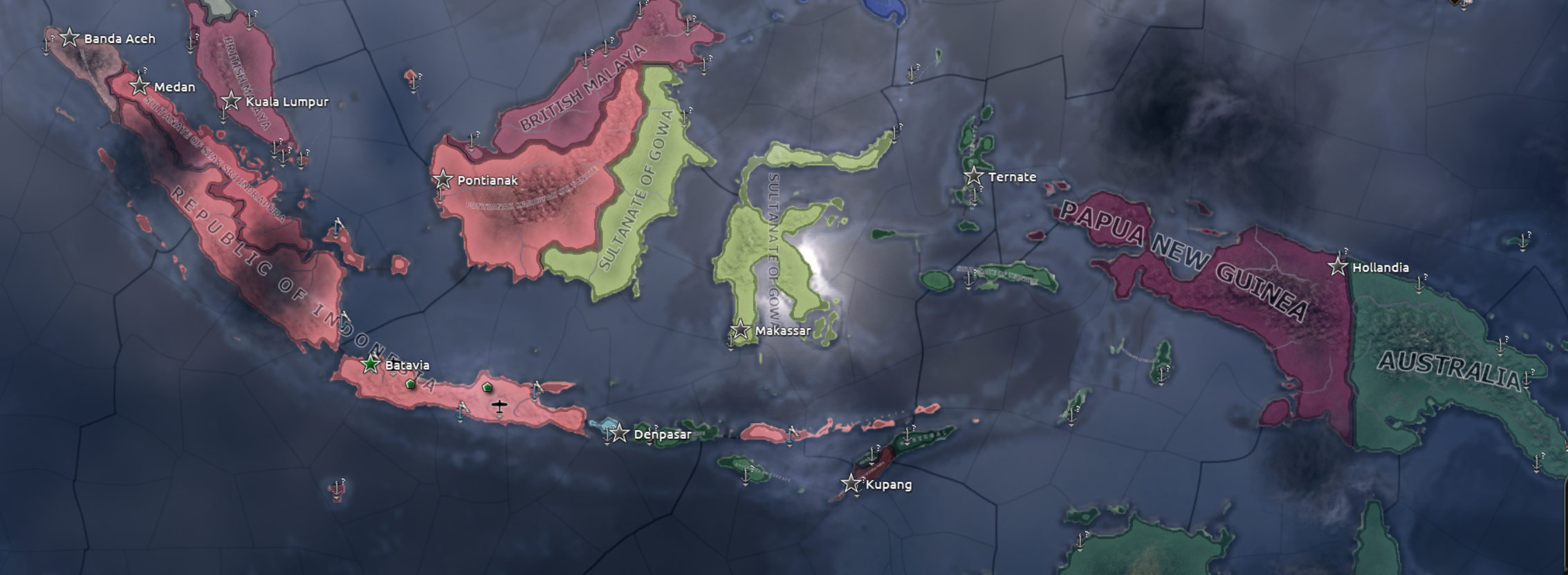
Map of Indonesia with all princely states released
But the worst of the worst is over, and countries are slowly starting to import more commodities again. This puts the East Indies in a unique position with many ways forward, and lots of economic potential. Will they rebuild their export economy once more, or will they diversify their economy?
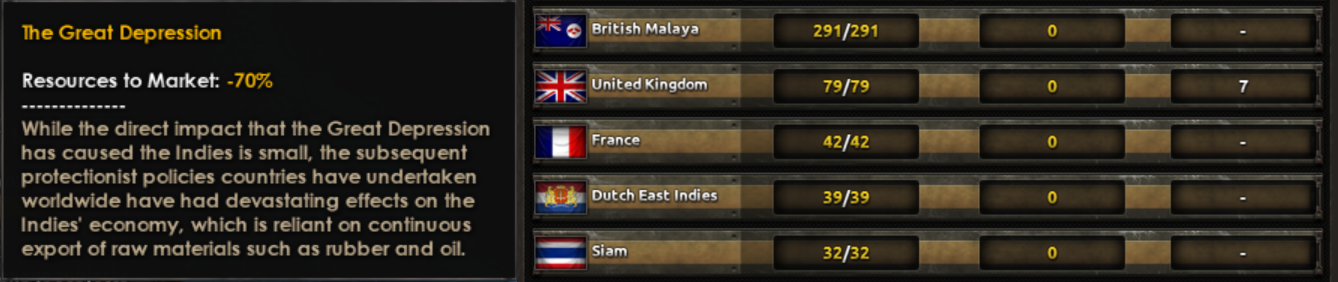
To represent this situation mechanically, Indonesia now starts with a national spirit which puts a heavy limit on how many resources Indonesia can export. Many focuses in the Industry branch will reduce the limit, however, it will often come at the cost of economic diversification.
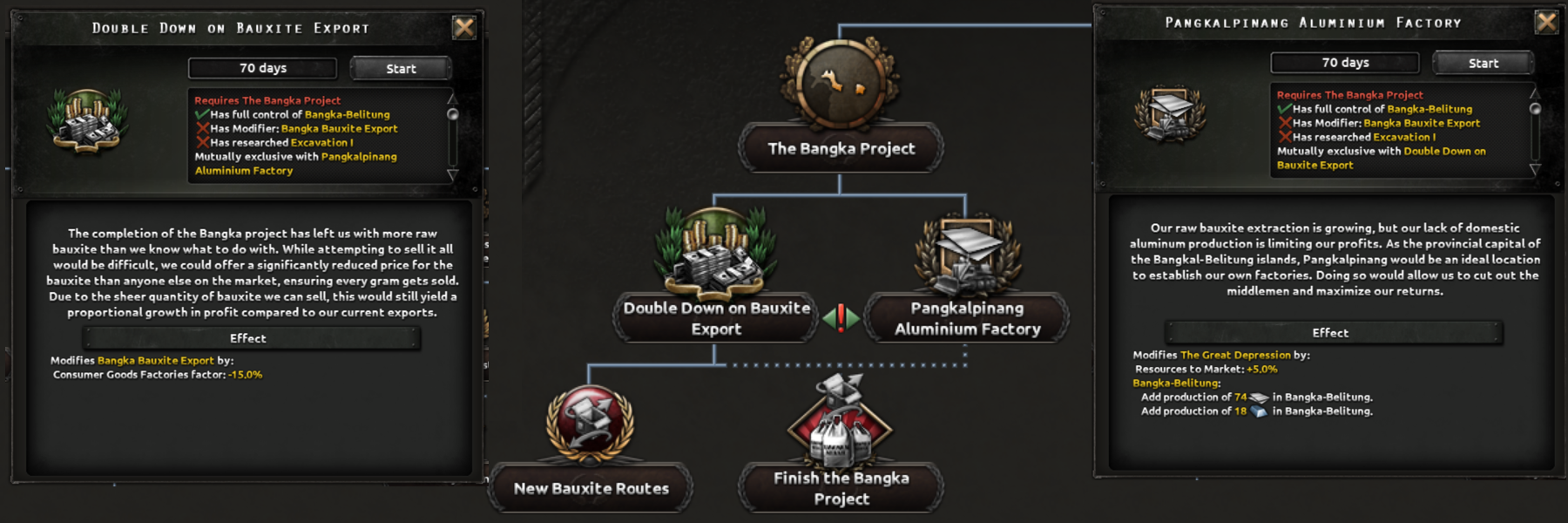
The Bangka and Belitung islands are home to a majority of Indonesian bauxite (for those unaware, bauxite is the raw ore that gets turned into aluminium), despite their small size. However, Indonesia lacks the infrastructure needed to actually produce aluminium, instead selling raw bauxite in bulk. When playing as Indonesia, you will be able to decide between continuing to sell raw materials, or building their own infrastructure.
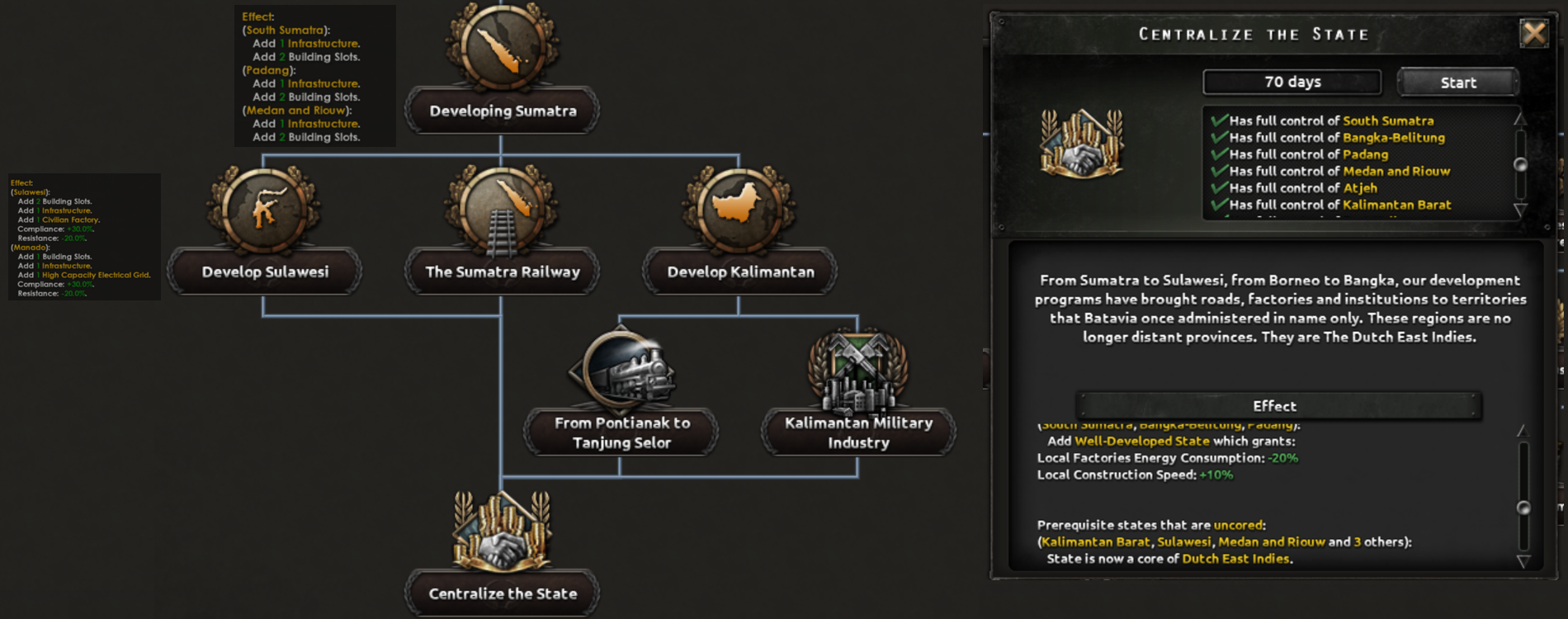
You can invest in underdeveloped regions, which eventually allows you to core certain princely states. Since there are several ways to core every state, we’ve made it so that any core state this focus would have cored will get a state modifier instead.
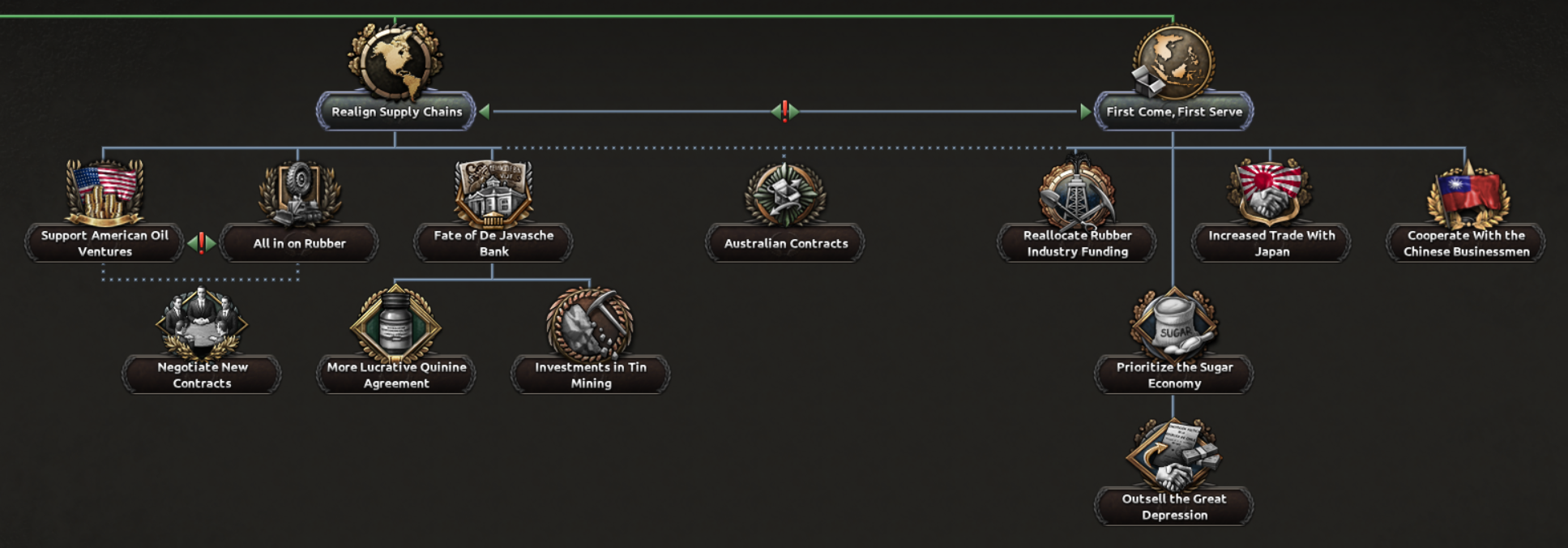
The biggest decision of the Industry branch is whether to work with western companies to sell off resources at cheap prices while building up a local industry, or to establish new deals within the Asian market, including Japan, which might make the Netherlands angry.
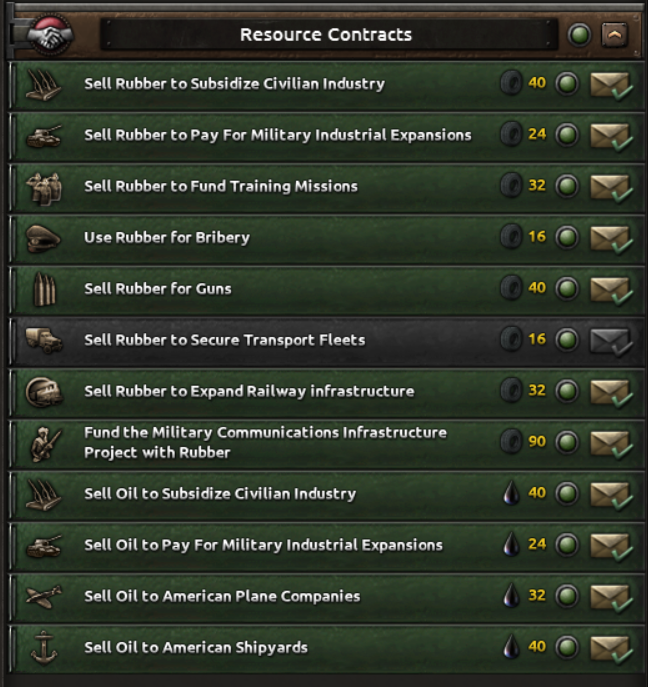
The resource market can be quite volatile, and since Indonesia’s economy is so dependent on exporting resources, we wanted to avoid situations where the player suddenly loses half of their civilian factories overnight due to market fluctuations. The Resource Contracts system helps counter this by letting Indonesia lease resources to private companies in order to pay for things such as civilian factories and weapons.
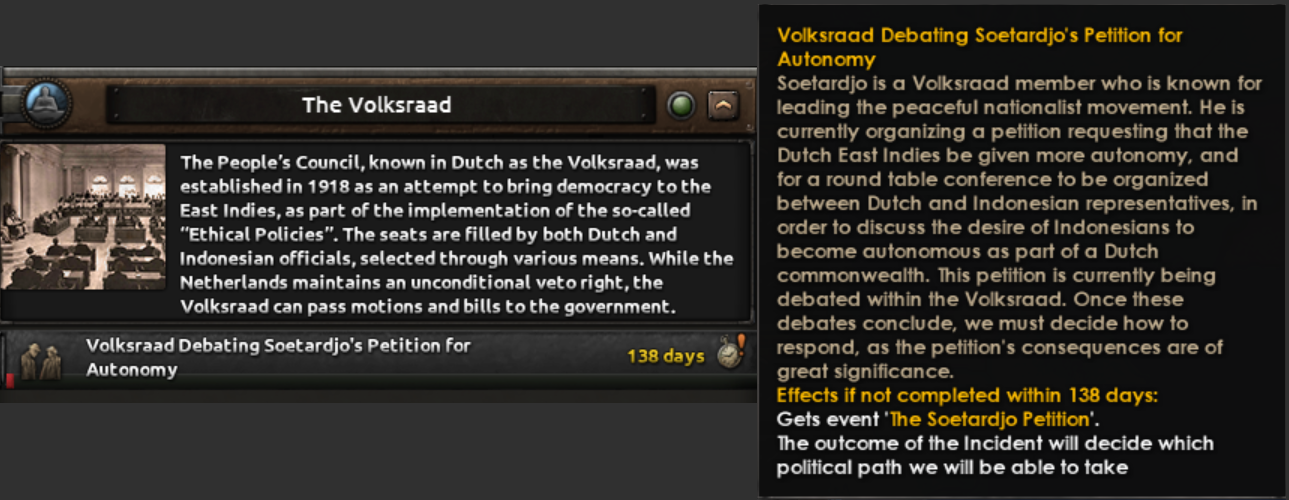
In 1936 a vote was held on whether or not to pass the Soetardjo petition, which called for Indonesia to gradually become autonomous under the Dutch crown, with a similar status as the British Dominions.
The vote is held after 140 days, giving the player an event which determines if they will go down the Loyalist branch while supporting or opposing Soetardjo, or denouncing the government all-together and calling for a revolution.
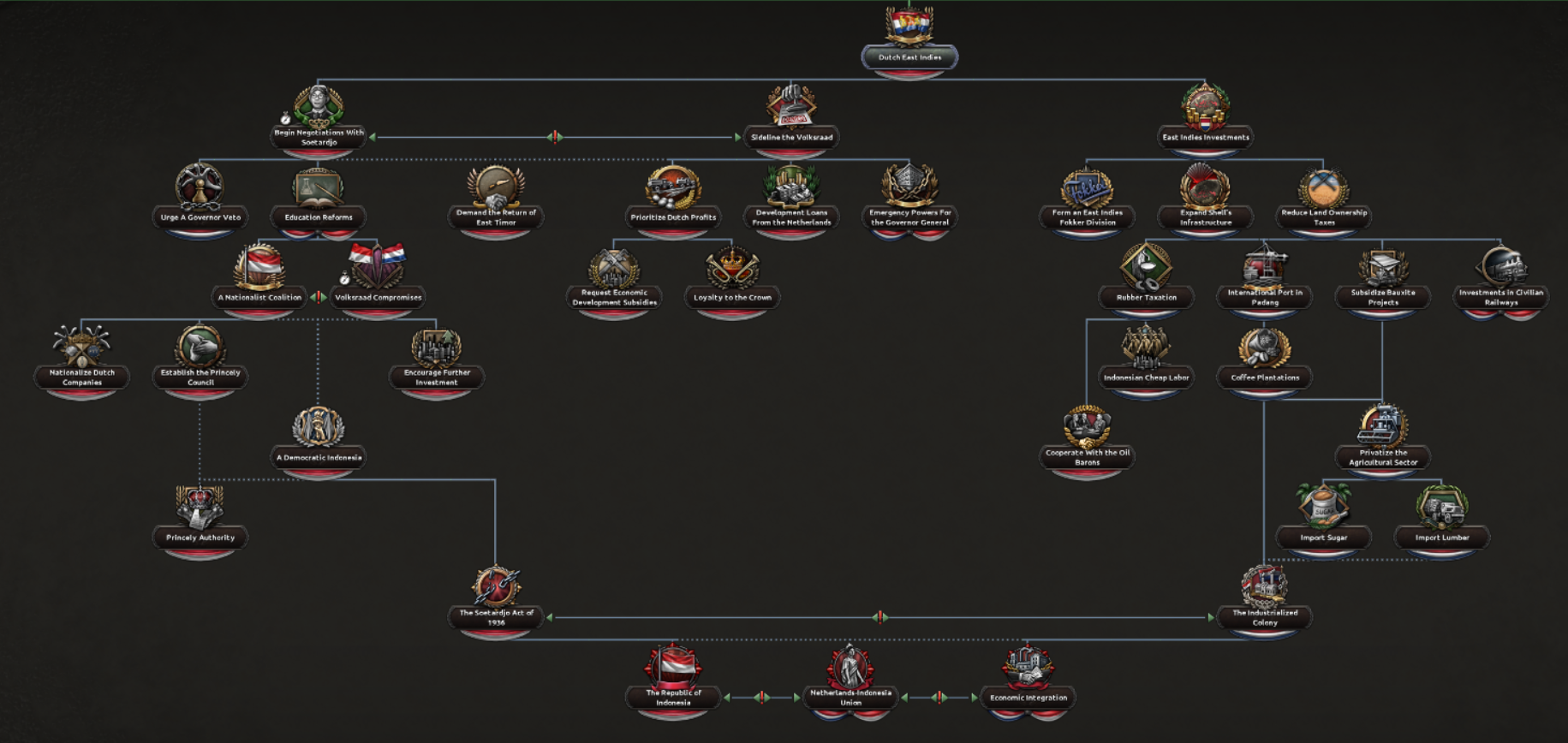
The right side of the tree is where the Netherlands can invest into the Indies (which reduces their autonomy), and the left side of the tree is where the Indies can work toward the goals established by the Soetardjo petition to gain autonomy. (unless the petition was rejected, which we will get to later)
Both branches lead up to their own respective capstone focus, one favoring the Indies, and one favoring the Netherlands. However, these capstones are mutually exclusive, meaning that there is a race between the two nations for who gets to complete their capstone.
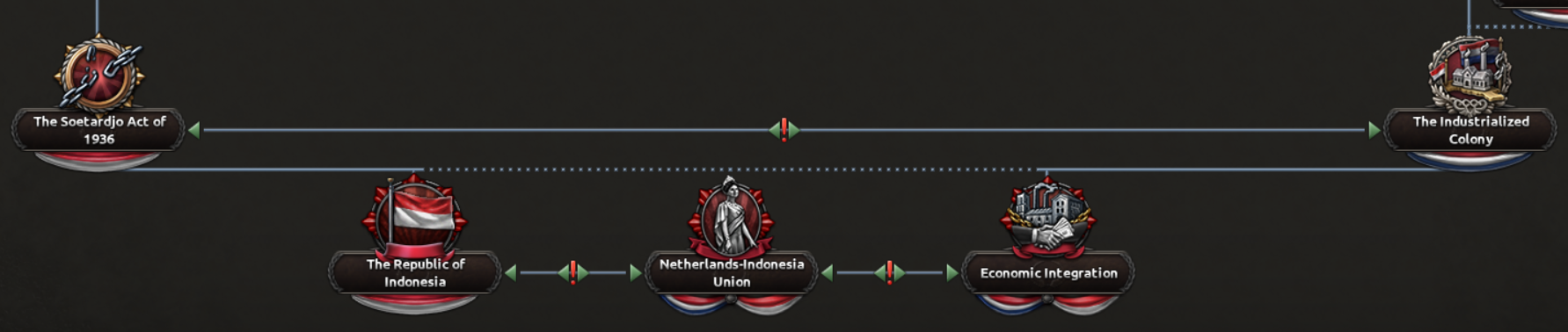
The Indies’ capstone can be taken if they complete all of the Soetardjo petition milestones, letting them declare independence. Whereas the Dutch capstone can be taken if they invest heavily into the colony, which will not only block the Indies from ever becoming independent, but will also force them to give large amounts of their industry to the Netherlands.
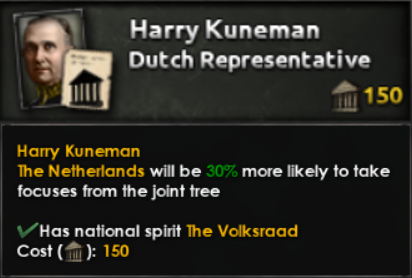
Despite this, when playing as the Indies you might still want the Netherlands to take some investment focuses, as they do significantly boost your economy. But this brings up an old issue with joint trees; It’s no fun waiting for the AI to complete a joint focus with no indication as to when or if they’ll actually get to it. To fix this, we added a modifier for how likely the AI will be to take joint focuses, which can be increased via certain advisors and focuses.
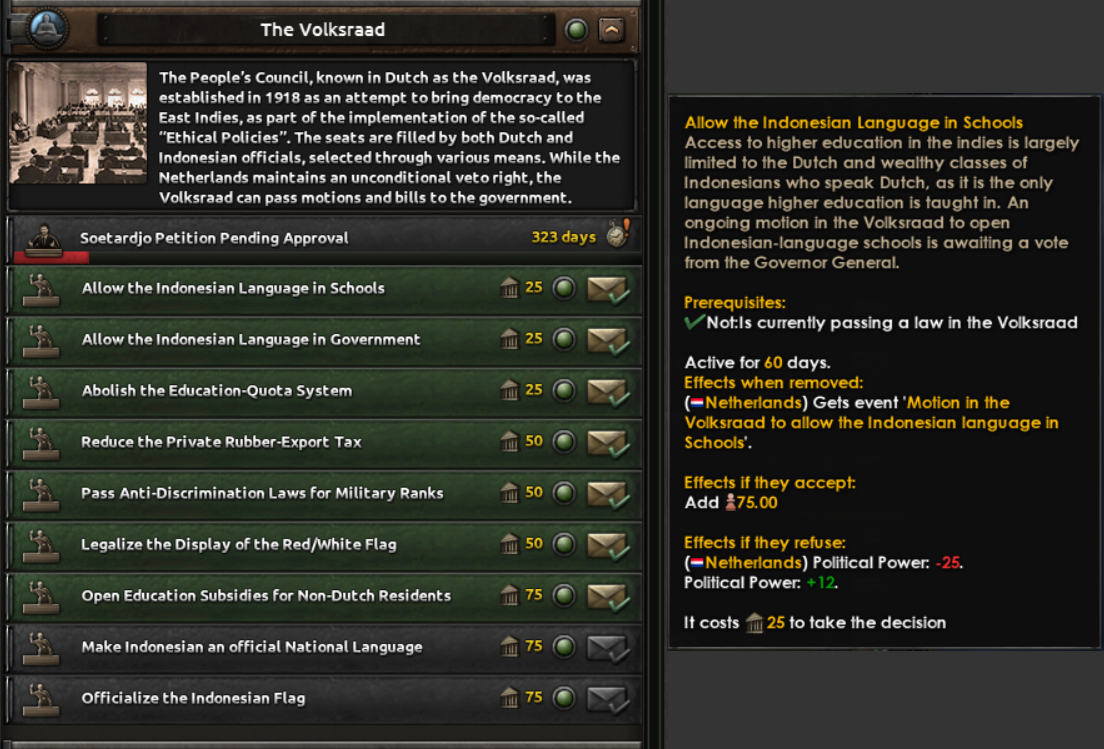
Historically, the Volksraad (People’s Council) was a semi-legislative council. It wasn’t exactly democratic, but it was the most democratic body of the Indies government. We’ve added a decision system to represent this, which can be used to attempt to pass laws to increase autonomy and boost the Soetardjo petition forward.
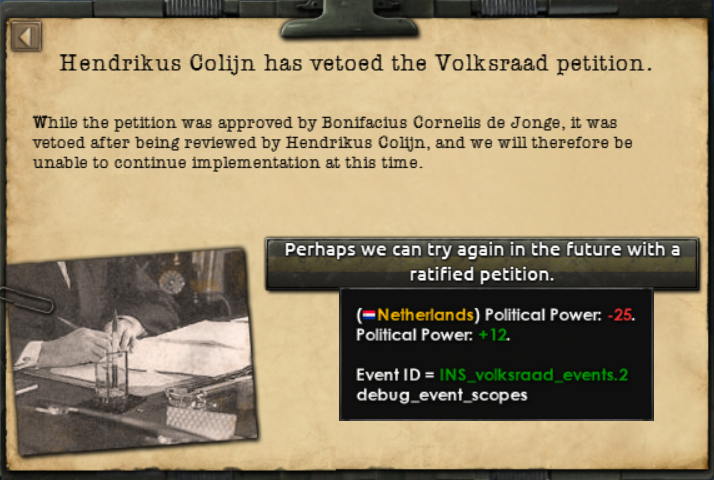
The Netherlands can always choose to veto a Volksraad petition, which will refund some of your political power, and you can try again later.
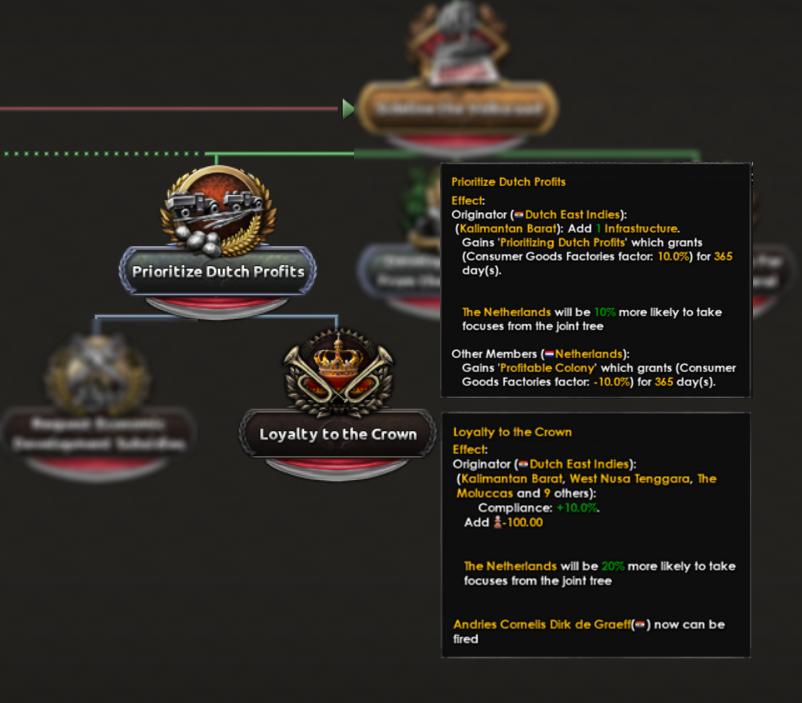
Returning to the political branch and the race to take the capstone, the previous explanation was assuming the East Indies supported the Soetardjo petition. However, If the East Indies rejects the Soetardjo petition, there is no race, as only the Dutch capstone is available, and the East Indies will never become independent. You might wonder why you’d voluntarily do this when playing as the East Indies, which is a good question.
…
…
…
Ok, seriously though, this sacrifice does actually come with some hefty benefits. Notably, you do not have to worry about the Netherlands investing too much, as there is no risk of them winning the race as a result. This means you can encourage the Netherlands to prioritize investing in the Indies heavily, which could snowball your industry if done right.
In a multiplayer game where one player plays the Netherlands, and another plays the Indies, rejecting the Soetardjo petition means the Netherlands can focus on building up the Indies in the early game, and then right before the war the Indies can begin to give back to the Netherlands.
Capstone of a Capstone
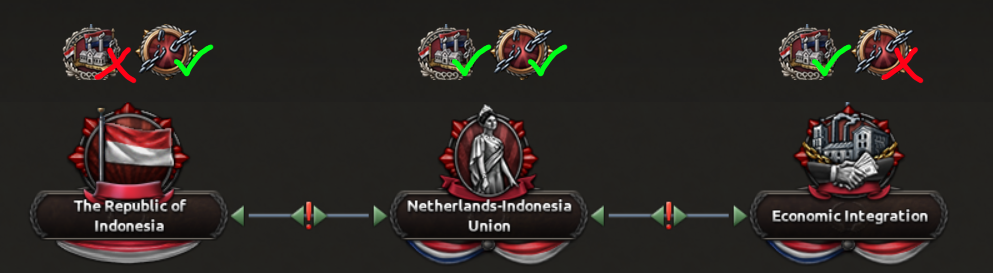
Depending on the capstone focus chosen, you can either complete the Republic of Indonesia or Economic Integration once you meet the requirements. Alternatively, the Netherlands-Indonesia Union is always available, but only during war.
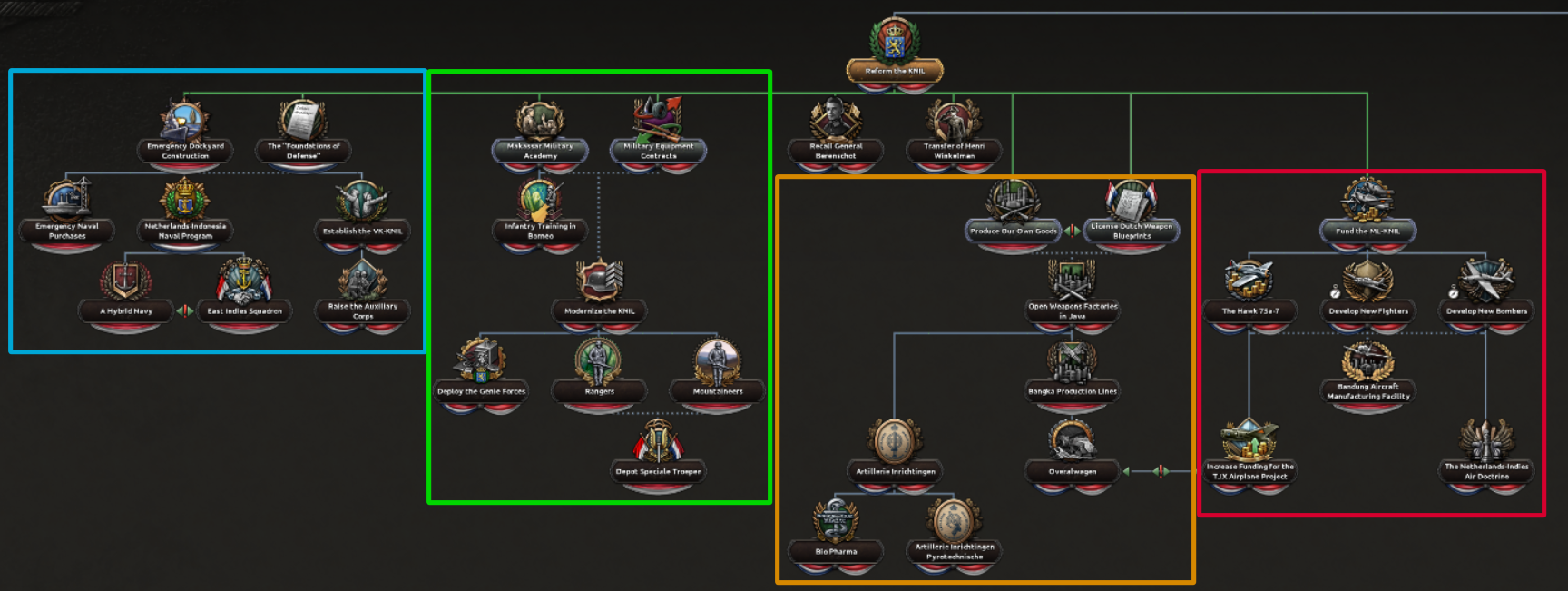
While the East Indies Army (the KNIL) was a fully independent organization from the Dutch army, the two armies were still very intertwined. After the Netherlands capitulated, they shifted focus to the East Indies.
Therefore, we’ve decided to not have a generic army branch, and instead make the entire army branch a joint focus tree, with most focuses being available to both the Netherlands and the Indies. The army branch has four subbranches which I’ve highlighted. Blue is navy, green is army, yellow is military industry, and red is air.
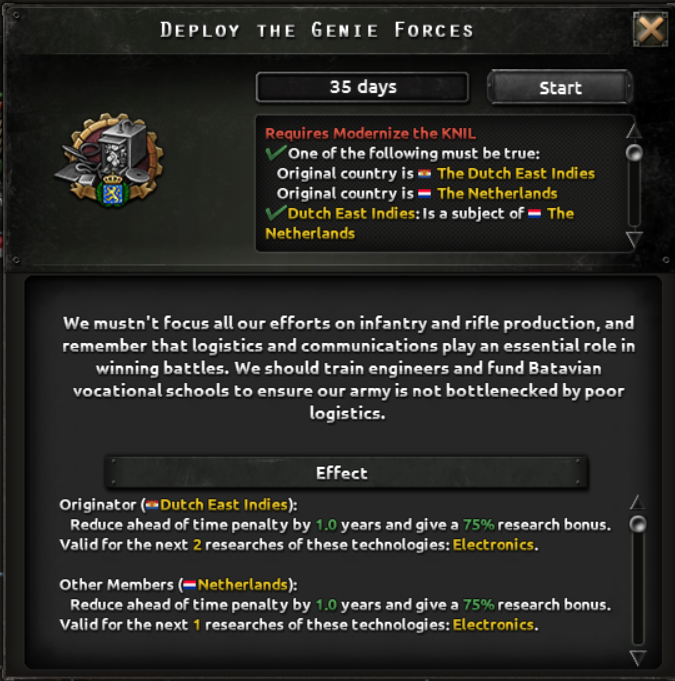
Most of the focuses follow a similar pattern; The originator gets the reward, the other country gets half the reward. The Netherlands will start prioritizing this branch quite heavily if they capitulate.
Before anyone asks, yes - the revolutionary branch has its own military focuses, and many of the joint military focuses will still be available for Indonesia if they become independent peacefully.
Changes to the Netherlands
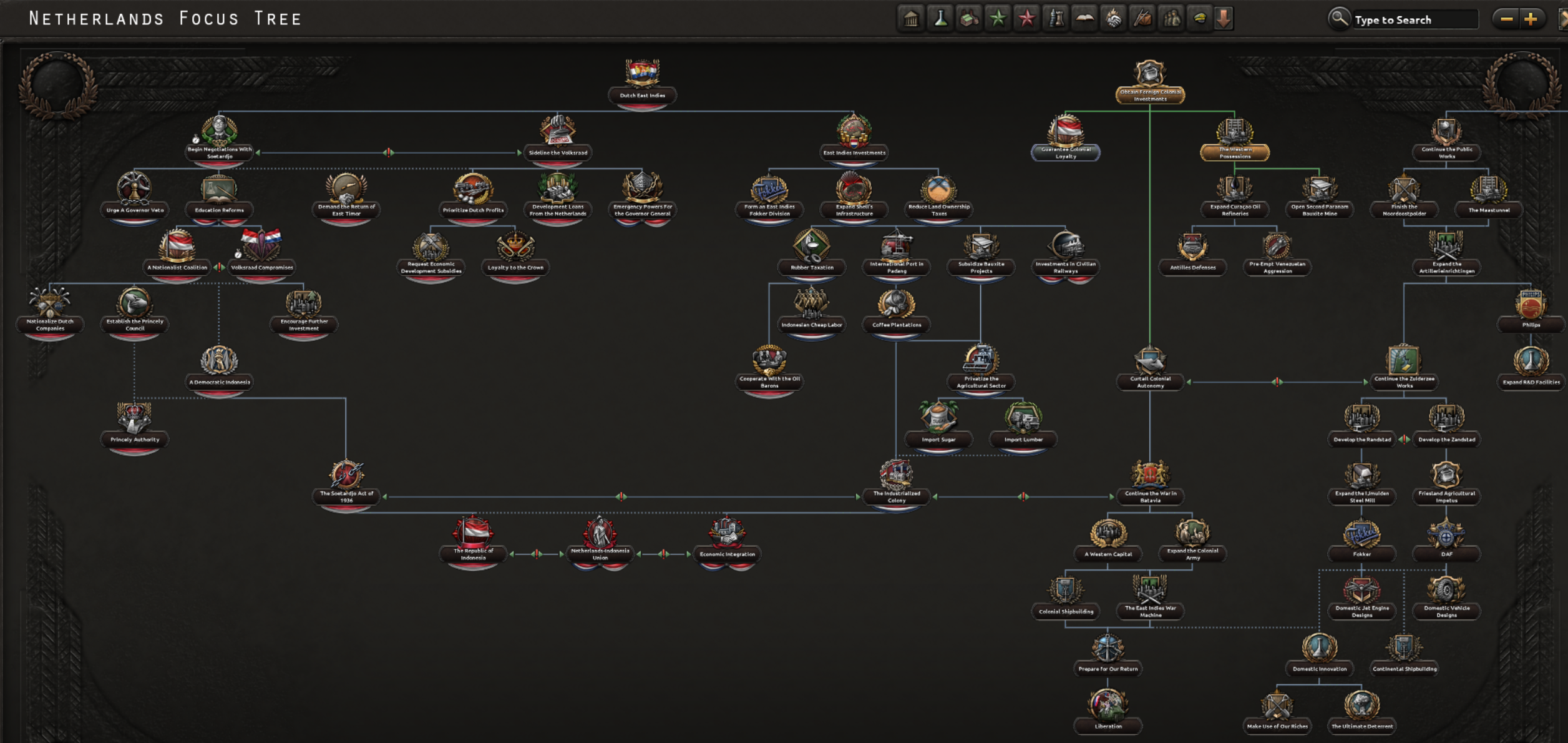
Aside from the addition of the joint focus tree, there have been a few minor changes to the Dutch tree to accommodate it. The reason for most changes is to ensure that the pacing of the Dutch tree is not thrown off by the addition of the new joint focus tree.
The colonial investment branch has been rendered mostly obsolete due to the joint focus tree, and has therefore been trimmed down to not throw off the pacing. The remaining focuses to invest in South America have been balanced, with several of them being reduced to 35 day focuses to be more in-line with the current balance standards.
The Netherlands will always be able to take a few focuses to invest in their colonies without falling behind on their own focus tree, but investing heavily in the Indies to build an economic powerhouse will of course come at a cost.
Occupation
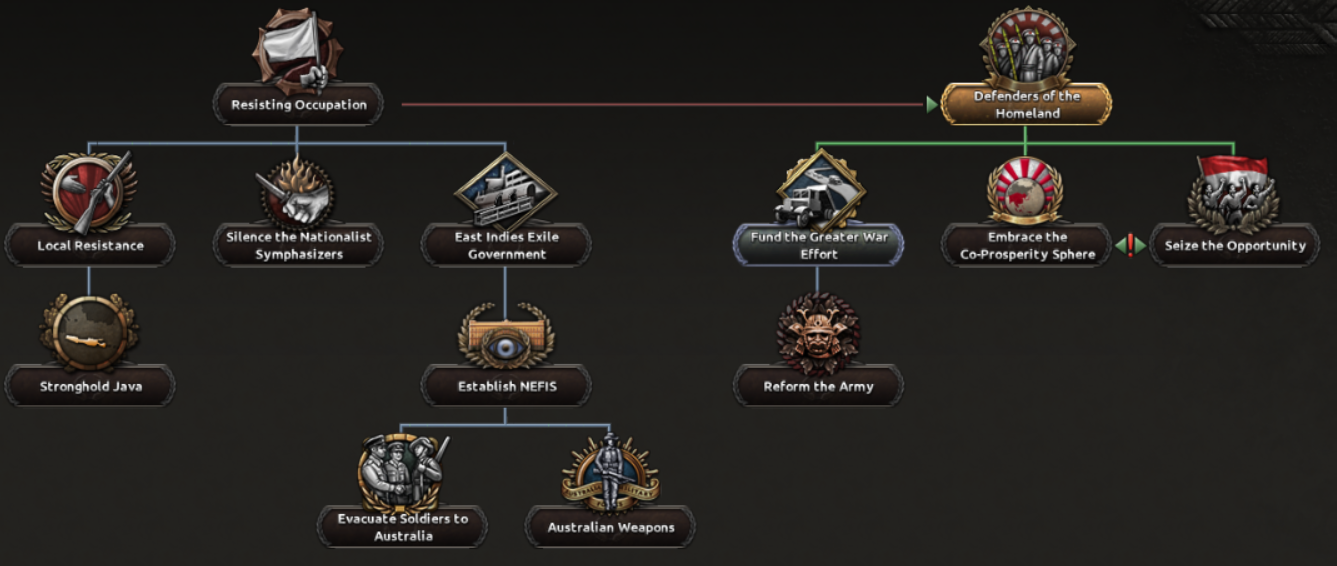
When Indonesia gets invaded by a major country, the “Resisting Occupation” branch is unlocked. It’s fairly straightforward, you can decide between moving all your forces to Java or trying to defend the whole archipelago.
However, if you get invaded by Japan specifically, you get the option to surrender and become a Japanese puppet instead. To explain the goal with this, I first need to give some historical context:
Representing Indonesia historically gets tricky, because we run into a similar issue as many other puppet countries, in that Indonesia does historically declare independence in 1945, after being occupied by Japan, but historically should be “playing” the Loyalist path until then.
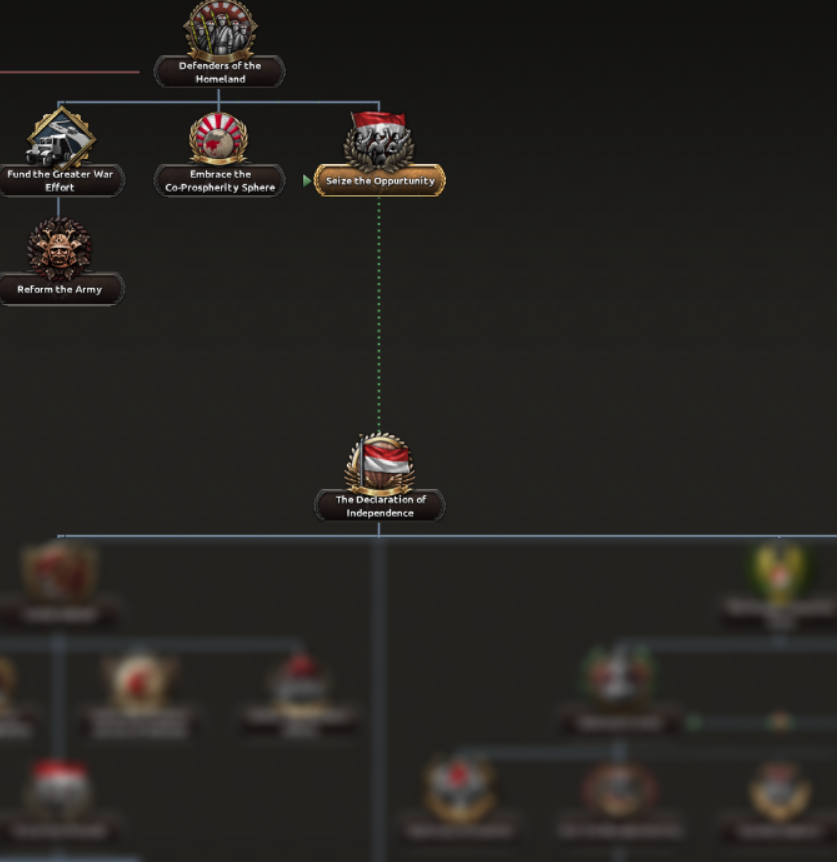
To solve that problem, we added a focus called Seize the Opportunity within the puppet branch. It’s only available if Japan is losing the war, and lets you completely switch your political branch mid-game to the revolutionary one.
It’s unlikely that Japan will actually gain any surrender progress by this point, being an island with a good navy and all, so instead we define “losing” as them controlling less than 70% of the states they controlled when establishing the puppet state. This means if Japan starts getting pushed back, losing control of e.g. China or the Philippines, then Indonesia gets the opportunity to break free.
History: Far and recent
The Dutch East Indies is one of the world’s longest-lasting colonies, being under Dutch rule for nearly 350 years as of 1936. It makes up a vast archipelago of over 17,000 islands, home to hundreds of distinct peoples, languages, and traditions.But despite this diversity, the shared struggle of living under apartheid has given rise to the shared national identity of “Indonesian”, a term that has only existed since the 1920’s.
Princely States
The Dutch East Indies is a massive archipelago, and the Netherlands had much less centralized control over the eastern islands compared to islands like Java. Many regions were known as “Self-ruling regions” (zelfbesturende landschappen), where local sultans or monarchs maintained a degree of autonomy.We’ve decided to represent this in a similar way as India, where these states will start as non-core states with high compliance and no resistance. There will be multiple ways to integrate/core them in the focus tree, across both generic & political branches.
Map of Indonesia with all princely states released
Economy
The Dutch East Indies produces over a third of the whole world’s rubber, and is a major producer of oil, bauxite, tin, quinine, sugar, and many, many other commodities. This sounds amazing on paper, until you remember it’s 1936, and the great depression has reduced global imports of commodities drastically. Since the East Indies put their entire economy in a singular basket, things aren’t going so well for the economy.But the worst of the worst is over, and countries are slowly starting to import more commodities again. This puts the East Indies in a unique position with many ways forward, and lots of economic potential. Will they rebuild their export economy once more, or will they diversify their economy?
To represent this situation mechanically, Indonesia now starts with a national spirit which puts a heavy limit on how many resources Indonesia can export. Many focuses in the Industry branch will reduce the limit, however, it will often come at the cost of economic diversification.
The Bangka and Belitung islands are home to a majority of Indonesian bauxite (for those unaware, bauxite is the raw ore that gets turned into aluminium), despite their small size. However, Indonesia lacks the infrastructure needed to actually produce aluminium, instead selling raw bauxite in bulk. When playing as Indonesia, you will be able to decide between continuing to sell raw materials, or building their own infrastructure.
You can invest in underdeveloped regions, which eventually allows you to core certain princely states. Since there are several ways to core every state, we’ve made it so that any core state this focus would have cored will get a state modifier instead.
The biggest decision of the Industry branch is whether to work with western companies to sell off resources at cheap prices while building up a local industry, or to establish new deals within the Asian market, including Japan, which might make the Netherlands angry.
The resource market can be quite volatile, and since Indonesia’s economy is so dependent on exporting resources, we wanted to avoid situations where the player suddenly loses half of their civilian factories overnight due to market fluctuations. The Resource Contracts system helps counter this by letting Indonesia lease resources to private companies in order to pay for things such as civilian factories and weapons.
The Soetardjo Petition
In 1936 a vote was held on whether or not to pass the Soetardjo petition, which called for Indonesia to gradually become autonomous under the Dutch crown, with a similar status as the British Dominions.
The vote is held after 140 days, giving the player an event which determines if they will go down the Loyalist branch while supporting or opposing Soetardjo, or denouncing the government all-together and calling for a revolution.
Loyalist Branch
Indonesia will have two joint focus trees with the Netherlands, where both are unlocked if the Loyalist branch is selected after the Soetardjo petition is voted on. The first one (which I will show you now) is for politics & economy, and the other one is a military tree.The right side of the tree is where the Netherlands can invest into the Indies (which reduces their autonomy), and the left side of the tree is where the Indies can work toward the goals established by the Soetardjo petition to gain autonomy. (unless the petition was rejected, which we will get to later)
Both branches lead up to their own respective capstone focus, one favoring the Indies, and one favoring the Netherlands. However, these capstones are mutually exclusive, meaning that there is a race between the two nations for who gets to complete their capstone.
The Indies’ capstone can be taken if they complete all of the Soetardjo petition milestones, letting them declare independence. Whereas the Dutch capstone can be taken if they invest heavily into the colony, which will not only block the Indies from ever becoming independent, but will also force them to give large amounts of their industry to the Netherlands.
Despite this, when playing as the Indies you might still want the Netherlands to take some investment focuses, as they do significantly boost your economy. But this brings up an old issue with joint trees; It’s no fun waiting for the AI to complete a joint focus with no indication as to when or if they’ll actually get to it. To fix this, we added a modifier for how likely the AI will be to take joint focuses, which can be increased via certain advisors and focuses.
The Volksraad
Historically, the Volksraad (People’s Council) was a semi-legislative council. It wasn’t exactly democratic, but it was the most democratic body of the Indies government. We’ve added a decision system to represent this, which can be used to attempt to pass laws to increase autonomy and boost the Soetardjo petition forward.
The Netherlands can always choose to veto a Volksraad petition, which will refund some of your political power, and you can try again later.
If you reject the Soetardjo Petition
Returning to the political branch and the race to take the capstone, the previous explanation was assuming the East Indies supported the Soetardjo petition. However, If the East Indies rejects the Soetardjo petition, there is no race, as only the Dutch capstone is available, and the East Indies will never become independent. You might wonder why you’d voluntarily do this when playing as the East Indies, which is a good question.
…
…
…
Ok, seriously though, this sacrifice does actually come with some hefty benefits. Notably, you do not have to worry about the Netherlands investing too much, as there is no risk of them winning the race as a result. This means you can encourage the Netherlands to prioritize investing in the Indies heavily, which could snowball your industry if done right.
In a multiplayer game where one player plays the Netherlands, and another plays the Indies, rejecting the Soetardjo petition means the Netherlands can focus on building up the Indies in the early game, and then right before the war the Indies can begin to give back to the Netherlands.
Capstone of a Capstone
Depending on the capstone focus chosen, you can either complete the Republic of Indonesia or Economic Integration once you meet the requirements. Alternatively, the Netherlands-Indonesia Union is always available, but only during war.
Military Branch
While the East Indies Army (the KNIL) was a fully independent organization from the Dutch army, the two armies were still very intertwined. After the Netherlands capitulated, they shifted focus to the East Indies.
Therefore, we’ve decided to not have a generic army branch, and instead make the entire army branch a joint focus tree, with most focuses being available to both the Netherlands and the Indies. The army branch has four subbranches which I’ve highlighted. Blue is navy, green is army, yellow is military industry, and red is air.
Most of the focuses follow a similar pattern; The originator gets the reward, the other country gets half the reward. The Netherlands will start prioritizing this branch quite heavily if they capitulate.
Before anyone asks, yes - the revolutionary branch has its own military focuses, and many of the joint military focuses will still be available for Indonesia if they become independent peacefully.
Changes to the Netherlands
Aside from the addition of the joint focus tree, there have been a few minor changes to the Dutch tree to accommodate it. The reason for most changes is to ensure that the pacing of the Dutch tree is not thrown off by the addition of the new joint focus tree.
The colonial investment branch has been rendered mostly obsolete due to the joint focus tree, and has therefore been trimmed down to not throw off the pacing. The remaining focuses to invest in South America have been balanced, with several of them being reduced to 35 day focuses to be more in-line with the current balance standards.
The Netherlands will always be able to take a few focuses to invest in their colonies without falling behind on their own focus tree, but investing heavily in the Indies to build an economic powerhouse will of course come at a cost.
Occupation
When Indonesia gets invaded by a major country, the “Resisting Occupation” branch is unlocked. It’s fairly straightforward, you can decide between moving all your forces to Java or trying to defend the whole archipelago.
However, if you get invaded by Japan specifically, you get the option to surrender and become a Japanese puppet instead. To explain the goal with this, I first need to give some historical context:
Representing Indonesia historically gets tricky, because we run into a similar issue as many other puppet countries, in that Indonesia does historically declare independence in 1945, after being occupied by Japan, but historically should be “playing” the Loyalist path until then.
To solve that problem, we added a focus called Seize the Opportunity within the puppet branch. It’s only available if Japan is losing the war, and lets you completely switch your political branch mid-game to the revolutionary one.
It’s unlikely that Japan will actually gain any surrender progress by this point, being an island with a good navy and all, so instead we define “losing” as them controlling less than 70% of the states they controlled when establishing the puppet state. This means if Japan starts getting pushed back, losing control of e.g. China or the Philippines, then Indonesia gets the opportunity to break free.
Outro
And that’s all for now! Thank you very much for reading, and keep your eyes peeled for the next Indonesian Dev Diary, where we will dive into the details of the revolutionary branch. I’ll stick around for a while to answer any questions you have, so this is your opportunity to ask!你覺得這篇文章如何?








XINKER - Business and Income Tips
Explore XINKER, the ultimate platform for mastering business strategies, discovering passive income opportunities, and learning success principles. Join a community of thinkers dedicated to achieving financial freedom and entrepreneurial excellence.