






Developer Diary | Alt-stralia
G’day mate!Punchrullar and Mordred Viking are back again to give you the lowdown on the more radical ideologies down under: Fascism and Communism. Australia in this period was a relatively stable democracy, but there were certainly groups who wanted to see the nation take a very different path.If Australia was so stable, then how do these movements come to power? That’s the question, isn’t it?Also, to show off all the Australia content, Mordred and Punchrullar will be hosting a live stream this Friday, May 22 at 15:00 CEST.Let’s get cracking.Australia FirstFascismFascist sentiments in Australia during the later 1930s was no common matter, or at the very least, it wasn’t a mobilized one. By backtracking only to 1933, however, we reach the year when the Centre Party was founded. Springing out of the paramilitary movement the New Guard, the Party adopted ideas of fascism and monarchism, but did not last beyond1935 when it dissolved following unpromising election results.Even if the New Guard and the Centre Party were impactful fascist actors right before the war years, we’ve chosen another, at first glance, smaller, actor to represent Australian World War II fascism: the Australia First Movement. The Movement was formed in 1941, dissolved as early as 1942, and reached a membership count of only 65. Australia First’s fruitlessness and close to non-existent impact on Australian politics, are what makes it the perfect choice for the playable Australian fascist party; since the Movement historically did not hold on long enough to set a course, the imagination of players will do so instead. The most impactful decision will be made already by the second focus; who shall lead Australia First?P.R. StephensenThe historical leader of the Australia First Movement was the writer and activist, P.R. Stephensen, whose interest in Australian identity and culture directed him towards nationalism and isolationism. He deemed severance from Britain necessary both to avoid involuntary involvement in British wars, and for the preservation of original Australian culture. Due to this ambition to sustain national identity, his view on Australia’s indigenous population was an odd contradiction to the Movement’s pro-nazi and anti-semitic sentiments. Personally, he funded one of the time’s most prominent Aboriginal rights organisations and supported their struggle for full citizen rights. From Stephenson’s point of view, the indigenous population’s welfare was of great importance in order to protect national identity. So, applying this all to Hearts of Iron, the choice of playing with Stephensen as fascist leader will lead Australia in a direction that supports his views. With Australia First represented by him, players can rally for immediate independence and the right to refuse British wars, while signing a pact with Germany to collaborate in taking Britain’s Pacific islands. As a result of the Great War, German territories in the Pacific were put under Australian and British control. And so, by promising the return of the small island of Nauru to Germany, players can create a common objective of invading the British held islands of New Zealand and the Solomons. Of course, pacts can always be broken, if Australia ultimately decides they want both.Stephensen players may also invest in Australian culture to raise citizen support and grow a sense of unity in external territories, eventually making them possible to core if Resistance sinks low enough. And last but not least, the United States of America must be stopped from sticking their nose in Australian matters and their feet on Australian soil; the western Pacific is for Australia to command.Adela Pankhurst WalshThe second option for Australia First leader is Adela Pankhurst Walsh. Present at the Movement’s formal establishment at the Shalimar Café in Sydney, Pankhurst was appointed as organizer. Although her prominent role in the group attests her support of its policies, the ambitions of Australia First would most definitely have looked very different if she herself had designed them.Being a daughter and sister to the leaders of the British suffragette movement, the woman’s role and place in society had always been a topic of discussion for Pankhurst. After moving to Australia, Pankhurst founded the anti-communist ‘Australian Women’s Guild of Empire’; an organization modelled on and affiliated with its British counterpart, Women’s Guild of Empire. While raising money for working class women and children affected by the Great Depression, the guild advocated for the need of industrial cooperation, a sense of communal responsibility, and continued strong cooperation within the British Commonwealth. Although Pankhurst did share the anti-war and collaborationist sentiments of Australia First and P.R. Stephensen, her background shone a different light upon Australian nationality and British overlordship. With both personal and professional ties to Britain, Pankhurst had experienced how Br
G’day mate!
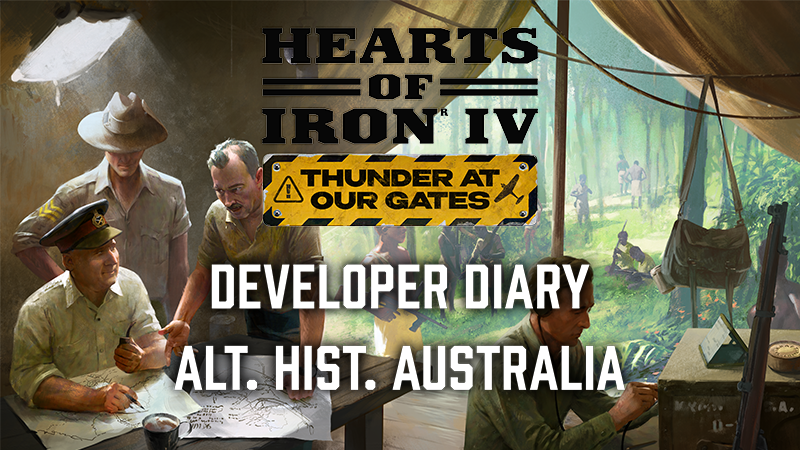
Punchrullar and Mordred Viking are back again to give you the lowdown on the more radical ideologies down under: Fascism and Communism. Australia in this period was a relatively stable democracy, but there were certainly groups who wanted to see the nation take a very different path.
If Australia was so stable, then how do these movements come to power? That’s the question, isn’t it?
Also, to show off all the Australia content, Mordred and Punchrullar will be hosting a live stream this Friday, May 22 at 15:00 CEST.
Let’s get cracking.
Fascist sentiments in Australia during the later 1930s was no common matter, or at the very least, it wasn’t a mobilized one. By backtracking only to 1933, however, we reach the year when the Centre Party was founded. Springing out of the paramilitary movement the New Guard, the Party adopted ideas of fascism and monarchism, but did not last beyond1935 when it dissolved following unpromising election results.
Even if the New Guard and the Centre Party were impactful fascist actors right before the war years, we’ve chosen another, at first glance, smaller, actor to represent Australian World War II fascism: the Australia First Movement.
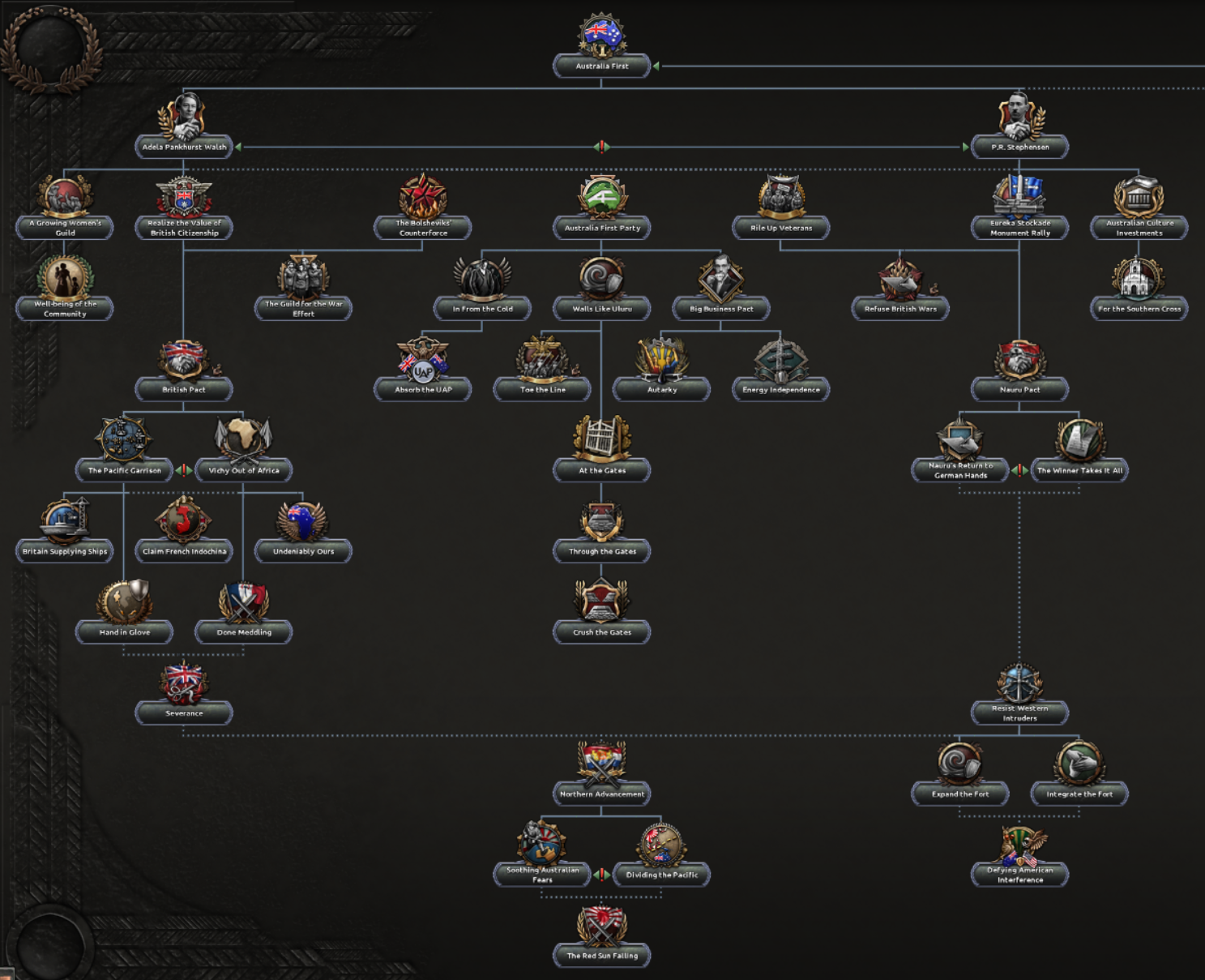
The Movement was formed in 1941, dissolved as early as 1942, and reached a membership count of only 65. Australia First’s fruitlessness and close to non-existent impact on Australian politics, are what makes it the perfect choice for the playable Australian fascist party; since the Movement historically did not hold on long enough to set a course, the imagination of players will do so instead. The most impactful decision will be made already by the second focus; who shall lead Australia First?
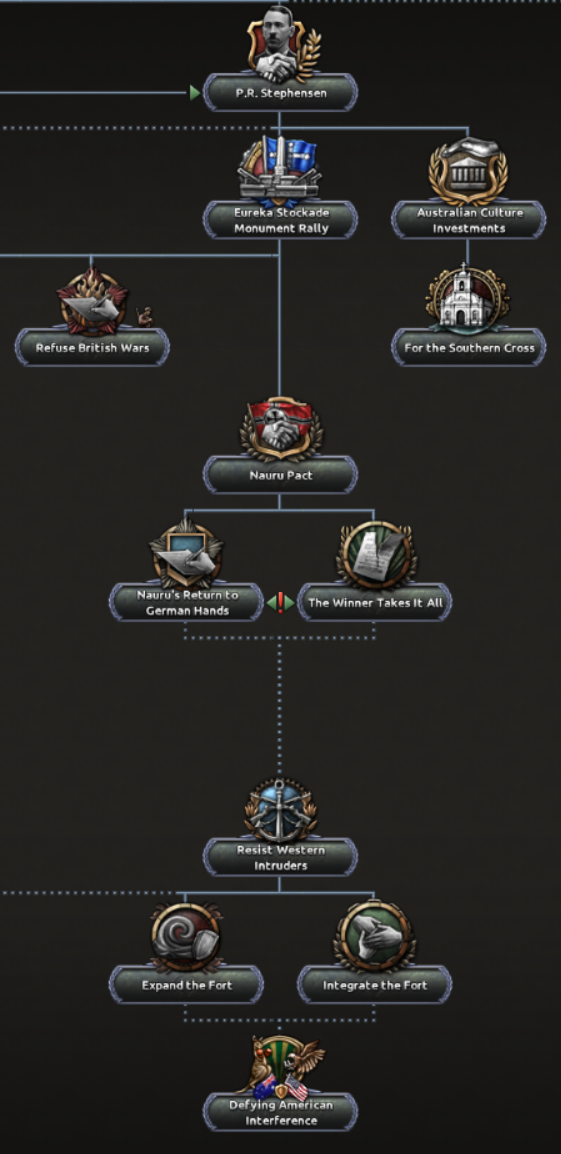
The historical leader of the Australia First Movement was the writer and activist, P.R. Stephensen, whose interest in Australian identity and culture directed him towards nationalism and isolationism. He deemed severance from Britain necessary both to avoid involuntary involvement in British wars, and for the preservation of original Australian culture. Due to this ambition to sustain national identity, his view on Australia’s indigenous population was an odd contradiction to the Movement’s pro-nazi and anti-semitic sentiments. Personally, he funded one of the time’s most prominent Aboriginal rights organisations and supported their struggle for full citizen rights. From Stephenson’s point of view, the indigenous population’s welfare was of great importance in order to protect national identity.
So, applying this all to Hearts of Iron, the choice of playing with Stephensen as fascist leader will lead Australia in a direction that supports his views. With Australia First represented by him, players can rally for immediate independence and the right to refuse British wars, while signing a pact with Germany to collaborate in taking Britain’s Pacific islands. As a result of the Great War, German territories in the Pacific were put under Australian and British control. And so, by promising the return of the small island of Nauru to Germany, players can create a common objective of invading the British held islands of New Zealand and the Solomons. Of course, pacts can always be broken, if Australia ultimately decides they want both.
Stephensen players may also invest in Australian culture to raise citizen support and grow a sense of unity in external territories, eventually making them possible to core if Resistance sinks low enough. And last but not least, the United States of America must be stopped from sticking their nose in Australian matters and their feet on Australian soil; the western Pacific is for Australia to command.
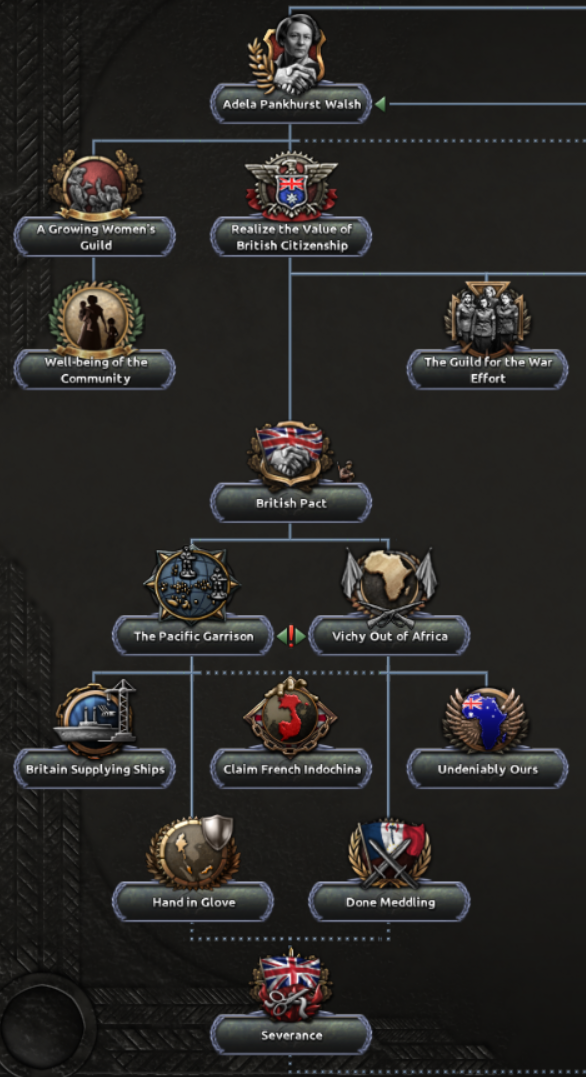
The second option for Australia First leader is Adela Pankhurst Walsh. Present at the Movement’s formal establishment at the Shalimar Café in Sydney, Pankhurst was appointed as organizer. Although her prominent role in the group attests her support of its policies, the ambitions of Australia First would most definitely have looked very different if she herself had designed them.
Being a daughter and sister to the leaders of the British suffragette movement, the woman’s role and place in society had always been a topic of discussion for Pankhurst. After moving to Australia, Pankhurst founded the anti-communist ‘Australian Women’s Guild of Empire’; an organization modelled on and affiliated with its British counterpart, Women’s Guild of Empire. While raising money for working class women and children affected by the Great Depression, the guild advocated for the need of industrial cooperation, a sense of communal responsibility, and continued strong cooperation within the British Commonwealth. Although Pankhurst did share the anti-war and collaborationist sentiments of Australia First and P.R. Stephensen, her background shone a different light upon Australian nationality and British overlordship. With both personal and professional ties to Britain, Pankhurst had experienced how British citizenship could be valuable to Australia, and did not believe that independence was a necessity.
By choosing to play with Pankhurst as leader of Australia First, players will not rush for independence, but rather utilize British cooperation in Australia’s best interest. While being supported by their overlord, players may either increase Australian responsibility and capabilities against aggressors in the Southeast Asian region, or join the British struggle against Vichy France in Africa. Britain will be stretched thin across multiple conflicts and regions, and so although its leaders may not wish to put faith in their newly turned fascist, Australian subject, they have little choice. Ultimately, when Australian influence has grown large and the importance of British support has lessened, Australia will finally become independent; peacefully, or with a final declaration of war, on the United Kingdom itself.
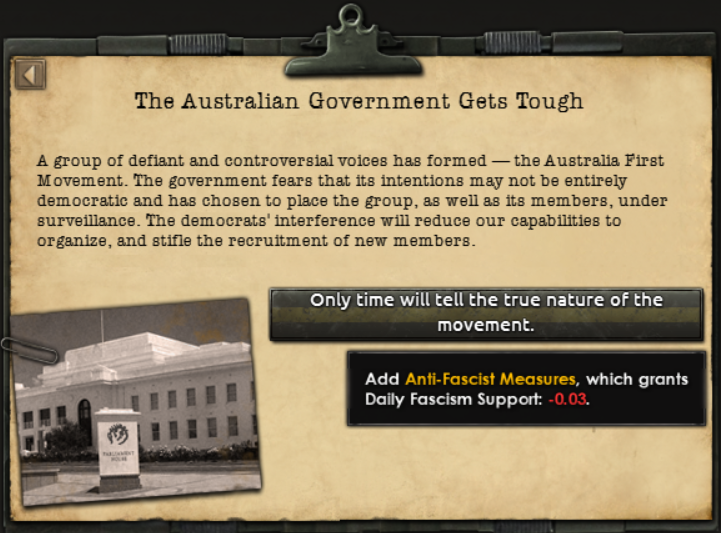
Regardless of whom players choose as leader for the Australia First Movement, they must struggle against the status quo of democratic supremacy. Historically, the Australian government surveilled the movement’s gatherings and activities, which in-game will be represented by heavy resistance in turning Australia fascist.
Only once enough Fascism support has accumulated, players will be able to rid themselves of the ‘Fascism Control’ malus, and gain Popularity much quicker, until it’s time for the grande finale: the Canberra Air Disaster.
We touched upon the Air Disaster and the following ‘Cabinet Trust’ decision system in the previous Dev Diary, but we did not explain how the latter will be the fascist player’s way to promote Australia First to ruling party. By spurring the tumult and political distrust that the Disaster inflicts, players will be able to flip Fascist through a no-confidence motion, rising from the ashes of democratic failures.
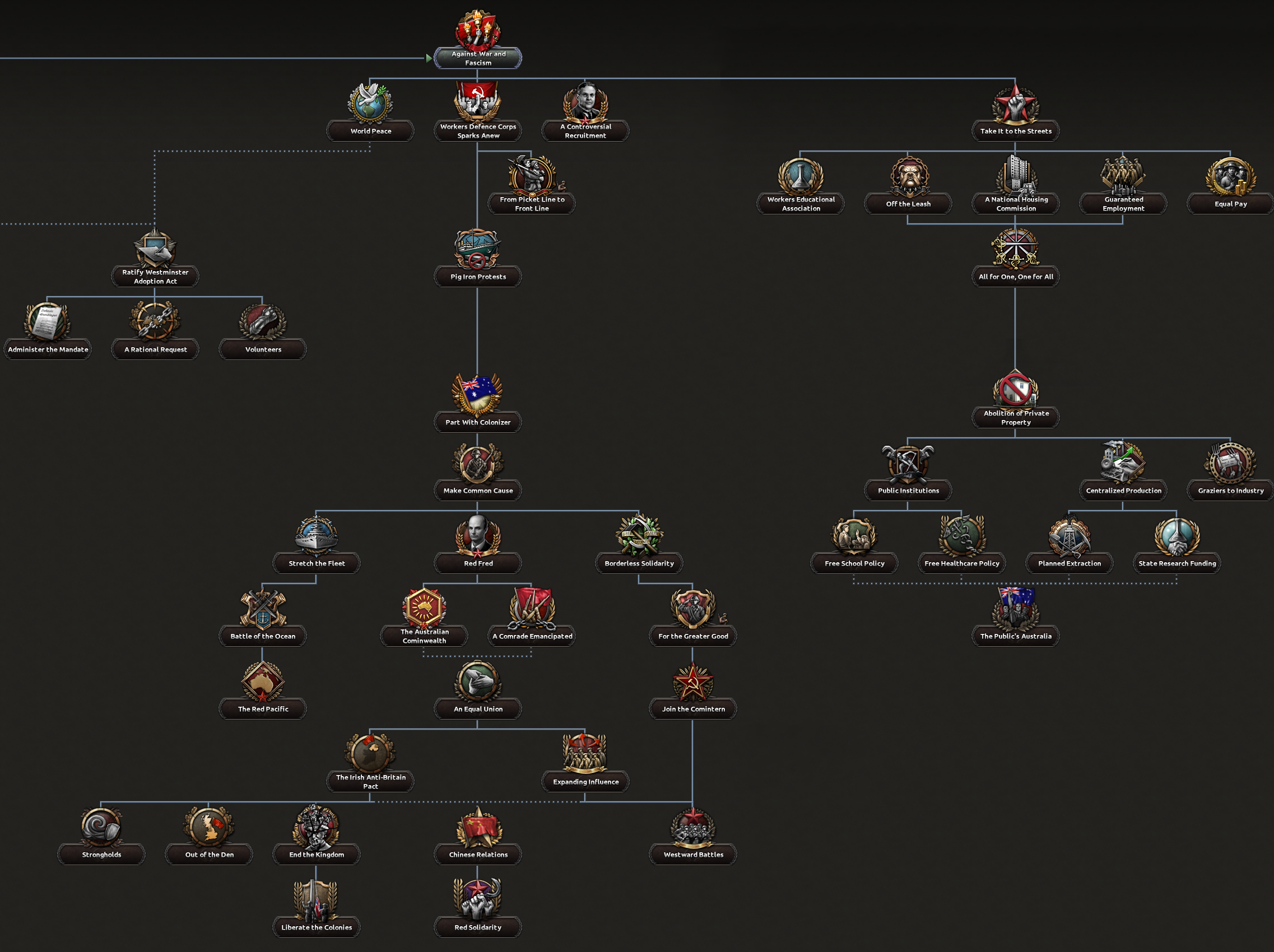
Similarly to the Fascist branch, Communism in Australia begins relatively low-key. At the time, a number of labour organisations were active, particularly among dockworkers, and it is these groups that form the backbone of this path. While more radical communists lacked momentum to enact lasting change, most socialists enjoyed democratic representation enough and rallied behind the Australian Labor Party.
In our scenario, the rise of Communism emerges from these labour movements as they grow increasingly frustrated with the state of the economy. As a result, they develop their own industrial branch, separate from both the Fascist and Democratic paths. You can see this branch on the right-hand side of the Communist tree.
So what provides the spark that changes history? The Dalfram Dispute. Historically, this was a strike called in response to increased iron ore exports to an increasingly belligerent Japan. In our scenario, the strike, combined with mounting economic discontent, spreads rapidly, ultimately leading to the collapse of the government.
Once the Communists seize power, you are faced with a critical choice: do you attempt to hasten the implosion of the British Empire, bringing down what you see as a global bastion of capitalism, or do you instead align with existing Communist powers, seeking mutual protection as you build towards a worker’s utopia?
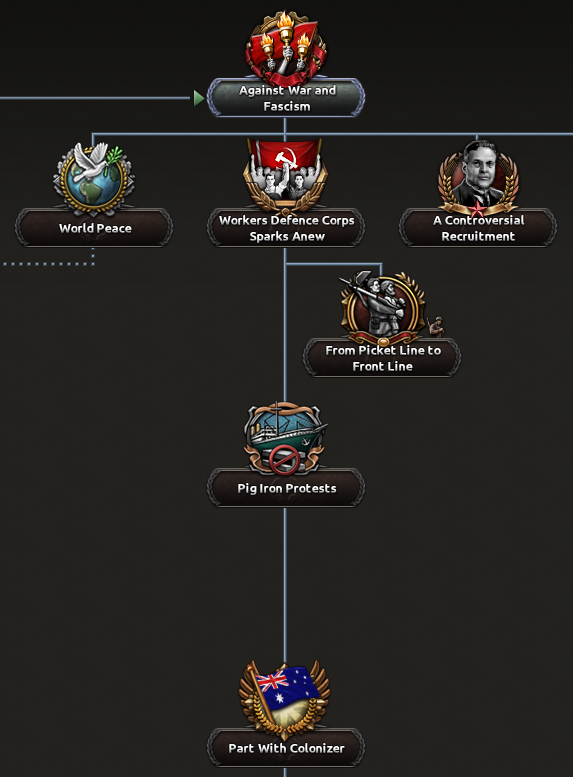
The early stages of this path focus on building your initial power base, laying the foundations for the state you intend to create. These focuses are used in parallel with a Trade Union Infiltration decision system, allowing you to target individual states and boost Communist support in exchange for Political Power and Stability.
However, rapid expansion comes at a cost: the faster your movement grows, the more fragile the nation becomes.
All of this unfolds against the backdrop of former New Guard members, who have become increasingly alarmed, and increasingly aggressive, towards the rising Communist movement. Push them too far, and they will plunge the country into civil war.
This all culminates in the Dalfram Dispute, which creates a vacuum in government, one the waiting Communists are ready to step into.
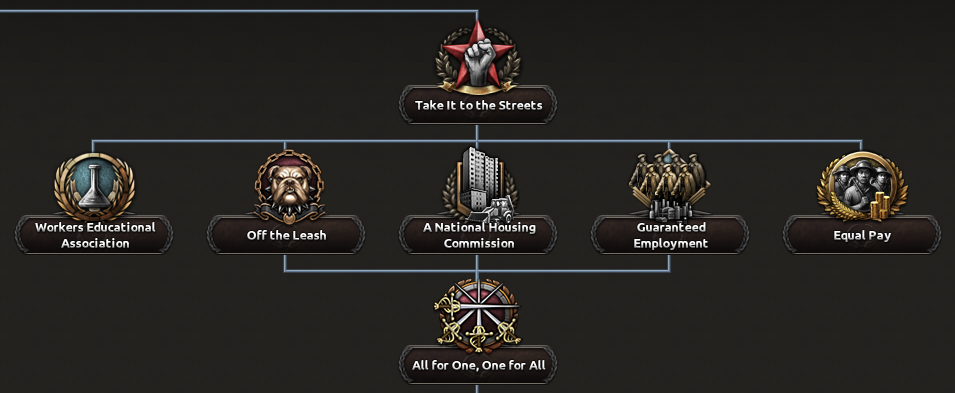
If you enjoy spinning plates, this branch is for you. Alongside your political manoeuvring outlined above, you will be instigating strikes across the country to force through industrial reforms.
Take It to the Streets unlocks a decision to trigger strikes. While a strike is active, you can complete a selection of focuses, each delivering significant economic changes. The strike will only end once a reform has been successfully passed.
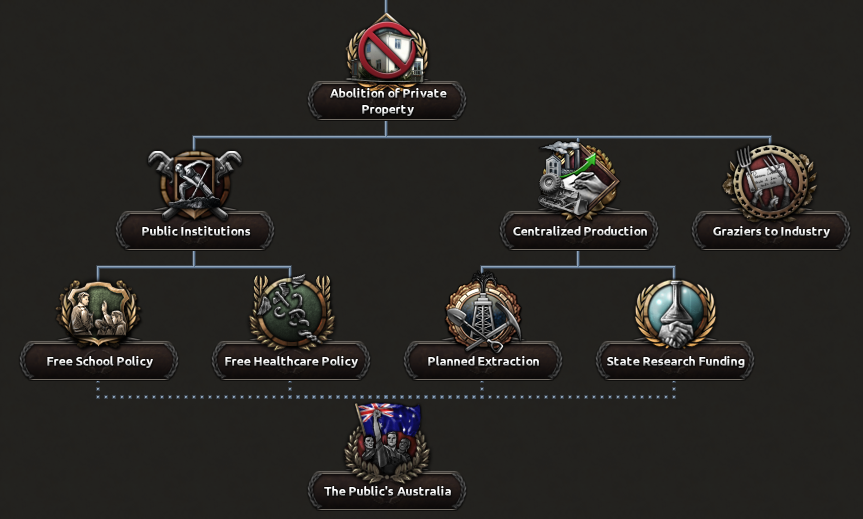
Once both The Dalfram Dispute and All for One, One for All have been completed, the latter half of the branch opens up. At this point, the focus shifts away from worker-led reforms towards a more hardline, centralised Communist state, introducing widespread nationalisation of industry and institutions.
Abolishing Private Property marks a major turning point. Not only does it remove the effects of the Great Depression in Australia (after all, there can be no depression in a worker’s paradise!), it also unlocks the nationalization process.
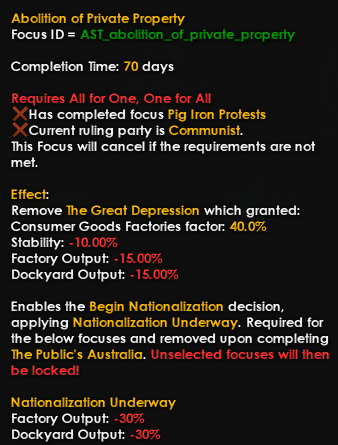
Nationalization is not without consequence. While active, it applies significant penalties as the remaining capitalist forces resist to the bitter end. This process must remain ongoing to access the focuses in this section, and will only conclude once The Public’s Australia is completed.
Unlike the earlier part of the branch, these choices are permanent, any skipped focuses cannot be revisited. You can either fully commit to nationalization for maximum long-term benefit, or push through it quickly to remove the penalties sooner. The balance is yours to strike.
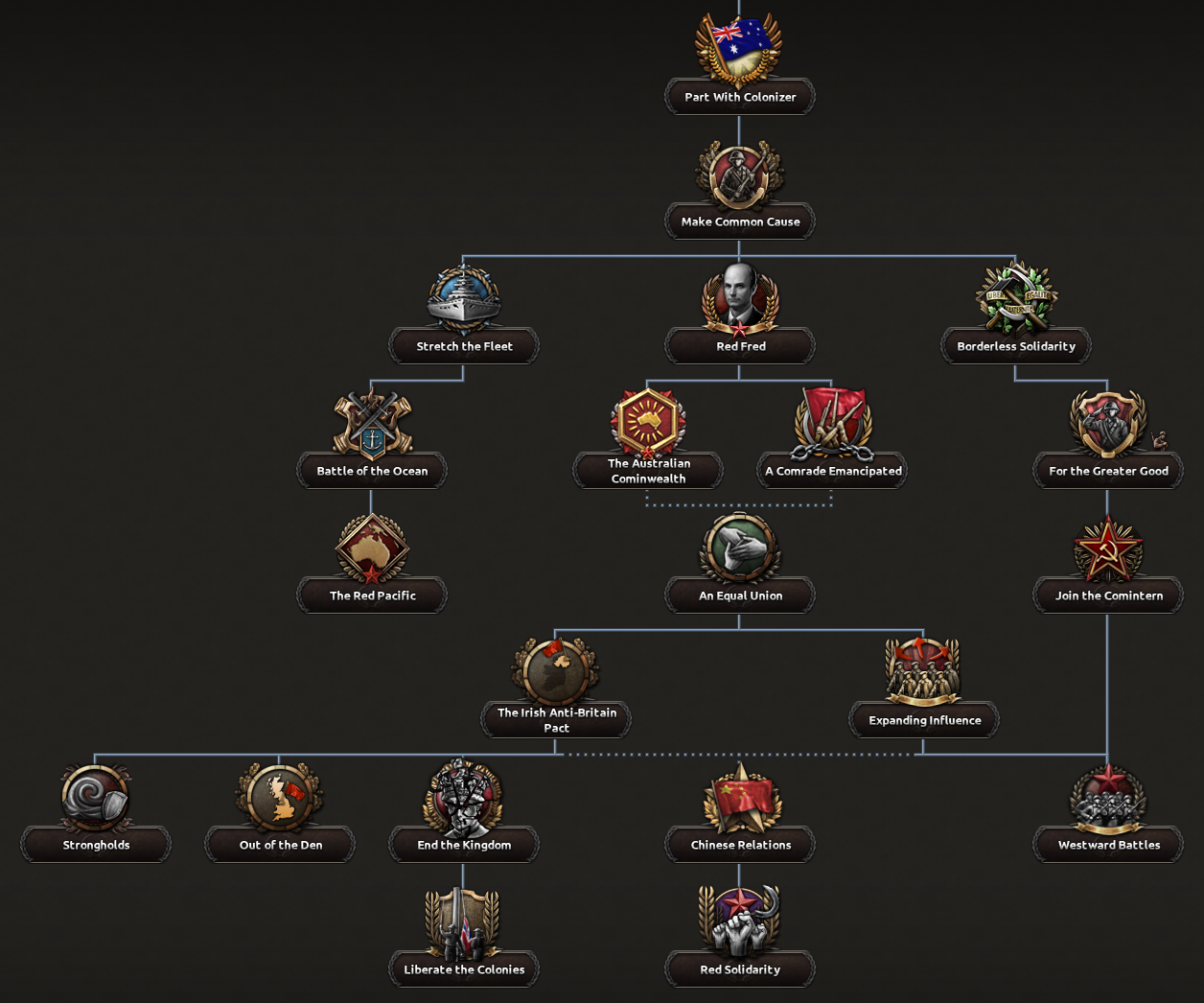
With the Dalfram Dispute resolved, the final section of the political branch becomes available, determining Australia’s place on the world stage. The name of the game here is infiltration. By taking The Australian Cominwealth (no, that’s not a typo!) and A Comrade Emancipated, Australia can work to turn Malaysia, Burma, New Zealand, India, Indonesia, and the Philippines Communist, ultimately bringing them into a new faction: the Cominwealth.
The Irish Anti-British Pact supports sympathetic elements in Ireland, establishing a foothold in the British Isles (launching a naval invasion from Australia otherwise would be… difficult). Alternatively, you can devote additional resources towards building up your own navy and taking the fight directly to Britain.
Australia also has the option of aligning more closely with the Soviet Union, eventually merging its faction with the wider Comintern movement. From this position, you can support Communist movements abroad, bolster China, and aid the Soviets in their war against Germany.
We’ll see you on Friday!
Punchrullar and Mordred Viking are back again to give you the lowdown on the more radical ideologies down under: Fascism and Communism. Australia in this period was a relatively stable democracy, but there were certainly groups who wanted to see the nation take a very different path.
If Australia was so stable, then how do these movements come to power? That’s the question, isn’t it?
Also, to show off all the Australia content, Mordred and Punchrullar will be hosting a live stream this Friday, May 22 at 15:00 CEST.
Let’s get cracking.
Australia First
Fascism
Fascist sentiments in Australia during the later 1930s was no common matter, or at the very least, it wasn’t a mobilized one. By backtracking only to 1933, however, we reach the year when the Centre Party was founded. Springing out of the paramilitary movement the New Guard, the Party adopted ideas of fascism and monarchism, but did not last beyond1935 when it dissolved following unpromising election results.
Even if the New Guard and the Centre Party were impactful fascist actors right before the war years, we’ve chosen another, at first glance, smaller, actor to represent Australian World War II fascism: the Australia First Movement.
The Movement was formed in 1941, dissolved as early as 1942, and reached a membership count of only 65. Australia First’s fruitlessness and close to non-existent impact on Australian politics, are what makes it the perfect choice for the playable Australian fascist party; since the Movement historically did not hold on long enough to set a course, the imagination of players will do so instead. The most impactful decision will be made already by the second focus; who shall lead Australia First?
P.R. Stephensen
The historical leader of the Australia First Movement was the writer and activist, P.R. Stephensen, whose interest in Australian identity and culture directed him towards nationalism and isolationism. He deemed severance from Britain necessary both to avoid involuntary involvement in British wars, and for the preservation of original Australian culture. Due to this ambition to sustain national identity, his view on Australia’s indigenous population was an odd contradiction to the Movement’s pro-nazi and anti-semitic sentiments. Personally, he funded one of the time’s most prominent Aboriginal rights organisations and supported their struggle for full citizen rights. From Stephenson’s point of view, the indigenous population’s welfare was of great importance in order to protect national identity.
So, applying this all to Hearts of Iron, the choice of playing with Stephensen as fascist leader will lead Australia in a direction that supports his views. With Australia First represented by him, players can rally for immediate independence and the right to refuse British wars, while signing a pact with Germany to collaborate in taking Britain’s Pacific islands. As a result of the Great War, German territories in the Pacific were put under Australian and British control. And so, by promising the return of the small island of Nauru to Germany, players can create a common objective of invading the British held islands of New Zealand and the Solomons. Of course, pacts can always be broken, if Australia ultimately decides they want both.
Stephensen players may also invest in Australian culture to raise citizen support and grow a sense of unity in external territories, eventually making them possible to core if Resistance sinks low enough. And last but not least, the United States of America must be stopped from sticking their nose in Australian matters and their feet on Australian soil; the western Pacific is for Australia to command.
Adela Pankhurst Walsh
The second option for Australia First leader is Adela Pankhurst Walsh. Present at the Movement’s formal establishment at the Shalimar Café in Sydney, Pankhurst was appointed as organizer. Although her prominent role in the group attests her support of its policies, the ambitions of Australia First would most definitely have looked very different if she herself had designed them.
Being a daughter and sister to the leaders of the British suffragette movement, the woman’s role and place in society had always been a topic of discussion for Pankhurst. After moving to Australia, Pankhurst founded the anti-communist ‘Australian Women’s Guild of Empire’; an organization modelled on and affiliated with its British counterpart, Women’s Guild of Empire. While raising money for working class women and children affected by the Great Depression, the guild advocated for the need of industrial cooperation, a sense of communal responsibility, and continued strong cooperation within the British Commonwealth. Although Pankhurst did share the anti-war and collaborationist sentiments of Australia First and P.R. Stephensen, her background shone a different light upon Australian nationality and British overlordship. With both personal and professional ties to Britain, Pankhurst had experienced how British citizenship could be valuable to Australia, and did not believe that independence was a necessity.
By choosing to play with Pankhurst as leader of Australia First, players will not rush for independence, but rather utilize British cooperation in Australia’s best interest. While being supported by their overlord, players may either increase Australian responsibility and capabilities against aggressors in the Southeast Asian region, or join the British struggle against Vichy France in Africa. Britain will be stretched thin across multiple conflicts and regions, and so although its leaders may not wish to put faith in their newly turned fascist, Australian subject, they have little choice. Ultimately, when Australian influence has grown large and the importance of British support has lessened, Australia will finally become independent; peacefully, or with a final declaration of war, on the United Kingdom itself.
From the Ruins They Rise
Regardless of whom players choose as leader for the Australia First Movement, they must struggle against the status quo of democratic supremacy. Historically, the Australian government surveilled the movement’s gatherings and activities, which in-game will be represented by heavy resistance in turning Australia fascist.
Only once enough Fascism support has accumulated, players will be able to rid themselves of the ‘Fascism Control’ malus, and gain Popularity much quicker, until it’s time for the grande finale: the Canberra Air Disaster.
We touched upon the Air Disaster and the following ‘Cabinet Trust’ decision system in the previous Dev Diary, but we did not explain how the latter will be the fascist player’s way to promote Australia First to ruling party. By spurring the tumult and political distrust that the Disaster inflicts, players will be able to flip Fascist through a no-confidence motion, rising from the ashes of democratic failures.
Against War and Fascism
Communism
Similarly to the Fascist branch, Communism in Australia begins relatively low-key. At the time, a number of labour organisations were active, particularly among dockworkers, and it is these groups that form the backbone of this path. While more radical communists lacked momentum to enact lasting change, most socialists enjoyed democratic representation enough and rallied behind the Australian Labor Party.
In our scenario, the rise of Communism emerges from these labour movements as they grow increasingly frustrated with the state of the economy. As a result, they develop their own industrial branch, separate from both the Fascist and Democratic paths. You can see this branch on the right-hand side of the Communist tree.
So what provides the spark that changes history? The Dalfram Dispute. Historically, this was a strike called in response to increased iron ore exports to an increasingly belligerent Japan. In our scenario, the strike, combined with mounting economic discontent, spreads rapidly, ultimately leading to the collapse of the government.
Once the Communists seize power, you are faced with a critical choice: do you attempt to hasten the implosion of the British Empire, bringing down what you see as a global bastion of capitalism, or do you instead align with existing Communist powers, seeking mutual protection as you build towards a worker’s utopia?
The Rise to Power
The early stages of this path focus on building your initial power base, laying the foundations for the state you intend to create. These focuses are used in parallel with a Trade Union Infiltration decision system, allowing you to target individual states and boost Communist support in exchange for Political Power and Stability.
However, rapid expansion comes at a cost: the faster your movement grows, the more fragile the nation becomes.
All of this unfolds against the backdrop of former New Guard members, who have become increasingly alarmed, and increasingly aggressive, towards the rising Communist movement. Push them too far, and they will plunge the country into civil war.
This all culminates in the Dalfram Dispute, which creates a vacuum in government, one the waiting Communists are ready to step into.
From Strikes to Nationalization
If you enjoy spinning plates, this branch is for you. Alongside your political manoeuvring outlined above, you will be instigating strikes across the country to force through industrial reforms.
Take It to the Streets unlocks a decision to trigger strikes. While a strike is active, you can complete a selection of focuses, each delivering significant economic changes. The strike will only end once a reform has been successfully passed.
Once both The Dalfram Dispute and All for One, One for All have been completed, the latter half of the branch opens up. At this point, the focus shifts away from worker-led reforms towards a more hardline, centralised Communist state, introducing widespread nationalisation of industry and institutions.
Abolishing Private Property marks a major turning point. Not only does it remove the effects of the Great Depression in Australia (after all, there can be no depression in a worker’s paradise!), it also unlocks the nationalization process.
Nationalization is not without consequence. While active, it applies significant penalties as the remaining capitalist forces resist to the bitter end. This process must remain ongoing to access the focuses in this section, and will only conclude once The Public’s Australia is completed.
Unlike the earlier part of the branch, these choices are permanent, any skipped focuses cannot be revisited. You can either fully commit to nationalization for maximum long-term benefit, or push through it quickly to remove the penalties sooner. The balance is yours to strike.
Communist At Last!
With the Dalfram Dispute resolved, the final section of the political branch becomes available, determining Australia’s place on the world stage. The name of the game here is infiltration. By taking The Australian Cominwealth (no, that’s not a typo!) and A Comrade Emancipated, Australia can work to turn Malaysia, Burma, New Zealand, India, Indonesia, and the Philippines Communist, ultimately bringing them into a new faction: the Cominwealth.
The Irish Anti-British Pact supports sympathetic elements in Ireland, establishing a foothold in the British Isles (launching a naval invasion from Australia otherwise would be… difficult). Alternatively, you can devote additional resources towards building up your own navy and taking the fight directly to Britain.
Australia also has the option of aligning more closely with the Soviet Union, eventually merging its faction with the wider Comintern movement. From this position, you can support Communist movements abroad, bolster China, and aid the Soviets in their war against Germany.
That's your lot for this one, guys!
Cheers for reading along, if you’ve got any questions chuck them in the comments below, and we’ll take a look. If not, no worries! We’ll see you on Friday!
你覺得這篇文章如何?








XINKER - Business and Income Tips
Explore XINKER, the ultimate platform for mastering business strategies, discovering passive income opportunities, and learning success principles. Join a community of thinkers dedicated to achieving financial freedom and entrepreneurial excellence.