
![[PRO Tips] Gold’s Bullish Revival: Seasonal Trends and Key Levels to Watch](https://xinker.org/uploads/images/202412/image_430x256_67724cc6ad0cd.webp)
![[PRO Tips] Gold Market Under Short-Term Pressure, Safe-Haven Demand and Central Bank Buying Support Long-Term Upside Potential](https://xinker.org/uploads/images/202412/image_430x256_676ffb4685287.webp)
![[PRO Tips] Analysis of 9 key points of differentiation strategy! Master differentiation to create a brand advantage that is unique in the world!](https://firebasestorage.googleapis.com/v0/b/xinker-tips.appspot.com/o/article_thumbnails%2Fscaled_differentiation%20strategy.png.png?alt=media&token=a1bfc3d2-e85a-4db7-8a6d-01c7274f8940)
![[PRO Tips] Will REITs regain growth momentum in 2024? 3 REITs ETFs you must know if you want to invest in real estate.](https://firebasestorage.googleapis.com/v0/b/xinker-tips.appspot.com/o/article_thumbnails%2Fscaled_REITs1.png.png?alt=media&token=8af4eb93-33ff-466f-8039-b6555fad52b4)
![[PRO Tips] Complete tutorial on how to make money in Adobe Stock!](https://firebasestorage.googleapis.com/v0/b/xinker-tips.appspot.com/o/article_thumbnails%2Fscaled_tut-adobe1.png.png?alt=media&token=0b2c8cf2-22bd-4142-883e-140ed1cbaf02)
![[Passive Income] Unlock the secret of passive income: 3 steps to apply for Google AdSense](https://xinker.org/uploads/images/202410/image_430x256_6717a4fb3052b.webp)
![[Passive Income] Earn over $200 a day with AI-generated articles!](https://firebasestorage.googleapis.com/v0/b/xinker-tips.appspot.com/o/article_thumbnails%2Fscaled_article1.png.png?alt=media&token=f61bf35b-8553-4719-826d-7360024adc70)
![[Passive Income] Earn over 20 USD per download with AI-generated images!](https://firebasestorage.googleapis.com/v0/b/xinker-tips.appspot.com/o/article_thumbnails%2Fscaled_adobe2.png.png?alt=media&token=3e20e76a-a907-45af-80aa-bf9b3600301f)
![[Passive Income] Earn 10 USD per new download by sharing CapCut!](https://firebasestorage.googleapis.com/v0/b/xinker-tips.appspot.com/o/article_thumbnails%2Fscaled_capcut2.png.png?alt=media&token=a04dec40-1fac-4857-86f2-19a8be02d38e)
![[Passive Income] Use your WiFi to create passive income in 5 minutes, and you can earn 4-6 U per day!](https://firebasestorage.googleapis.com/v0/b/xinker-tips.appspot.com/o/article_thumbnails%2Fscaled_Grassio.webp.png?alt=media&token=7659a95e-0e47-4f27-a17d-c942ac3cf7f4)


![[Business Talk] The Unique Theme of XINKER's Song: Beef Wellington and Business Mastery](https://xinker.org/uploads/images/202410/image_430x256_671afc155f47f.webp)
![[Business Talk] Chagee: Opening 3,500 stores in 6 years](https://xinker.org/uploads/images/202410/image_430x256_671afce80c5f9.webp)

Brazil’s game ambitions face a big hurdle: funding | interview
With 154,000 attendees, Gamescom Latam 2026 was a big success, with an audience up 17% over a year earlier. In my third visit to the big show in Sao Paulo, Brazil, since Gamescom took over the BIG Festival in 2024, it was clear that the Brazilian game industry was growing. The country has started embracing games, first by legally recognizing the industry a few years ago as a distinct industry, separate from gambling and other industries. The Brazilian government has also started an accelerator that provides seed funding for game studios. And it has enacted a new law to protect kids in multiplayer games and social media. And, of course, Brazilian game fans and creators are among the most enthusiastic video game fans in the world. There’s a clear path up the food chain in Brazil. Game developers teach themselves how to make games or go to universities to learn game development. They start out doing work for hire, and then they start working on their own intellectual property — often highlighting Brazilian culture in some way with the hope that the content will be universally appealing. Sportia highlights sports and Brazilian culture. Source: GamesBeat/Dean Takahashi Game studios are plentiful and passionate — there were 38 games in the Abragames booth this year — and the country and region itself are a model of “stability” these days, something the rest of the world is lacking in a very big way. But there’s one thing that’s missing: funding for game studios. I spoke with Patricia Sato, executive manager at Brazil Games, a nonprofit industry development group, and Rodrigo Terra, president of Abragames, the Brazilian game developers association. We discussed the progress and challenges the Brazilian game industry faces as it moves up the food chain of gaming. Here’s an edited transcript of our interview. Rodrigo Terra of Abragames and Patricia Sato of Brazil Games. Source: GamesBeat/Dean Takahashi GamesBeat: Did you have any news that you talked about here at the show? Patricia Sato: The latest news we have this year for the Gamescom event is we have the biggest ever booth in terms of games exposed. I saw you there. We have 14 games from the members exhibiting, and then 24 more from the accelerator. It’s the biggest exhibition we’ve ever done for our games. We’ve never had so many games in one exhibit. I’m super excited for this weekend. It’s nice to see that we have this new wave of Brazilian games coming out very soon. We talked a bit about this at GDC as well. I’m glad to see we have a lot of new, fresh content inspired by our culture being exposed here on the stage. My talk yesterday was about the beginning of the first panel, DNA Brazil. A bit about games with Brazilian culture, talking about myth and memory and the culture that came before us. Today we have the reverse of that panel, about our culture and day to day life today, urban style. New visions and innovations we have in Brazil. I’m glad to see that this is trending. I’m very proud of the keynote. GamesBeat: Is there a pattern among the games you see at the exhibition? Are they all very focused on Brazilian culture, or aiming at a global audience, or other themes? Sato: We have a mix of both. We have games that are pure fantasy. We have games that have Brazilian thematics. We have games that talk about global thematics from a Brazilian perspective. But what I’m most glad to see is that we have a lot of originality. We have games that are very different. We have games working with different kinds of technology, different innovations. I’m glad to see that our studios are able to showcase a lot of their original ideas. Our booth is packed. Taigo Prudente of Salvador, Brazil, is making a real-time strategy game called Black Sailors. Source: GamesBeat/Dean Takahashi What I see a lot is we’ve begun to be approached by investors who want to know more about the games in the accelerator. That’s new. We have more people coming in and asking us what’s happening. Maybe they want to pitch in. Maybe they want to get involved in mentorship to get a first look at games in advance. We all thought this would happen eventually, but I’m glad to see it working. Rodrigo Terra: At Abragames we’re doing more for the studios here this year. We don’t just have one or two stations. The accelerator program is going full steam ahead. During the event we’re able to showcase the initial projects the studios have been working on during the program. We had a cross-team boot camp before the event, to prepare the studios for their meetings. Giving them recommendations for when they’re face to face with buyers. We’re doing this for the second year in a row. Buyers and publishers asked us to do it, because we got very positive feedback last year. This year, 2026, I don’t want to call it a pivotal moment, but it’s a moment where we’re expanding all of our programs for studios here. Of course the showcases are important, the access to an international event. We have our booths at GD

With 154,000 attendees, Gamescom Latam 2026 was a big success, with an audience up 17% over a year earlier.
In my third visit to the big show in Sao Paulo, Brazil, since Gamescom took over the BIG Festival in 2024, it was clear that the Brazilian game industry was growing.
The country has started embracing games, first by legally recognizing the industry a few years ago as a distinct industry, separate from gambling and other industries. The Brazilian government has also started an accelerator that provides seed funding for game studios. And it has enacted a new law to protect kids in multiplayer games and social media. And, of course, Brazilian game fans and creators are among the most enthusiastic video game fans in the world.
There’s a clear path up the food chain in Brazil. Game developers teach themselves how to make games or go to universities to learn game development. They start out doing work for hire, and then they start working on their own intellectual property — often highlighting Brazilian culture in some way with the hope that the content will be universally appealing.
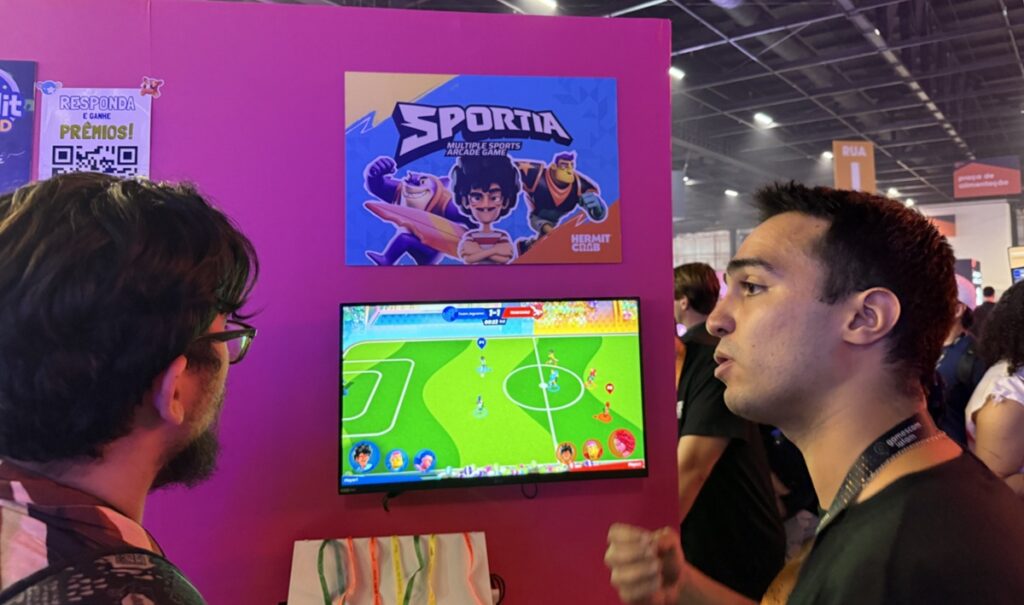 Sportia highlights sports and Brazilian culture. Source: GamesBeat/Dean Takahashi Game studios are plentiful and passionate — there were 38 games in the Abragames booth this year — and the country and region itself are a model of “stability” these days, something the rest of the world is lacking in a very big way.
But there’s one thing that’s missing: funding for game studios.
I spoke with Patricia Sato, executive manager at Brazil Games, a nonprofit industry development group, and Rodrigo Terra, president of Abragames, the Brazilian game developers association. We discussed the progress and challenges the Brazilian game industry faces as it moves up the food chain of gaming.
Here’s an edited transcript of our interview.
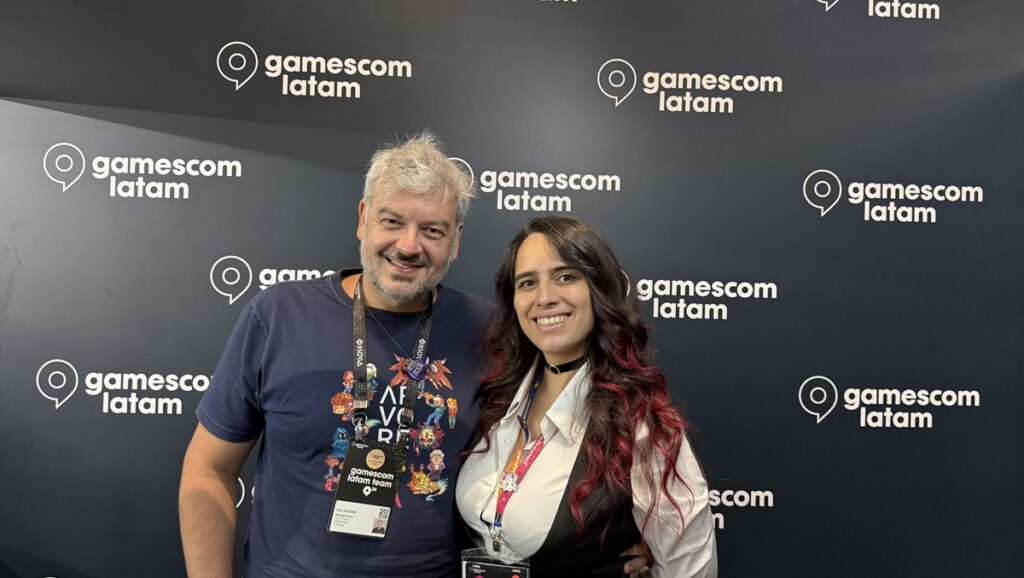 Rodrigo Terra of Abragames and Patricia Sato of Brazil Games. Source: GamesBeat/Dean Takahashi GamesBeat: Did you have any news that you talked about here at the show?
Patricia Sato: The latest news we have this year for the Gamescom event is we have the biggest ever booth in terms of games exposed. I saw you there. We have 14 games from the members exhibiting, and then 24 more from the accelerator. It’s the biggest exhibition we’ve ever done for our games. We’ve never had so many games in one exhibit. I’m super excited for this weekend. It’s nice to see that we have this new wave of Brazilian games coming out very soon.
We talked a bit about this at GDC as well. I’m glad to see we have a lot of new, fresh content inspired by our culture being exposed here on the stage. My talk yesterday was about the beginning of the first panel, DNA Brazil. A bit about games with Brazilian culture, talking about myth and memory and the culture that came before us. Today we have the reverse of that panel, about our culture and day to day life today, urban style. New visions and innovations we have in Brazil. I’m glad to see that this is trending. I’m very proud of the keynote.
GamesBeat: Is there a pattern among the games you see at the exhibition? Are they all very focused on Brazilian culture, or aiming at a global audience, or other themes?
Sato: We have a mix of both. We have games that are pure fantasy. We have games that have Brazilian thematics. We have games that talk about global thematics from a Brazilian perspective. But what I’m most glad to see is that we have a lot of originality. We have games that are very different. We have games working with different kinds of technology, different innovations. I’m glad to see that our studios are able to showcase a lot of their original ideas. Our booth is packed.
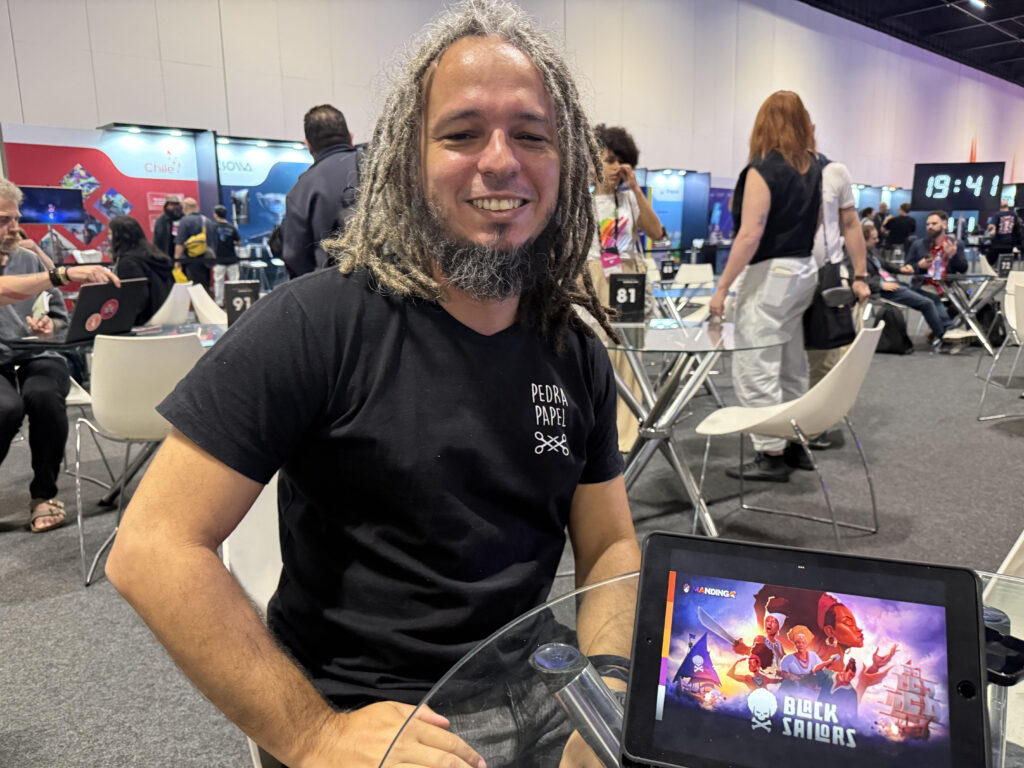 Taigo Prudente of Salvador, Brazil, is making a real-time strategy game called Black Sailors. Source: GamesBeat/Dean Takahashi What I see a lot is we’ve begun to be approached by investors who want to know more about the games in the accelerator. That’s new. We have more people coming in and asking us what’s happening. Maybe they want to pitch in. Maybe they want to get involved in mentorship to get a first look at games in advance. We all thought this would happen eventually, but I’m glad to see it working.
Rodrigo Terra: At Abragames we’re doing more for the studios here this year. We don’t just have one or two stations. The accelerator program is going full steam ahead. During the event we’re able to showcase the initial projects the studios have been working on during the program. We had a cross-team boot camp before the event, to prepare the studios for their meetings. Giving them recommendations for when they’re face to face with buyers. We’re doing this for the second year in a row. Buyers and publishers asked us to do it, because we got very positive feedback last year.
This year, 2026, I don’t want to call it a pivotal moment, but it’s a moment where we’re expanding all of our programs for studios here. Of course the showcases are important, the access to an international event. We have our booths at GDC and TGS and Gamescom in Cologne. That’s all part of the strategy for us. But now we understand that we can do more. We planned last year and two years ago to prepare the studios more, to make them understand that they don’t just need to work on their projects. They need to work on their companies as well. We identified the gaps, where we need to help them attack to start growing more sustainably and becoming recognized internationally. Of course they’re doing great games now. They’re putting new ideas out into the market. But how will they make their companies compeitive enough, after launching their first or second or third game?
We’ve been defining that for two years now. Since last year, we plan to have all these actions this year. This is the moment where we’re now putting all of them together. Piloting and testing and checking out if it resonates with the publishers and the ecosystem.
GamesBeat: How many applications came in for the accelerators?
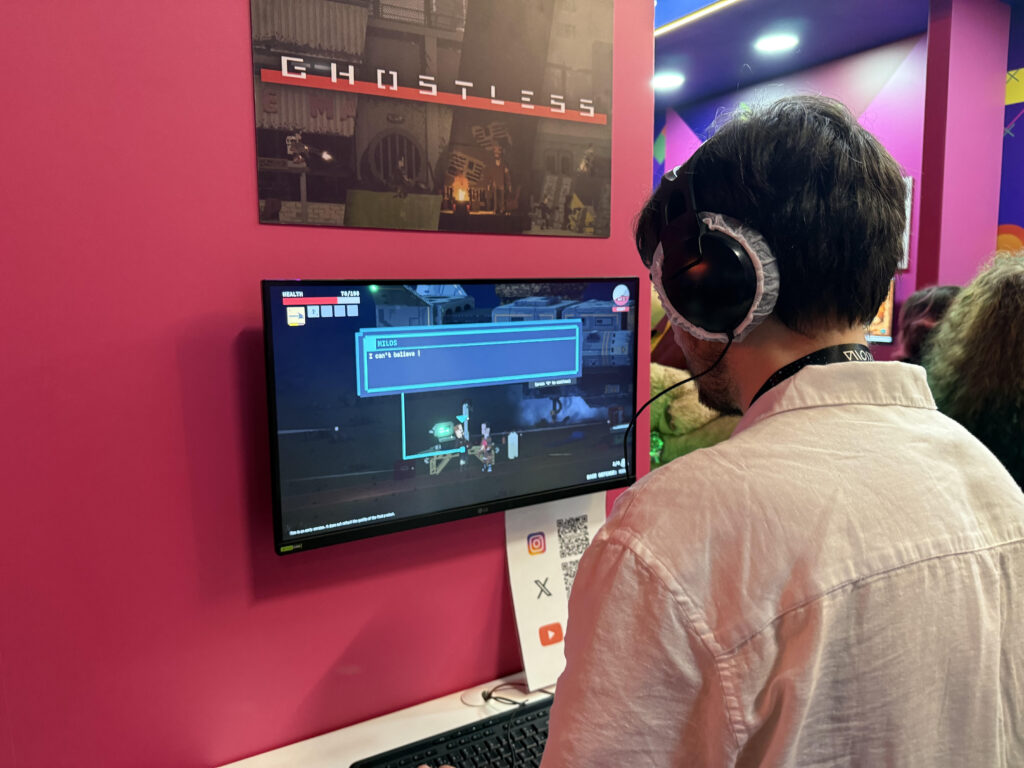 Ghostless is an upcoming ‘hi-fi 3D pixel art’ post-apocalyptic survival action colony sim. Source: GamesBeat/Dean Takahashi Sato: More than 150. We expected about 100. It was kind of funny. We expected to receive fewer applications. We thought that as long as we had more than the number of slots we had available, it was fine. Then we reached 80 and we thought, “It’s okay. We have double the number we can select. That’s fine.” Then the last weekend before the application period ended, we jumped to more than 150. It was so funny. I remember when the coordinator called me. “They’re flooding our inbox! What do I do?” We got a great selection of studios. A lot of talent. A lot of very different games, very different ideas. It’s great for what we’re trying to do.
The game industry is changing a lot all the time. Both of us, we’re always trying to reinvent and reimagine our program. Trying to keep up with the pace of the industry. A lot of what we did this year, trying to prepare for Gamescom Latam–the external development executive boot camp, that was the full name of what we put on. It was like a summit. We called it a boot camp because it sounds more fun. But it was more like a summit. We realized that external development is huge. We have lots of companies that make this their primary focus and objective. Now we have data inside the program showing that revenue, between studios working on their own IP and working on external development, is very well-balanced. That means we need to focus more on the external development segment. That’s why we created the summit. It was very positive.
GamesBeat: I’m curious about the legal climate here too. In the United States, Roblox is getting sued a lot over child safety problems. There’s some talk of more regulation. Matthew Ball, in his slide deck, pointed out that the addiction industries are all growing faster, and they’re very close to games, adjacent to games. Games are more fun, less about addiction, but if they lean that way, then they could end up in trouble. Turkey recently passed laws around child safety in games. People there are concerned that the government is interested in censorship. What do you feel about the kind of laws that are being passed? Is there a good version of this kind of law or a bad version that you have to be concerned about, or advise the government around?
Terra: We’ve been working with Congress for two years around this law. It’s a broader law than just child safety for games. It’s different from Turkey or other initiatives in other countries, where they focus explicitly on video games, or certain types of games. What’s happening here is broader than that. It’s not just games. Games is like two articles in a small chapter of a broader law about child safety in online environments. Games, online games, live service games, games that use voice and text chat and so on, they kind of fit into this concept of an online environment.
It’s similar to what’s happening in the European Union right now, and also close to what’s happening in South Korea. Age verification for everything that’s 18+. The systems that are being planned here, that would be enforced by the law, are close to what they have now in South Korea. They’re thinking about public solutions as well. The thing is, games are different. We worked for two years to not be exactly like that. We believe that these articles should be inside a video games legal framework, not a different law. We want to legislate everything inside a single vertical, not spreading things across legislation.
Of course this was needed here in the country. Society needed an answer. We want kids to have a safe environment. Roblox doesn’t receive too much attention here. But the law now is stronger than in the west. They’ll need to adapt right away if they want to operate.
GamesBeat: Using age estimation, things like that?
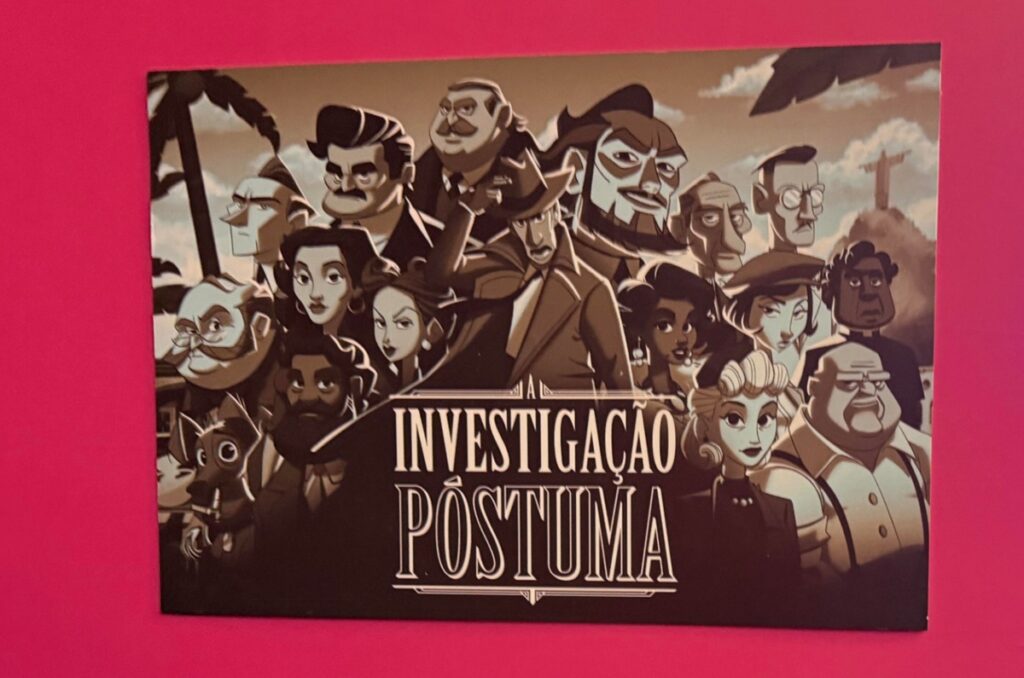 Investigacao Postuma is a point-and-click detective mystery game. Source: GamesBeat/Dean Takahashi
Terra: Not just age estimation. They’ll have to decide whether or not to close the voice and text chat. There’s another legislation that’s cooking, like in the European Union, for social media regulation. Similar to what we’ve seen in Australia and Spain. That conversation is happening here as well. Our role is to guarantee that games are not treated like social media. We need to make that statement. Games are another thing. Games can be addictive if handled wrong, but what kind of addiction are we talking about? Gambling addiction? That’s where lines get crossed and we try to separate things. Loot boxes are forbidden now for players who are under 18. What’s next? You have to follow the rules now. If you have loot boxes kids and teenagers can’t play your game. It’s as simple as that.
It’s a global movement. As a country we can’t just stand outside the conversation. Our role here is to try to make the government understand that these things are separate. It’s not all the same basket. You need to have separate conversations. This takes time. It takes time to mature and understand. Social media is one thing. Gambling is another thing. Video games, chats and so on, that’s another thing. We need to treat these things separately, not create legislation that’s super broad and open to too many interpretations.
GamesBeat: Is most of your work here advisory, or are there any specific campaigns you’ve worked on?
Terra: For now it’s advisory. We’re not doing a stronger campaign, not right now. We’re in the middle of the process of regulation, the children’s safety law. We’re not trying to go against anything. What we want is, when we’re regulating anything, putting out the new articles that create the rules for the system, these rules can be transparent enough to not create any doubt about what anyone needs to do. My company, Roblox, Discord, whoever, we need to know the path. Developers as well. If I have a game that has in-app purchases and now in-app purchases are only for players 16 and up, we need to have a clear process. If the government tells the platforms that your game needs to be re-classified, you need to know why. We need a process for that.
That’s why we’ve tried to advise and make them understand. If you don’t know too much about games, you need to talk to the video game sector to understand more. You need to listen to what society wants, for sure, but you need to listen to the sector as well. This dialogue, we’ve established it pretty well.
GamesBeat: What is stability like in the Latin American region? It looks pretty good compared to North America and some other places in the world. I’d guess that job creation is continuing here. North America is losing high-paying jobs that are spreading out to the rest of the world.
Terra: I always joke, but it’s not exactly a joke. We’re used to being poor. I say that in a positive way. The challenges North America is facing are inflation, job losses, and so on. Latin America has lived that for 40 or 50 years. It’s been a roller coaster for 40, 50, 60 years. We’re used to it. We created mechanisms as a society to answer that. Instability was a part of our way of life. I’m not saying that’s good. But we needed to create mechanisms that let us roll with that.
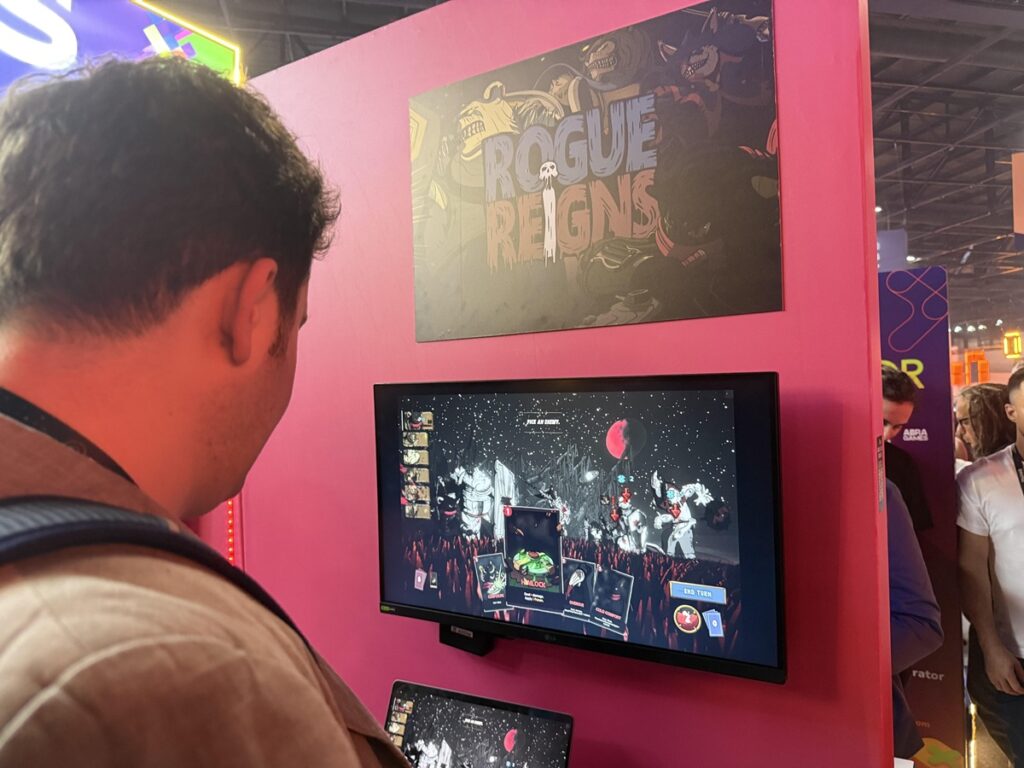 Rogue Reigns is a roguelike card battle game. Source: GamesBeat/Dean Takahashi Now you look at it and it seems to be more stable because it is. Definitely it is. We’re resilient enough to understand the changes in the world, how they come about. We’re used to these changes internally. Now the rest of the world is facing that. Europe is facing that. We can maybe offer some advice to the rest of the world. It’s not the end of the world. You just need to change how you do things, how you adapt. You need to be creative in how you do things with less money. You’re not going to make a triple-A game with $500 million anymore. It’s not going to pay off. So what are you going to do? We make games for a fraction of that, good games. We’re growing a sustainable industry doing more with less. It’s possible.
When you look down past the equator, you can see that we’re growing. This is the new hot spot of the world. But it’s because of our hard work. We know how to face the adversities that North America and Europe are facing now.
Sato: We don’t just have resilience, but we have our cameraderie with each other. Anywhere we go, we always hear from other delegations. “Why are the Brazilians so united?” That’s the thing. For our delegation, for our country, this was never a question. We’re all in this together. You don’t find Brazilian studios fighting among themselves for a space that everyone can occupy. You find a lot of studios cooperating. That’s something we want to show with the accelerator and everything else we do in our programs and our games. We’re not here to build careers, just bridges.
Terra: Of course you find one or two studios that fight each other, just like every ecosystem around the world. But we always foster the feeling that this is a community. You can compete. Of course you can compete. But let’s create an environment where we can work together.
GamesBeat: It reminds me of Finland, where they have the biggest IGDA chapter in the world. They all help each other out because they know they’re not fighting for the Finnish market. They’re working for the global market.
Terra: Exactly. Finland is a smaller country, but the benchmark is there. It’s possible. We need to do that with a thousand more studios, but that’s our challenge. It can work. It worked for them and it can work here.
GamesBeat: What more do you need for your industry here? What’s the next step in your ambitions for the country?
Terra: Funding. We need funding. This is the hardest moment. The setup is done. We’re maturing. As Abragames and Brazil Games, we’ve been here for a decade. We’ve helped studios to grow and start shining. Now, if you’re PlayStation or Nintendo or Xbox, it’s the moment to look further than the North American market. Also, funding coming from the government here – public funds and grants – like in Canada and Europe, public funding is a big part of it. And the third thing is the Brazilian ecosystem understanding that video games in Brazil is a sustainable and potentially profitable market.
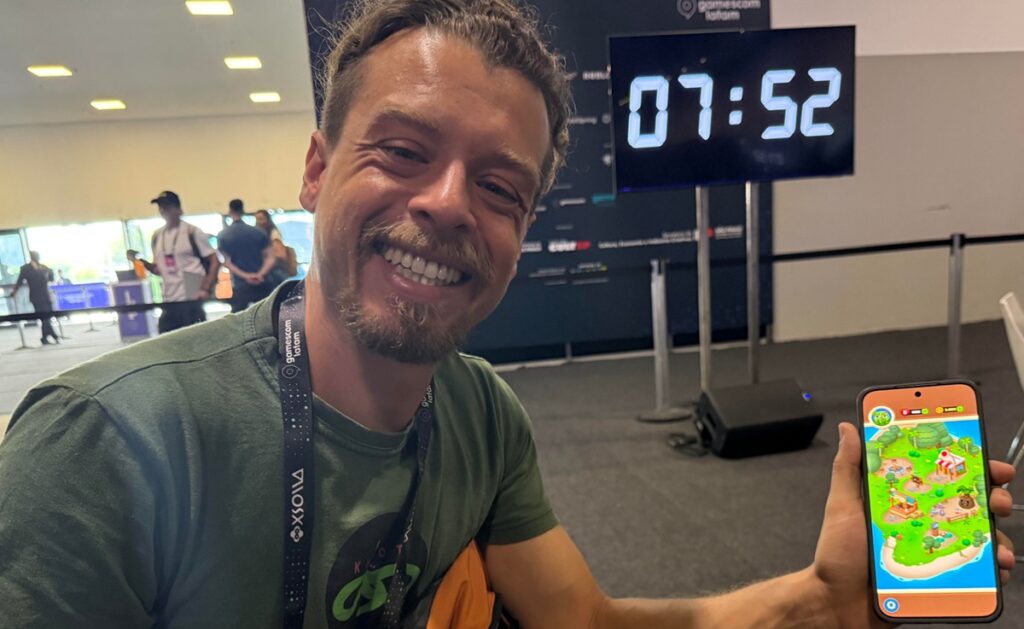 Pedro Teixeira Correia of Knot Studios shows off Tree Tales. Source: GamesBeat/Dean Takahashi It’s not just about money from outside, but money from companies here in the country supporting Brazilian companies. Of course we want everyone to come and open operations here, hire here. The ecosystem is great. But my vision, Patricia’s vision, and the vision of the association and our members, we want to create our own Blizzard. Are they going to be the size of Blizzard? I don’t know. Are they going to do triple-A? Maybe not. But they’ll be be a reference for the world like Blizzard or Ubisoft or whatever. That’s the end goal for our next challenge. We want Brazilian companies competing globally and being recognized as global players. That’s a bit of what I think about for the future.
GamesBeat: Do you have expectations for AI in the Brazilian industry? Do you think it’s going to help developers in some ways?
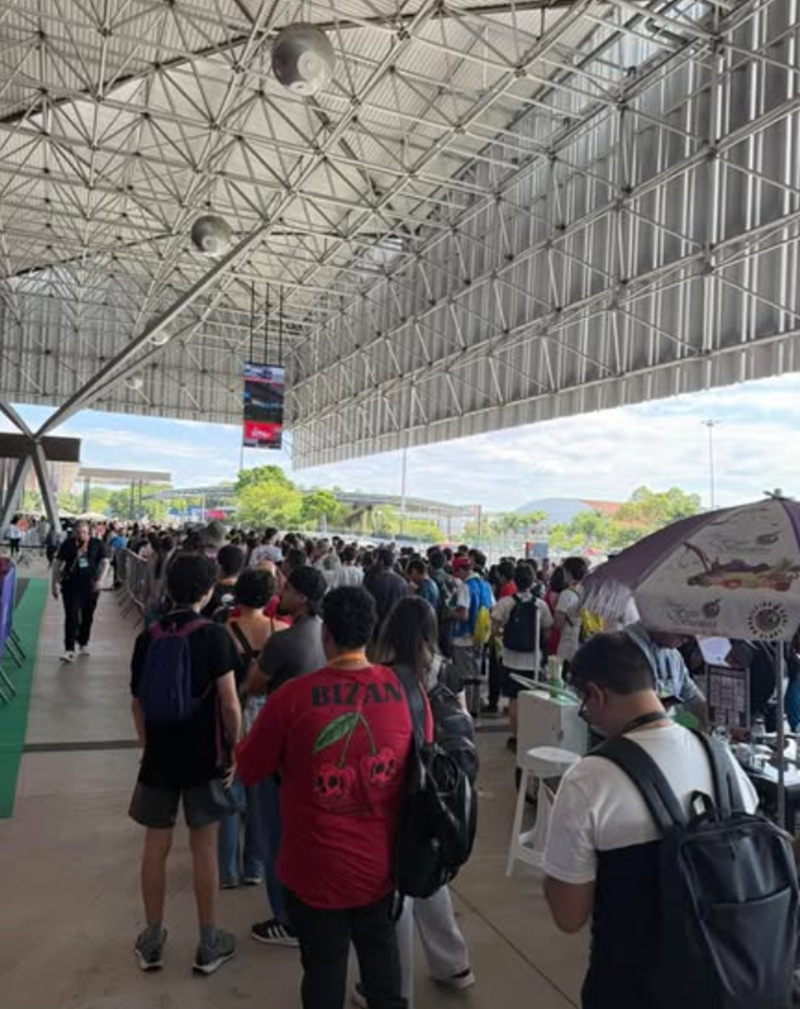 The crowds are huge at Gamescom Latam, which is in its third year. Source: GamesBeat/Dean Takahashi Terra: We’re at about the same place here as Europe as far as AI regulation, digital environment regulation. It’s necessary to do that before things go wrong. Social media regulation has come after almost 20 years. AI regulation, I think, is coming at the best time to set rules and ethics that will be part of what we do next.
My personal view is that AI can help us create tools for studios and people to use. It’ll help with their jobs on a daily basis. I don’t think AI can replace an artist. You can try, but your game’s originality won’t come from AI. You can use AI, even image generation, as a tool for expression, a way to improve your process. As a tool for prototyping, as part of the process, it’s amazing. We’re not going to turn back from that. But to deliver something just made by AI, replacing human beings, I don’t believe in that. In the end, what the consumer wants to see is your originality. That originality is something AI can’t give you.
Disclosure: Gamescom Latam paid my way to Brazil, where I moderated two sessions.
The post Brazil’s game ambitions face a big hurdle: funding | interview appeared first on GamesBeat.
In my third visit to the big show in Sao Paulo, Brazil, since Gamescom took over the BIG Festival in 2024, it was clear that the Brazilian game industry was growing.
The country has started embracing games, first by legally recognizing the industry a few years ago as a distinct industry, separate from gambling and other industries. The Brazilian government has also started an accelerator that provides seed funding for game studios. And it has enacted a new law to protect kids in multiplayer games and social media. And, of course, Brazilian game fans and creators are among the most enthusiastic video game fans in the world.
There’s a clear path up the food chain in Brazil. Game developers teach themselves how to make games or go to universities to learn game development. They start out doing work for hire, and then they start working on their own intellectual property — often highlighting Brazilian culture in some way with the hope that the content will be universally appealing.
Sportia highlights sports and Brazilian culture. Source: GamesBeat/Dean Takahashi Game studios are plentiful and passionate — there were 38 games in the Abragames booth this year — and the country and region itself are a model of “stability” these days, something the rest of the world is lacking in a very big way.But there’s one thing that’s missing: funding for game studios.
I spoke with Patricia Sato, executive manager at Brazil Games, a nonprofit industry development group, and Rodrigo Terra, president of Abragames, the Brazilian game developers association. We discussed the progress and challenges the Brazilian game industry faces as it moves up the food chain of gaming.
Here’s an edited transcript of our interview.
Rodrigo Terra of Abragames and Patricia Sato of Brazil Games. Source: GamesBeat/Dean Takahashi GamesBeat: Did you have any news that you talked about here at the show?Patricia Sato: The latest news we have this year for the Gamescom event is we have the biggest ever booth in terms of games exposed. I saw you there. We have 14 games from the members exhibiting, and then 24 more from the accelerator. It’s the biggest exhibition we’ve ever done for our games. We’ve never had so many games in one exhibit. I’m super excited for this weekend. It’s nice to see that we have this new wave of Brazilian games coming out very soon.
We talked a bit about this at GDC as well. I’m glad to see we have a lot of new, fresh content inspired by our culture being exposed here on the stage. My talk yesterday was about the beginning of the first panel, DNA Brazil. A bit about games with Brazilian culture, talking about myth and memory and the culture that came before us. Today we have the reverse of that panel, about our culture and day to day life today, urban style. New visions and innovations we have in Brazil. I’m glad to see that this is trending. I’m very proud of the keynote.
GamesBeat: Is there a pattern among the games you see at the exhibition? Are they all very focused on Brazilian culture, or aiming at a global audience, or other themes?
Sato: We have a mix of both. We have games that are pure fantasy. We have games that have Brazilian thematics. We have games that talk about global thematics from a Brazilian perspective. But what I’m most glad to see is that we have a lot of originality. We have games that are very different. We have games working with different kinds of technology, different innovations. I’m glad to see that our studios are able to showcase a lot of their original ideas. Our booth is packed.
Taigo Prudente of Salvador, Brazil, is making a real-time strategy game called Black Sailors. Source: GamesBeat/Dean Takahashi What I see a lot is we’ve begun to be approached by investors who want to know more about the games in the accelerator. That’s new. We have more people coming in and asking us what’s happening. Maybe they want to pitch in. Maybe they want to get involved in mentorship to get a first look at games in advance. We all thought this would happen eventually, but I’m glad to see it working.Rodrigo Terra: At Abragames we’re doing more for the studios here this year. We don’t just have one or two stations. The accelerator program is going full steam ahead. During the event we’re able to showcase the initial projects the studios have been working on during the program. We had a cross-team boot camp before the event, to prepare the studios for their meetings. Giving them recommendations for when they’re face to face with buyers. We’re doing this for the second year in a row. Buyers and publishers asked us to do it, because we got very positive feedback last year.
This year, 2026, I don’t want to call it a pivotal moment, but it’s a moment where we’re expanding all of our programs for studios here. Of course the showcases are important, the access to an international event. We have our booths at GDC and TGS and Gamescom in Cologne. That’s all part of the strategy for us. But now we understand that we can do more. We planned last year and two years ago to prepare the studios more, to make them understand that they don’t just need to work on their projects. They need to work on their companies as well. We identified the gaps, where we need to help them attack to start growing more sustainably and becoming recognized internationally. Of course they’re doing great games now. They’re putting new ideas out into the market. But how will they make their companies compeitive enough, after launching their first or second or third game?
We’ve been defining that for two years now. Since last year, we plan to have all these actions this year. This is the moment where we’re now putting all of them together. Piloting and testing and checking out if it resonates with the publishers and the ecosystem.
GamesBeat: How many applications came in for the accelerators?
Ghostless is an upcoming ‘hi-fi 3D pixel art’ post-apocalyptic survival action colony sim. Source: GamesBeat/Dean Takahashi Sato: More than 150. We expected about 100. It was kind of funny. We expected to receive fewer applications. We thought that as long as we had more than the number of slots we had available, it was fine. Then we reached 80 and we thought, “It’s okay. We have double the number we can select. That’s fine.” Then the last weekend before the application period ended, we jumped to more than 150. It was so funny. I remember when the coordinator called me. “They’re flooding our inbox! What do I do?” We got a great selection of studios. A lot of talent. A lot of very different games, very different ideas. It’s great for what we’re trying to do.The game industry is changing a lot all the time. Both of us, we’re always trying to reinvent and reimagine our program. Trying to keep up with the pace of the industry. A lot of what we did this year, trying to prepare for Gamescom Latam–the external development executive boot camp, that was the full name of what we put on. It was like a summit. We called it a boot camp because it sounds more fun. But it was more like a summit. We realized that external development is huge. We have lots of companies that make this their primary focus and objective. Now we have data inside the program showing that revenue, between studios working on their own IP and working on external development, is very well-balanced. That means we need to focus more on the external development segment. That’s why we created the summit. It was very positive.
GamesBeat: I’m curious about the legal climate here too. In the United States, Roblox is getting sued a lot over child safety problems. There’s some talk of more regulation. Matthew Ball, in his slide deck, pointed out that the addiction industries are all growing faster, and they’re very close to games, adjacent to games. Games are more fun, less about addiction, but if they lean that way, then they could end up in trouble. Turkey recently passed laws around child safety in games. People there are concerned that the government is interested in censorship. What do you feel about the kind of laws that are being passed? Is there a good version of this kind of law or a bad version that you have to be concerned about, or advise the government around?
Terra: We’ve been working with Congress for two years around this law. It’s a broader law than just child safety for games. It’s different from Turkey or other initiatives in other countries, where they focus explicitly on video games, or certain types of games. What’s happening here is broader than that. It’s not just games. Games is like two articles in a small chapter of a broader law about child safety in online environments. Games, online games, live service games, games that use voice and text chat and so on, they kind of fit into this concept of an online environment.
It’s similar to what’s happening in the European Union right now, and also close to what’s happening in South Korea. Age verification for everything that’s 18+. The systems that are being planned here, that would be enforced by the law, are close to what they have now in South Korea. They’re thinking about public solutions as well. The thing is, games are different. We worked for two years to not be exactly like that. We believe that these articles should be inside a video games legal framework, not a different law. We want to legislate everything inside a single vertical, not spreading things across legislation.
Of course this was needed here in the country. Society needed an answer. We want kids to have a safe environment. Roblox doesn’t receive too much attention here. But the law now is stronger than in the west. They’ll need to adapt right away if they want to operate.
GamesBeat: Using age estimation, things like that?
Investigacao Postuma is a point-and-click detective mystery game. Source: GamesBeat/Dean Takahashi Terra: Not just age estimation. They’ll have to decide whether or not to close the voice and text chat. There’s another legislation that’s cooking, like in the European Union, for social media regulation. Similar to what we’ve seen in Australia and Spain. That conversation is happening here as well. Our role is to guarantee that games are not treated like social media. We need to make that statement. Games are another thing. Games can be addictive if handled wrong, but what kind of addiction are we talking about? Gambling addiction? That’s where lines get crossed and we try to separate things. Loot boxes are forbidden now for players who are under 18. What’s next? You have to follow the rules now. If you have loot boxes kids and teenagers can’t play your game. It’s as simple as that.
It’s a global movement. As a country we can’t just stand outside the conversation. Our role here is to try to make the government understand that these things are separate. It’s not all the same basket. You need to have separate conversations. This takes time. It takes time to mature and understand. Social media is one thing. Gambling is another thing. Video games, chats and so on, that’s another thing. We need to treat these things separately, not create legislation that’s super broad and open to too many interpretations.
GamesBeat: Is most of your work here advisory, or are there any specific campaigns you’ve worked on?
Terra: For now it’s advisory. We’re not doing a stronger campaign, not right now. We’re in the middle of the process of regulation, the children’s safety law. We’re not trying to go against anything. What we want is, when we’re regulating anything, putting out the new articles that create the rules for the system, these rules can be transparent enough to not create any doubt about what anyone needs to do. My company, Roblox, Discord, whoever, we need to know the path. Developers as well. If I have a game that has in-app purchases and now in-app purchases are only for players 16 and up, we need to have a clear process. If the government tells the platforms that your game needs to be re-classified, you need to know why. We need a process for that.
That’s why we’ve tried to advise and make them understand. If you don’t know too much about games, you need to talk to the video game sector to understand more. You need to listen to what society wants, for sure, but you need to listen to the sector as well. This dialogue, we’ve established it pretty well.
GamesBeat: What is stability like in the Latin American region? It looks pretty good compared to North America and some other places in the world. I’d guess that job creation is continuing here. North America is losing high-paying jobs that are spreading out to the rest of the world.
Terra: I always joke, but it’s not exactly a joke. We’re used to being poor. I say that in a positive way. The challenges North America is facing are inflation, job losses, and so on. Latin America has lived that for 40 or 50 years. It’s been a roller coaster for 40, 50, 60 years. We’re used to it. We created mechanisms as a society to answer that. Instability was a part of our way of life. I’m not saying that’s good. But we needed to create mechanisms that let us roll with that.
Rogue Reigns is a roguelike card battle game. Source: GamesBeat/Dean Takahashi Now you look at it and it seems to be more stable because it is. Definitely it is. We’re resilient enough to understand the changes in the world, how they come about. We’re used to these changes internally. Now the rest of the world is facing that. Europe is facing that. We can maybe offer some advice to the rest of the world. It’s not the end of the world. You just need to change how you do things, how you adapt. You need to be creative in how you do things with less money. You’re not going to make a triple-A game with $500 million anymore. It’s not going to pay off. So what are you going to do? We make games for a fraction of that, good games. We’re growing a sustainable industry doing more with less. It’s possible.When you look down past the equator, you can see that we’re growing. This is the new hot spot of the world. But it’s because of our hard work. We know how to face the adversities that North America and Europe are facing now.
Sato: We don’t just have resilience, but we have our cameraderie with each other. Anywhere we go, we always hear from other delegations. “Why are the Brazilians so united?” That’s the thing. For our delegation, for our country, this was never a question. We’re all in this together. You don’t find Brazilian studios fighting among themselves for a space that everyone can occupy. You find a lot of studios cooperating. That’s something we want to show with the accelerator and everything else we do in our programs and our games. We’re not here to build careers, just bridges.
Terra: Of course you find one or two studios that fight each other, just like every ecosystem around the world. But we always foster the feeling that this is a community. You can compete. Of course you can compete. But let’s create an environment where we can work together.
GamesBeat: It reminds me of Finland, where they have the biggest IGDA chapter in the world. They all help each other out because they know they’re not fighting for the Finnish market. They’re working for the global market.
Terra: Exactly. Finland is a smaller country, but the benchmark is there. It’s possible. We need to do that with a thousand more studios, but that’s our challenge. It can work. It worked for them and it can work here.
GamesBeat: What more do you need for your industry here? What’s the next step in your ambitions for the country?
Terra: Funding. We need funding. This is the hardest moment. The setup is done. We’re maturing. As Abragames and Brazil Games, we’ve been here for a decade. We’ve helped studios to grow and start shining. Now, if you’re PlayStation or Nintendo or Xbox, it’s the moment to look further than the North American market. Also, funding coming from the government here – public funds and grants – like in Canada and Europe, public funding is a big part of it. And the third thing is the Brazilian ecosystem understanding that video games in Brazil is a sustainable and potentially profitable market.
Pedro Teixeira Correia of Knot Studios shows off Tree Tales. Source: GamesBeat/Dean Takahashi It’s not just about money from outside, but money from companies here in the country supporting Brazilian companies. Of course we want everyone to come and open operations here, hire here. The ecosystem is great. But my vision, Patricia’s vision, and the vision of the association and our members, we want to create our own Blizzard. Are they going to be the size of Blizzard? I don’t know. Are they going to do triple-A? Maybe not. But they’ll be be a reference for the world like Blizzard or Ubisoft or whatever. That’s the end goal for our next challenge. We want Brazilian companies competing globally and being recognized as global players. That’s a bit of what I think about for the future.GamesBeat: Do you have expectations for AI in the Brazilian industry? Do you think it’s going to help developers in some ways?
The crowds are huge at Gamescom Latam, which is in its third year. Source: GamesBeat/Dean Takahashi Terra: We’re at about the same place here as Europe as far as AI regulation, digital environment regulation. It’s necessary to do that before things go wrong. Social media regulation has come after almost 20 years. AI regulation, I think, is coming at the best time to set rules and ethics that will be part of what we do next.My personal view is that AI can help us create tools for studios and people to use. It’ll help with their jobs on a daily basis. I don’t think AI can replace an artist. You can try, but your game’s originality won’t come from AI. You can use AI, even image generation, as a tool for expression, a way to improve your process. As a tool for prototyping, as part of the process, it’s amazing. We’re not going to turn back from that. But to deliver something just made by AI, replacing human beings, I don’t believe in that. In the end, what the consumer wants to see is your originality. That originality is something AI can’t give you.
Disclosure: Gamescom Latam paid my way to Brazil, where I moderated two sessions.
The post Brazil’s game ambitions face a big hurdle: funding | interview appeared first on GamesBeat.
What's Your Reaction?








XINKER - Business and Income Tips
Explore XINKER, the ultimate platform for mastering business strategies, discovering passive income opportunities, and learning success principles. Join a community of thinkers dedicated to achieving financial freedom and entrepreneurial excellence.

![[Business Talk] Chagee: Opening 3,500 stores in 6 years](https://xinker.org/uploads/images/202410/image_140x98_671afce94bf91.webp)