



Civilization VII - Test of Time Dev Diary: Audio
Designing the Sound of Civilization VIIHello Civ fans! My name is Kadet Kuhne and I'm the Associate Audio Director for Sid Meier's Civilization VII at Firaxis Games, working with our awesome Audio team which currently includes Sound Designers Dylan Escalona-Sandoval and Dmytro Nebesh, in-game Composers Roland Rizzo and Geoff Knorr, Audio Programmers Eric Phister and Joseph Marcus, Producer Emily Walton, and our Studio Audio and Narrative Director, Justin Drust.I'm thrilled to share this Dev Diary that's all about Audio, where I'll outline key audio design features from launch and post-launch that are directly tied to core gameplay, and give an overview of what's new for Test of Time, a free, upcoming major update to Civilization VII.Representing Civilizations Through Sound In Civilization VII, we've embarked on a journey to bring sound to the forefront of your experience, enhancing not only the gameplay but also immersing you in the world of your chosen civilization like never before. The driving force behind this venture was a desire to make Civilization VII sound authentic, lively, and responsive to your choices. When planning out the sound design and music direction, our main goal was representing the unique identity of each civilization through sound. This meant paying attention to the details: the sounds of specific Units, Buildings, Wonders, music, and even the natural world. With all of these magnificent details constructing the soundscape, the greatest final challenge as an audio dev team was to maintain clarity in our final sound mix to prioritize key gameplay sounds.With the upcoming Test of Time update, we've evolved the sound design and music to enhance and reflect the new themes, systems, and mechanics. In case you aren't yet familiar, Test of Time is a huge update to Civilization VII, launching on May 19, 2026. It introduces Time-Tested civilizations so you have the option to start and stay as any civ. It also replaces prescriptive victory checklists and Legacy Paths for Triumphs and a new Victory model. For those of you that have been requesting to play as one civ, this update aims to fulfill that classic Civ fantasy, while also retaining the "layered history" of Civ VII that makes this title unique. Now, let's take a deep dive into how we approached sound in this new update and for Civ VII as a whole. Immersive Sound DesignWhen it came to sound effects, our goal was clear: embrace the legacy of past Civilization games while pushing the boundaries of what sound could do in Civ VII. We started by referencing key sounds from previous games – especially Civ V and VI – to maintain the feel of the franchise. We also made a concerted effort to evolve those sounds, making them more dynamic, responsive, and immersive for players.AmbiencesOn a broad level, we've refined how sound interacts with civilizations across the Ages. As you progress through the Ages, you'll hear how the soundscape changes to reflect the evolving technological and cultural advancements of your civilization. The transition from Antiquity to Exploration and finally to Modern is marked by an audible evolution, with voices, sound effects, ambiences, and music adapting and growing in complexity to reflect gameplay progress and the passing of time.The ambience of Civ VII is made up of a 2D environmental bed and 3D sounds we call static emitters. The 2D environmental bed contains sound for our various Biomes represented across the different tiles in the game: Desert, Tundra, Grassland, Tropical, Ocean, Plains, etc. For Civ VII, we introduced a more refined ambient system where each Biome and height level has its own unique ambient sounds. Imagine rustling leaves and birdsong variations as you traverse a tropical forest, or occasional sandy gusts of wind with tumbleweeds in the desert. Then, as you zoom out on the map, you'll have a sense of airy spaciousness with only the core Unit and other gameplay sounds audible. Another exciting change we've implemented in Civ VII is the return of Building sounds. Now, each Building has its own unique audio cue, whether it's the hammering of a blacksmith or the bustle of a market, and culturally specific wallas (crowd ambience and background chatter) for some of the unique hero Buildings. For added gameplay immersion and historical accuracy, we've included site-specific sounds from each civilization, such as cathedral bells and mosque adhans, as well as regional birds and other animals. You'll notice a few other audio improvements with Test of Time's 1.4.0 update, like additional sound design added to some of the map resources to provide sonic cues for key gameplay tactics. These representative layers across resources have an added bonus of varying the landscape ambience as well, which reduces listening fatigue and provides a richer world over hours of playing. UnitsWe also did a deep dive into designing historically accurate Unit sounds (e.g. the Katyusha's rockets, the firing of the Xunleichong,
Hello Civ fans! My name is Kadet Kuhne and I'm the Associate Audio Director for Sid Meier's Civilization VII at Firaxis Games, working with our awesome Audio team which currently includes Sound Designers Dylan Escalona-Sandoval and Dmytro Nebesh, in-game Composers Roland Rizzo and Geoff Knorr, Audio Programmers Eric Phister and Joseph Marcus, Producer Emily Walton, and our Studio Audio and Narrative Director, Justin Drust.
I'm thrilled to share this Dev Diary that's all about Audio, where I'll outline key audio design features from launch and post-launch that are directly tied to core gameplay, and give an overview of what's new for Test of Time, a free, upcoming major update to Civilization VII.
In Civilization VII, we've embarked on a journey to bring sound to the forefront of your experience, enhancing not only the gameplay but also immersing you in the world of your chosen civilization like never before. The driving force behind this venture was a desire to make Civilization VII sound authentic, lively, and responsive to your choices.
When planning out the sound design and music direction, our main goal was representing the unique identity of each civilization through sound. This meant paying attention to the details: the sounds of specific Units, Buildings, Wonders, music, and even the natural world. With all of these magnificent details constructing the soundscape, the greatest final challenge as an audio dev team was to maintain clarity in our final sound mix to prioritize key gameplay sounds.
With the upcoming Test of Time update, we've evolved the sound design and music to enhance and reflect the new themes, systems, and mechanics. In case you aren't yet familiar, Test of Time is a huge update to Civilization VII, launching on May 19, 2026. It introduces Time-Tested civilizations so you have the option to start and stay as any civ. It also replaces prescriptive victory checklists and Legacy Paths for Triumphs and a new Victory model. For those of you that have been requesting to play as one civ, this update aims to fulfill that classic Civ fantasy, while also retaining the "layered history" of Civ VII that makes this title unique.
Now, let's take a deep dive into how we approached sound in this new update and for Civ VII as a whole.
When it came to sound effects, our goal was clear: embrace the legacy of past Civilization games while pushing the boundaries of what sound could do in Civ VII. We started by referencing key sounds from previous games – especially Civ V and VI – to maintain the feel of the franchise. We also made a concerted effort to evolve those sounds, making them more dynamic, responsive, and immersive for players.

On a broad level, we've refined how sound interacts with civilizations across the Ages. As you progress through the Ages, you'll hear how the soundscape changes to reflect the evolving technological and cultural advancements of your civilization. The transition from Antiquity to Exploration and finally to Modern is marked by an audible evolution, with voices, sound effects, ambiences, and music adapting and growing in complexity to reflect gameplay progress and the passing of time.
The ambience of Civ VII is made up of a 2D environmental bed and 3D sounds we call static emitters. The 2D environmental bed contains sound for our various Biomes represented across the different tiles in the game: Desert, Tundra, Grassland, Tropical, Ocean, Plains, etc. For Civ VII, we introduced a more refined ambient system where each Biome and height level has its own unique ambient sounds. Imagine rustling leaves and birdsong variations as you traverse a tropical forest, or occasional sandy gusts of wind with tumbleweeds in the desert. Then, as you zoom out on the map, you'll have a sense of airy spaciousness with only the core Unit and other gameplay sounds audible.
Another exciting change we've implemented in Civ VII is the return of Building sounds. Now, each Building has its own unique audio cue, whether it's the hammering of a blacksmith or the bustle of a market, and culturally specific wallas (crowd ambience and background chatter) for some of the unique hero Buildings. For added gameplay immersion and historical accuracy, we've included site-specific sounds from each civilization, such as cathedral bells and mosque adhans, as well as regional birds and other animals.
You'll notice a few other audio improvements with Test of Time's 1.4.0 update, like additional sound design added to some of the map resources to provide sonic cues for key gameplay tactics. These representative layers across resources have an added bonus of varying the landscape ambience as well, which reduces listening fatigue and provides a richer world over hours of playing.
We also did a deep dive into designing historically accurate Unit sounds (e.g. the Katyusha's rockets, the firing of the Xunleichong, and planes such as the Stuka) across all the Units for all civilizations, to enhance your immersive connection to the civilizations you spend turn after turn building.
One of the most exciting features in Civ VII is our revamped combat system, making battles feel more alive and responsive. From the clashing of swords to the blasts of gunfire, combat engages at a faster pace, and the sound reacts accordingly – creating a more gripping experience for players. The military and combat gameplay systems include several new and improved elements, focusing on more detailed sound design and greater clarity to better match the enhanced visuals.
Previous iterations of Civ relied on a “slap and run” technique: the Units attack and run back to the place they were. It was simple and efficient, but very unrealistic. Civ VII uses an improved system, which we've dubbed Continuous Combat, meaning when a melee Unit attacks another Unit, it stays in combat until the next turn. This required an approach to design and mixing that supports a dynamic sound experience to keep the battlefield alive, without becoming fatiguing.
For Civ VII's leader voiceovers, we worked closely with historians and language experts to handle the challenge of representing ancient and dead languages in a way that felt authentic. Some languages, like Ancient Greek or Akkadian, have no living speakers, so we relied heavily on historical research and the expertise of linguistic scholars to accurately recreate them. We also made sure that the voice actors we selected could deliver their lines in a way that reflected the tone and gravitas appropriate to their civilization.
Leaders in Civilization VII are the player characters – they are prominent historical figures through whom the player rules their empire. Crafting leaders requires the right balance of authenticity and gameplay engagement. Language is key to this: it reflects how leaders communicated in their time and the cultures they came from, offering players a window into the past as leaders express themselves and their personalities as living characters within the game.
Additionally, we wanted the vocal content in our Units' character expressions to represent cultural variation across our civs, so we worked with our historians on identifying linguistic variation in vocal expressions (e.g. attack yells, hit reacts, efforts/exertions), and then hired a diverse pool of talent with fluency in key world languages to capture these distinctions and bring the civilizations further to life.
For our Test of Time update, we've reworked our system of assigning vocal expressions across animations for Unit combat, idles, and continuous combat. The result is a more expressive and reactive soundscape: Units carry greater personality, respond more vividly to reflect your actions, and bring a stronger sense of presence to the map. Altogether, it makes your world feel more alive, shaped not just by your decisions, but by the character of the Units carrying them out – like active participants in the history you're shaping.
For our UI audio, we carried forward some familiar, iconic sounds with a refresh, but most audio cues were newly created to match the visual style and fidelity of Civ VII. Central to our designs are key sonic themes and palettes, many of which are continued from past Civ games, and some newly developed. The goal was to provide consistent cues that add meaning, clarity, and context. Overall, we aimed for a globally relevant direction – for example, for Religion we avoided a Western organ and instead used layers of chimes, whooshes, and choral sounds.
The iconic Unit Selects sounds were a must as they're a core part of the Civilization experience, and we knew we had to refresh them. Players will immediately notice a snappier, more responsive experience when selecting Units, allowing players to move faster in their decision making.
There were about 70 notifications to design for launch, and since launch we've added in many more. It was a massive undertaking, but we sped up the process by identifying which notifications from past Civ games were relevant to Civ VII, and what new ones were needed for brand new systems (e.g., Crisis Revolt). Our audio team continues to assess where moments need more clarity, and we listen to player suggestions – especially from places like the Civ Discord. For example, feedback led us to bringing back the sound for coming across a Goody Hut, or Discovery as it's now called.
In our immediate post-launch efforts, we focused heavily on establishing sonic palettes to define categories related to Diplomacy to support the new systems in Civ VII: Diplomatic Actions (Endeavors, Sanctions, Treaties, Espionage), Independent Powers, War Support, etc. Also, unique Tech and Civic select sounds are new in Civ VII, such as selecting to research Sailing or Globalism. Bespoke UI sounds were also added to Town Focus, Narrative Rewards, and Leader Attributes UI that center on our sonic themes. For Building placement UI sounds, we included music stems that were pulled from their associated Wonder Reveal compositions to tie in that cultural association.
The UI updates for Test of Time provided an opportunity to introduce even more fun, engaging, and gameplay-driven audio design. We focused on supporting new systems with bespoke sounds that convey personality and clear player feedback, including Syncretism, Commerce interactions like resource slotting, and the expanded Triumph system with both major and minor Triumph sound effects. Custom UI sounds were created for features like Narrative Event popups to enliven the background art, and the new Advisors panel features unique sounds per each category – Scientific, Economic, Military, and Culture – for the follow/unfollow options and other functionality.
Across the board, the goal was to provide more consistent and meaningful feedback, from polishing moment-to-moment interactions like the Celebration panel, to adding key notification sounds such as City Lost, to designing larger beats such as the end-of-game flows for Victories that now feature leader VO and new cinematic ambiences!
Now that we've covered sound effects and voice, let's dive into an aspect of the game every Civ player loves: the music! The music in Civ VII was carefully crafted to elevate the emotional resonance of the game. Each civilization has its own distinct musical theme, reflecting its culture, history, and values (you can check out many of those civ themes here!). Our composers did extensive research and worked with a diverse ensemble of musicians to ensure that every civilization's music is as immersive and authentic as the rest of the game's audio design. From the ancient instrument reconstructions of the early game to the symphonic orchestration of the modern era, we wanted players to feel as though they were truly guiding their civilization through time.
Civilization's extended gameplay and replayability make it a difficult context for music composing. It needs to remain engaging and supportive of player decisions over long periods of time, without becoming repetitive. In the base game, we approached this by introducing unique themes for each civilization alongside Age-specific ambient music for war and peace. The original soundtrack ultimately featured more ensembles and musicians than any previous entry in the series.
Memorable melodies, clear themes, and strong musical forms play an important role in shaping a player's experience – especially during pivotal moments like declaring war, winning a battle, or unlocking something new. When used well, they can elevate those moments in a meaningful way. At the same time, hearing that kind of music too frequently can reduce its impact. With the Test of Time update, we wanted to build more variation around those key moments, creating space between them so they remain effective.
Test of Time's new gameplay options also introduced additional audio opportunities! Players can now choose any civilization in any Age, or carry a single civ across all Ages. This created the potential for musical mismatches – for example, hearing a full modern orchestral theme at the very start of a game in the Antiquity Age didn't quite fit the tone of a newly founded Settlement. Creating entirely new recordings for every civ in every Age wasn't feasible, given the scale of the original soundtrack and the number of musicians involved. Instead, we took a hybrid approach: reuse and adapt existing material wherever possible, and compose and record new music only when necessary.
One of the key advantages we had was how the original themes were recorded. Many of the orchestral civ themes included soloists recorded separately from the main ensemble. Because of that separation, we were able to extract those parts and place them in new contexts. In some cases, this meant isolating a solo performance; in others, it involved combining it with different instruments to create a variation with a very different feel.
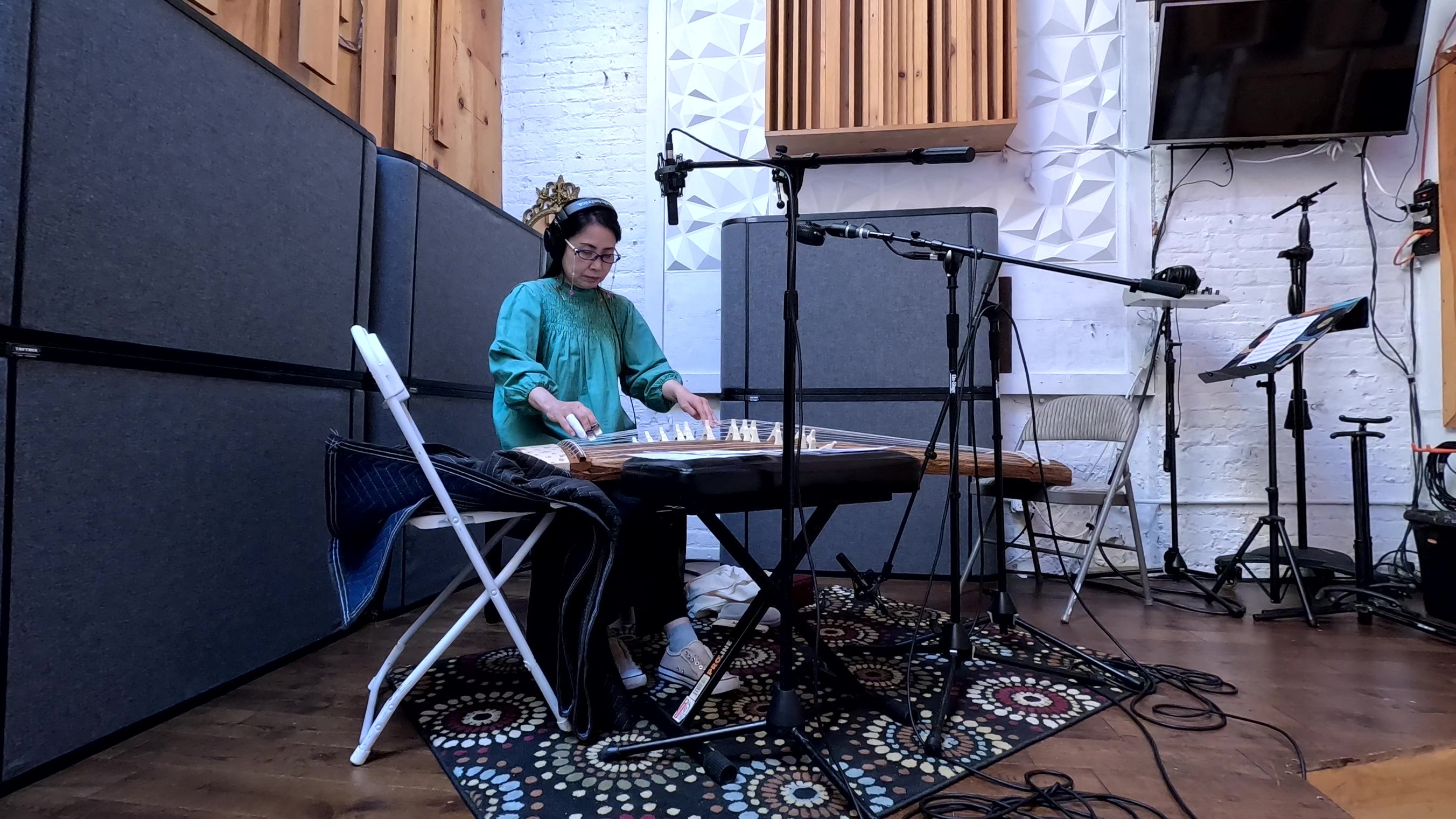 Masayo Ishigure recording the koto part for the Meiji Japan civ theme at Pinch Recording, New York City.
The theme for Meiji Japan is a good example. The original Modern Age version features koto and shakuhachi soloists alongside a full orchestra. The orchestra was recorded in Dvořák Hall in Prague, while the solo instruments were recorded separately in New York. By editing and restructuring the solo recordings, we were able to create new versions built around the koto and shakuhachi alone. For a second, more militaristic melody, we introduced taiko drums alongside the koto to form a new variation. From there, removing the koto entirely created yet another version focused just on taiko drums. Applied across the full soundtrack, this additive/subtractive approach allowed us to generate a large number of alternate mixes.
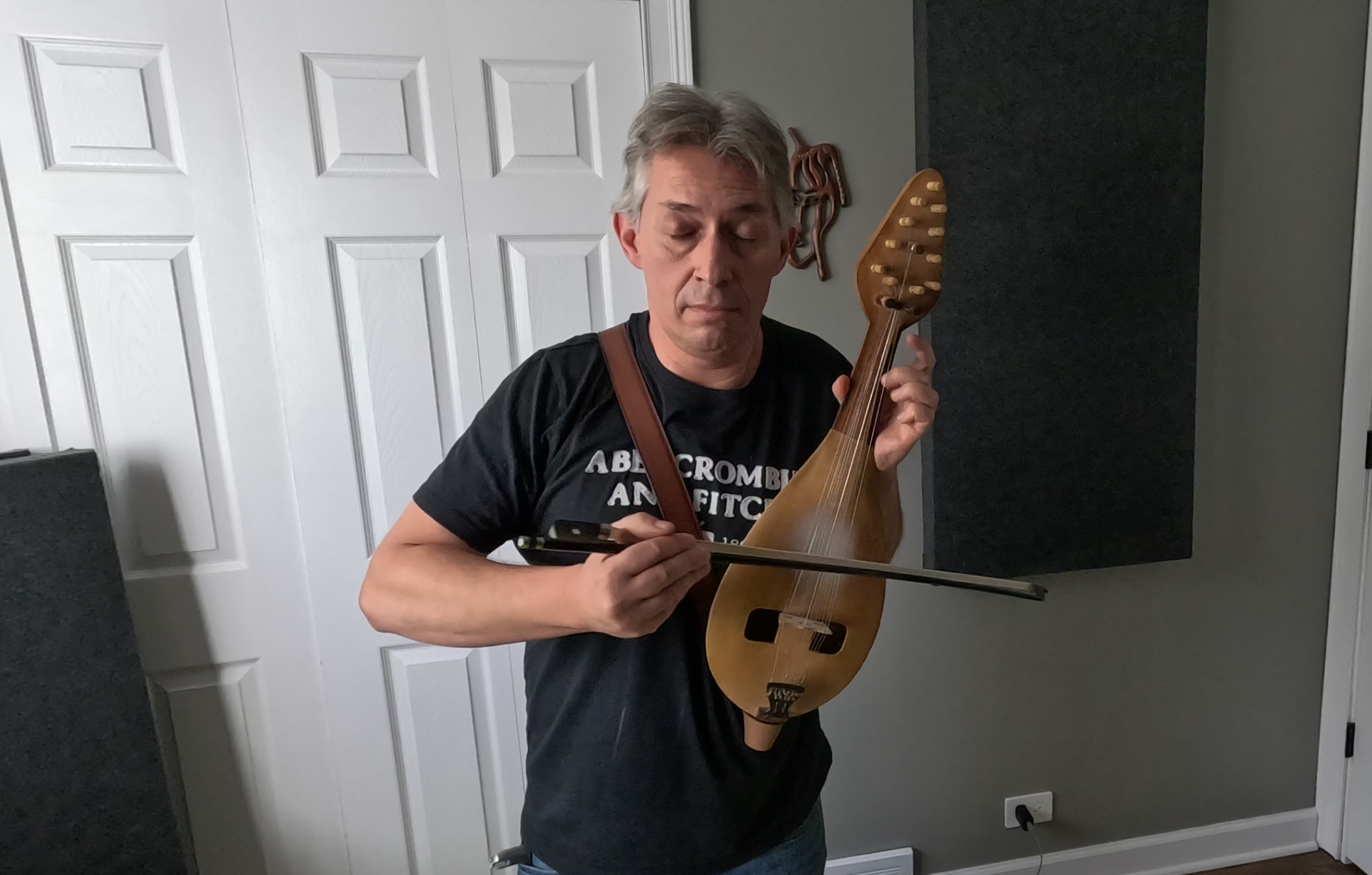 Angel Dobrev overdubbing the gadulka parts for the Bulgarian civ theme after the initial ensemble recording.
We used similar techniques for civilizations in the Antiquity and Exploration Ages. While many themes were recorded with full ensembles, some elements – often added later after an initial ensemble recording – could still be separated and reworked. Bulgaria's theme is a strong example: the core ensemble was recorded together, but instruments like the gadulka and gaida were overdubbed after the initial ensemble recording session. Isolating those parts allowed us to create alternate mixes, including versions without the vocal elements, giving the theme a very different character.
During this process, we also found that in some cases we could separate percussion from the melodic and vocal material. These percussion-only versions became useful for adding more variety and creating space between recognizable themes, helping reduce the sense of repetition over time.
There were also situations – primarily in some Modern Age themes – where extracting usable elements wasn't possible. In those cases, we composed and arranged new versions with instrumentation better suited to earlier Ages. For instance, Mexico's new version features clay flutes and maracas, and the Russian Empire's new version replaces the orchestra with the balalaika and gusli. These necessary additional tracks allow the core identity of a civ's theme to remain consistent, while reserving the full orchestral version for its intended context.
We applied all of these methods to the ambient music as well, creating a wide range of new mixes and variations. Even with that, we felt additional material was needed to provide enough contrast and pacing. As a result, we also composed new ambient tracks for each Age. These new pieces were also designed to support further variation through similar additive/subtractive techniques.
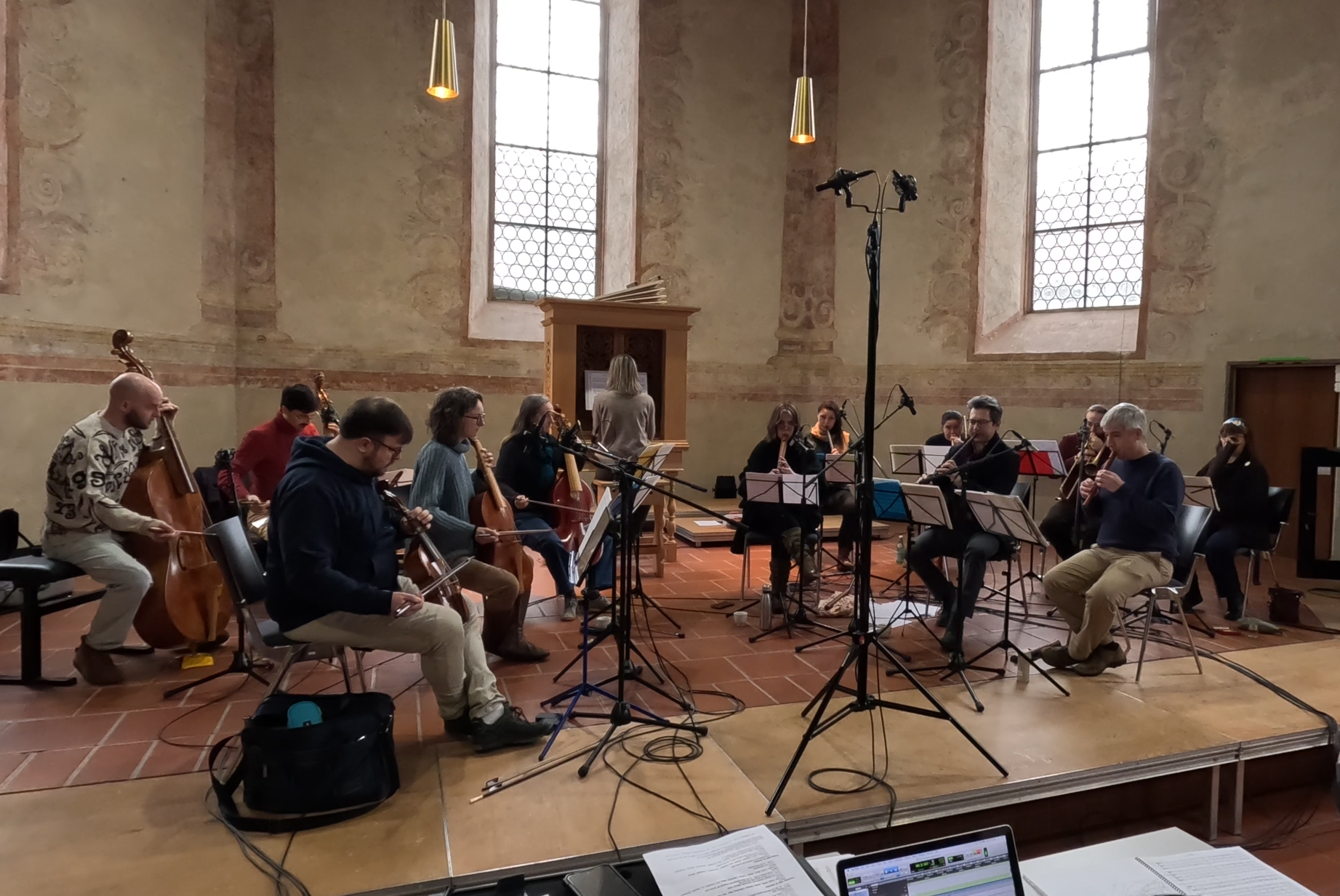 Ensemble I Fedeli recording new Exploration Age ambient music for the Test of Time update.
In total, these new scores, additional recordings, remixes, and variations add more than 9 hours of music to the game, across over 170 new tracks. With this expanded set of material, we've been able to refine how music is used in-game. Earlier stages tend to favor more minimal, restrained variations, while later stages introduce fuller and more developed versions. By the time a civilization reaches its Apex Age (the Age when it's at the height of its power), the complete theme is heard in its original form. For civs that begin in their Apex Age of Antiquity, the game opens with simpler variations, saving the full version for later in the Age.
Overall, the goal was to create a broader and more flexible musical palette – one that better supports the pacing of the game and evolves alongside each player's experience.
Be sure to take a behind-the-scenes look at how Firaxis Games brings history to life in the Civilization series' award-winning music!
Given that Civ is a game that only grows in the amount of content as the turns progress, we were faced with the challenge of ensuring that the mix remains clear, and that you as a player know when you've done something interesting and impactful, all while making that action feel dynamic and fun! For example, moments of engagement when actual damage and Unit deaths occur are a key gameplay focus, so during combat we leaned on sidechaining to lower other elements in the game's soundscape so your actions are clearly in focus.
In comparison to previous titles, Civ VII is busier and much more complex. Audio for Buildings, resources, and character models all have unique sources placed on the map so the player can immerse themselves in the 3D environment of the game. Additionally, most of the Units are now composed of at least 8 characters (up to 14 for some Modern Units), which is at least double the quantity of characters on screen compared to Civ VI.
With thousands of potential audio events triggered in real time, we built scalable systems for dynamic prioritization and real-time mixing, ensuring that the soundscape remains coherent, expressive, and deeply tied to player choice. The challenging part was to figure out how to make the camera transitions feel natural and seamless between the zoomed-in, highly immersive point of view where you hear all the details we poured into our game, and the zoomed-out, strategic point of view where we aim to give you the most important gameplay information.
One of the biggest technical upgrades in Civ VII is the move to Dolby Atmos sound for an immersive, 3D experience across all your map heights, natural disasters, and airplanes as they fly overhead. Whether you're on a mountain peak or in the depths of a jungle, you'll hear the world around you with spatial clarity and presence.
Our core priorities in Civ VII were enhancing the gameplay immersion and player feedback. This encompasses the tangible sense of progress, engagement, and satisfaction you experience through your actions in the game, and sound plays a crucial role here. Whether it's the rewarding chorus of awe when completing a Wonder, the rapid-fire snap of arrows in combat, or the urgent, pounding drums when a neighboring civilization declares war, sound is designed to offer clear and immediate feedback to guide you through your decisions.
The world of Civ VII has an auditory identity as varied and diverse as the civilizations themselves. This level of detail helps bring the world alive and gives the player a deeper sense of place. Civilization VII is a celebration of what makes each civilization unique, and sound is a key part of that. We hope that as you explore the world of Civ VII, you'll not only hear it but feel it too.
For even more information on our process, check out this exclusive interview with the Firaxis audio team hosted by A Sound Effect.
你覺得這篇文章如何?